| 规格 | 价格 | 库存 | 数量 |
|---|---|---|---|
| 5mg |
|
||
| 10mg |
|
||
| 25mg |
|
||
| 50mg |
|
||
| 100mg |
|
||
| 250mg |
|
||
| 500mg |
|
||
| Other Sizes |
|
| 靶点 |
K145 is a selective sphingosine kinase-2 (SphK2) inhibitor (IC₅₀ = 4.30 ± 0.06 µM). It competitively inhibits SphK2 with a Ki of 6.4 ± 0.7 µM (with respect to sphingosine). [1]
|
|---|---|
| 体外研究 (In Vitro) |
K145(0-10 µM;24-72 小时;U937 细胞)治疗以浓度依赖性方式极大地减少 U937 细胞的增殖 [1]。 K145(10 µM;24 小时;U937 细胞)治疗有效促进 U937 细胞凋亡 [1]。 K145(4-8 µM;3 小时;U937 细胞)处理可降低 ERK 和 Akt 磷酸化 [1]。 K145 (10 µM) 治疗导致细胞总 S1P 减少,但对神经酰胺水平没有显着影响 [1]。
K145 以剂量依赖方式选择性抑制重组 SphK2 活性,IC₅₀ 为 4.30 ± 0.06 µM,而在浓度高达 10 µM 时对 SphK1 无抑制作用。 K145 (10 µM) 降低了 U937 细胞中总细胞鞘氨醇-1-磷酸 (S1P) 水平,而对神经酰胺或神经酰胺-1-磷酸 (C1P) 水平无显著影响。 K145 (10 µM) 抑制了 U937 细胞中 SphK2 特异性底物 FTY720 的磷酸化。 K145 以浓度依赖方式显著抑制在 10% 血清中培养的人白血病 U937 细胞的增殖。 K145 (10 µM, 24 小时) 诱导 U937 细胞凋亡,主要是晚期凋亡,坏死细胞比例极低。 K145 处理 (低至 4 µM, 1 小时) 抑制了 U937 细胞中 ERK 和 Akt 的磷酸化,表明其抑制了下游生存信号通路。 K145 在 10 µM 浓度下对另外 11 种蛋白激酶组表现出相对选择性。 [1] |
| 体内研究 (In Vivo) |
用 K145(50 mg/kg;口服强饲;每天;持续 15 天)治疗 BALB/c-nu 小鼠可显着减缓裸鼠中 U937 肿瘤的形成 [1]。
在裸鼠 U937 异种移植模型中,每日腹腔注射 K145 (15 mg/kg,持续 17 天) 显著抑制肿瘤生长,肿瘤生长抑制率 (TGI) 为 44.2%。未观察到显著的体重减轻。 在免疫正常的 BALB/c 小鼠同系 JC 乳腺腺癌模型中,每日腹腔注射 K145 (20 mg/kg 和 35 mg/kg,持续 15 天) 以剂量依赖方式显著抑制肿瘤生长。肿瘤样本中 S1P 水平降低,磷酸化 ERK 和磷酸化 Akt 水平下降。未观察到体重或主要器官的显著毒性变化。 在裸鼠 U937 异种移植模型中,每日口服给予 K145 (50 mg/kg,持续 15 天) 显著抑制肿瘤生长 (TGI = 51.25%),证明了其口服生物利用度和体内药效。未观察到明显毒性。 [1] |
| 酶活实验 |
使用过表达相应酶的细胞裂解液测量重组 SphK1 和 SphK2 活性。SphK1 活性测定使用 5 µM 鞘氨醇和 [γ-³²P]ATP,并加入 0.25% Triton X-100 以抑制 SphK2。SphK2 活性测定使用与 BSA 复合的鞘氨醇和 [γ-³²P]ATP,并在 1 M KCl 存在下进行以抑制 SphK1。在存在不同浓度 K145 或对照抑制剂的情况下测量抑制效果。
神经酰胺激酶 (CERK) 活性采用发光激酶法测定。将重组 CERK 与神经酰胺和 ATP 在存在或不存在 K145 的情况下孵育。加入检测试剂后测量发光强度。 [1] |
| 细胞实验 |
细胞活力测定 [1]
细胞类型: U937 细胞 测试浓度: 0 µM、4 µM、6 µM、8 µM、10 µM 孵化持续时间:24小时、48小时、72小时 实验结果:在一定浓度下可显着抑制U937细胞的生长,呈生长依赖性。 细胞凋亡分析 [1] 细胞类型: U937 细胞 测试浓度: 10 µM 孵育时间: 24小时 实验结果:显着诱导U937细胞凋亡。 蛋白质印迹分析[1] 细胞类型: U937 细胞 测试浓度: 4 µM、8 µM 孵育持续时间:3 小时 实验结果:磷酸化 ERK 和 Akt 减少。 使用 MTT 法评估细胞增殖。将 U937 细胞接种于 96 孔板,用 K145 处理 72 小时,然后与 MTT 试剂孵育。生成的甲臜产物用 DMSO 溶解,在 570 nm 处测量吸光度。 采用 Annexin V-FITC 和碘化丙啶 (PI) 双染通过流式细胞术分析细胞凋亡。用 K145 处理 U937 细胞,收集、洗涤并按照说明书染色。分析细胞以区分早期凋亡 (Annexin V+/PI-)、晚期凋亡 (Annexin V+/PI+) 和坏死 (Annexin V-/PI+) 群体。 通过蛋白质印迹法分析信号蛋白。用 K145 处理 U937 细胞,裂解后通过 SDS-PAGE 分离蛋白,转移到 PVDF 膜上,并用特异性抗体(抗磷酸化 ERK、总 ERK、磷酸化 Akt、总 Akt,以及 GAPDH 作为上样对照)进行检测。 通过电喷雾串联质谱 (ESI-MS/MS) 测量细胞脂质水平 (S1P、神经酰胺、C1P) 和药物积累。用 K145 处理细胞,收集、洗涤并提取脂质进行分析。 [1] |
| 动物实验 |
动物/疾病模型: BALB/c-nu(裸鼠)注射U937细胞[1]
剂量: 50 mg/kg 给药途径: 灌胃(po);每日一次;15天 实验结果: 灌胃(po);每日一次;50 mg/kg剂量可抑制U937肿瘤生长15天,且未观察到明显毒性。 在裸鼠(BALB/c-nu)的U937异种移植研究中,将U937细胞皮下植入。当肿瘤达到可触及的大小时,每天腹腔注射K145(15 mg/kg)或载体,持续17天。定期监测肿瘤体积和体重。 在BALB/c小鼠的同源JC肿瘤模型中,将JC乳腺腺癌细胞皮下植入小鼠体内。小鼠每日腹腔注射K145(20 mg/kg或35 mg/kg)或载体,持续15天。监测肿瘤体积和体重。 在U937异种移植瘤模型的口服疗效研究中,荷U937肿瘤的裸鼠每日灌胃给予K145(50 mg/kg)或载体,持续15天。监测肿瘤体积和体重。[1] |
| 药代性质 (ADME/PK) |
K145以浓度依赖的方式被U937细胞吸收。
在用该化合物治疗的小鼠的肿瘤组织中检测到了K145。 用K145治疗导致肿瘤组织内S1P水平降低。[1] |
| 毒性/毒理 (Toxicokinetics/TK) |
在U937异种移植模型(腹腔注射,15 mg/kg)中,与载体对照组相比,K145治疗组小鼠的体重未见下降。在同源JC肿瘤模型(腹腔注射,20和35 mg/kg)中,未观察到体重显著变化或主要器官(心脏、肺、肝脏、肾脏)出现明显毒性。在口服U937异种移植模型(50 mg/kg)中,观察到初始体重略有下降,但在治疗过程中体重恢复,未观察到其他明显毒性。[1]
|
| 参考文献 | |
| 其他信息 |
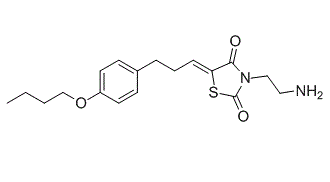
K145 (3-(2-氨基乙基)-5-[3-(4-丁氧基苯基)亚丙基]-噻唑烷-2,4-二酮) 是一种噻唑烷-2,4-二酮 (TZD) 类似物,被设计为选择性 SphK2 抑制剂。
分子建模和分子对接研究表明,K145 优先结合 SphK2 的鞘氨醇结合口袋,而非 SphK1,这可能是由于关键相互作用残基的差异所致,SphK2 为谷氨酰胺 (Gln),而 SphK1 为谷氨酸 (Glu)。 K145 的抗肿瘤作用归因于其对 SphK2 的抑制,导致 S1P 水平降低,进而抑制下游 ERK 和 Akt 生存信号通路,最终诱导细胞凋亡。 K145 被认为是一种新型先导化合物。用于开发更有效、更具选择性的SphK2抑制剂和潜在抗癌药物的化合物。[1] |
| 分子式 |
C₁₈H₂₄N₂O₃S
|
|---|---|
| 分子量 |
348.46
|
| 精确质量 |
348.151
|
| CAS号 |
1309444-75-4
|
| 相关CAS号 |
K145 hydrochloride;1449240-68-9
|
| PubChem CID |
71714682
|
| 外观&性状 |
Typically exists as solid at room temperature
|
| LogP |
3.974
|
| tPSA |
97.93
|
| 氢键供体(HBD)数目 |
1
|
| 氢键受体(HBA)数目 |
5
|
| 可旋转键数目(RBC) |
9
|
| 重原子数目 |
24
|
| 分子复杂度/Complexity |
459
|
| 定义原子立体中心数目 |
0
|
| SMILES |
O=C(N(CCN)C/1=O)SC1=C/CCC2=CC=C(OCCCC)C=C2
|
| InChi Key |
MPZXLTZVPUSTFY-SOFYXZRVSA-N
|
| InChi Code |
InChI=1S/C18H24N2O3S/c1-2-3-13-23-15-9-7-14(8-10-15)5-4-6-16-17(21)20(12-11-19)18(22)24-16/h6-10H,2-5,11-13,19H2,1H3/b16-6-
|
| 化学名 |
(5Z)-3-(2-aminoethyl)-5-[3-(4-butoxyphenyl)propylidene]-1,3-thiazolidine-2,4-dione
|
| 别名 |
K145 K-145 K 145
|
| HS Tariff Code |
2934.99.9001
|
| 存储方式 |
Powder -20°C 3 years 4°C 2 years In solvent -80°C 6 months -20°C 1 month |
| 运输条件 |
Room temperature (This product is stable at ambient temperature for a few days during ordinary shipping and time spent in Customs)
|
| 溶解度 (体外实验) |
May dissolve in DMSO (in most cases), if not, try other solvents such as H2O, Ethanol, or DMF with a minute amount of products to avoid loss of samples
|
|---|---|
| 溶解度 (体内实验) |
注意: 如下所列的是一些常用的体内动物实验溶解配方,主要用于溶解难溶或不溶于水的产品(水溶度<1 mg/mL)。 建议您先取少量样品进行尝试,如该配方可行,再根据实验需求增加样品量。
注射用配方
注射用配方1: DMSO : Tween 80: Saline = 10 : 5 : 85 (如: 100 μL DMSO → 50 μL Tween 80 → 850 μL Saline)(IP/IV/IM/SC等) *生理盐水/Saline的制备:将0.9g氯化钠/NaCl溶解在100 mL ddH ₂ O中,得到澄清溶液。 注射用配方 2: DMSO : PEG300 :Tween 80 : Saline = 10 : 40 : 5 : 45 (如: 100 μL DMSO → 400 μL PEG300 → 50 μL Tween 80 → 450 μL Saline) 注射用配方 3: DMSO : Corn oil = 10 : 90 (如: 100 μL DMSO → 900 μL Corn oil) 示例: 以注射用配方 3 (DMSO : Corn oil = 10 : 90) 为例说明, 如果要配制 1 mL 2.5 mg/mL的工作液, 您可以取 100 μL 25 mg/mL 澄清的 DMSO 储备液,加到 900 μL Corn oil/玉米油中, 混合均匀。 View More
注射用配方 4: DMSO : 20% SBE-β-CD in Saline = 10 : 90 [如:100 μL DMSO → 900 μL (20% SBE-β-CD in Saline)] 口服配方
口服配方 1: 悬浮于0.5% CMC Na (羧甲基纤维素钠) 口服配方 2: 悬浮于0.5% Carboxymethyl cellulose (羧甲基纤维素) 示例: 以口服配方 1 (悬浮于 0.5% CMC Na)为例说明, 如果要配制 100 mL 2.5 mg/mL 的工作液, 您可以先取0.5g CMC Na并将其溶解于100mL ddH2O中,得到0.5%CMC-Na澄清溶液;然后将250 mg待测化合物加到100 mL前述 0.5%CMC Na溶液中,得到悬浮液。 View More
口服配方 3: 溶解于 PEG400 (聚乙二醇400) 请根据您的实验动物和给药方式选择适当的溶解配方/方案: 1、请先配制澄清的储备液(如:用DMSO配置50 或 100 mg/mL母液(储备液)); 2、取适量母液,按从左到右的顺序依次添加助溶剂,澄清后再加入下一助溶剂。以 下列配方为例说明 (注意此配方只用于说明,并不一定代表此产品 的实际溶解配方): 10% DMSO → 40% PEG300 → 5% Tween-80 → 45% ddH2O (或 saline); 假设最终工作液的体积为 1 mL, 浓度为5 mg/mL: 取 100 μL 50 mg/mL 的澄清 DMSO 储备液加到 400 μL PEG300 中,混合均匀/澄清;向上述体系中加入50 μL Tween-80,混合均匀/澄清;然后继续加入450 μL ddH2O (或 saline)定容至 1 mL; 3、溶剂前显示的百分比是指该溶剂在最终溶液/工作液中的体积所占比例; 4、 如产品在配制过程中出现沉淀/析出,可通过加热(≤50℃)或超声的方式助溶; 5、为保证最佳实验结果,工作液请现配现用! 6、如不确定怎么将母液配置成体内动物实验的工作液,请查看说明书或联系我们; 7、 以上所有助溶剂都可在 Invivochem.cn网站购买。 |
| 制备储备液 | 1 mg | 5 mg | 10 mg | |
| 1 mM | 2.8698 mL | 14.3488 mL | 28.6977 mL | |
| 5 mM | 0.5740 mL | 2.8698 mL | 5.7395 mL | |
| 10 mM | 0.2870 mL | 1.4349 mL | 2.8698 mL |
1、根据实验需要选择合适的溶剂配制储备液 (母液):对于大多数产品,InvivoChem推荐用DMSO配置母液 (比如:5、10、20mM或者10、20、50 mg/mL浓度),个别水溶性高的产品可直接溶于水。产品在DMSO 、水或其他溶剂中的具体溶解度详见上”溶解度 (体外)”部分;
2、如果您找不到您想要的溶解度信息,或者很难将产品溶解在溶液中,请联系我们;
3、建议使用下列计算器进行相关计算(摩尔浓度计算器、稀释计算器、分子量计算器、重组计算器等);
4、母液配好之后,将其分装到常规用量,并储存在-20°C或-80°C,尽量减少反复冻融循环。
计算结果:
工作液浓度: mg/mL;
DMSO母液配制方法: mg 药物溶于 μL DMSO溶液(母液浓度 mg/mL)。如该浓度超过该批次药物DMSO溶解度,请首先与我们联系。
体内配方配制方法:取 μL DMSO母液,加入 μL PEG300,混匀澄清后加入μL Tween 80,混匀澄清后加入 μL ddH2O,混匀澄清。
(1) 请确保溶液澄清之后,再加入下一种溶剂 (助溶剂) 。可利用涡旋、超声或水浴加热等方法助溶;
(2) 一定要按顺序加入溶剂 (助溶剂) 。
InvivoChem的所有产品仅用于作科学研究,不面向患者销售
Copyright 2020 InvivoChem LLC | All Rights Reserved 粤ICP备20063088号-1


 粤公网安备 44011102003439号
 463611831
