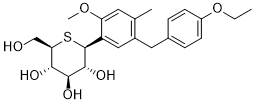
Luseogliflozin

别名: TS71 TS-071 TS 71 TS071 TS-71 鲁格列净;鲁格列净杂质
目录号: V20486 纯度: ≥98%
Luseogliflozin (TS71; TS071) 是一种新型、有效的钠依赖性葡萄糖协同转运蛋白 2 (SGLT2,Kd = 1.3 nM) 抑制剂,具有抗糖尿病作用。
Luseogliflozin CAS号: 898537-18-3
产品类别: New1
产品仅用于科学研究,不针对患者销售
规格 价格 库存 数量
1mg
5mg
10mg
Other Sizes

Other Forms of Luseogliflozin:

  • Luseogliflozin hydrate (TS 071 hydrate)
点击了解更多
InvivoChem产品被CNS等顶刊论文引用
产品描述
卢格列净(TS71;TS071)是一种新型强效的钠依赖性葡萄糖协同转运蛋白2(SGLT2,Kd = 1.3 nM)抑制剂,具有抗糖尿病作用。
卢格列净(CAS号:898537-18-3),又名TS-071,是一种强效、选择性且口服有效的钠依赖性葡萄糖协同转运蛋白2(SGLT2)抑制剂。它以Ki值为1.10 nM、IC50值为2.26 nM的竞争性抑制人SGLT2介导的葡萄糖摄取。卢格列净对SGLT1(IC50 = 3,990 nM)的选择性约为SGLT1的1,765倍,这对于最大限度地减少SGLT1抑制相关的胃肠道副作用至关重要。卢格列净通过选择性阻断肾近端小管中的SGLT2,减少滤过葡萄糖的重吸收并增加尿糖排泄,从而降低血糖水平。该机制不依赖于胰岛素,因此卢格列净是治疗2型糖尿病的有效选择。该化合物的分子式为C23H30O6S,分子量为434.55。卢格列净已在日本获批用于治疗2型糖尿病,并以商品名Lusefi®上市。体内实验表明,在小鼠和犬模型中,口服1 mg/kg剂量的卢格列净可显著降低血糖并显著增加尿糖排泄。卢格列净还能促进小鼠β细胞增殖。其良好的药代动力学特征使其在代谢性疾病研究中具有应用价值。
生物活性&实验参考方法
靶点
Luseogliflozin targets the sodium-dependent glucose cotransporter 2 (SGLT2), a protein primarily expressed in the proximal tubule of the kidney. SGLT2 is responsible for the reabsorption of the majority of filtered glucose from the glomerular filtrate back into the bloodstream. By inhibiting SGLT2, Luseogliflozin reduces glucose reabsorption, leading to increased urinary glucose excretion (glucosuria) and a consequent decrease in blood glucose levels. This mechanism is insulin-independent, making it effective even in patients with insulin resistance or impaired insulin secretion. Luseogliflozin is a competitive inhibitor of human SGLT2, with a Ki of 1.10 nM and an IC50 of 2.26 nM. It demonstrates high selectivity for SGLT2 over SGLT1 (approximately 1,765-fold), which is clinically relevant because SGLT1 is also expressed in the gastrointestinal tract, and its inhibition can cause gastrointestinal side effects. The compound's selectivity and potency make it an effective and well-tolerated antidiabetic agent. In addition to its effects on glucose, SGLT2 inhibition also promotes β-cell proliferation and improves glycemic control. Luseogliflozin's target, SGLT2, is a well-validated therapeutic target for type 2 diabetes, and its inhibition provides a safe and effective approach to lowering blood glucose.
体外研究 (In Vitro)
卢格列净(TS-071,3p)是一种强效的钠依赖性葡萄糖协同转运蛋白2(SGLT2)抑制剂,其IC50值为2.26 nM,选择性约为SGLT1(IC50为3990 nM)的1765倍。它可用于治疗2型糖尿病[1]。
卢格列净在体外表现出强大的SGLT2抑制剂活性。它以Ki值为1.10 nM、IC50值为2.26 nM的竞争性抑制人SGLT2介导的葡萄糖摄取。这种高效性表明卢格列净与SGLT2具有高亲和力,并能有效阻断其功能。该化合物对SGLT1(IC50 = 3990 nM)的选择性约为1765倍。这种选择性对于最大限度地减少脱靶效应至关重要,尤其是在SGLT1表达的胃肠道中。SGLT1的抑制会导致葡萄糖吸收不良和腹泻,因此,卢格列净对SGLT2的高选择性是一项显著优势。利用表达人SGLT2的细胞进行的体外研究证实了该化合物具有强效且选择性的抑制活性。这些发现表明,卢格列净是一种高效且选择性的SGLT2抑制剂,具有良好的体外活性,可用于治疗2型糖尿病。
体内研究 (In Vivo)
在大鼠和犬中,卢格列净(1 mg/kg,口服)表现出良好的药代动力学特性、优异的尿糖排泄特性和降血糖作用[1]。卢格列净主要通过增加尿糖排泄来降低血糖水平,从而展现出显著的体内活性。在体内,口服1 mg/kg的卢格列净可在大鼠和犬模型中产生显著的降血糖作用和强劲的尿糖排泄。这表明其在不同物种中均有效,并支持其在人体应用中的潜力。除了降血糖作用外,卢格列净(10 mg/kg,口服,7天)还能改善小鼠的高血糖症并促进β细胞增殖。这表明卢格列净除了降低血糖外,可能对胰岛β细胞功能具有有益作用。该化合物良好的药代动力学特征,包括口服生物利用度,支持其在代谢性疾病研究中的应用。卢格列净已在日本获批用于治疗2型糖尿病,证实了其临床疗效和安全性。这些体内研究结果表明,卢格列净是一种强效的SGLT2抑制剂,具有治疗2型糖尿病的巨大潜力。
酶活实验
卢格列净的体外酶/受体结合(非细胞)测定通常包括使用无细胞系统或表达转运蛋白的细胞来评估其对SGLT2和SGLT1的抑制活性。在典型的测定中,将表达人SGLT2或SGLT1的细胞与放射性标记或荧光标记的葡萄糖类似物(例如[14C]-α-甲基-吡喃葡萄糖苷,AMG)和不同浓度的卢格列净一起孵育。测量标记底物进入细胞的量,并利用卢格列净对摄取的抑制作用来计算IC50和Ki值。对于卢格列净,该方法已用于测定其对SGLT2的Ki值为1.10 nM,IC50值为2.26 nM,对SGLT1的IC50值为3,990 nM,表明其具有高效性和选择性。这些检测对于在分子水平上表征化合物的抑制活性和选择性至关重要。
细胞实验
卢格列净的体外细胞活性测定通常包括评估其对表达SGLT2的细胞葡萄糖摄取的影响。在典型的测定中,首先对细胞(例如中国仓鼠卵巢细胞)进行基因工程改造,使其表达人SGLT2。然后将这些细胞与放射性标记或荧光标记的葡萄糖类似物(例如[14C]-AMG)在不同浓度的卢格列净存在下孵育。测量标记底物进入细胞的量,并利用卢格列净对摄取的抑制作用计算IC50值。结果表明,卢格列净能有效抑制SGLT2介导的葡萄糖摄取。该细胞活性测定为该化合物在相关生物学背景下作为SGLT2抑制剂的活性提供了功能性证据。
动物实验
卢格列净的体内动物实验方案通常采用大鼠、犬或小鼠模型来评估其对血糖和尿糖排泄的影响。在典型的研究中,动物经口给予不同剂量(例如1 mg/kg)的卢格列净。在不同时间点采集血液和尿液样本以测量血糖水平。随后评估该化合物降低血糖和增加尿糖排泄的能力。为了研究其对β细胞增殖的影响,小鼠接受卢格列净(10 mg/kg,口服,7天)治疗,并采集胰腺组织进行组织学分析。这些体内模型对于验证该化合物的疗效以及从整体机体的角度理解其作用机制至关重要。
药代性质 (ADME/PK)
卢格列净具有口服活性,其良好的药代动力学特性支持每日一次给药。体内实验表明,在小鼠和犬模型中,口服1 mg/kg剂量的卢格列净可显著降低血糖,并促进尿糖排泄。这表明该化合物吸收良好,且具有足够的全身暴露量以发挥其药理作用。所提供的参考文献中未详细列出半衰期、清除率和分布容积等具体药代动力学参数。然而,该化合物在日本获准临床应用,证实其在人体内具有良好的药代动力学特征。卢格列净的分子量为434.55。有关其药代动力学特性的更多详细信息,请参阅临床文献。
毒性/毒理 (Toxicokinetics/TK)
所提供的参考文献中并未详细列出卢格列净的具体毒性(毒理学)数据。然而,作为一种在日本获批用于治疗2型糖尿病的药物,其安全性已在临床试验中得到广泛评估。该化合物通常耐受性良好,最常见的副作用与其作用机制相关,例如尿糖升高引起的泌尿道感染和生殖器感染。为支持其临床开发,已开展了包括急性毒性、慢性毒性、遗传毒性和致癌性在内的全面毒理学评估。
参考文献

[1]. (1S)-1,5-anhydro-1-[5-(4-ethoxybenzyl)-2-methoxy-4-methylphenyl]-1-thio-D-glucitol (TS-071) is a potent, selective sodium-dependent glucose cotransporter 2 (SGLT2) inhibitor for type 2 diabetes treatment. J Med Chem. 2010 Apr 22;53(8):3247-61.

其他信息
卢格列净是一种二芳基甲烷类药物。卢格列净已用于临床试验,以研究其治疗2型糖尿病的疗效。
卢格列净也称为TS-071,并以Lusefi®的商品名上市。它是一种强效、选择性且口服有效的钠依赖性葡萄糖协同转运蛋白2 (SGLT2) 抑制剂。卢格列净以Ki值为1.10 nM、IC50值为2.26 nM的竞争性抑制人SGLT2,其对SGLT1的选择性约为1765倍。它能减少肾脏滤过葡萄糖的重吸收,并降低肾脏葡萄糖阈值,从而增加尿糖排泄。卢格列净已在日本获批用于治疗2型糖尿病。体内研究表明,它能显著降低小鼠血糖,并促进β细胞增殖。其良好的药代动力学特性支持其在代谢疾病研究中的应用。
*注: 文献方法仅供参考, InvivoChem并未独立验证这些方法的准确性
化学信息 & 存储运输条件
分子式
C23H30O6S
分子量
434.547
精确质量
434.176
CAS号
898537-18-3
相关CAS号
Luseogliflozin hydrate;1152425-66-5
PubChem CID
11988953
外观&性状
White to off-white solid powder
密度
1.3±0.1 g/cm3
沸点
624.5±55.0 °C at 760 mmHg
熔点
155.0-157.0℃
闪点
331.5±31.5 °C
蒸汽压
0.0±1.9 mmHg at 25°C
折射率
1.616
LogP
4.43
tPSA
124.68
氢键供体(HBD)数目
4
氢键受体(HBA)数目
7
可旋转键数目(RBC)
7
重原子数目
30
分子复杂度/Complexity
514
定义原子立体中心数目
5
SMILES
CCOC1=CC=C(C=C1)CC2=CC(=C(C=C2C)OC)[C@H]3[C@@H]([C@H]([C@@H]([C@H](S3)CO)O)O)O
InChi Key
WHSOLWOTCHFFBK-ZQGJOIPISA-N
InChi Code
InChI=1S/C23H30O6S/c1-4-29-16-7-5-14(6-8-16)10-15-11-17(18(28-3)9-13(15)2)23-22(27)21(26)20(25)19(12-24)30-23/h5-9,11,19-27H,4,10,12H2,1-3H3/t19-,20-,21+,22-,23+/m1/s1
化学名
(2S,3R,4R,5S,6R)-2-[5-[(4-ethoxyphenyl)methyl]-2-methoxy-4-methylphenyl]-6-(hydroxymethyl)thiane-3,4,5-triol
别名
TS71 TS-071 TS 71 TS071 TS-71
HS Tariff Code
2934.99.9001
存储方式

Powder      -20°C    3 years

                     4°C     2 years

In solvent   -80°C    6 months

                  -20°C    1 month

运输条件
Room temperature (This product is stable at ambient temperature for a few days during ordinary shipping and time spent in Customs)
溶解度数据
溶解度 (体外实验)
May dissolve in DMSO (in most cases), if not, try other solvents such as H2O, Ethanol, or DMF with a minute amount of products to avoid loss of samples
溶解度 (体内实验)
注意: 如下所列的是一些常用的体内动物实验溶解配方,主要用于溶解难溶或不溶于水的产品(水溶度<1 mg/mL)。 建议您先取少量样品进行尝试,如该配方可行,再根据实验需求增加样品量。

注射用配方
(IP/IV/IM/SC等)
注射用配方1: DMSO : Tween 80: Saline = 10 : 5 : 85 (如: 100 μL DMSO 50 μL Tween 80 850 μL Saline)
*生理盐水/Saline的制备:将0.9g氯化钠/NaCl溶解在100 mL ddH ₂ O中,得到澄清溶液。
注射用配方 2: DMSO : PEG300Tween 80 : Saline = 10 : 40 : 5 : 45 (如: 100 μL DMSO 400 μL PEG300 50 μL Tween 80 450 μL Saline)
注射用配方 3: DMSO : Corn oil = 10 : 90 (如: 100 μL DMSO 900 μL Corn oil)
示例: 注射用配方 3 (DMSO : Corn oil = 10 : 90) 为例说明, 如果要配制 1 mL 2.5 mg/mL的工作液, 您可以取 100 μL 25 mg/mL 澄清的 DMSO 储备液,加到 900 μL Corn oil/玉米油中, 混合均匀。
View More

注射用配方 4: DMSO : 20% SBE-β-CD in Saline = 10 : 90 [如:100 μL DMSO 900 μL (20% SBE-β-CD in Saline)]
*20% SBE-β-CD in Saline的制备(4°C,储存1周):将2g SBE-β-CD (磺丁基-β-环糊精) 溶解于10mL生理盐水中,得到澄清溶液。
注射用配方 5: 2-Hydroxypropyl-β-cyclodextrin : Saline = 50 : 50 (如: 500 μL 2-Hydroxypropyl-β-cyclodextrin (羟丙基环胡精) 500 μL Saline)
注射用配方 6: DMSO : PEG300 : Castor oil : Saline = 5 : 10 : 20 : 65 (如: 50 μL DMSO 100 μL PEG300 200 μL Castor oil 650 μL Saline)
注射用配方 7: Ethanol : Cremophor : Saline = 10: 10 : 80 (如: 100 μL Ethanol 100 μL Cremophor 800 μL Saline)
注射用配方 8: 溶解于Cremophor/Ethanol (50 : 50), 然后用生理盐水稀释。
注射用配方 9: EtOH : Corn oil = 10 : 90 (如: 100 μL EtOH 900 μL Corn oil)
注射用配方 10: EtOH : PEG300Tween 80 : Saline = 10 : 40 : 5 : 45 (如: 100 μL EtOH 400 μL PEG300 50 μL Tween 80 450 μL Saline)


口服配方
口服配方 1: 悬浮于0.5% CMC Na (羧甲基纤维素钠)
口服配方 2: 悬浮于0.5% Carboxymethyl cellulose (羧甲基纤维素)
示例: 口服配方 1 (悬浮于 0.5% CMC Na)为例说明, 如果要配制 100 mL 2.5 mg/mL 的工作液, 您可以先取0.5g CMC Na并将其溶解于100mL ddH2O中,得到0.5%CMC-Na澄清溶液;然后将250 mg待测化合物加到100 mL前述 0.5%CMC Na溶液中,得到悬浮液。
View More

口服配方 3: 溶解于 PEG400 (聚乙二醇400)
口服配方 4: 悬浮于0.2% Carboxymethyl cellulose (羧甲基纤维素)
口服配方 5: 溶解于0.25% Tween 80 and 0.5% Carboxymethyl cellulose (羧甲基纤维素)
口服配方 6: 做成粉末与食物混合


注意: 以上为较为常见方法,仅供参考, InvivoChem并未独立验证这些配方的准确性。具体溶剂的选择首先应参照文献已报道溶解方法、配方或剂型,对于某些尚未有文献报道溶解方法的化合物,需通过前期实验来确定(建议先取少量样品进行尝试),包括产品的溶解情况、梯度设置、动物的耐受性等。

请根据您的实验动物和给药方式选择适当的溶解配方/方案:
1、请先配制澄清的储备液(如:用DMSO配置50 或 100 mg/mL母液(储备液));
2、取适量母液,按从左到右的顺序依次添加助溶剂,澄清后再加入下一助溶剂。以 下列配方为例说明 (注意此配方只用于说明,并不一定代表此产品 的实际溶解配方):
10% DMSO → 40% PEG300 → 5% Tween-80 → 45% ddH2O (或 saline);
假设最终工作液的体积为 1 mL, 浓度为5 mg/mL: 取 100 μL 50 mg/mL 的澄清 DMSO 储备液加到 400 μL PEG300 中,混合均匀/澄清;向上述体系中加入50 μL Tween-80,混合均匀/澄清;然后继续加入450 μL ddH2O (或 saline)定容至 1 mL;

3、溶剂前显示的百分比是指该溶剂在最终溶液/工作液中的体积所占比例;
4、 如产品在配制过程中出现沉淀/析出,可通过加热(≤50℃)或超声的方式助溶;
5、为保证最佳实验结果,工作液请现配现用!
6、如不确定怎么将母液配置成体内动物实验的工作液,请查看说明书或联系我们;
7、 以上所有助溶剂都可在 Invivochem.cn网站购买。
制备储备液 1 mg 5 mg 10 mg
1 mM 2.3012 mL 11.5062 mL 23.0123 mL
5 mM 0.4602 mL 2.3012 mL 4.6025 mL
10 mM 0.2301 mL 1.1506 mL 2.3012 mL

1、根据实验需要选择合适的溶剂配制储备液 (母液):对于大多数产品,InvivoChem推荐用DMSO配置母液 (比如:5、10、20mM或者10、20、50 mg/mL浓度),个别水溶性高的产品可直接溶于水。产品在DMSO 、水或其他溶剂中的具体溶解度详见上”溶解度 (体外)”部分;

2、如果您找不到您想要的溶解度信息,或者很难将产品溶解在溶液中,请联系我们;

3、建议使用下列计算器进行相关计算(摩尔浓度计算器、稀释计算器、分子量计算器、重组计算器等);

4、母液配好之后,将其分装到常规用量,并储存在-20°C或-80°C,尽量减少反复冻融循环。

计算器

摩尔浓度计算器可计算特定溶液所需的质量、体积/浓度,具体如下:

  • 计算制备已知体积和浓度的溶液所需的化合物的质量
  • 计算将已知质量的化合物溶解到所需浓度所需的溶液体积
  • 计算特定体积中已知质量的化合物产生的溶液的浓度
使用摩尔浓度计算器计算摩尔浓度的示例如下所示:
假如化合物的分子量为350.26 g/mol,在5mL DMSO中制备10mM储备液所需的化合物的质量是多少?
  • 在分子量(MW)框中输入350.26
  • 在“浓度”框中输入10,然后选择正确的单位(mM)
  • 在“体积”框中输入5,然后选择正确的单位(mL)
  • 单击“计算”按钮
  • 答案17.513 mg出现在“质量”框中。以类似的方式,您可以计算体积和浓度。

稀释计算器可计算如何稀释已知浓度的储备液。例如,可以输入C1、C2和V2来计算V1,具体如下:

制备25毫升25μM溶液需要多少体积的10 mM储备溶液?
使用方程式C1V1=C2V2,其中C1=10mM,C2=25μM,V2=25 ml,V1未知:
  • 在C1框中输入10,然后选择正确的单位(mM)
  • 在C2框中输入25,然后选择正确的单位(μM)
  • 在V2框中输入25,然后选择正确的单位(mL)
  • 单击“计算”按钮
  • 答案62.5μL(0.1 ml)出现在V1框中
g/mol

分子量计算器可计算化合物的分子量 (摩尔质量)和元素组成,具体如下:

注:化学分子式大小写敏感:C12H18N3O4  c12h18n3o4
计算化合物摩尔质量(分子量)的说明:
  • 要计算化合物的分子量 (摩尔质量),请输入化学/分子式,然后单击“计算”按钮。
分子质量、分子量、摩尔质量和摩尔量的定义:
  • 分子质量(或分子量)是一种物质的一个分子的质量,用统一的原子质量单位(u)表示。(1u等于碳-12中一个原子质量的1/12)
  • 摩尔质量(摩尔重量)是一摩尔物质的质量,以g/mol表示。
/

配液计算器可计算将特定质量的产品配成特定浓度所需的溶剂体积 (配液体积)

  • 输入试剂的质量、所需的配液浓度以及正确的单位
  • 单击“计算”按钮
  • 答案显示在体积框中
动物体内实验配方计算器(澄清溶液)
第一步:请输入基本实验信息(考虑到实验过程中的损耗,建议多配一只动物的药量)
第二步:请输入动物体内配方组成(配方适用于不溶/难溶于水的化合物),不同的产品和批次配方组成不同,如对配方有疑问,可先联系我们提供正确的体内实验配方。此外,请注意这只是一个配方计算器,而不是特定产品的确切配方。
+
+
+

计算结果:

工作液浓度 mg/mL;

DMSO母液配制方法 mg 药物溶于 μL DMSO溶液(母液浓度 mg/mL)。如该浓度超过该批次药物DMSO溶解度,请首先与我们联系。

体内配方配制方法μL DMSO母液,加入 μL PEG300,混匀澄清后加入μL Tween 80,混匀澄清后加入 μL ddH2O,混匀澄清。

(1) 请确保溶液澄清之后,再加入下一种溶剂 (助溶剂) 。可利用涡旋、超声或水浴加热等方法助溶;
            (2) 一定要按顺序加入溶剂 (助溶剂) 。

临床试验信息
Exploring Mechanistic Study: Potential of Luseogliflozin on Restoration of Cardiomyocyte Energy Metabolism in Diabetic Patients with Coronary Artery Disease
CTID: UMIN000037291
Phase:    Status: Complete: follow-up complete
Date: 2019-07-05
The Study of Effect of antidiabetic agents on pancreatic beta-Cell REsponsiveness To glucose; comparative Evaluation of DPP-4 Inhibitors and SGLT2 inhibitor, Luseogliflozin
CTID: jRCTs061190008
Phase:    Status: Complete
Date: 2019-06-24
Alternation in glucagon secretion by Sodium glucose transporter-2 inhibitor
CTID: jRCTs031190010
Phase:    Status: Complete
Date: 2019-04-16
Longitudinal analysis of bone microstructural changes under luseogliflozin treatment using second-generation High-Resolution peripheral Quantitative Computed Tomography (HR-pQCT) in elderly patients with type 2 diabetes
CTID: UMIN000036202
Phase: Phase IV    Status: Recruiting
Date: 2019-04-01
Multicenter explorative study of the beneficial effect of Luseogliflozin on cardiovascular function in Japanese T2DM patients (LUSCAR Study)
CTID: jRCTs031180434
Phase:    Status: Complete
Date: 2019-03-27
View More

Investigation on Renal Protective Effect by Luseogliflozin
CTID: jRCTs071180077
Phase:    Status: Complete
Date: 2019-03-26


Efficacy and safety of luseogliflozin in patient with type 2 diabetes complicated with hepatic dysfunction
CTID: jRCTs021180017
Phase:    Status: Complete
Date: 2019-03-25
Longitudinal analysis of bone microstructural changes under luseogliflozin treatment using second-generation High-Resolution peripheral Quantitative Computed Tomography (HR-pQCT) in elderly patients with type 2 diabetes
CTID: jRCTs071180061
Phase:    Status: Complete
Date: 2019-03-19
Luseogliflozin ABPM study
CTID: jRCTs011180019
Phase:    Status: Complete
Date: 2019-03-19
The Japanese Study for Efficacy of Luseogliflozin on composite Endpoint, Compared to DPP-4 inhibitors, in Type 2 diabetes mellitus patients
CTID: jRCTs031180241
Phase:    Status: Complete
Date: 2019-03-15
COMET Trial
CTID: jRCTs031180210
Phase:    Status: Not Recruiting
Date: 2019-03-07
CHAT-Lu
CTID: jRCTs051180060
Phase:    Status: Complete
Date: 2019-02-14
Exploring Mechanistic Study: Potential of Luseogliflozin on Restoration of Cardiomyocyte Energy Metabolism in Diabetic Patients with Heart Failure
CTID: UMIN000035243
PhaseNot applicable    Status: Recruiting
Date: 2019-01-04
Efficacy of luseogliflozin for fattty liver with diabetes mellitus
CTID: UMIN000031694
Phase:    Status: Recruiting
Date: 2018-04-01
Investigation on Renal Protective Effect by Luseogliflozin
CTID: UMIN000032005
Phase:    Status: Complete: follow-up complete
Date: 2018-03-30
Study for the effect on blood pressure and heart rate fluctuation by switching from DPP-4 inhibitor to SGLT2 inhibitor Luseogliflozin in patients with type 2 diabetes. - multicenter, prospective, randomized, open-label, parallel group, comparison study -
CTID: UMIN000031451
Phase: Phase IV    Status: Complete: follow-up complete
Date: 2018-02-28
The Japanese Study for Efficacy of Luseogliflozin on composite Endpoint, Compared to DPP-4 inhibitors, in Type 2 diabetes mellitus patients (J-SELECT study)
CTID: UMIN000030128
Phase:    Status: Complete: follow-up continuing
Date: 2017-11-27
The effect of SGLT2 inhibitor on glomrular hyperfiltration in type 2 diabetes patients.
CTID: UMIN000026887
Phase:    Status: Complete: follow-up complete
Date: 2017-04-09
Prospective Comparison of SGLT-2 inhibitor, Luseogliflozin,versus GLP-1 Receptor Agonist,Dulaglutide, on Regression of Coronary Atherosclerosis with Type 2 Diabetes Mellitus who have Undergone Percutaneous Coronary Intervention: Open-label Randomized Parallel-group Trial
CTID: UMIN000026630
Phase:    Status: Recruiting
Date: 2017-04-01
Efficacy and safety of luseogliflozin in patient with type 2 diabetes complicated with hepatic dysfunction
CTID: UMIN000025808
Phase:    Status: Pending
Date: 2017-01-23
Luseogliflozin Ehime Diabetes Study (LED study)
CTID: UMIN000023649
Phase: Phase IV    Status: Complete: follow-up complete
Date: 2016-08-17
Evaluation of the efficacy and safety of luseogliflozin and changes in QOL
CTID: UMIN000023035
PhaseNot applicable    Status: Complete: follow-up complete
Date: 2016-07-11
Alternation in glucagon secretion by dietary intake after administration of sodium glucose transporter-2 inhibitor.
CTID: UMIN000021977
PhaseNot applicable    Status: Complete: follow-up complete
Date: 2016-05-01
Investigation on efficacy and safety of order of SGLT-2 inhibitor and DPP-4 inhibitor administration
CTID: UMIN000021658
PhaseNot applicable    Status: Complete: follow-up complete
Date: 2016-05-01
Effective and safe examination of Luseogliflozin for patients with fatty liver merger type II diabetes mellitus
CTID: UMIN000021087
PhaseNot applicable    Status: Complete: follow-up complete
Date: 2016-02-18
Study of Luseogliflozin against hypertension merger diabetes patients
CTID: UMIN000020427
PhaseNot applicable    Status: Complete: follow-up complete
Date: 2016-01-04
The effect of luseogliflozin on epicardial fat accumulation in obese patients with type 2 diabetes
CTID: UMIN000019072
Phase:    Status: Complete: follow-up complete
Date: 2015-11-15
Prospective comparison of Luseogliflozin and alpha-glucosidase inhibitor on the management of diabetic patients with chronic heart failure and preserved left-ventricular ejection fraction
CTID: UMIN000018395
Phase:    Status: Complete: follow-up complete
Date: 2015-09-20
Study on changes in urinary glucose concentrations in Type 2 diabetes patients treated with the selective SGLT2 inhibitor luseogliflozin
CTID: UMIN000018806
Phase:    Status: Complete: follow-up complete
Date: 2015-09-16
Efficacy of SGLT2 inhibitors on bone mineral density in patients with type 2 diabetes
CTID: UMIN000016921
Phase:    Status: Complete: follow-up complete
Date: 2015-03-26
Randomized, controlled trial of thel effect of luseogliflozin in type 2 diabetic patients with fattiy liver
CTID: UMIN000016090
Phase:    Status: Complete: follow-up complete
Date: 2015-02-01
A study of Luseogliflozin : the components of weight loss in the Japanese patients with type 2 diabetes mellitus
CTID: UMIN000015112
PhaseNot applicable    Status: Complete: follow-up complete
Date: 2014-09-10
Comparison of DPP4 inhibitors versus luseogliflozin, a SGLT2 inhibitor using cotinuous glucose monitoring (CGM)
CTID: UMIN000014333
Phase:    Status: Complete: follow-up complete
Date: 2014-07-14
None
CTID: jRCT1080222531
Phase:    Status:
Date: 2014-06-19
None
CTID: jRCT1080222532
Phase:    Status:
Date: 2014-06-19
None
CTID: jRCT1080222497
Phase:    Status:
Date: 2014-05-27
None
CTID: jRCT2080222304
Phase:    Status:
Date: 2013-11-21
None
CTID: jRCT2080222305
Phase:    Status:
Date: 2013-11-21
None
CTID: jRCT2080222303
Phase:    Status:
Date: 2013-11-21
None
CTID: jRCT2080222304
Phase:    Status:
Date: 2013-11-21
None
CTID: jRCT2080222305
Phase:    Status:
Date: 2013-11-21
None
CTID: jRCT2080222303
Phase:    Status:
Date: 2013-11-21

联系我们