| 规格 | 价格 | |
|---|---|---|
| 500mg | ||
| 1g | ||
| Other Sizes |
| 靶点 |
Nav1.8
|
|---|---|
| 体外研究 (In Vitro) |
Cyfluthrin(0-50 μM;24 小时)抑制 SH-SY5Y 细胞的增殖,IC50 和 IC30 分别为 19.39 μM 和 4.81 μM[1]。
|
| 药代性质 (ADME/PK) |
Absorption, Distribution and Excretion
Nine male volunteers were exposed to the pyrethroid insecticide deltamethrin. The study was conducted in an exposure chamber where deltamethrin-containing aerosols were sprayed to obtain deltamethrin environments with average concentrations of 160 and 40 μg/m³. Four volunteers were exposed at a concentration of 160 μg/m³ for 10, 30, and 60 minutes, respectively, while the other five volunteers were exposed at a concentration of 40 μg/m³ for 60 minutes. For exposure at 160 μg/m³, urine samples were collected before exposure, immediately after exposure, and at 1–2, 2–3, 3–4, 4–5, 5–6, 6–12, and 12–24 hours post-exposure. For exposure at 40 μg/m³, urine samples were collected before exposure and 2 hours post-exposure. ...After inhalation at a concentration of 160 μg/m³, 93% of the metabolites were excreted within 24 hours (peak excretion time ranged from 0.5 to 3 hours). ...The amount of metabolites in urine depended on the administered dose and exposure time, and there were individual differences. After a single oral dose of 0.5 and 10 mg/kg of the 14C-labeled alcohol formulation, the alcohol-derived 14C was rapidly and completely excreted in urine and feces, with 55-70% and 25-35% of the dose excreted in urine and feces, respectively. Approximately 34% of 14C was excreted in bile. Relatively high levels of 14C tissue residue were observed in adipose tissue and the sciatic nerve. This study investigated the effect of the formulation carrier on the absorption rate of cyhalothrin. Fourteen fasted male Wistar rats were selected for the experiment and administered a single dose of 10 mg/kg body weight of cyhalothrin via gavage, dissolved in polyethylene glycol (PEG) 400 or Cremophor EL: aqueous emulsion. Two rats from each group were randomly selected and sacrificed at 0.5, 1, 2, 4, 6, 16, and 24 hours after administration. The concentrations of cyhalothrin and its enantiomers in blood and gastric juice were measured. When the compound was emulsified in Cremophor EL: aqueous solution, absorption was rapid; the cis isomer was the most abundant detected within 30 minutes after administration. Peak plasma concentrations were reached within 1 hour after administration. Cyhalothrin emulsified in PEG 400 was not detected until 4 hours after administration, and peak plasma concentrations appeared only at 6 hours after administration. Examination of gastric contents showed that rats administered the PEG 400 emulsion had higher cyhalothrin levels in their stomachs. A total of 30 male and 24 female Mura:SPRA (SPF 68 Han) rats in four groups were administered 14C radiolabeled cypermethrin via oral or 10 mg/kg body weight, or intravenous or duodenal administration of 0.5 mg/kg body weight. Another group of rats received unlabeled cypermethrin orally once daily for 14 consecutive days, followed by a single oral administration of 0.5 mg/kg body weight of 14C-labeled cypermethrin. Excretory, organ, tissue, and blood samples were collected at multiple time points for radiolabeling analysis. Regardless of the administration regimen, after oral administration, females showed effective absorption of up to 80% of the labeled cypermethrin, while males absorbed approximately 90%. …48 hours after oral administration, the residual amount of the radiolabeled drug in the body was less than 2%. Since the 14CO₂ content detected in exhaled breath was less than 0.001%, there was no significant pulmonary excretion pathway. Approximately 98-99% of the orally administered dose is excreted directly through the kidneys and feces. …In men, urinary excretion is two to three times that in feces, while in women, the renal-to-fecal excretion ratio after oral administration is 1.2-1.7:1. Therefore, the area under the curve (AUC) for women is twice that of men. 48 hours after intravenous administration, 93-95% of the dose is excreted, with a renal-to-fecal excretion ratio of 2.9:1 in men and 2.3:1 in women. Therefore, drug excretion depends to some extent on the route of administration and sex. …Residual amounts in organs and tissues are affected by the route of administration, as the mean relative concentration of cyhalothrin in males and females at sacrifice was lower after oral administration (0.013) than after intravenous administration (0.06). Female rats showed higher plasma concentrations after a single oral high or low dose; however, lower concentrations were detected in the bones and muscles of both males and females, and in the testes of male rats, 48 hours after administration. Similar relative concentrations were observed in the sciatic nerve, which may explain the observed toxic effects on the peripheral nervous system. Higher concentrations were detected in the spleen, adrenal glands, liver, plasma, and ovaries of both men and women. Following oral or intravenous administration, concentrations in renal adipose tissue increased approximately 7-fold, while mean concentrations in brain tissue decreased significantly (p = 0.0006–0.006)... For more complete data on the absorption, distribution, and excretion of cyhalothrin (9 species), please visit the HSDB records page. Metabolisms/Metabolites Nine male volunteers were exposed to the pyrethroid insecticide cyhalothrin. ...The major metabolites of cyhalothrin, cis/trans-3-(2,2-dichlorovinyl)-2,2-dimethylcyclopropanecarboxylic acid (DCCA) and 4-fluoro-3-phenoxybenzoic acid (FPBA), were determined in urine. The limits of detection (LOD) for all metabolites was 0.0025 μg (0.5 μg/L) in a 5 mL urine sample. After inhaling 40 μg/m³ cyhalothrin air for 60 minutes, the levels of metabolites in urine collected within the first 2 hours post-exposure were all below the LOD, with cis-DCCA at 0.14 μg, trans-DCCA at 0.15–0.28 μg, and FPBA at 0.12–0.23 μg. After inhaling 160 μg/m³ cyhalothrin, 93% of the metabolites were excreted within 24 hours (peak excretion occurring between 0.5 and 3 hours). The levels of metabolites in urine depend on the administered dose and exposure time, and individual variability exists. Eight hours after oral administration of 10 mg/kg body weight of 14C-labeled cyhalothrin to three male Sprague-Dawley rats, approximately 60% of the labeled cyhalothrin was excreted in the urine as conjugates. A conjugate of 4'-hydroxy-3-phenoxyfluorobenzoic acid was identified (50%); a second major metabolite, a conjugate of 3-phenoxy-4-fluorohippuric acid (40%), was identified after hydrochloric acid hydrolysis. These metabolites accounted for 33% and 27% of the administered radiolabeled cyhalothrin, respectively. Glycine conjugates accounted for 2.5% of the conjugate metabolites. In another study… five male and five female rats in each of four groups received 14C-labeled cyhalothrin… The first step in the biotransformation of cyhalothrin is ester hydrolysis, yielding a 3-phenoxy-4-fluorobenzyl alcohol intermediate and a chloroformic acid moiety. In studies of pyrethroids with similar chemical structures, the metabolism of chloroformic acid in rats has been well-established. Following ester hydrolysis, 3-phenoxy-4-fluorobenzyl alcohol is partially oxidized to the free metabolite 3-phenoxy-4-fluorobenzoic acid. This metabolite can conjugate with glycine to form 3-phenoxy-4-fluorohippuric acid (a minor metabolite, accounting for <3% of recovered urinary radiolabeled substances, regardless of sex or dose), or be hydroxylated to form 4'-hydroxy-3-phenoxy-4-fluorobenzoic acid (its conjugates account for 41-50% of the total radiolabeled substances recovered in the urine of rats administered 0.5 mg/kg body weight in a single or multiple doses of lambda-cyhalothrin). The excretion of the free form of this metabolite in the feces of female rats is often higher than that of male rats. At high doses (10 mg/kg body weight), both male and female rats excreted approximately 35% of the administered dose as a 4'-hydroxy-3-phenoxy-4-fluorobenzoic acid conjugate, while female rats excreted approximately 5% more as free metabolites than male rats. Following 14 consecutive days of oral administration of a 0.5 mg/kg body weight dose, 12–16% of the labeled metabolite (in the form of cyhalothrin) was detected in feces, compared to less than 1% after a single oral dose. Following a single oral dose of 10 mg/kg body weight, 17–19% of the labeled metabolite (in the form of the parent compound) was detected in feces. The authors conclude that the metabolism of cyhalothrin is slightly dose-dependent. The metabolic pathways of pyrethroids do not differ significantly among different mammalian species, but vary slightly depending on their structure. ...Basically, pyrethroids and allethrin are mainly decomposed through oxidation of the isobutylene side chain of the acid moiety and the unsaturated side chain of the alcohol moiety, with ester hydrolysis also playing an important role; while other pyrethroids are mainly decomposed through ester hydrolysis. /Pyrethroids and Pyrethroids/ For more complete metabolite/metabolite data on cyhalothrin (a total of 8 metabolites), please visit the HSDB record page. The first step in the biotransformation of cyhalothrin is ester hydrolysis, producing a 3-phenoxy-4-fluorobenzyl alcohol intermediate and a permethrin component. After ester hydrolysis, the 3-phenoxy-4-fluorobenzyl alcohol is partially oxidized to the free metabolite 3-phenoxy-4-fluorobenzoic acid. This metabolite can combine with glycine to form 3-phenoxy-4-fluorohippuric acid, or be hydroxylated to form 4'-hydroxy-3-phenoxy-4-fluorobenzoic acid. The metabolites, along with a small amount of unmetabolized compounds, are excreted in urine and feces. (L857, A562) Biological Half-Life Nine male volunteers were exposed to the pyrethroid insecticide deltamethrin. …The mean half-life of cis-3-(2,2-dichlorovinyl)-2,2-dimethylcyclopropanecarboxylic acid (cis-DCCA) was 6.9 hours, that of trans-3-(2,2-dichlorovinyl)-2,2-dimethylcyclopropanecarboxylic acid (trans-DCCA) was 6.2 hours, and that of 4-fluoro-3-phenoxybenzoic acid was 5.3 hours. The mean ratio of trans-DCCA to cis-DCCA was 1.9 throughout the experiment and in each subject. … …The deltamethrin elimination assay showed that the elimination of deltamethrin metabolites followed first-order kinetics (t1/2 = 6.4 hours)… |
| 毒性/毒理 (Toxicokinetics/TK) |
Toxicity Summary
Both type I and type II pyrethroids exert their effects by prolonging the opening time of sodium ion channels during nerve cell excitation. They appear to bind to membrane lipids near sodium ion channels, thereby altering channel dynamics. This blocks the closing of sodium ion channels in the nerve, thus prolonging the time it takes for the membrane potential to return to its resting state. Repetitive (sensory, motor) neuronal firing and prolonged negative afterpotentials produce effects very similar to DDT, leading to nervous system hyperactivity, which may result in paralysis and/or death. Other mechanisms of action of pyrethroids include antagonism of γ-aminobutyric acid (GABA)-mediated inhibition, regulation of nicotinic cholinergic transmission, enhancement of norepinephrine release, and action on calcium ions. They also inhibit calcium ion channels and Ca2+,Mg2+-ATPase. (T10, T18, L857) Toxicity Data LD50: 869-1271 mg/kg (oral, rat) (L862) LD50: 291-609 mg/kg (oral, mouse) (L862) L50: > 5000 mg/kg (dermal, rat) (L862) Interactions /Pyrethroid/Detoxification…is important for fruit flies, but the addition of synergists (organophosphates or carbamates) may delay detoxification to ensure lethality. …/Pyrethroid/ Synergist ethers enhance/the/insectic activity/ of pyrethroids by inhibiting hydrolytic enzymes responsible for pyrethroid metabolism in arthropods. When piperitin is used in combination with pyrethroids, the latter's insecticidal activity can be increased by 2-12 times. Adding 1000 ppm pyrethrin and 10000 ppm piperonyl butyl ether to the feed resulted in significant enlargement, marginalization, and cytoplasmic inclusions in rat hepatocytes within just 8 days, though these did not reach their maximum values. These changes were dose-proportional and similar to the effects of DDT. The effects of the two drugs had an additive effect. /Pyrethrin/ Non-human toxicity values LD50: Male rats, oral administration 500-800 mg/kg; Female rats, oral administration 1200 mg/kg LD50: Male mice, oral administration 300 mg/kg; Female mice, oral administration 600 mg/kg LD50: Rat, oral administration 500 mg/kg (polyethylene glycol solution) LD50: Rat, oral administration 270 mg/kg (xylene solution) For more complete non-human toxicity data for cycloflufenicol (9 in total), please visit the HSDB record page. |
| 参考文献 |
[1]. Jin-Sung Choi,et al.Structure-activity Relationships for the Action of 11 Pyrethroid Insecticides on Rat Na v 1.8 Sodium Channels Expressed in Xenopus Oocytes.Toxicol Appl Pharmacol. 2006 Mar 15;211(3):233-44
[2]. María-Aránzazu Martínez, et al. Oxidative Stress and Related Gene Expression Effects of Cyfluthrin in Human Neuroblastoma SH-SY5Y Cells: Protective Effect of Melatonin. Environ Res. 2019 Oct;177:108579. |
| 其他信息 |
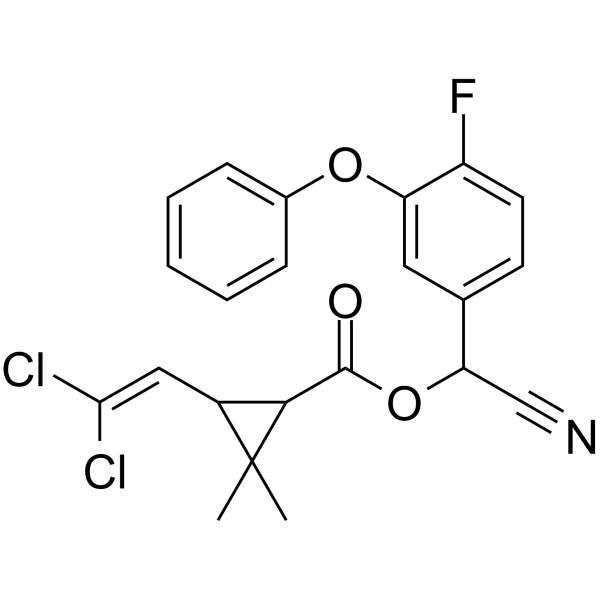
Cyfluthrin is a viscous, amber-colored, partially crystalline oil used as an insecticide. Cyfluthrin is a carboxylic acid ester formed by the condensation of 3-(2,2-dichlorovinyl)-2,2-dimethylcyclopropanecarboxylic acid and (4-fluoro-3-phenoxyphenyl)(hydroxy)acetonitrile. It is a pyrethroid insecticide and agricultural chemical. It is an organochlorine compound, organofluorine compound, nitrile compound, aromatic ether compound, and cyclopropane carboxylic acid ester compound. Its structure is similar to that of 3-(2,2-dichlorovinyl)-2,2-dimethylcyclopropanecarboxylic acid. Cyfluthrin is a synthetic (type II) pyrethroid insecticide with contact and stomach poison effects. It is a non-systemic chemical agent used to control a variety of pests, including root weevils, ants, silverfish, cockroaches, termites, grain weevils, snout weevils, mosquitoes, fleas, flies, corn borers, tobacco bud moths, codling moths, European corn borers, cabbage caterpillars, inchworms, armyworms, boll weevils, alfalfa weevils, and Colorado potato beetles. Its main agricultural applications are the control of chewing and piercing-sucking pests on crops such as cotton, lawns, ornamental plants, hops, grains, corn, deciduous fruit trees, peanuts, potatoes, and other vegetables. Cypermethrin is also used in public health and building pest control. (L862)
Mechanism of Action Synthetic pyrethroid compounds delay the closure of sodium ion channels, thereby generating a sodium ion tail current, characterized by a slow influx of sodium ions at the end of depolarization. Clearly, pyrethroid molecules keep the activation gate open. Pyrethroids containing α-cyano groups (e.g., cypermethrin) produce a more persistent sodium tail current than other pyrethroids (e.g., permethrin, bio-permethrin). The former class of pyrethroids induces a stronger dermal sensation than the latter. /Synthetic Pyrethroids/ Interaction with sodium channels is not the only mechanism of action for pyrethroids. Their effects on the central nervous system have led many researchers to propose that their mechanisms of action may include antagonism of γ-aminobutyric acid (GABA)-mediated inhibition, regulation of nicotinic cholinergic transmission, enhancement of norepinephrine release, or action on calcium ions. Since neurotransmitter-specific drugs offer limited or only partial protection against poisoning, these effects are unlikely to be the primary mechanisms of action for pyrethroids; most neurotransmitter release is a secondary consequence of increased sodium ion influx. /Pyrethroids/ …Type II pyrethroids are a class of insecticides widely used in agriculture and public health. The nervous system is a major target organ for pyrethroids in insects and mammals. Following overdose, a significant toxic manifestation is facial skin paresthesia and irritation-related respiratory symptoms, including behavioral agitation, primarily observed in workers or occupational environments where pyrethroids have been sprayed. In rats with acute exposure, type II pyrethroids induce a severe syndrome characterized by salivation and choreiform dysphoria. Since the acute functional effects of many type II pyrethroid insecticides may be associated with neurotoxicity to 5-HT neurons, this study aimed to investigate whether administration of deltamethrin, cypermethrin, and lambda-cyhalothrin resulted in changes in 5-HT levels in the rat brain. …Rats were intraperitoneally injected with corn oil or pyrethroid insecticides (deltamethrin, 20 mg/kg/day, intraperitoneal injection for 6 consecutive days; cypermethrin, 14 mg/kg/day, intraperitoneal injection for 6 consecutive days; lambda-cyhalothrin, 8 mg/kg/day, intraperitoneal injection for 6 consecutive days). Twenty-four hours after administration, the prefrontal cortex, hippocampus, midbrain, and striatum of rats were examined, and the levels of 5-HT and 5-hydroxyindoleacetic acid (5-HIAA) were analyzed using high-performance liquid chromatography-electrochemical detection. …These type II pyrethroid insecticides all exhibited a serotonin-lowering effect. In the brain regions of pyrethroid-treated animals, the concentrations of 5-hydroxytryptamine (5-HT) and its metabolite 5-hydroxyindoleacetic acid (5-HIAA) were reduced. Pyrethroids accelerated the turnover of 5-HT in the midbrain and striatum. Therefore, it was concluded that pyrethroids affect serotonin neurotransmission. …Since type II pyrethroid insecticides deltamethrin and cypermethrin (rather than type I pyrethroid insecticide cis-permethrin) act on chloride channels, this may contribute to the bimodal characteristic of pyrethroid poisoning syndrome. …Inverted flaps of differentiated mouse neuroblastoma cells were used, and the average channel opening probability was calculated. At a single 10 μM dose, allethrin, β-cyhalothrin, cypermethrin, deltamethrin, and fenpropathrin significantly reduced the channel opening probability (p < 0.05). Bifenthrin, permethrin, cis-permethrin, cis-permethrin, cyhalothrin isomers 2 and 4, λ-cyhalothrin, fenpropathrin, and deltamethrin did not significantly alter the chloride channel opening probability (p > 0.05). Since the type II pyrethroid insecticides fenpropathrin and λ-cyhalothrin were ineffective, it must be concluded that targeting the chloride channel itself cannot explain the difference between the two poisoning syndromes. Continuous use of type II pyrethroid insecticides did not lead to further chloride channel closure. However, the type I pyrethroid insecticide cis-permethrin blocked the subsequent effects of the mixed pyrethroid insecticide fenpropathrin. Conversely, the type I pyrethroid insecticide cis-cypermethrin does not prevent the subsequent action of the type II pyrethroid insecticide deltamethrin. The difference in efficacy is likely due to differences in potency, as deltamethrin is more potent than deltamethrin. Therefore, it is evident that in some combinations, type I and type II pyrethroid insecticides may compete and may bind to the same chloride channel target site. For more complete data on the mechanisms of action of cyclofluoroquinolones (7 in total), please visit the HSDB record page. |
| 分子式 |
C22H18CL2FNO3
|
|---|---|
| 分子量 |
434.28762
|
| 精确质量 |
433.064
|
| CAS号 |
68359-37-5
|
| PubChem CID |
104926
|
| 外观&性状 |
Yellowish-brown oil
Colorless crystals |
| 密度 |
1.4±0.1 g/cm3
|
| 沸点 |
496.3±45.0 °C at 760 mmHg
|
| 熔点 |
60ºC
|
| 闪点 |
253.9±28.7 °C
|
| 蒸汽压 |
0.0±1.3 mmHg at 25°C
|
| 折射率 |
1.611
|
| LogP |
6.29
|
| tPSA |
59.32
|
| 氢键供体(HBD)数目 |
0
|
| 氢键受体(HBA)数目 |
5
|
| 可旋转键数目(RBC) |
7
|
| 重原子数目 |
29
|
| 分子复杂度/Complexity |
679
|
| 定义原子立体中心数目 |
0
|
| SMILES |
CC1(C)C(C=C(Cl)Cl)C1C(=O)OC(C#N)C2=CC(=C(C=C2)F)OC3=CC=CC=C3
|
| InChi Key |
QQODLKZGRKWIFG-UHFFFAOYSA-N
|
| InChi Code |
InChI=1S/C22H18Cl2FNO3/c1-22(2)15(11-19(23)24)20(22)21(27)29-18(12-26)13-8-9-16(25)17(10-13)28-14-6-4-3-5-7-14/h3-11,15,18,20H,1-2H3
|
| 化学名 |
[cyano-(4-fluoro-3-phenoxyphenyl)methyl] 3-(2,2-dichloroethenyl)-2,2-dimethylcyclopropane-1-carboxylate
|
| HS Tariff Code |
2934.99.9001
|
| 存储方式 |
Powder -20°C 3 years 4°C 2 years In solvent -80°C 6 months -20°C 1 month |
| 运输条件 |
Room temperature (This product is stable at ambient temperature for a few days during ordinary shipping and time spent in Customs)
|
| 溶解度 (体外实验) |
May dissolve in DMSO (in most cases), if not, try other solvents such as H2O, Ethanol, or DMF with a minute amount of products to avoid loss of samples
|
|---|---|
| 溶解度 (体内实验) |
注意: 如下所列的是一些常用的体内动物实验溶解配方,主要用于溶解难溶或不溶于水的产品(水溶度<1 mg/mL)。 建议您先取少量样品进行尝试,如该配方可行,再根据实验需求增加样品量。
注射用配方
注射用配方1: DMSO : Tween 80: Saline = 10 : 5 : 85 (如: 100 μL DMSO → 50 μL Tween 80 → 850 μL Saline)(IP/IV/IM/SC等) *生理盐水/Saline的制备:将0.9g氯化钠/NaCl溶解在100 mL ddH ₂ O中,得到澄清溶液。 注射用配方 2: DMSO : PEG300 :Tween 80 : Saline = 10 : 40 : 5 : 45 (如: 100 μL DMSO → 400 μL PEG300 → 50 μL Tween 80 → 450 μL Saline) 注射用配方 3: DMSO : Corn oil = 10 : 90 (如: 100 μL DMSO → 900 μL Corn oil) 示例: 以注射用配方 3 (DMSO : Corn oil = 10 : 90) 为例说明, 如果要配制 1 mL 2.5 mg/mL的工作液, 您可以取 100 μL 25 mg/mL 澄清的 DMSO 储备液,加到 900 μL Corn oil/玉米油中, 混合均匀。 View More
注射用配方 4: DMSO : 20% SBE-β-CD in Saline = 10 : 90 [如:100 μL DMSO → 900 μL (20% SBE-β-CD in Saline)] 口服配方
口服配方 1: 悬浮于0.5% CMC Na (羧甲基纤维素钠) 口服配方 2: 悬浮于0.5% Carboxymethyl cellulose (羧甲基纤维素) 示例: 以口服配方 1 (悬浮于 0.5% CMC Na)为例说明, 如果要配制 100 mL 2.5 mg/mL 的工作液, 您可以先取0.5g CMC Na并将其溶解于100mL ddH2O中,得到0.5%CMC-Na澄清溶液;然后将250 mg待测化合物加到100 mL前述 0.5%CMC Na溶液中,得到悬浮液。 View More
口服配方 3: 溶解于 PEG400 (聚乙二醇400) 请根据您的实验动物和给药方式选择适当的溶解配方/方案: 1、请先配制澄清的储备液(如:用DMSO配置50 或 100 mg/mL母液(储备液)); 2、取适量母液,按从左到右的顺序依次添加助溶剂,澄清后再加入下一助溶剂。以 下列配方为例说明 (注意此配方只用于说明,并不一定代表此产品 的实际溶解配方): 10% DMSO → 40% PEG300 → 5% Tween-80 → 45% ddH2O (或 saline); 假设最终工作液的体积为 1 mL, 浓度为5 mg/mL: 取 100 μL 50 mg/mL 的澄清 DMSO 储备液加到 400 μL PEG300 中,混合均匀/澄清;向上述体系中加入50 μL Tween-80,混合均匀/澄清;然后继续加入450 μL ddH2O (或 saline)定容至 1 mL; 3、溶剂前显示的百分比是指该溶剂在最终溶液/工作液中的体积所占比例; 4、 如产品在配制过程中出现沉淀/析出,可通过加热(≤50℃)或超声的方式助溶; 5、为保证最佳实验结果,工作液请现配现用! 6、如不确定怎么将母液配置成体内动物实验的工作液,请查看说明书或联系我们; 7、 以上所有助溶剂都可在 Invivochem.cn网站购买。 |
| 制备储备液 | 1 mg | 5 mg | 10 mg | |
| 1 mM | 2.3026 mL | 11.5130 mL | 23.0261 mL | |
| 5 mM | 0.4605 mL | 2.3026 mL | 4.6052 mL | |
| 10 mM | 0.2303 mL | 1.1513 mL | 2.3026 mL |
1、根据实验需要选择合适的溶剂配制储备液 (母液):对于大多数产品,InvivoChem推荐用DMSO配置母液 (比如:5、10、20mM或者10、20、50 mg/mL浓度),个别水溶性高的产品可直接溶于水。产品在DMSO 、水或其他溶剂中的具体溶解度详见上”溶解度 (体外)”部分;
2、如果您找不到您想要的溶解度信息,或者很难将产品溶解在溶液中,请联系我们;
3、建议使用下列计算器进行相关计算(摩尔浓度计算器、稀释计算器、分子量计算器、重组计算器等);
4、母液配好之后,将其分装到常规用量,并储存在-20°C或-80°C,尽量减少反复冻融循环。
计算结果:
工作液浓度: mg/mL;
DMSO母液配制方法: mg 药物溶于 μL DMSO溶液(母液浓度 mg/mL)。如该浓度超过该批次药物DMSO溶解度,请首先与我们联系。
体内配方配制方法:取 μL DMSO母液,加入 μL PEG300,混匀澄清后加入μL Tween 80,混匀澄清后加入 μL ddH2O,混匀澄清。
(1) 请确保溶液澄清之后,再加入下一种溶剂 (助溶剂) 。可利用涡旋、超声或水浴加热等方法助溶;
(2) 一定要按顺序加入溶剂 (助溶剂) 。