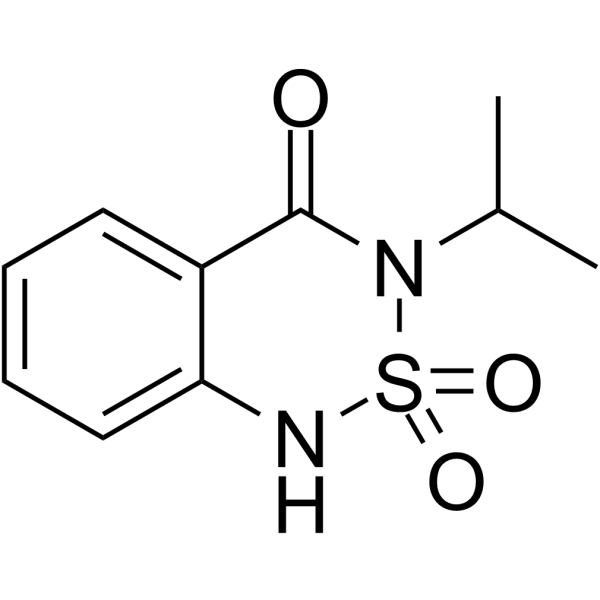
Bentazone

别名: 苯达松;百草克;本达隆;灭草松;排草丹;噻草平;苯并硫二嗪酮;燕麦敌二号;3-异丙基-(1H)-苯并-2,1,3-噻二嗪-4-酮-2,2-二氧化物;3-异丙基-2,1,3-苯并噻二嗪-4-酮-2,2-二氧化物水剂;灭草松水剂;噻草平水剂;乙草胺;嗪草酮;灭草松标准品;灭草松标准溶液; 灭草松水剂;苯达松;灭草松 溶于乙腈 标准品;苯达松 分析标准品;灭草松;百草克;苯并硫二嗪酮;噻草平;排草丹;本达隆;3-异丙基-(1H)-苯骈-2,1,3-噻二嗪-4-酮-2,2-二氧化物;灭草松-[13C2,15N]同位素内标;噻草平-[13C2,15N];苯达松;灭草松
目录号: V12398 纯度: ≥98%
苯达松是一种芽后除草剂,用于选择性控制豆类、水稻、玉米、花生、薄荷等阔叶杂草和莎草。
Bentazone CAS号: 25057-89-0
产品类别: New1
产品仅用于科学研究,不针对患者销售
规格 价格 库存 数量
100mg
500mg
Other Sizes

Other Forms of Bentazone:

  • Bentazone-13C10,15N
  • Bentazone-d7
点击了解更多
InvivoChem产品被CNS等顶刊论文引用
产品描述
苯达松是一种芽后除草剂,用于选择性控制豆类、水稻、玉米、花生、薄荷等阔叶杂草和莎草。苯达松通过干扰光合作用起作用。
生物活性&实验参考方法
药代性质 (ADME/PK)
Absorption, Distribution and Excretion
Toxicokinetic studies in mice, rats, and rabbits showed that bentazon is rapidly and almost completely absorbed (>99%) via the oral route, reaching maximum plasma concentrations in approximately 15 minutes at low doses (4 mg/kg body weight) and in approximately 1 hour at high doses (200 mg/kg body weight). Absorption was not significantly different when administered as a sodium salt or free acid. No evidence of drug penetration into the central nervous system or spinal cord was found, and it was rapidly cleared from other tissues without any signs of bioaccumulation. The drug is almost completely excreted in the urine (approximately 91% excreted within 24 hours); after 5 days of administration, the drug content in feces was less than 2%, and in exhaled breath less than 0.02%. Very little radioactive material was excreted in bile. No significant differences in absorption and elimination were found among the different species studied (rats, rabbits, and mice).
The skin permeability of bentazon sodium salt was evaluated by applying a single topical application of approximately 4933, 49.3, or 8.22 μg/cm² of the active ingredient (prepared with BAS 351 32 H) to a layered skin membrane mounted on a Franz-type diffusion cell. Doses represented either the formulation concentrate or two representative spray diluents (1:100 and 1:600) for field use. Five diffusion cells were used for each dose. …It can be concluded that the in vitro skin permeability of the water-soluble (liquid) concentrate of bentazon sodium is appropriate as a percentage of absorbed dose. Considering that the amount of radiolabeled material remaining on the skin after washing (remaining skin and tape strips 3-6) can be absorbed, and combining this with the absorption detected in the receptor, the skin permeability of the concentrate is approximately 0.06%, the skin permeability of the 1:100 spray dilution is approximately 1.31%, and the skin permeability of the 1:600 dilution is approximately 1.23%. /Bentazapine Sodium/
This article presents a case of death due to suicidal bentazapine poisoning and describes the different analytical methods involved. A 56-year-old farmer was examined by his family doctor one hour after voluntarily ingesting 500 ml of Fighter (approximately 250 g of bentazapine). He had a Glasgow Coma Scale score of 15 and presented with shortness of breath, diarrhea, and vomiting. En route to the hospital by ambulance, he tossed and turned, sweated profusely, and suddenly developed respiratory distress, followed by heart failure. The patient died within 2 hours of ingestion. Blood and urine samples were collected shortly before death. The plasma and urine concentrations of bentazon were 1500 mg/L and 1000 mg/L, respectively. A 59-year-old woman intentionally ingested 100-200 mL of paraquat (containing approximately 50-100 g of bentazon) and was hospitalized two days later due to cardiac arrest. During this time, she experienced vomiting, urination, and diarrhea, accompanied by drowsiness and slurred speech. Analysis of biological samples collected during the autopsy revealed active metabolites of bentazon, alcohol, and citalopram. The plasma concentrations of bentazon, alcohol, and desmethylcitalopram were 625 mg/kg, 0.62 g/L, and 0.03 mg/kg, respectively. Metabolites/Metabolites: The metabolism of bentazon was investigated through multiple toxicokinetic studies following oral (rat and rabbit) or intravenous (mouse) administration… Bendasone is metabolized at a very low rate, with its parent compound being the main excretory product. Only trace amounts of 6-hydroxybenzardine and 8-hydroxybenzardine were detected. No conjugation products were found in rats, rabbits, and mice. 6-Hydroxybenzardine and 8-hydroxybenzardine are the major plant metabolites of bentazon. Since humans, livestock, or pets may consume the treated plant, they are theoretically exposed to these two compounds. Although both metabolites have been shown to be produced in mammals, thus qualifying them for toxicological testing of the parent compound, dedicated toxicological studies were conducted. The results showed that the 8-hydroxy and 6-hydroxybenzardine metabolites had comparable toxicity after oral administration, both lower than the parent compound. Furthermore, neither metabolite was detected as inducing bacterial point mutations in the Ames assay. Since the transfer of hydroxyl groups in the bentazon ring system is unlikely to significantly alter its toxicity, 8-hydroxybenzardine was chosen as a reference for further investigation. To this end, subchronic feeding studies, multiple mutagenicity studies, and prenatal developmental studies were conducted on 8-hydroxybenzardine. These studies indicate that these metabolites are not mutagenic or teratogenic, and their toxicity is lower than that of the parent substance. In studies on soybean [Glycine max (Leguminatae) Merr.] and common bean (Phaseolus vulgaris Leguminatae), four unidentified conjugates were observed. Bentazon, after absorption via leaves or roots, is rapidly metabolized in soybean, undergoing hydroxylation at positions 6 and 8. These hydroxylated products are conjugates. Analysis of soybean field samples showed that hydroxylation of bentazon occurs in the early growth stages. Although there were no significant differences in the absorption and translocation of bentazon between resistant and susceptible rice (C. serotinus), significant differences existed in metabolism. In rice, 80% of absorbed bentazon was metabolized within 24 hours and converted to a major water-soluble metabolite within 7 days, with a conversion rate of 85%. In late-flowering lamb's quarter (C. serotinus), only 25-50% of bentazon was metabolized within 7 days. Similar results were obtained in other resistant and susceptible plant species, indicating that the ability to metabolize this compound is the main mechanism of its selectivity. The major metabolite in rice was identified by GC-MS, NMR, and IR as 6-(benzalofop-P-O-β-glucopyranoside. Other studies have shown that soybeans produce roughly equal amounts of 6-hydroxybenzalofop-P-O and 8-hydroxybenzalofop-P-O, while wheat, rice, peanuts, Senecio, and Chenopodium species predominate in 6-hydroxybenzalofop-P-O. For more complete data on the metabolism/metabolites of bentazon (a total of 8 metabolites), please visit the HSDB record page.
毒性/毒理 (Toxicokinetics/TK)
Toxicity Summary
Identification and Uses: Bentasol is a white crystalline solid. It has been used as a herbicide. Human Studies: Bentasol is irritating to the eyes and mucous membranes. A 50-year-old man was hospitalized after spraying corn with a bentasol solution, experiencing symptoms including sweating, fever, nausea, watery and bloody vomiting, and hematochezia. He received symptomatic treatment, including extracorporeal hemodialysis, but ultimately developed multiple organ failure (acute respiratory failure, acute liver failure, coagulation disorder, acute kidney failure, metabolic acidosis, and gastrointestinal bleeding) and died 11.35 hours after admission. In another case, intentional ingestion of 130 grams of bentasol resulted in vomiting, fever, sweating, tubular muscle rigidity, sinus tachycardia, drowsiness, leukocytosis, rhabdomyolysis, and liver and kidney damage. Animal Studies: Bentasol is non-irritating to the skin but has moderate eye irritation in rabbits. It is sensitizing to the skin in guinea pigs. In a chronic toxicity study, rats (50 males and 50 females per group) were fed bentazon via diet at doses of 0, 5, 17, and 76 mg/kg body weight/day for two consecutive years. Statistical analysis of tumor incidence revealed no significant differences between groups. Bendasone was not teratogenic in rabbits or rats. In rat developmental studies, a daily dose of 250 mg/kg body weight resulted in increased post-implantation embryo loss, skeletal variations (incomplete or absent ossification of phalangeal nuclei, sternum, and cervical vertebrae), and reduced fetal weight surviving to day 21. No signs of neurotoxicity were observed in rats supplemented with bentazon via diet at dose levels of 0, 300, 1000, and 3500 ppm. In vitro genetic toxicity studies included bacterial reverse mutation assays in Salmonella typhimurium and Escherichia coli, DNA damage and repair studies in Escherichia coli and Saccharomyces cerevisiae, and chromosomal aberration and positive mutation assays in CHO cells. In vivo studies included chromosome analysis in mice and rats, unplanned DNA synthesis assays in mice, and mutation assays in mouse and rat germ cells. Bentazon showed no toxicity in all of these studies. Ecotoxicity studies: Bentazon had effects on zebrafish embryos and their associated bacterial communities. It was non-toxic to bees.
Toxicity Data
LC50 (rat) = 5,100 mg/m³/4hInteractions
The effects of various cytochrome P450 monooxygenase inhibitors on the absorption and metabolism of the herbicide bentazon were studied using Mexican black sweet corn cell suspension cultures. Bentazon was rapidly absorbed by corn cells and metabolized to glycosylated 6-hydroxybenzon via aryl hydroxylation and glycosylation. The accumulation of bentazon in black corn Mexican sweet corn cells was approximately 20 times that in external media. When black corn Mexican sweet corn cells were cultured in an external medium containing 25 μM bentazon, the formation of glycosylated conjugates (approximately 2 nmol/min/g fresh weight) was rate-limited by aryl hydroxylation. Plant growth inhibitor tetracycline, mechanism-based cytochrome P450 inhibitor phenylhydrazine, and insecticide synergist piperonyl butyl ether all inhibited the metabolism of bentazon, with I50 values of approximately 0.1 μM, 1.0 μM, and 1.0 μM, respectively. Other mechanism-based cytochrome P450 inhibitors, such as 3-(2,4-dichlorophenoxy)-1-propyne and aminobenzotriazole, also inhibited bentazon metabolism, but with poorer effects. The results obtained using the selected inhibitors are consistent with the hypothesis that the aryl hydroxylation of bentazon is catalyzed by cytochrome P450 monooxygenase.
Non-human toxicity values
Rats oral LD50 850-2470 mg/kg body weight / including free acid and sodium salt forms; data from tables/
Guinea pig oral LD50 1100 mg/kg body weight / free acid and sodium salt forms; data from tables/
Rabbit oral LD50 1139 mg/kg body weight / data from tables/
Rats dermal LD50 >5000 mg/kg body weight / acid form; data from tables/
For more complete non-human toxicity values for bentazon (26 in total), please visit the HSDB records page.
参考文献

[1]. Herbicide Applications Increase Greenhouse Gas Emissions of Alfalfa Pasture in the Inland Arid Region of Northwest China. PeerJ. 2020 May 25;8:e9231.

其他信息
Bentazon is a benzothiadiazine compound with the chemical name 1H-2,1,3-benzothiadiazine-4(3H)-one-2,2-dioxide, substituted with an isopropyl group at the 3-position. It is an environmental pollutant, exogenous substance, and herbicide. Bentazon is a herbicide produced by BASF Chemical Company. It belongs to the thiadiazine class of compounds. Sodium bentazon is commercially available and is light brown. The U.S. Environmental Protection Agency (EPA) classifies bentazon as a Group E chemical because, based on animal studies, it is considered non-carcinogenic to humans. However, no studies or experiments have yet determined the toxicity and/or carcinogenicity of bentazon in humans. Mechanism of Action: Inhibits photosynthesis in photosystem II.
*注: 文献方法仅供参考, InvivoChem并未独立验证这些方法的准确性
化学信息 & 存储运输条件
分子式
C10H12N2O3S
分子量
240.28
精确质量
240.056
CAS号
25057-89-0
相关CAS号
Bentazone-13C10,15N;Bentazone-d7;131842-77-8
PubChem CID
2328
外观&性状
Colorless crystals; tech. is an ochre-yellow solid [
White, crystalline powder
密度
1.3±0.1 g/cm3
沸点
395.7±25.0 °C at 760 mmHg
熔点
137-139°C
闪点
193.1±23.2 °C
蒸汽压
0.0±0.9 mmHg at 25°C
折射率
1.583
LogP
2.8
tPSA
74.86
氢键供体(HBD)数目
1
氢键受体(HBA)数目
4
可旋转键数目(RBC)
1
重原子数目
16
分子复杂度/Complexity
385
定义原子立体中心数目
0
SMILES
CC(C)N1C(=O)C2=CC=CC=C2NS1(=O)=O
InChi Key
ZOMSMJKLGFBRBS-UHFFFAOYSA-N
InChi Code
InChI=1S/C10H12N2O3S/c1-7(2)12-10(13)8-5-3-4-6-9(8)11-16(12,14)15/h3-7,11H,1-2H3
化学名
2,2-dioxo-3-propan-2-yl-1H-2λ6,1,3-benzothiadiazin-4-one
HS Tariff Code
2934.99.9001
存储方式

Powder      -20°C    3 years

                     4°C     2 years

In solvent   -80°C    6 months

                  -20°C    1 month

运输条件
Room temperature (This product is stable at ambient temperature for a few days during ordinary shipping and time spent in Customs)
溶解度数据
溶解度 (体外实验)
May dissolve in DMSO (in most cases), if not, try other solvents such as H2O, Ethanol, or DMF with a minute amount of products to avoid loss of samples
溶解度 (体内实验)
注意: 如下所列的是一些常用的体内动物实验溶解配方,主要用于溶解难溶或不溶于水的产品(水溶度<1 mg/mL)。 建议您先取少量样品进行尝试,如该配方可行,再根据实验需求增加样品量。

注射用配方
(IP/IV/IM/SC等)
注射用配方1: DMSO : Tween 80: Saline = 10 : 5 : 85 (如: 100 μL DMSO 50 μL Tween 80 850 μL Saline)
*生理盐水/Saline的制备:将0.9g氯化钠/NaCl溶解在100 mL ddH ₂ O中,得到澄清溶液。
注射用配方 2: DMSO : PEG300Tween 80 : Saline = 10 : 40 : 5 : 45 (如: 100 μL DMSO 400 μL PEG300 50 μL Tween 80 450 μL Saline)
注射用配方 3: DMSO : Corn oil = 10 : 90 (如: 100 μL DMSO 900 μL Corn oil)
示例: 注射用配方 3 (DMSO : Corn oil = 10 : 90) 为例说明, 如果要配制 1 mL 2.5 mg/mL的工作液, 您可以取 100 μL 25 mg/mL 澄清的 DMSO 储备液,加到 900 μL Corn oil/玉米油中, 混合均匀。
View More

注射用配方 4: DMSO : 20% SBE-β-CD in Saline = 10 : 90 [如:100 μL DMSO 900 μL (20% SBE-β-CD in Saline)]
*20% SBE-β-CD in Saline的制备(4°C,储存1周):将2g SBE-β-CD (磺丁基-β-环糊精) 溶解于10mL生理盐水中,得到澄清溶液。
注射用配方 5: 2-Hydroxypropyl-β-cyclodextrin : Saline = 50 : 50 (如: 500 μL 2-Hydroxypropyl-β-cyclodextrin (羟丙基环胡精) 500 μL Saline)
注射用配方 6: DMSO : PEG300 : Castor oil : Saline = 5 : 10 : 20 : 65 (如: 50 μL DMSO 100 μL PEG300 200 μL Castor oil 650 μL Saline)
注射用配方 7: Ethanol : Cremophor : Saline = 10: 10 : 80 (如: 100 μL Ethanol 100 μL Cremophor 800 μL Saline)
注射用配方 8: 溶解于Cremophor/Ethanol (50 : 50), 然后用生理盐水稀释。
注射用配方 9: EtOH : Corn oil = 10 : 90 (如: 100 μL EtOH 900 μL Corn oil)
注射用配方 10: EtOH : PEG300Tween 80 : Saline = 10 : 40 : 5 : 45 (如: 100 μL EtOH 400 μL PEG300 50 μL Tween 80 450 μL Saline)


口服配方
口服配方 1: 悬浮于0.5% CMC Na (羧甲基纤维素钠)
口服配方 2: 悬浮于0.5% Carboxymethyl cellulose (羧甲基纤维素)
示例: 口服配方 1 (悬浮于 0.5% CMC Na)为例说明, 如果要配制 100 mL 2.5 mg/mL 的工作液, 您可以先取0.5g CMC Na并将其溶解于100mL ddH2O中,得到0.5%CMC-Na澄清溶液;然后将250 mg待测化合物加到100 mL前述 0.5%CMC Na溶液中,得到悬浮液。
View More

口服配方 3: 溶解于 PEG400 (聚乙二醇400)
口服配方 4: 悬浮于0.2% Carboxymethyl cellulose (羧甲基纤维素)
口服配方 5: 溶解于0.25% Tween 80 and 0.5% Carboxymethyl cellulose (羧甲基纤维素)
口服配方 6: 做成粉末与食物混合


注意: 以上为较为常见方法,仅供参考, InvivoChem并未独立验证这些配方的准确性。具体溶剂的选择首先应参照文献已报道溶解方法、配方或剂型,对于某些尚未有文献报道溶解方法的化合物,需通过前期实验来确定(建议先取少量样品进行尝试),包括产品的溶解情况、梯度设置、动物的耐受性等。

请根据您的实验动物和给药方式选择适当的溶解配方/方案:
1、请先配制澄清的储备液(如:用DMSO配置50 或 100 mg/mL母液(储备液));
2、取适量母液,按从左到右的顺序依次添加助溶剂,澄清后再加入下一助溶剂。以 下列配方为例说明 (注意此配方只用于说明,并不一定代表此产品 的实际溶解配方):
10% DMSO → 40% PEG300 → 5% Tween-80 → 45% ddH2O (或 saline);
假设最终工作液的体积为 1 mL, 浓度为5 mg/mL: 取 100 μL 50 mg/mL 的澄清 DMSO 储备液加到 400 μL PEG300 中,混合均匀/澄清;向上述体系中加入50 μL Tween-80,混合均匀/澄清;然后继续加入450 μL ddH2O (或 saline)定容至 1 mL;

3、溶剂前显示的百分比是指该溶剂在最终溶液/工作液中的体积所占比例;
4、 如产品在配制过程中出现沉淀/析出,可通过加热(≤50℃)或超声的方式助溶;
5、为保证最佳实验结果,工作液请现配现用!
6、如不确定怎么将母液配置成体内动物实验的工作液,请查看说明书或联系我们;
7、 以上所有助溶剂都可在 Invivochem.cn网站购买。
制备储备液 1 mg 5 mg 10 mg
1 mM 4.1618 mL 20.8091 mL 41.6181 mL
5 mM 0.8324 mL 4.1618 mL 8.3236 mL
10 mM 0.4162 mL 2.0809 mL 4.1618 mL

1、根据实验需要选择合适的溶剂配制储备液 (母液):对于大多数产品,InvivoChem推荐用DMSO配置母液 (比如:5、10、20mM或者10、20、50 mg/mL浓度),个别水溶性高的产品可直接溶于水。产品在DMSO 、水或其他溶剂中的具体溶解度详见上”溶解度 (体外)”部分;

2、如果您找不到您想要的溶解度信息,或者很难将产品溶解在溶液中,请联系我们;

3、建议使用下列计算器进行相关计算(摩尔浓度计算器、稀释计算器、分子量计算器、重组计算器等);

4、母液配好之后,将其分装到常规用量,并储存在-20°C或-80°C,尽量减少反复冻融循环。

计算器

摩尔浓度计算器可计算特定溶液所需的质量、体积/浓度,具体如下:

  • 计算制备已知体积和浓度的溶液所需的化合物的质量
  • 计算将已知质量的化合物溶解到所需浓度所需的溶液体积
  • 计算特定体积中已知质量的化合物产生的溶液的浓度
使用摩尔浓度计算器计算摩尔浓度的示例如下所示:
假如化合物的分子量为350.26 g/mol,在5mL DMSO中制备10mM储备液所需的化合物的质量是多少?
  • 在分子量(MW)框中输入350.26
  • 在“浓度”框中输入10,然后选择正确的单位(mM)
  • 在“体积”框中输入5,然后选择正确的单位(mL)
  • 单击“计算”按钮
  • 答案17.513 mg出现在“质量”框中。以类似的方式,您可以计算体积和浓度。

稀释计算器可计算如何稀释已知浓度的储备液。例如,可以输入C1、C2和V2来计算V1,具体如下:

制备25毫升25μM溶液需要多少体积的10 mM储备溶液?
使用方程式C1V1=C2V2,其中C1=10mM,C2=25μM,V2=25 ml,V1未知:
  • 在C1框中输入10,然后选择正确的单位(mM)
  • 在C2框中输入25,然后选择正确的单位(μM)
  • 在V2框中输入25,然后选择正确的单位(mL)
  • 单击“计算”按钮
  • 答案62.5μL(0.1 ml)出现在V1框中
g/mol

分子量计算器可计算化合物的分子量 (摩尔质量)和元素组成,具体如下:

注:化学分子式大小写敏感:C12H18N3O4  c12h18n3o4
计算化合物摩尔质量(分子量)的说明:
  • 要计算化合物的分子量 (摩尔质量),请输入化学/分子式,然后单击“计算”按钮。
分子质量、分子量、摩尔质量和摩尔量的定义:
  • 分子质量(或分子量)是一种物质的一个分子的质量,用统一的原子质量单位(u)表示。(1u等于碳-12中一个原子质量的1/12)
  • 摩尔质量(摩尔重量)是一摩尔物质的质量,以g/mol表示。
/

配液计算器可计算将特定质量的产品配成特定浓度所需的溶剂体积 (配液体积)

  • 输入试剂的质量、所需的配液浓度以及正确的单位
  • 单击“计算”按钮
  • 答案显示在体积框中
动物体内实验配方计算器(澄清溶液)
第一步:请输入基本实验信息(考虑到实验过程中的损耗,建议多配一只动物的药量)
第二步:请输入动物体内配方组成(配方适用于不溶/难溶于水的化合物),不同的产品和批次配方组成不同,如对配方有疑问,可先联系我们提供正确的体内实验配方。此外,请注意这只是一个配方计算器,而不是特定产品的确切配方。
+
+
+

计算结果:

工作液浓度 mg/mL;

DMSO母液配制方法 mg 药物溶于 μL DMSO溶液(母液浓度 mg/mL)。如该浓度超过该批次药物DMSO溶解度,请首先与我们联系。

体内配方配制方法μL DMSO母液,加入 μL PEG300,混匀澄清后加入μL Tween 80,混匀澄清后加入 μL ddH2O,混匀澄清。

(1) 请确保溶液澄清之后,再加入下一种溶剂 (助溶剂) 。可利用涡旋、超声或水浴加热等方法助溶;
            (2) 一定要按顺序加入溶剂 (助溶剂) 。

相关产品
联系我们