| 规格 | 价格 | 库存 | 数量 |
|---|---|---|---|
| 5mg |
|
||
| 10mg |
|
||
| 25mg |
|
||
| 50mg |
|
||
| 100mg |
|
||
| Other Sizes |
|
| 靶点 |
α-glucosidase
|
|---|---|
| 体外研究 (In Vitro) |
α-葡萄糖苷酶抑制活性[2]
几十年来,研究人员已经证明,桑叶提取物对大鼠和人α-葡萄糖苷酶有很强的抑制作用(Anno et al., 2004, Miyahara et al., 2004, Oku et al., 2006)。α-葡萄糖苷酶位于肠细胞的刷状缘表面膜上,被认为是淀粉和其他碳水化合物消化过程中最重要的酶(Herscovics, 1999)。通过膳食食物和药物改变碳水化合物代谢可能具有治疗价值。1-Deoxynojirimycin (Duvoglustat)/DNJ结合到α-葡萄糖苷酶的活性中心,在小肠中是该酶的有效抑制剂(Junge, Matzke, & Stoltefuss, 1996)。 对于营养保健品的商业开发,应该知道目标化合物及其在产品中的浓度,以达到最佳的治疗效果。在桑树干茶中,我们认为DNJ是关键化合物,因为它能强烈抑制α-葡萄糖苷酶,桑叶中含有高浓度的DNJ(占总亚氨基糖的50%)(Asano et al., 2001)。α-葡萄糖苷酶抑制与纯DNJ (r = 0.96)(图4B)和桑叶DNJ含量(r = 0.84)(图4A)高度相关。在1-Deoxynojirimycin (Duvoglustat)/DNJ浓度下,桑叶提取物对α-葡萄糖苷酶的抑制活性高于DNJ标准:如在5 μg DNJ/ml时,桑叶提取物对α-葡萄糖苷酶的抑制作用为27%,纯DNJ对α-葡萄糖苷酶的抑制作用为23%。这种额外的抑制作用可以解释为桑树提取物中存在其他亚氨基糖(即n -甲基- dnj, 2-O-α-d-半乳糖酰氨基- dnj和fagomine)和其他成分,如异槲皮素,槲皮素和芦丁。 |
| 体内研究 (In Vivo) |
Duvoglustat 盐酸盐(1-Deoxynojirimycin 盐酸盐)(20-80 mg/kg;静脉注射;每天一次,持续四个星期)显示出抗肥胖作用 [3]。盐酸度伏鲁司他通过激活 db/db 小鼠骨骼肌中的胰岛素信号 PI3K/AKT 通路,显着提高胰岛素敏感性[3]。
1-Deoxynojirimycin (Duvoglustat)/DNJ作为肠道α-葡萄糖苷酶抑制剂广泛用于糖尿病的治疗。然而,关于其对改善胰岛素敏感性的作用的报道很少。本研究的目的是探讨DNJ是否通过改善胰岛素敏感性来降低高血糖。建立了一种制备大量DNJ的经济方法。然后,db/db小鼠静脉注射DNJ(20、40和80 mg·kg(-1)·d(-1)) 4周。通过血糖和生化分析来评价其对高血糖的治疗效果,并探讨骨骼肌的相关分子机制。DNJ显著降低体重、血糖和血清胰岛素水平。DNJ治疗也改善了葡萄糖耐量和胰岛素耐量。此外,虽然骨骼肌中总蛋白激酶B (AKT)、磷脂酰肌醇3激酶(PI3K)、胰岛素受体β (IR-β)、胰岛素受体底物-1 (IRS1)和葡萄糖转运蛋白4 (GLUT4)的表达不受影响,但DNJ处理显著增加了Ser473-AKT、p85-PI3K、Tyr1361-IR-β和Tyr612-IRS1的GLUT4易位和磷酸化。这些结果表明,DNJ通过激活db/db小鼠骨骼肌中胰岛素信号通路PI3K/AKT显著改善胰岛素敏感性。[3] |
| 酶活实验 |
α-葡萄糖苷酶抑制试验[1]
α-葡萄糖苷酶抑制活性是通过Ma, Hattori, Daneshtalab和Wang(2008)描述的程序的修改来测量的。简单地说,将大鼠肠丙酮粉(1 g)悬浮在100 mM磷酸钾缓冲液(pH 7.0)中,超声振荡20 min。在3000 rpm下离心30 min后,将上清液作为α-葡萄糖苷酶的来源。底物(2 mM 4-硝基苯-α-d-葡萄糖吡喃苷)在100 mM磷酸钾缓冲液(pH 7.0)中移液至96孔板(40 μl/孔)。加入5 μl桑树样品或对照溶液(乙醇与蒸馏水的比例为50:50)混合。加入酶(5 μl)后,37℃孵育20 min,测定405 nm的紫外吸光度。计算桑树样品和标准1-Deoxynojirimycin (Duvoglustat)/DNJ α-葡萄糖苷酶抑制活性的百分比为:(ΔAcontrol-ΔAsample) × 100/ΔAcontrol,其中ΔA为405 nm吸光度。 |
| 细胞实验 |
蛋白质印迹[3]
为了研究1-脱氧野尻霉素/1-Deoxynojirimycin (Duvoglustat)对胰岛素信号通路的影响,如前所述进行了蛋白质印迹分析。简而言之,骨骼肌组织(0.1 g)在裂解缓冲液(50 mM Tris(pH 7.4)、150 mM NaCl、0.1%SDS、0.5%脱氧胆酸钠、1%NP40、10μL磷酸酶抑制剂、1μL蛋白酶抑制剂和5μL 100 mM PMSF)中裂解,在4°C下以16000×g离心15分钟,并通过双辛可宁酸蛋白测定法定量蛋白质浓度。将等量的蛋白质(70μg)装载在10%SDS-PAGE上,并转移到PVDF膜上。膜被阻断后,它们与抗IR-β、对-Tyr1361-IR-β,IRS1、对-Tur612-IRS1、PI3K、对-p85-PI3K、AKT、对-Ser473-AKT、GLUT4、β-actin或Na+K+-ATP酶α1的一抗在4°C下孵育过夜,然后在室温下与HRP偶联的二抗孵育2小时。使用ECL检测试剂盒观察蛋白质条带。以β-actin为对照进行总蛋白表达的正常化。以Na+K+-ATP酶α1为对照进行m-GLUT4表达的正常化。 |
| 动物实验 |
db/db小鼠
20、40、80 mg/kg 静脉注射;每日一次,持续四周 十周后,接受静脉注射生理盐水的野生型C57BLKS小鼠作为正常对照组(N对照组)(n = 6)。db/db小鼠分为四组(n = 6):第一组作为糖尿病对照组,接受静脉注射生理盐水(D对照组)。第二、三、四组分别静脉注射1-脱氧野尻霉素(Duvoglustat)/DNJ 20、40和80 mg·kg−1·day−1。选择静脉注射是为了避免DNJ作为α-糖苷酶抑制剂在胃肠道中的作用。为了选择DNJ的剂量,我们之前的研究通过ICR小鼠的葡萄糖耐量试验筛选了大量中药,其中包括桑叶。我们发现从桑叶中分离得到的生物碱(DNJ 40 mg·kg−1)能够改善ICR小鼠的葡萄糖耐量(图A1)。随后,我们测试了10、20和40 mg·kg−1的剂量,但10和20 mg·kg−1均未观察到任何效果(图A2)。因此,我们最终选择了1-脱氧野尻霉素(Duvoglustat)/DNJ的剂量为20、40和80 mg·kg−1·day−1。所有剂量均连续给药4周。每周测量小鼠的血糖、体重、平均食物摄入量、饮水量和尿量。实验结束后,小鼠禁食12小时后用水合氯醛麻醉,并采集血样测定血清胰岛素水平。此外,采血后取出骨骼肌,用生理盐水冲洗,立即置于−80 °C保存[3]。 |
| 毒性/毒理 (Toxicokinetics/TK) |
大鼠口服LD50 >5 gm/kg 行为:嗜睡(总体活动减少);肾脏、输尿管和膀胱:尿量增加;皮肤及其附属器官(皮肤):毛发:其他。《国际毒理学杂志》,16(增刊)
|
| 参考文献 |
|
| 其他信息 |
AT2220 是一种用于治疗庞贝氏症的实验性口服药物,属于一类被称为药理伴侣的分子。它是一种小分子,旨在作为药理伴侣,特异性结合、稳定并促进 α-葡萄糖苷酶 (GAA) 的正确折叠和转运。GAA 被转运至溶酶体,在那里发挥其正常功能。研究表明,AT2220 可提高庞贝氏症患者来源细胞系和表达错误折叠 GAA 的转染细胞中 GAA 的活性。
一种具有抗病毒作用的 α-葡萄糖苷酶抑制剂。脱氧野尻霉素衍生物可能具有抗HIV活性。 药物适应症 庞贝氏病,又称II型糖原贮积症或酸性麦芽糖酶缺乏症,是一种相对罕见的神经肌肉和溶酶体贮积症,由一种名为α-葡萄糖苷酶(Gaa)的关键酶的遗传基因突变引起。 作用机制 AT2220旨在作为一种药理学伴侣,选择性地与导致庞贝氏病的错误折叠酶Gaa结合。AT2220与该酶结合后,被认为能够促进该酶的正确折叠、加工和转运,使其从内质网到达其最终目的地——溶酶体,溶酶体是该酶在细胞内发挥作用的区域。一旦到达溶酶体,药理学伴侣蛋白就会被置换出来,酶就能发挥其正常功能,即分解其天然底物糖原。 杜沃格鲁司他是一种具有2R,3R,4R,5S构型的2-(羟甲基)哌啶-3,4,5-三醇的光学活性形式。它是一种EC 3.2.1.20(α-葡萄糖苷酶)抑制剂、抗HIV药物、抗肥胖药物、细菌代谢产物、降血糖药物、保肝药物和植物代谢产物。它是一种2-(羟甲基)哌啶-3,4,5-三醇和哌啶生物碱。 一种具有抗病毒作用的α-葡萄糖苷酶抑制剂。脱氧野尻霉素的衍生物可能具有抗HIV活性。 据报道,1-脱氧野尻霉素存在于南极假丝酵母(Parmotrema austrosinense)、前缘假丝酵母(Parmotrema praesorediosum)以及其他有相关数据的生物体中。 一种具有抗病毒作用的α-葡萄糖苷酶抑制剂。脱氧野尻霉素的衍生物可能具有抗HIV活性。 另见:法戈明(注释已移至此处)。 1-脱氧野尻霉素(DNJ,C₆H13NO₄,163.17 g/mol)是一种生物碱氮杂糖或亚氨基糖,是一种存在于桑叶、鸭跖草(Commelina communis)以及多种细菌菌株(如芽孢杆菌属和链霉菌属)中的具有生物活性的天然化合物。脱氧野尻霉素具有降血糖、抗肥胖和抗病毒特性。因此,本文旨在详细综述脱氧野尻霉素(DNJ)的来源、提取、纯化、测定、化学性质和生物活性等方面的现有知识,以便研究人员能够利用这些知识探索DNJ的未来研究方向。此外,本文还将采用合适的计算机模拟方法研究DNJ可能的分子靶点。[1] 桑葚1-脱氧野尻霉素(DNJ)是一种强效的α-葡萄糖苷酶抑制剂,能够抑制餐后血糖,从而可能预防糖尿病。目前,桑葚干茶在许多国家作为功能性食品进行商业销售,但由于其DNJ含量较低(约100 mg/100 g干重),这些产品可能无法提供有效剂量(6 mg DNJ/60 kg体重)。因此,开发DNJ含量更高的茶饮是十分必要的。为了研究DNJ的分布及其对α-葡萄糖苷酶的抑制活性,我们调查了35个泰国桑树品种中DNJ的含量。幼叶中DNJ的含量在不同桑树品种间存在差异,范围为30至170 mg/100 g干叶。DNJ含量最高的品种为Kam、Burirum 60和Burirum 51。叶片位置对DNJ含量有显著影响:嫩枝 > 幼叶 > 成熟叶。DNJ浓度与α-葡萄糖苷酶抑制活性呈高度相关(r = 0.84),表明桑叶的α-葡萄糖苷酶抑制活性主要来源于DNJ。因此,我们利用Burirum 60等品种的嫩枝制作了高DNJ含量的桑叶茶,其DNJ含量高达300 mg/100 g干叶。我们采用响应面法优化了制茶条件,以获得最高的DNJ提取率。在98℃下保持400秒,高DNJ含量干茶中约95%的总DNJ被提取出来;这些条件可适用于制备高DNJ含量的商业产品。一杯(230毫升,标准份量)富含DNJ的桑叶茶含有足够的DNJ(6.5毫克),可有效抑制餐后血糖。[2] |
| 分子式 |
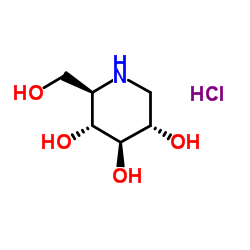
C6H14CLNO4
|
|---|---|
| 分子量 |
199.631
|
| 精确质量 |
199.061
|
| 元素分析 |
C, 36.10; H, 7.07; Cl, 17.76; N, 7.02; O, 32.06
|
| CAS号 |
73285-50-4
|
| 相关CAS号 |
1-Deoxynojirimycin;19130-96-2
|
| PubChem CID |
13018787
|
| 外观&性状 |
White to off-white solid powder
|
| 密度 |
1.456 g/cm3
|
| 沸点 |
361.1ºC at 760 mmHg
|
| 熔点 |
195-196ºC
|
| 闪点 |
197.3ºC
|
| tPSA |
92.95
|
| 氢键供体(HBD)数目 |
6
|
| 氢键受体(HBA)数目 |
5
|
| 可旋转键数目(RBC) |
1
|
| 重原子数目 |
12
|
| 分子复杂度/Complexity |
132
|
| 定义原子立体中心数目 |
4
|
| SMILES |
Cl.OC[C@H]1NC[C@H](O)[C@@H](O)[C@@H]1O
|
| InChi Key |
ZJIHMALTJRDNQI-VFQQELCFSA-N
|
| InChi Code |
InChI=1S/C6H13NO4.ClH/c8-2-3-5(10)6(11)4(9)1-7-3/h3-11H,1-2H21H/t3-,4+,5-,6-/m1./s1
|
| 化学名 |
(2R,3R,4R,5S)-2-(hydroxymethyl)piperidine-3,4,5-triol hydrochloride
|
| 别名 |
Duvoglustat; BAY-h 5595; AT2220; AT-2220; AT 2220; DNJ; 1DNJ; NOJ; Moranoline; Moranolin; Duvoglustat hydrochloride; deoxynojirimycin; 1-Deoxynojirimycin; 1-Deoxy-Nojirimycin
1-Deoxynojirimycin hydrochloride; 73285-50-4; Duvoglustat HCl; Moranoline hydrochloride; Moranoline HCl; (2R,3R,4R,5S)-2-(Hydroxymethyl)piperidine-3,4,5-triol hydrochloride
|
| HS Tariff Code |
2934.99.9001
|
| 存储方式 |
Powder -20°C 3 years 4°C 2 years In solvent -80°C 6 months -20°C 1 month 注意: 请将本产品存放在密封且受保护的环境中(例如氮气保护),避免吸湿/受潮和光照。 |
| 运输条件 |
Room temperature (This product is stable at ambient temperature for a few days during ordinary shipping and time spent in Customs)
|
| 溶解度 (体外实验) |
H2O : ~250 mg/mL (~1252.32 mM)
|
|---|---|
| 溶解度 (体内实验) |
注意: 如下所列的是一些常用的体内动物实验溶解配方,主要用于溶解难溶或不溶于水的产品(水溶度<1 mg/mL)。 建议您先取少量样品进行尝试,如该配方可行,再根据实验需求增加样品量。
注射用配方
注射用配方1: DMSO : Tween 80: Saline = 10 : 5 : 85 (如: 100 μL DMSO → 50 μL Tween 80 → 850 μL Saline)(IP/IV/IM/SC等) *生理盐水/Saline的制备:将0.9g氯化钠/NaCl溶解在100 mL ddH ₂ O中,得到澄清溶液。 注射用配方 2: DMSO : PEG300 :Tween 80 : Saline = 10 : 40 : 5 : 45 (如: 100 μL DMSO → 400 μL PEG300 → 50 μL Tween 80 → 450 μL Saline) 注射用配方 3: DMSO : Corn oil = 10 : 90 (如: 100 μL DMSO → 900 μL Corn oil) 示例: 以注射用配方 3 (DMSO : Corn oil = 10 : 90) 为例说明, 如果要配制 1 mL 2.5 mg/mL的工作液, 您可以取 100 μL 25 mg/mL 澄清的 DMSO 储备液,加到 900 μL Corn oil/玉米油中, 混合均匀。 View More
注射用配方 4: DMSO : 20% SBE-β-CD in Saline = 10 : 90 [如:100 μL DMSO → 900 μL (20% SBE-β-CD in Saline)] 口服配方
口服配方 1: 悬浮于0.5% CMC Na (羧甲基纤维素钠) 口服配方 2: 悬浮于0.5% Carboxymethyl cellulose (羧甲基纤维素) 示例: 以口服配方 1 (悬浮于 0.5% CMC Na)为例说明, 如果要配制 100 mL 2.5 mg/mL 的工作液, 您可以先取0.5g CMC Na并将其溶解于100mL ddH2O中,得到0.5%CMC-Na澄清溶液;然后将250 mg待测化合物加到100 mL前述 0.5%CMC Na溶液中,得到悬浮液。 View More
口服配方 3: 溶解于 PEG400 (聚乙二醇400) 请根据您的实验动物和给药方式选择适当的溶解配方/方案: 1、请先配制澄清的储备液(如:用DMSO配置50 或 100 mg/mL母液(储备液)); 2、取适量母液,按从左到右的顺序依次添加助溶剂,澄清后再加入下一助溶剂。以 下列配方为例说明 (注意此配方只用于说明,并不一定代表此产品 的实际溶解配方): 10% DMSO → 40% PEG300 → 5% Tween-80 → 45% ddH2O (或 saline); 假设最终工作液的体积为 1 mL, 浓度为5 mg/mL: 取 100 μL 50 mg/mL 的澄清 DMSO 储备液加到 400 μL PEG300 中,混合均匀/澄清;向上述体系中加入50 μL Tween-80,混合均匀/澄清;然后继续加入450 μL ddH2O (或 saline)定容至 1 mL; 3、溶剂前显示的百分比是指该溶剂在最终溶液/工作液中的体积所占比例; 4、 如产品在配制过程中出现沉淀/析出,可通过加热(≤50℃)或超声的方式助溶; 5、为保证最佳实验结果,工作液请现配现用! 6、如不确定怎么将母液配置成体内动物实验的工作液,请查看说明书或联系我们; 7、 以上所有助溶剂都可在 Invivochem.cn网站购买。 |
| 制备储备液 | 1 mg | 5 mg | 10 mg | |
| 1 mM | 5.0093 mL | 25.0463 mL | 50.0927 mL | |
| 5 mM | 1.0019 mL | 5.0093 mL | 10.0185 mL | |
| 10 mM | 0.5009 mL | 2.5046 mL | 5.0093 mL |
1、根据实验需要选择合适的溶剂配制储备液 (母液):对于大多数产品,InvivoChem推荐用DMSO配置母液 (比如:5、10、20mM或者10、20、50 mg/mL浓度),个别水溶性高的产品可直接溶于水。产品在DMSO 、水或其他溶剂中的具体溶解度详见上”溶解度 (体外)”部分;
2、如果您找不到您想要的溶解度信息,或者很难将产品溶解在溶液中,请联系我们;
3、建议使用下列计算器进行相关计算(摩尔浓度计算器、稀释计算器、分子量计算器、重组计算器等);
4、母液配好之后,将其分装到常规用量,并储存在-20°C或-80°C,尽量减少反复冻融循环。
计算结果:
工作液浓度: mg/mL;
DMSO母液配制方法: mg 药物溶于 μL DMSO溶液(母液浓度 mg/mL)。如该浓度超过该批次药物DMSO溶解度,请首先与我们联系。
体内配方配制方法:取 μL DMSO母液,加入 μL PEG300,混匀澄清后加入μL Tween 80,混匀澄清后加入 μL ddH2O,混匀澄清。
(1) 请确保溶液澄清之后,再加入下一种溶剂 (助溶剂) 。可利用涡旋、超声或水浴加热等方法助溶;
(2) 一定要按顺序加入溶剂 (助溶剂) 。
| NCT Number | Status | Interventions | Conditions | Sponsor/Collaborators | Start Date | Phases |
| NCT01380743 | Completed | Drug: duvoglustat Drug: rhGAA |
Pompe Disease | Amicus Therapeutics | October 31, 2011 | Phase 2 |
| NCT01489995 | Completed | Drug: A (migalastat) Drug: B (migalastat) |
Fabry Disease | Amicus Therapeutics | October 2011 | Phase 1 |
| NCT03832452 | Completed | Other: Placebo Drug: Moxifloxacin |
Healthy | Idorsia Pharmaceuticals Ltd. | February 14, 2019 | Phase 1 |
| NCT01822028 | Completed | Drug: Treatment A Drug: Treatment B |
Diarrhea | Actelion | March 2013 | Phase 1 |
| NCT01853852 | Completed | Other: Potable water Drug: Placebo capsule |
Fabry Disease | Amicus Therapeutics | September 2011 | Phase 1 |
InvivoChem的所有产品仅用于作科学研究,不面向患者销售
Copyright 2020 InvivoChem LLC | All Rights Reserved 粤ICP备20063088号-1


 粤公网安备 44011102003439号
 463611831
