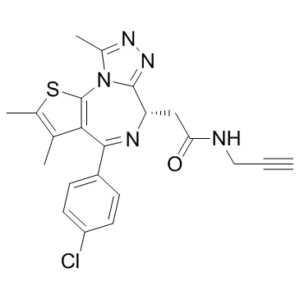
| 规格 | 价格 | 库存 | 数量 |
|---|---|---|---|
| 5mg |
|
||
| 10mg |
|
||
| 25mg |
|
||
| 50mg |
|
||
| 100mg |
|
||
| 250mg |
|
||
| 500mg |
|
||
| Other Sizes |
|

| 靶点 |
BET ( IC50 = 10.4 nM)[1].
Bromodomain and Extra-Terminal (BET) Family Proteins (BRD4 Bromodomain 1: Ki=1.9 nM; BRD4 Bromodomain 2: Ki=3.3 nM; BRD2 Bromodomain 1: Ki=4.5 nM; BRD3 Bromodomain 1: Ki=5.1 nM) [1] |
|---|---|
| 体外研究 (In Vitro) |
(+)-JQ1 PA 是 JQ1 的衍生物,也是 BET 的抑制剂。 (+)-JQ1 PA 针对 BET 的 IC50 为 10.4 nM,而 JQ1 在 MV4;11 细胞中的 IC50 为 14.3 nM [1]。
(+)-JQ1 PA 是(+)-JQ1的炔丙基功能化衍生物,为强效、选择性BET溴结构域抑制剂,设计用于点击化学介导的靶点验证和临床前成像[1] - BET溴结构域结合亲和力:保留对BET家族溴结构域的高亲和力,Ki值分别为1.9 nM(BRD4 BD1)、3.3 nM(BRD4 BD2)、4.5 nM(BRD2 BD1)和5.1 nM(BRD3 BD1);对非BET溴结构域(如BRD7、BRD9、CECR2)的选择性>1000倍,Ki>10 μM[1] - 抑制BET介导的转录调控:剂量依赖性降低MV4;11白血病细胞中c-Myc mRNA表达(IC₅₀=28 nM)和蛋白水平(100 nM时降低65%)(qPCR和western blot)[1] - 抗增殖活性:抑制BET依赖性癌细胞系增殖,包括MV4;11(IC₅₀=72 nM)、OCI-LY10(弥漫大B细胞淋巴瘤,IC₅₀=95 nM)和NCI-H460(非小细胞肺癌,IC₅₀=150 nM)(MTT实验,72小时处理)[1] - 点击化学兼容的靶点结合验证:通过Cu(I)催化的点击化学与叠氮功能化荧光染料或生物素形成稳定的三唑缀合物;可定量检测细胞裂解液中BET蛋白结合(pull-down实验)和细胞内靶点占用(荧光显微镜)[1] - 对正常细胞无显著细胞毒性:人外周血单个核细胞(PBMCs)与高达500 nM的 (+)-JQ1 PA 孵育72小时,细胞存活率>85%[1] |
| 体内研究 (In Vivo) |
(+)-JQ1 (50 mg/kg) 抑制 NMC 797 异种移植小鼠的肿瘤生长。 (+)-JQ1 (50 mg/kg) 导致 NMC 797 异种移植小鼠中 NUT 核斑点的消失,这与与核染色质的竞争性结合一致。 (+)-JQ1 (50 mg/kg) 在 NMC 797 异种移植物中诱导强(31 级)角蛋白表达。 (+)-JQ1 (50 mg/kg) 促进 NMC 异种移植小鼠模型的分化、肿瘤消退和延长生存期。与媒介物处理的动物相比,静脉注射 MM.1S-luc+ 细胞后,(+)-JQ1 (50 mg/kg) 导致原位异种移植的 SCID 米色小鼠的总生存期显着延长。 (+)-JQ1 (50 mg/kg ip) 导致带有 Raji 异种移植物的小鼠的存活率显着增加。
抑制MV4;11荷瘤裸鼠肿瘤生长:6–8周龄雌性BALB/c裸鼠右侧胁腹皮下接种MV4;11细胞(1×10⁷个/只),肿瘤体积达100–150 mm³后随机分为溶媒对照组和治疗组(n=8/组)。(+)-JQ1 PA 用10%DMSO+10%Cremophor EL+80%无菌生理盐水溶解,以25 mg/kg、50 mg/kg剂量腹腔注射,每日一次,连续14天。50 mg/kg剂量使肿瘤体积减少68%(从1320±180 mm³降至423±95 mm³,p<0.001),肿瘤重量减少62%(从1.45±0.21 g降至0.55±0.13 g,p<0.001)[1] - 点击化学介导的体内靶点验证:腹腔注射 (+)-JQ1 PA(50 mg/kg)4小时后,尾静脉注射叠氮-荧光素(10 mg/kg),通过荧光成像检测肿瘤组织中BET蛋白结合;肿瘤/肌肉荧光比值为4.8±0.7,证实特异性肿瘤靶点结合[1] - 降低肿瘤组织中c-Myc表达:MV4;11异种移植瘤免疫组化分析显示,50 mg/kg (+)-JQ1 PA 使c-Myc蛋白表达较溶媒对照组降低70%[1] |
| 酶活实验 |
Enhancers with differential JQ1–PA occupancy[1]
使用BEDtools(32)计算ChIP-seq和click-seq读取的覆盖率,并根据区域大小和库大小进行归一化。用15 ggplot2绘制R(33)图。每个增强子的相对点击序列覆盖率与BRD4 ChIP-seq覆盖率是通过JQ1-PA标准化读取与BRD4标准化读取的LFC计算的。所得LFC用于将增强剂分为5个大小相等、JQ1-PA占用率不同的组。 BET溴结构域结合实验(AlphaScreen法):重组人BET溴结构域(BRD2 BD1、BRD3 BD1、BRD4 BD1/BD2)用实验缓冲液(50 mM HEPES pH 7.5、100 mM NaCl、0.01% Tween-20、1 mM DTT)稀释。将 (+)-JQ1 PA 系列3倍稀释液(0.01 nM–1 μM)与溴结构域蛋白、生物素化乙酰化组蛋白H4(1-20位氨基酸,K5ac/K8ac/K12ac/K16ac)底物在384孔板中混合,加入链霉亲和素偶联供体珠和抗GST受体珠(针对GST标签化溴结构域),室温孵育90分钟。检测AlphaScreen信号(激发光680 nm,发射光520–620 nm),采用Cheng-Prusoff方程计算Ki值[1] - 点击化学结合验证实验:(+)-JQ1 PA(100 nM)与重组BRD4 BD1/BD2(1 μM)在结合缓冲液中孵育1小时,加入叠氮-PEG4-生物素(200 nM)和CuSO₄-THPTA复合物(10 μM)启动点击反应,37°C孵育30分钟。链霉亲和素-琼脂糖珠 pull-down 生物素化BRD4,western blot用抗BRD4抗体检测结合蛋白[1] |
| 细胞实验 |
RNA测序[1]
将MV4;11细胞与JQ1或JQ1-PA (0.5μM)一起培养6小时。如前所述提取RNA。通过Tophat2和Bowtie2将读取与人类基因组(G1k V37)进行比对,并将读取分配给具有htseq计数的基因。微分表达式是用R统计编程语言中的edgeR计算的。假发现率(用Benjamini和Hochberg的方法进行多次检测校正)低于0.05且log2倍变化(LFC)大于1的基因被认为存在显著差异表达。在R中用ggplot2绘制RNA-seq数据的相关图和热图。 体外点击化学荧光。[1] (Cu(I)依赖性)MV4;11细胞用JQ1-PA 处理,50nM-5μM(显微镜下为3μM)或载体;5μM JQ1在培养基中培养3小时,用4%PFA(EMS)固定10分钟,渗透(0.1%Triton-X)并加入Cu+依赖的Click Master Mix中;(488 Alexa氟叠氮化物5μM,E301 5mM和4mM CuSO4)。然后将细胞在16-PBST缓冲液中洗涤3次,并将其安装在聚-L-赖氨酸涂层的载玻片上和/或通过流式细胞术进行评估。根据上述方案,还对显微镜成像的细胞进行BRD4探测,并在Leica TCS SP5共聚焦显微镜上用63×油物镜成像。 细胞增殖实验(MTT):BET依赖性癌细胞(MV4;11、OCI-LY10、NCI-H460)以5×10³个/孔接种到96孔板,用系列浓度 (+)-JQ1 PA(1 nM–1 μM)处理72小时。加入MTT试剂37°C孵育4小时,测定570 nm处吸光度,非线性回归分析计算IC₅₀值[1] - 细胞内靶点占用实验:MV4;11细胞用 (+)-JQ1 PA(0–500 nM)处理2小时,洗涤后加入叠氮-荧光素(1 μM)+Cu(I)催化剂,37°C孵育30分钟。细胞固定、透化后用DAPI染核,流式细胞术定量荧光强度(FITC通道),确定靶点占用率(EC₅₀=35 nM)[1] - BET下游靶点western blot分析:MV4;11细胞用 (+)-JQ1 PA(10–500 nM)处理24小时,RIPA缓冲液裂解细胞,SDS-PAGE分离蛋白。膜与抗c-Myc、cyclin D1、BRD4和GAPDH(内参)一抗孵育,HRP偶联二抗检测,密度分析法量化条带强度[1] - 点击化学pull-down实验:MV4;11细胞用 (+)-JQ1 PA(100 nM)处理4小时,裂解后细胞裂解液与叠氮-PEG4-生物素和Cu(I)催化剂孵育1小时。加入链霉亲和素-琼脂糖珠 pull-down 生物素化复合物,western blot检测结合的BET蛋白(BRD4、BRD2、BRD3)[1] |
| 动物实验 |
已报道的体内制剂:
1. 溶于 5% 葡萄糖溶液;50 mg/kg;腹腔注射;Nature. 2010 年 12 月 23 日;468(7327):1067-73 2. 溶于 10% DMSO 和 90% 的 10% 2-羟丙基-β-环糊精溶液;Leukemia. 2017 年 10 月;31(10):2037-2047 3. 溶于 1% DMSO + 5% 葡萄糖 + 双蒸水; Cell. 2018 年 9 月 20 日;175(1):186-199.e19 4. 溶于 20% 羟丙基-β-环糊精、5% DMSO、0.2% Tween-80 的生理盐水中;Mol Cancer Ther. 2016 年 6 月;15(6):1217-26 5. 溶于 1:1 丙二醇:水混合溶液中;J Biol Chem. 2016 年 11 月 4 日;291(45):23756-23768 6. 溶于 5% DMSO 和 10% 2-羟丙基-β-环糊精溶液中;Cancer Lett. 2017 年 8 月 28 日;402:100-109 MV4;11 异种移植裸鼠模型:将 6-8 周龄的雌性 BALB/c nu/nu 小鼠麻醉,并将悬浮于 Matrigel 中的 MV4;11 细胞(1×10⁷ 个细胞/只小鼠)皮下植入右侧腹部。当肿瘤体积达到 100-150 mm³ 时,将小鼠随机分为载体对照组和治疗组(每组 n=8)。将 (+)-JQ1 PA 溶解于 10% DMSO + 10% Cremophor EL + 80% 无菌生理盐水中,并以 25 mg/kg 或 50 mg/kg 的剂量,每日一次腹腔注射,连续 14 天。每 2 天测量一次肿瘤体积(体积 = 长 × 宽² / 2),并在治疗结束后处死小鼠,收集肿瘤组织进行重量测量、免疫组织化学和蛋白质印迹分析 [1]。 - 体内点击化学成像方案:将携带 MV4;11 异种移植瘤的裸鼠腹腔注射 (+)-JQ1 PA (50 mg/kg) 或载体。4 小时后,经尾静脉注射叠氮荧光素 (10 mg/kg)。循环1小时后,对小鼠进行麻醉,并使用小动物成像系统(激发波长488 nm,发射波长520 nm)进行体内荧光成像。成像后采集肿瘤和肌肉组织,以测量离体荧光强度[1]。 |
| 药代性质 (ADME/PK) |
血浆药代动力学:BALB/c 小鼠腹腔注射 (+)-JQ1 PA (50 mg/kg) 后,Cmax=8.7 μM,AUC₀–24h=42.3 μM·h,末端半衰期 (t₁/₂)=5.8 小时 [1]
- 组织分布:给药 4 小时后(50 mg/kg,腹腔注射),在肿瘤组织 (12.3 μM)、肝脏 (9.8 μM) 和肾脏 (7.5 μM) 中检测到最高浓度;血浆浓度为 3.2 μM,肿瘤/血浆比值为 3.8 [1] - 代谢:在小鼠肝微粒体中代谢极少;孵育 2 小时后,可回收超过 85% 的母体化合物 [1] - 排泄:48 小时累积排泄率:尿液 35%(其中 28% 为母体药物),粪便 52%(其中 45% 为母体药物)[1] |
| 毒性/毒理 (Toxicokinetics/TK) |
急性毒性(小鼠):腹腔注射 LD₅₀ > 200 mg/kg;剂量高达 150 mg/kg 时未观察到死亡或严重毒性[1]
- 亚慢性毒性(小鼠,14 天):腹腔注射 50 mg/kg/天 (+)-JQ1 PA 不会引起体重、食物摄入量或血液学/生化参数(ALT、AST、BUN、肌酐)的显著变化;肝脏、肾脏、心脏或脾脏未见组织病理学异常[1] - 人血浆蛋白结合率:92–95%(平衡透析,0.1–10 μM)[1] - 无显著脱靶毒性:浓度高达 10 μM 时不抑制主要细胞色素 P450 同工酶(CYP1A2、CYP2C9、CYP2C19、CYP2D6、CYP3A4)[1] |
| 参考文献 | |
| 其他信息 |
新疗法的成功取决于我们能否理解其分子和细胞作用机制。我们对基于表观遗传学的疗法——BET溴结构域抑制剂进行了改造,构建了功能保守的化合物,这些化合物适用于点击化学反应,并可作为体外和体内分子探针。我们利用点击蛋白质组学和点击测序技术,探索了BRD4(含溴结构域蛋白4)的基因调控功能以及BET抑制剂诱导的转录变化。在急性白血病小鼠模型的研究中,我们利用高分辨率显微镜和流式细胞术,揭示了位于不同组织隔室的肿瘤细胞内药物活性的异质性。此外,我们还展示了BET抑制剂在正常细胞和恶性细胞中的分布和作用差异。本研究为多种药物的临床前评估提供了一个潜在的框架。[1]
(+)-JQ1 PA(炔丙基功能化的(+)-JQ1)是一种与点击化学兼容的BET溴结构域抑制剂,专为临床前靶点验证、药代动力学成像和靶向表观遗传治疗评估而开发。[1] - 结构特征:在(+)-JQ1的末端引入炔丙基(-C≡CH),使其能够与叠氮功能化的探针(荧光染料、生物素)进行Cu(I)催化的叠氮-炔环加成反应(点击化学),用于体外和体内靶点结合分析。[1] - 作用机制:与BET溴结构域(主要是BRD4)的乙酰赖氨酸结合口袋结合,阻断其与乙酰化组蛋白的相互作用,并抑制BET依赖性癌基因的转录。 (例如,c-Myc、cyclin D1),从而抑制癌细胞增殖和肿瘤生长[1] - 临床前应用:用于验证 BET 作为血液肿瘤和实体瘤的治疗靶点,并通过点击化学介导的成像技术研究体内药代动力学和肿瘤靶向效率[1] - 相较于亲本 (+)-JQ1 的优势:保留了完整的 BET 抑制活性,同时能够直接观察和定量细胞和组织中的靶点结合,从而促进 BET 靶向疗法的临床前开发[1] |
| 分子式 |
C22H20CLN5OS
|
|
|---|---|---|
| 分子量 |
437.945101737976
|
|
| 精确质量 |
437.11
|
|
| 元素分析 |
C, 60.34; H, 4.60; Cl, 8.09; N, 15.99; O, 3.65; S, 7.32
|
|
| CAS号 |
2115701-93-2
|
|
| 相关CAS号 |
|
|
| PubChem CID |
134821687
|
|
| 外观&性状 |
Typically exists as Light yellow to yellow solids
|
|
| LogP |
3.4
|
|
| tPSA |
100Ų
|
|
| 氢键供体(HBD)数目 |
1
|
|
| 氢键受体(HBA)数目 |
5
|
|
| 可旋转键数目(RBC) |
4
|
|
| 重原子数目 |
30
|
|
| 分子复杂度/Complexity |
730
|
|
| 定义原子立体中心数目 |
1
|
|
| SMILES |
CC1=C(SC2=C1C(=N[C@H](C3=NN=C(N32)C)CC(=O)NCC#C)C4=CC=C(C=C4)Cl)C
|
|
| InChi Key |
ZLSCJWMPQYKVKU-KRWDZBQOSA-N
|
|
| InChi Code |
InChI=1S/C22H20ClN5OS/c1-5-10-24-18(29)11-17-21-27-26-14(4)28(21)22-19(12(2)13(3)30-22)20(25-17)15-6-8-16(23)9-7-15/h1,6-9,17H,10-11H2,2-4H3,(H,24,29)/t17-/m0/s1
|
|
| 化学名 |
2-[(9S)-7-(4-chlorophenyl)-4,5,13-trimethyl-3-thia-1,8,11,12-tetrazatricyclo[8.3.0.02,6]trideca-2(6),4,7,10,12-pentaen-9-yl]-N-prop-2-ynylacetamide
|
|
| 别名 |
|
|
| HS Tariff Code |
2934.99.9001
|
|
| 存储方式 |
Powder -20°C 3 years 4°C 2 years In solvent -80°C 6 months -20°C 1 month |
|
| 运输条件 |
Room temperature (This product is stable at ambient temperature for a few days during ordinary shipping and time spent in Customs)
|
| 溶解度 (体外实验) |
|
|||
|---|---|---|---|---|
| 溶解度 (体内实验) |
注意: 如下所列的是一些常用的体内动物实验溶解配方,主要用于溶解难溶或不溶于水的产品(水溶度<1 mg/mL)。 建议您先取少量样品进行尝试,如该配方可行,再根据实验需求增加样品量。
注射用配方
注射用配方1: DMSO : Tween 80: Saline = 10 : 5 : 85 (如: 100 μL DMSO → 50 μL Tween 80 → 850 μL Saline)(IP/IV/IM/SC等) *生理盐水/Saline的制备:将0.9g氯化钠/NaCl溶解在100 mL ddH ₂ O中,得到澄清溶液。 注射用配方 2: DMSO : PEG300 :Tween 80 : Saline = 10 : 40 : 5 : 45 (如: 100 μL DMSO → 400 μL PEG300 → 50 μL Tween 80 → 450 μL Saline) 注射用配方 3: DMSO : Corn oil = 10 : 90 (如: 100 μL DMSO → 900 μL Corn oil) 示例: 以注射用配方 3 (DMSO : Corn oil = 10 : 90) 为例说明, 如果要配制 1 mL 2.5 mg/mL的工作液, 您可以取 100 μL 25 mg/mL 澄清的 DMSO 储备液,加到 900 μL Corn oil/玉米油中, 混合均匀。 View More
注射用配方 4: DMSO : 20% SBE-β-CD in Saline = 10 : 90 [如:100 μL DMSO → 900 μL (20% SBE-β-CD in Saline)] 口服配方
口服配方 1: 悬浮于0.5% CMC Na (羧甲基纤维素钠) 口服配方 2: 悬浮于0.5% Carboxymethyl cellulose (羧甲基纤维素) 示例: 以口服配方 1 (悬浮于 0.5% CMC Na)为例说明, 如果要配制 100 mL 2.5 mg/mL 的工作液, 您可以先取0.5g CMC Na并将其溶解于100mL ddH2O中,得到0.5%CMC-Na澄清溶液;然后将250 mg待测化合物加到100 mL前述 0.5%CMC Na溶液中,得到悬浮液。 View More
口服配方 3: 溶解于 PEG400 (聚乙二醇400) 请根据您的实验动物和给药方式选择适当的溶解配方/方案: 1、请先配制澄清的储备液(如:用DMSO配置50 或 100 mg/mL母液(储备液)); 2、取适量母液,按从左到右的顺序依次添加助溶剂,澄清后再加入下一助溶剂。以 下列配方为例说明 (注意此配方只用于说明,并不一定代表此产品 的实际溶解配方): 10% DMSO → 40% PEG300 → 5% Tween-80 → 45% ddH2O (或 saline); 假设最终工作液的体积为 1 mL, 浓度为5 mg/mL: 取 100 μL 50 mg/mL 的澄清 DMSO 储备液加到 400 μL PEG300 中,混合均匀/澄清;向上述体系中加入50 μL Tween-80,混合均匀/澄清;然后继续加入450 μL ddH2O (或 saline)定容至 1 mL; 3、溶剂前显示的百分比是指该溶剂在最终溶液/工作液中的体积所占比例; 4、 如产品在配制过程中出现沉淀/析出,可通过加热(≤50℃)或超声的方式助溶; 5、为保证最佳实验结果,工作液请现配现用! 6、如不确定怎么将母液配置成体内动物实验的工作液,请查看说明书或联系我们; 7、 以上所有助溶剂都可在 Invivochem.cn网站购买。 |
| 制备储备液 | 1 mg | 5 mg | 10 mg | |
| 1 mM | 2.2834 mL | 11.4168 mL | 22.8337 mL | |
| 5 mM | 0.4567 mL | 2.2834 mL | 4.5667 mL | |
| 10 mM | 0.2283 mL | 1.1417 mL | 2.2834 mL |
1、根据实验需要选择合适的溶剂配制储备液 (母液):对于大多数产品,InvivoChem推荐用DMSO配置母液 (比如:5、10、20mM或者10、20、50 mg/mL浓度),个别水溶性高的产品可直接溶于水。产品在DMSO 、水或其他溶剂中的具体溶解度详见上”溶解度 (体外)”部分;
2、如果您找不到您想要的溶解度信息,或者很难将产品溶解在溶液中,请联系我们;
3、建议使用下列计算器进行相关计算(摩尔浓度计算器、稀释计算器、分子量计算器、重组计算器等);
4、母液配好之后,将其分装到常规用量,并储存在-20°C或-80°C,尽量减少反复冻融循环。
计算结果:
工作液浓度: mg/mL;
DMSO母液配制方法: mg 药物溶于 μL DMSO溶液(母液浓度 mg/mL)。如该浓度超过该批次药物DMSO溶解度,请首先与我们联系。
体内配方配制方法:取 μL DMSO母液,加入 μL PEG300,混匀澄清后加入μL Tween 80,混匀澄清后加入 μL ddH2O,混匀澄清。
(1) 请确保溶液澄清之后,再加入下一种溶剂 (助溶剂) 。可利用涡旋、超声或水浴加热等方法助溶;
(2) 一定要按顺序加入溶剂 (助溶剂) 。
 Clickable compounds phenocopy the parental compounds.Science.2017 Jun 30;356(6345):1397-1401. |
|---|
 Click chemistry reveals insights into the binding of BRD4 to chromatin.Science.2017 Jun 30;356(6345):1397-1401 Click chemistry reveals insights into the binding of BRD4 to chromatin.Science.2017 Jun 30;356(6345):1397-1401 |
 Clickable compounds can be visualized and quantified in vitro. Preclinical assessment of clickable compounds in vivo.Science.2017 Jun 30;356(6345):1397-1401. |
 Leukemia and lymphoma cell lines are broadly sensitive to BET-bromodomain inhibition.Proc Natl Acad Sci U S A.2011 Oct 4;108(40):16669-74. |
|---|
 Gene expression profiling of LP-1 and Raji cells treated with active or inactive BET inhibitors.Proc Natl Acad Sci U S A.2011 Oct 4;108(40):16669-74. |
 Small molecule BET-bromodomain inhibition suppressesMYCtranscription.Proc Natl Acad Sci U S A.2011 Oct 4;108(40):16669-74. |
 MYC reconstitution significantly protects cells from BET-mediated effects.Proc Natl Acad Sci U S A.2011 Oct 4;108(40):16669-74. |
|---|
 BET-bromodomain inhibition decreases tumor load in vivo.Proc Natl Acad Sci U S A.2011 Oct 4;108(40):16669-74. |
 Integrated genomic rationale for BET bromodomains as therapeutic targets in MM.Cell.2011 Sep 16;146(6):904-17. |
 Inhibition of Myc-dependent transcription by theJQ1BET bromodomain inhibitor.Cell.2011 Sep 16;146(6):904-17. |
|---|
 BET inhibition suppressesMYCtranscription in MM.Cell.2011 Sep 16;146(6):904-17. |
 Regulation ofMYCtranscription by BET bromodomains.Cell.2011 Sep 16;146(6):904-17. |
 Anti-myeloma activity ofJQ1in vitro.Cell.2011 Sep 16;146(6):904-17. |
|---|
 JQ1induces cell cycle arrest and cellular senescence in MM cells.Cell.2011 Sep 16;146(6):904-17. |
 Translational implications of BET bromodomain inhibition in MM.Cell.2011 Sep 16;146(6):904-17. |
|
|---|
|
|
InvivoChem的所有产品仅用于作科学研究,不面向患者销售
Copyright 2020 InvivoChem LLC | All Rights Reserved 粤ICP备20063088号-1


 COA
COA


 粤公网安备 44011102003439号
 463611831
