| 规格 | 价格 | |
|---|---|---|
| 500mg | ||
| 1g | ||
| Other Sizes |

| 药代性质 (ADME/PK) |
Metabolism / Metabolites
... The lack or low content of /JWH-018 and JWH-073/ in urine requires detailed identification of their metabolites, which are excreted with urine and are present in blood. Using gas and liquid chromatography-mass spectrometry, /investigators/ identified a series of metabolites in urine samples from humans and rats that were products of the following reactions: (a) mono- and dihydroxylation of the parent compounds with hydroxyl groups located at aromatic and aliphatic residues, (b) carboxylation, (c) N-dealkylation and (d) N-dealkylation and hydroxylation. The prevailing urinary metabolites in humans are monohydroxylated forms, while N-dealkylated and N-dealkyl monohydroxylated forms are found in rats. ... ... This study evaluates nine human recombinant uridine diphosphate-glucuronosyltransferase (UGT) isoforms and human liver and intestinal microsomes for their ability to glucuronidate hydroxylated metabolites of 1-naphthalenyl-1(1-pentyl-1H-indol-3-yl)-methanone (JWH-018) and (1-butyl-1H-indol-3-yl)-1-naphthalenyl-methanone (JWH-073), the two most common synthetic cannabinoids found in K2 products. Conjugates were identified and characterized using liquid chromatography/tandem mass spectrometry, whereas kinetic parameters were quantified using high-performance liquid chromatography-UV-visible methods. UGT1A1, UGT1A3, UGT1A9, UGT1A10, and UGT2B7 were shown to be the major enzymes involved, showing relatively high affinity with K(m) ranging from 12 to 18 uM for some hydroxylated K2s. These UGTs also exhibited a high metabolic capacity for these compounds, which indicates that K2 metabolites may be rapidly glucuronidated and eliminated from the body. ... ... Two subjects that consumed JWH-018 primarily excreted glucuronidated conjugates of 5-(3-(1-naphthoyl)-1H-indol-1-yl)-pentanoic acid (>30 ng/mL) and (1-(5-hydroxypentyl)-1H-indol-3-yl)(naphthalene-1-yl)-methanone (>50 ng/mL). Interestingly, oxidized metabolites of both JWH-018 and JWH-073 were detected in these specimens, suggesting either metabolic demethylation of JWH-018 to JWH-073 or a nonreported, previous JWH-073 exposure. Metabolic profiles generated from a subject who consumed a mixture of JWH-018 and JWH-073 were similar to profiles generated from subjects who presumably consumed JWH-018 exclusively. Oxidized metabolites of JWH-018 and JWH-073 were of the same pattern, but JWH-018 metabolites were excreted at lower concentrations. ... Results from four urine specimens collected after individuals reportedly self-administered either JWH-018 or a mixture of JWH-018 and JWH-073 showed the following: (1) all tested metabolites were excreted in high concentrations, (2) (omega)- and (omega-1)-hydroxyl metabolites were exclusively excreted as glucuronic acid conjugates, and (3) approximately 5%-80% of the (omega)-carboxyl metabolites was excreted as glucuronic acid conjugates. ... |
|---|---|
| 其他信息 |
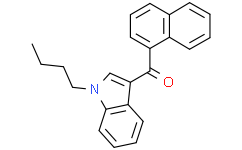
1-Butyl-3-(1-naphthoyl)indole is an indolecarboxamide.
1-butyl-3-(1-naphthoyl)indole is a DEA Schedule I controlled substance. Substances in the DEA Schedule I have no currently accepted medical use in the United States, a lack of accepted safety for use under medical supervision, and a high potential for abuse. It is a Cannabimimetic agents substance. Mechanism of Action /Synthetic cannabinoid/ agonistic activity on the CB1 receptor is responsible for elevating mood and inducing a feeling of well-being. Some /synthetic cannabinoid/ users have reported effects similar to or even stronger than those obtained by smoking cannabis, such as physical relaxation, changes in perception, and mild euphoria. ... The butyl homolog of JWH-018, JWH-073 (naphthalen-1-yl-(1-butylindol-3-yl)methanone), which seems to bind more specifically to the CB1 receptor. The latter has been recently shown to act similarly to JWH-018, although it is less potent in inhibiting neurotransmission and slower in producing internalization of cannabinoid receptors. |
| 分子式 |
C23H21NO
|
|---|---|
| 分子量 |
327.42
|
| 精确质量 |
327.162
|
| CAS号 |
208987-48-8
|
| PubChem CID |
10471670
|
| 外观&性状 |
Typically exists as solid at room temperature
|
| LogP |
5.8
|
| tPSA |
22
|
| 氢键供体(HBD)数目 |
0
|
| 氢键受体(HBA)数目 |
1
|
| 可旋转键数目(RBC) |
5
|
| 重原子数目 |
25
|
| 分子复杂度/Complexity |
461
|
| 定义原子立体中心数目 |
0
|
| InChi Key |
VCHHHSMPMLNVGS-UHFFFAOYSA-N
|
| InChi Code |
InChI=1S/C23H21NO/c1-2-3-15-24-16-21(19-12-6-7-14-22(19)24)23(25)20-13-8-10-17-9-4-5-11-18(17)20/h4-14,16H,2-3,15H2,1H3
|
| 化学名 |
(1-butylindol-3-yl)-naphthalen-1-ylmethanone
|
| HS Tariff Code |
2934.99.9001
|
| 存储方式 |
Powder -20°C 3 years 4°C 2 years In solvent -80°C 6 months -20°C 1 month |
| 运输条件 |
Room temperature (This product is stable at ambient temperature for a few days during ordinary shipping and time spent in Customs)
|
| 溶解度 (体外实验) |
May dissolve in DMSO (in most cases), if not, try other solvents such as H2O, Ethanol, or DMF with a minute amount of products to avoid loss of samples
|
|---|---|
| 溶解度 (体内实验) |
注意: 如下所列的是一些常用的体内动物实验溶解配方,主要用于溶解难溶或不溶于水的产品(水溶度<1 mg/mL)。 建议您先取少量样品进行尝试,如该配方可行,再根据实验需求增加样品量。
注射用配方
注射用配方1: DMSO : Tween 80: Saline = 10 : 5 : 85 (如: 100 μL DMSO → 50 μL Tween 80 → 850 μL Saline)(IP/IV/IM/SC等) *生理盐水/Saline的制备:将0.9g氯化钠/NaCl溶解在100 mL ddH ₂ O中,得到澄清溶液。 注射用配方 2: DMSO : PEG300 :Tween 80 : Saline = 10 : 40 : 5 : 45 (如: 100 μL DMSO → 400 μL PEG300 → 50 μL Tween 80 → 450 μL Saline) 注射用配方 3: DMSO : Corn oil = 10 : 90 (如: 100 μL DMSO → 900 μL Corn oil) 示例: 以注射用配方 3 (DMSO : Corn oil = 10 : 90) 为例说明, 如果要配制 1 mL 2.5 mg/mL的工作液, 您可以取 100 μL 25 mg/mL 澄清的 DMSO 储备液,加到 900 μL Corn oil/玉米油中, 混合均匀。 View More
注射用配方 4: DMSO : 20% SBE-β-CD in Saline = 10 : 90 [如:100 μL DMSO → 900 μL (20% SBE-β-CD in Saline)] 口服配方
口服配方 1: 悬浮于0.5% CMC Na (羧甲基纤维素钠) 口服配方 2: 悬浮于0.5% Carboxymethyl cellulose (羧甲基纤维素) 示例: 以口服配方 1 (悬浮于 0.5% CMC Na)为例说明, 如果要配制 100 mL 2.5 mg/mL 的工作液, 您可以先取0.5g CMC Na并将其溶解于100mL ddH2O中,得到0.5%CMC-Na澄清溶液;然后将250 mg待测化合物加到100 mL前述 0.5%CMC Na溶液中,得到悬浮液。 View More
口服配方 3: 溶解于 PEG400 (聚乙二醇400) 请根据您的实验动物和给药方式选择适当的溶解配方/方案: 1、请先配制澄清的储备液(如:用DMSO配置50 或 100 mg/mL母液(储备液)); 2、取适量母液,按从左到右的顺序依次添加助溶剂,澄清后再加入下一助溶剂。以 下列配方为例说明 (注意此配方只用于说明,并不一定代表此产品 的实际溶解配方): 10% DMSO → 40% PEG300 → 5% Tween-80 → 45% ddH2O (或 saline); 假设最终工作液的体积为 1 mL, 浓度为5 mg/mL: 取 100 μL 50 mg/mL 的澄清 DMSO 储备液加到 400 μL PEG300 中,混合均匀/澄清;向上述体系中加入50 μL Tween-80,混合均匀/澄清;然后继续加入450 μL ddH2O (或 saline)定容至 1 mL; 3、溶剂前显示的百分比是指该溶剂在最终溶液/工作液中的体积所占比例; 4、 如产品在配制过程中出现沉淀/析出,可通过加热(≤50℃)或超声的方式助溶; 5、为保证最佳实验结果,工作液请现配现用! 6、如不确定怎么将母液配置成体内动物实验的工作液,请查看说明书或联系我们; 7、 以上所有助溶剂都可在 Invivochem.cn网站购买。 |
| 制备储备液 | 1 mg | 5 mg | 10 mg | |
| 1 mM | 3.0542 mL | 15.2709 mL | 30.5418 mL | |
| 5 mM | 0.6108 mL | 3.0542 mL | 6.1084 mL | |
| 10 mM | 0.3054 mL | 1.5271 mL | 3.0542 mL |
1、根据实验需要选择合适的溶剂配制储备液 (母液):对于大多数产品,InvivoChem推荐用DMSO配置母液 (比如:5、10、20mM或者10、20、50 mg/mL浓度),个别水溶性高的产品可直接溶于水。产品在DMSO 、水或其他溶剂中的具体溶解度详见上”溶解度 (体外)”部分;
2、如果您找不到您想要的溶解度信息,或者很难将产品溶解在溶液中,请联系我们;
3、建议使用下列计算器进行相关计算(摩尔浓度计算器、稀释计算器、分子量计算器、重组计算器等);
4、母液配好之后,将其分装到常规用量,并储存在-20°C或-80°C,尽量减少反复冻融循环。
计算结果:
工作液浓度: mg/mL;
DMSO母液配制方法: mg 药物溶于 μL DMSO溶液(母液浓度 mg/mL)。如该浓度超过该批次药物DMSO溶解度,请首先与我们联系。
体内配方配制方法:取 μL DMSO母液,加入 μL PEG300,混匀澄清后加入μL Tween 80,混匀澄清后加入 μL ddH2O,混匀澄清。
(1) 请确保溶液澄清之后,再加入下一种溶剂 (助溶剂) 。可利用涡旋、超声或水浴加热等方法助溶;
(2) 一定要按顺序加入溶剂 (助溶剂) 。
InvivoChem的所有产品仅用于作科学研究,不面向患者销售
Copyright 2020 InvivoChem LLC | All Rights Reserved 粤ICP备20063088号-1


 粤公网安备 44011102003439号
 463611831
