| 规格 | 价格 | |
|---|---|---|
| 500mg | ||
| 1g | ||
| Other Sizes |

| 靶点 |
Tripeptide; cosmetic ingredient
|
|---|---|
| 体外研究 (In Vitro) |
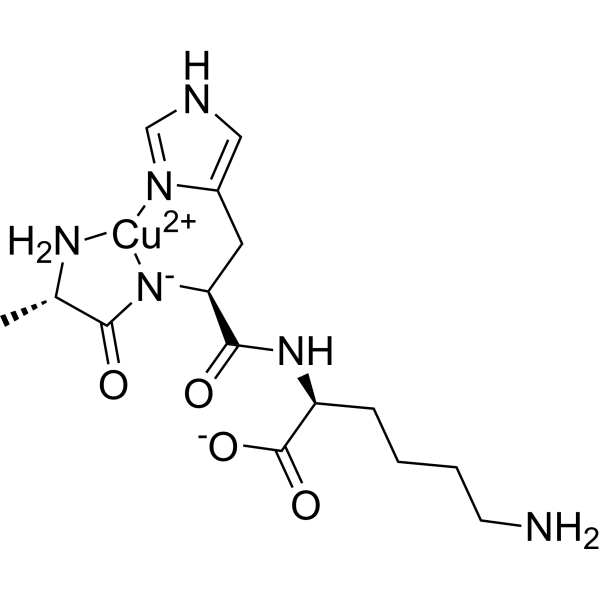
三肽-铜复合物是多种分化细胞的生长因子,刺激真皮成纤维细胞增殖,提高血管内皮生长因子的产生,但降低真皮成纤维细胞分泌转化生长因子- β 1。真皮乳头细胞是一种特化的成纤维细胞,在毛囊的形态发生和生长中起着重要的作用。本研究考察了l-丙烯酰-l -组氨酸-l -赖氨酸- cu2 + (AHK-Cu)对人毛发生长和体外培养真皮乳头细胞的影响。AHK-Cu (10(-12) - 10(-9) M)在体外刺激人毛囊的伸长和DPCs的增殖。Annexin v -荧光素异硫氰酸酯/碘化丙啶标记和流式细胞术分析显示,10(-9)M AHK-Cu减少了凋亡的DPCs数量,但这种减少没有统计学意义。10(-9) M AHK-Cu处理后,Bcl-2/Bax比值升高,caspase-3和PARP的裂解形式水平降低。本研究提出AHK-Cu促进人毛囊的生长,这种刺激作用可能是通过刺激DPCs的增殖和阻止DPCs的凋亡来实现的。[1]
精炼眼部提升含有铜肽l-丙氨酸- l-组氨酸- l-赖氨酸铜(INCI丙氨酸/组氨酸/赖氨酸多肽铜HCl)或AHK-Cu。这是一种多功能铜肽,既能增加真皮细胞的增殖和活力,又能增加胶原蛋白的沉积,以更新细胞外基质。 真皮成纤维细胞是负责生产胶原蛋白和其他健康皮肤所必需的蛋白质的主要细胞。用培养细胞研究了人真皮成纤维细胞对AHK-Cu的反应。结果表明,AHK-Cu可以促进真皮成纤维细胞的生长和活力,同时刺激胶原蛋白的产生。将正常人真皮成纤维细胞接种于96孔细胞培养板中,在添加10%胎牛血清的高糖培养基中融合生长3天。然后将它们置于含有2%血清和不同量的AHK-Cu复合物的低糖培养基中。再过3天,用中性红孵育,评估细胞活力,用硫丹素B染色,计数细胞数。图1和图2的结果显示,添加AHK-Cu复合物刺激了正常人真皮成纤维细胞的增殖,提高了其生存能力。 AHK-Cu铜肽复合物对胶原形成的影响是通过测定人成纤维细胞在细胞培养中产生的I型胶原的数量发现的。随着AHK-Cu添加量的增加,培养3天后,收集培养基,使用纯化的I型胶原抗体,用夹心ELISA法分析I型胶原的含量。下图3的结果显示,添加AHK-Cu复合物后,I型胶原的形成比对照组增加了300%。[2] |
| 细胞实验 |
离体人毛囊器官培养[1]
如前所述,分离的人类头皮毛囊在体外培养(Philpott et al., 1996)。从皮下脂肪中分离毛囊,并在距DP基部约2.5 mm处切割。将卵泡在37~ 5% CO2中孵育,在48孔板中培养12天,孔板中含有Williams' E培养基,添加l-谷氨酰胺(2mM)、胰岛素(10 mg/ml)、氢化可的松(40 ng/ml)和抗生素(1%)(Thibaut et al, 2003)。毛囊每周补喂三次。AHK-Cu加入培养基,终浓度为1013 M ~ 10-7M。用奥林巴斯立体显微镜和实物比例尺直接测量培养12天后毛囊的伸长。在每组条件下(每组30个毛囊),对来自3名不同志愿者的240个毛囊进行了分析。[1] 细胞存活率[1] 使用MTT法测定细胞存活率(Yu et al ., 2007)。将DPCs (5.0 × 10³个细胞/孔)接种于96孔板中,在AHK-Cu (10 -13 ~ 10.7 M)条件下培养24 h,每孔加入20 mL MTT (5 mg/mL),在37~条件下培养4 h,比较光密度,而不是实际细胞数,结果以6个培养对照的平均百分比表示。[1] 流式细胞术测定[1] Annexin V-异硫氰酸荧光素(FITC)和碘化丙啶(PI)标记检测凋亡细胞死亡均按照制造商的方案(BD PharMingen, San Diego, CA, usa)进行。简单地说,培养的DPCs用AHK-Cu (10.9 M)处理72 h。lx106 DPCs用磷酸盐缓冲盐水(PBS)洗涤两次,用5 ~L Annexin VFITC和10 pL PI (5 ~g/mL)在结合缓冲液(10 mM HEPES, pH 7.4, 140 mM NaOH, 2.5 mM CaCI2)中在室温下黑暗染色15 min。流式细胞术分析DPCs。膜联蛋白V是一种结合磷脂酰丝氨酸残基的蛋白质,它暴露在凋亡细胞的表面,而不是正常细胞的表面。该试验可区分完整细胞(Annexin V-/PI-)、早期凋亡细胞(Annexin V+/PI-)和晚期凋亡坏死细胞(Annexin V+/PI+)。[1] Western blotting [1] Western blot分析方法如下:简单地说,DPCs在无血清DMEM中培养24 h,然后用10.9 M AHK-Cu处理24或72 h。然后将细胞清洗并刮入lxPBS中,用含有50 mM Tris-HCI (pH 7.4), 2 mM EDTA, 100 i~g/mL lepeptin, 20 pg/mL approtein in和100 mM NaCI的缓冲液提取蛋白质。在13000 rpm、4~离心15 min下获得可溶性提取物。收集上清液,在-70~保存至需要时。采用7.5或12%的sds -聚丙烯酰胺凝胶电泳,每车道分离50 ~g蛋白质,然后印迹到聚偏氟乙烯(PVDF)膜上。然后用含有0.1% Tween 20 (TBST)的TBS洗涤两次膜。A~er阻断,用含5%脱脂乳的TBS孵育60 min,用适当稀释度的一抗(抗bcl -2单克隆抗体,1:1000;抗bax单克隆抗体,1:1000;抗肌动蛋白单克隆抗体,1:2000;抗caspase-3单克隆抗体和抗裂解caspase-3多克隆抗体,1:500;抗parp多克隆836 H.K. Pyo等抗体,1:1000),用TBST-5%牛白蛋白洗涤3次。用抗小鼠igg -辣根过氧化物酶(HRP)偶联物(1:2000)、抗兔IgG-HRP偶联物或抗山羊IgG-HRP偶联物(1:2000)在室温下探针1小时,然后用TBST洗涤3次。使用ECL +系统检测抗体-抗原复合物,并将其暴露于柯达x射线胶片上,使用TINA软件测量波段强度。[1] |
| 参考文献 | |
| 其他信息 |
In the present study, 10 -12 ~ 10 .9 M AHK-Cu was found to stimulate human hair growth ex vivo. It is generally believed that DPCs are primarily responsible for the proliferation and differentiation of hair matrix cells in the hair cycle. DPCs may secrete many kinds of growth hormones, as well as stimulate the proliferation and differentiation of the follicular epithelium (Rhee et al., 2006). Hence, any cause that promotes the survival of DPCs may ultimately stimulate the proliferation and growth of hair matrix cells, as well as hair follicle elongation. In this respect, we supposed that AHK-Cu would have the proliferative or anti-apoptotic effect on DPCs. At concentrations between 10 -12 and 10 .9 M, AHK-Cu induced the proliferation of DPCs. In the flow cytometric analysis, the treatment of 10-9M AHK-Cu did not significantly decrease the number of apoptotic DPCs. However, the reduction of apoptotic cells was not be negligible; therefore, Bcl-2, Bax, caspase-3 and PARP were further evaluated. Bcl-2 family proteins are well-known regulators of apoptosis in both directions. Bcl-2 itself is an anti-apoptotic molecule; whereas, Bax is pro-apoptotic (Nunez and Clarke, 1994). The expression of Bcl-2 in human hair is dominant during telogen-anagen transition (Soma and Hibino, 2004). In the present study, AHK-Cu increased the expression of Bcl-2 in DPCs, decreased that of Bax, leading to a net sum in the anti-apoptosis arm. Caspase-3 is a critical component molecule in the apoptosis of many cell types (Sawaya et al., 2002), with poly ADP-ribose polymerase (PARP) being one of the main cleavage targets of caspase-3 in vivo (Nicholson et al., 1995). The apoptosis of DPCs induced by serum starvation was detected by monitoring the cleaved forms of caspase-3 (19, 17 kDa) and PARP (89 kDa). Our study showed that AHK-Cu treatment reduced the expressions of the cleaved forms of caspase-3 and PARP versus those in the vehicle-treated control. In summary, the present study has provided strong in vitro evidence that AHK-Cu may stimulate hair growth by increasing the proliferation of DPCs, and by preventing their apoptosis. The effects of AHK-Cu on different cell types in hair follicles as well as the molecular basis for its promotion of hair growth both require further investigation. [1]
Neova® Refining Eye Lift treatment combines the advanced DNA repair of Mitosomes, the restorative action of copper peptide and the biological activity of Argireline to reduce the appearance of fine lines and wrinkles around the eye. New to the formula is the Mitosome DNA repair enzyme, encapsulated in liposomes, to target damaged DNA (within cells in the upper layer of skin surrounding the eye) for protection from continuing photodamage that results from UV irradiation. Copper peptides have been shown to enhance the deposition of new extracellular matrix. Argireline is known as a needle-free alternative to Botox® because of its effect to inhibit muscle contractions which form deep lines of expression. These functions are supplemented by enhanced moisturization action provided by Sodium hyaluronate and the tissue rebuilding and restorative action of a specialized Saccharomyces Lysate ingredient.[2] |
| 分子式 |
C15H24CUN6O4
|
|---|---|
| 分子量 |
415.93
|
| 精确质量 |
414.10767
|
| CAS号 |
767286-83-9
|
| PubChem CID |
169450582
|
| 外观&性状 |
Light blue to blue solid powder
|
| tPSA |
143 Ų
|
| 氢键供体(HBD)数目 |
4
|
| 氢键受体(HBA)数目 |
8
|
| 可旋转键数目(RBC) |
6
|
| 重原子数目 |
26
|
| 分子复杂度/Complexity |
462
|
| 定义原子立体中心数目 |
3
|
| SMILES |
C[C@@H](C(=O)[N-][C@@H](CC1=CNC=N1)C(=O)N[C@@H](CCCCN)C(=O)[O-])[NH-].[Cu+2]
|
| InChi Key |
NTHUFERRBBBKHC-LBRAPMIBSA-L
|
| InChi Code |
InChI=1S/C15H25N6O4.Cu/c1-9(17)13(22)21-12(6-10-7-18-8-19-10)14(23)20-11(15(24)25)4-2-3-5-16;/h7-9,11-12,17H,2-6,16H2,1H3,(H4,18,19,20,21,22,23,24,25);/q-1;+2/p-2/t9-,11-,12-;/m0./s1
|
| 化学名 |
copper;(2S)-6-amino-2-[[(2S)-2-[(2S)-2-azanidylpropanoyl]azanidyl-3-(1H-imidazol-4-yl)propanoyl]amino]hexanoate
|
| 别名 |
Copper tripeptide-3; Copper tripeptide 3;
|
| HS Tariff Code |
2934.99.9001
|
| 存储方式 |
Powder -20°C 3 years 4°C 2 years In solvent -80°C 6 months -20°C 1 month |
| 运输条件 |
Room temperature (This product is stable at ambient temperature for a few days during ordinary shipping and time spent in Customs)
|
| 溶解度 (体外实验) |
May dissolve in DMSO (in most cases), if not, try other solvents such as H2O, Ethanol, or DMF with a minute amount of products to avoid loss of samples
|
|---|---|
| 溶解度 (体内实验) |
注意: 如下所列的是一些常用的体内动物实验溶解配方,主要用于溶解难溶或不溶于水的产品(水溶度<1 mg/mL)。 建议您先取少量样品进行尝试,如该配方可行,再根据实验需求增加样品量。
注射用配方
注射用配方1: DMSO : Tween 80: Saline = 10 : 5 : 85 (如: 100 μL DMSO → 50 μL Tween 80 → 850 μL Saline)(IP/IV/IM/SC等) *生理盐水/Saline的制备:将0.9g氯化钠/NaCl溶解在100 mL ddH ₂ O中,得到澄清溶液。 注射用配方 2: DMSO : PEG300 :Tween 80 : Saline = 10 : 40 : 5 : 45 (如: 100 μL DMSO → 400 μL PEG300 → 50 μL Tween 80 → 450 μL Saline) 注射用配方 3: DMSO : Corn oil = 10 : 90 (如: 100 μL DMSO → 900 μL Corn oil) 示例: 以注射用配方 3 (DMSO : Corn oil = 10 : 90) 为例说明, 如果要配制 1 mL 2.5 mg/mL的工作液, 您可以取 100 μL 25 mg/mL 澄清的 DMSO 储备液,加到 900 μL Corn oil/玉米油中, 混合均匀。 View More
注射用配方 4: DMSO : 20% SBE-β-CD in Saline = 10 : 90 [如:100 μL DMSO → 900 μL (20% SBE-β-CD in Saline)] 口服配方
口服配方 1: 悬浮于0.5% CMC Na (羧甲基纤维素钠) 口服配方 2: 悬浮于0.5% Carboxymethyl cellulose (羧甲基纤维素) 示例: 以口服配方 1 (悬浮于 0.5% CMC Na)为例说明, 如果要配制 100 mL 2.5 mg/mL 的工作液, 您可以先取0.5g CMC Na并将其溶解于100mL ddH2O中,得到0.5%CMC-Na澄清溶液;然后将250 mg待测化合物加到100 mL前述 0.5%CMC Na溶液中,得到悬浮液。 View More
口服配方 3: 溶解于 PEG400 (聚乙二醇400) 请根据您的实验动物和给药方式选择适当的溶解配方/方案: 1、请先配制澄清的储备液(如:用DMSO配置50 或 100 mg/mL母液(储备液)); 2、取适量母液,按从左到右的顺序依次添加助溶剂,澄清后再加入下一助溶剂。以 下列配方为例说明 (注意此配方只用于说明,并不一定代表此产品 的实际溶解配方): 10% DMSO → 40% PEG300 → 5% Tween-80 → 45% ddH2O (或 saline); 假设最终工作液的体积为 1 mL, 浓度为5 mg/mL: 取 100 μL 50 mg/mL 的澄清 DMSO 储备液加到 400 μL PEG300 中,混合均匀/澄清;向上述体系中加入50 μL Tween-80,混合均匀/澄清;然后继续加入450 μL ddH2O (或 saline)定容至 1 mL; 3、溶剂前显示的百分比是指该溶剂在最终溶液/工作液中的体积所占比例; 4、 如产品在配制过程中出现沉淀/析出,可通过加热(≤50℃)或超声的方式助溶; 5、为保证最佳实验结果,工作液请现配现用! 6、如不确定怎么将母液配置成体内动物实验的工作液,请查看说明书或联系我们; 7、 以上所有助溶剂都可在 Invivochem.cn网站购买。 |
| 制备储备液 | 1 mg | 5 mg | 10 mg | |
| 1 mM | 2.4043 mL | 12.0213 mL | 24.0425 mL | |
| 5 mM | 0.4809 mL | 2.4043 mL | 4.8085 mL | |
| 10 mM | 0.2404 mL | 1.2021 mL | 2.4043 mL |
1、根据实验需要选择合适的溶剂配制储备液 (母液):对于大多数产品,InvivoChem推荐用DMSO配置母液 (比如:5、10、20mM或者10、20、50 mg/mL浓度),个别水溶性高的产品可直接溶于水。产品在DMSO 、水或其他溶剂中的具体溶解度详见上”溶解度 (体外)”部分;
2、如果您找不到您想要的溶解度信息,或者很难将产品溶解在溶液中,请联系我们;
3、建议使用下列计算器进行相关计算(摩尔浓度计算器、稀释计算器、分子量计算器、重组计算器等);
4、母液配好之后,将其分装到常规用量,并储存在-20°C或-80°C,尽量减少反复冻融循环。
计算结果:
工作液浓度: mg/mL;
DMSO母液配制方法: mg 药物溶于 μL DMSO溶液(母液浓度 mg/mL)。如该浓度超过该批次药物DMSO溶解度,请首先与我们联系。
体内配方配制方法:取 μL DMSO母液,加入 μL PEG300,混匀澄清后加入μL Tween 80,混匀澄清后加入 μL ddH2O,混匀澄清。
(1) 请确保溶液澄清之后,再加入下一种溶剂 (助溶剂) 。可利用涡旋、超声或水浴加热等方法助溶;
(2) 一定要按顺序加入溶剂 (助溶剂) 。
 MSI-78A
 Cyclo(D-Leu-D-Pro)
 Glp-Pro-Val-pNA
 Osteocalcin, bovine
InvivoChem的所有产品仅用于作科学研究,不面向患者销售
Copyright 2020 InvivoChem LLC | All Rights Reserved 粤ICP备20063088号-1


 粤公网安备 44011102003439号
 463611831
