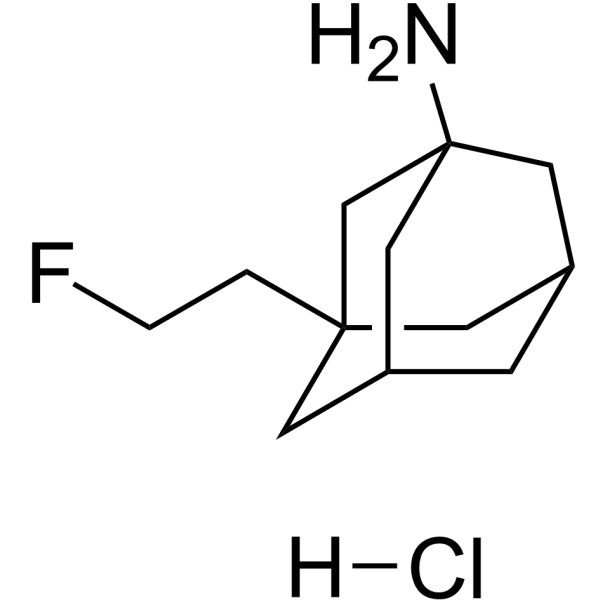
Fluoroethylnormemantine hydrochloride

别名: Fluoroethylnormemantine hydrochloride; Fluoroethylnormemantine (hydrochloride); 1639210-25-5; 3-(2-fluoroethyl)adamantan-1-amine;hydrochloride 3-(2-氟乙基)-三环[3.3.1.13,7]癸-1-胺 盐酸盐
目录号: V70423 纯度: ≥98%
Fluoroethnormemantine HCl 是 Memantine 的类似物,也是 N-甲基-D-天冬氨酸 (NMDA) 受体的拮抗剂。
Fluoroethylnormemantine hydrochloride CAS号: 1639210-25-5
产品类别: iGluR
产品仅用于科学研究,不针对患者销售
规格 价格 库存 数量
1mg
5mg
10mg
Other Sizes

Other Forms of Fluoroethylnormemantine hydrochloride:

  • Fluoroethylnormemantine
点击了解更多
InvivoChem产品被CNS等顶刊论文引用
产品描述
Fluoroethnormemantine HCl 是 Memantine 的类似物,也是 N-甲基-D-天冬氨酸 (NMDA) 受体的拮抗剂。 [18F]-氟乙基去甲美金刚盐酸盐可用作正电子发射断层扫描(PET)示踪剂。 Fluoroethnormemantine HCl 具有抗遗忘、神经保护、抗抑郁样和减少恐惧的作用。
生物活性&实验参考方法
靶点
NMDA/N-methyl-D-aspartate receptor
体内研究 (In Vivo)
由 Aβ 25-35 引起的学习障碍小鼠在给予氟乙基去甲美金刚(0.1-10 mg/kg;单次腹腔注射)时表现出抗遗忘作用[1]。在小鼠中,氟乙基去甲美金刚(0.1–10 mg/kg;腹膜内注射,每天一次,持续 7 天)可以减轻 Aβ 25-35 诱导的行为障碍、神经炎症、氧化应激、细胞凋亡和细胞死亡[1]。在大鼠中,氟乙基去甲美金刚(1-20 mg/kg;单次注射)可降低提示恐惧调节 (FC) 和消退训练中的恐惧行为,以及强迫游泳测试 (FST) 中的行为绝望[2]。
在压力后给予Fluoroethylnormemantine/FENM可以减少行为绝望,减少坚持行为。在再次暴露后给药时,FENM促进了灭绝学习。作为预防措施,FENM减轻了习得性恐惧,减少了压力引起的行为绝望。FENM对雄性和雌性小鼠的行为均有效。(R,S)-氯胺酮增加了vCA3中c-fos的表达,但FENM没有。(R,S)-氯胺酮和FENM均能减弱vCA3中AMPA受体介导的大振幅爆发,表明这是一种有待进一步研究的常见神经生物学机制。 结论 我们的研究结果表明,Fluoroethylnormemantine/FENM是一种新型药物,在应激前后不同时间给药时均有效。未来的工作将进一步表征FENM的作用机制,以实现临床开发的目标。[1]
结果:与美金刚胺不同,Fluoroethylnormemantine不会产生非特异性副作用,也不会改变感觉运动门控或运动。FENM在强迫游泳测试中降低了不动性。此外,在暗示恐惧条件训练或音调再暴露之前服用FENM,可以有力地促进恐惧消退学习。 结论:这些结果表明,FENM是一种有前景的新型化合物,可以显著减少恐惧行为,可能有助于进一步的临床前测试。[2]
结果:美金刚胺和Fluoroethylnormemantine/FENM在Aβ25-35治疗的小鼠中均显示出症状性抗遗忘作用。有趣的是,与美金刚胺相反,单独以10mg/kg的剂量进行测试时,FENM不会失忆。每天注射一次药物可以预防Aβ25-35诱导的记忆缺陷、氧化应激(脂质过氧化、细胞色素c释放)、炎症(白细胞介素-6、肿瘤坏死因子-α增加;海马和皮质中的胶质纤维酸性蛋白和Iba1免疫反应性)以及凋亡和细胞损失(Bcl-2相关X/B细胞淋巴瘤2比率;海马CA1区的细胞损失)。然而,FENM的效果比美金刚更为显著,与Aβ25-35治疗组相比,FENM明显减弱。 结论:因此,在AD模型中,FENM似乎是一种有效的神经保护药物,与美金刚相比具有更优的疗效,并且在更高剂量下没有直接的健忘症作用。这些结果为以比美金刚胺治疗AD中实际提出的剂量更相关的剂量使用该化合物提供了可能性[3]。
动物实验
Animal/Disease Models: Male Swiss CD-1 mice (7-9 weeks) were injected with Aβ25-35[1]
Doses: 0.1, 0.3, 1, 3, 10 mg/kg
Route of Administration: Ip 30 minutes before the behavioral tests
Experimental Results: Attenuated Aβ 25-35-induced spontaneous alternation deficit, passive avoidance deficit, and novel object exploration deficit.
Fluoroethylnormemantine: FENM/Fluoroethylnormemantine was administered in a single dose at 10, 20, or 30 mg/kg of body weight. Saline, memantine (10 mg/kg), (R,S)-ketamine (30 mg/kg), or FENM (10, 20, or 30 mg/kg) was administered before or after contextual fear conditioning in 129S6/SvEv mice. Drug efficacy was assayed using various behavioral tests. Protein expression in the hippocampus was quantified with immunohistochemistry or Western blotting. In vitro radioligand binding was used to assay drug binding affinity. Patch clamp electrophysiology was used to determine the effect of drug administration on glutamatergic activity in ventral hippocampal cornu ammonis 3 (vCA3) 1 week after injection. [1]
Researchers administered saline, FENM, or memantine prior to a number of behavioral assays, including paired-pulse inhibition, open field, light dark test, forced swim test, and cued fear conditioning in male Wistar rats. FENM/Fluoroethylnormemantine was administered in a single dose at 1, 3, 5, 10, or 20 mg/kg of body weight. [2]
Swiss mice were treated intracerebroventricularly with aggregated Aβ 25-35 peptide and examined after 1 week in a battery of memory tests (spontaneous alternation, passive avoidance, object recognition, place learning in the water-maze, topographic memory in the Hamlet). Toxicity induced in the mouse hippocampus or cortex was analyzed biochemically or morphologically.
Researchers examined 2 effects of the drugs/Fluoroethylnormemantine. First, symptomatic effects were analyzed in Aβ 25-35-treated mice by injecting the drugs just before the behavioral tests. Second, the neuroprotection was analyzed by repeatedly o.d. injecting the mice for 1 week starting on the day of peptide injection. For symptomatic effects, drugs were injected only on day 8 after Aβ 25–35 injection, 30 minutes before the behavioral tests: spontaneous alternation, passive avoidance training, session 2 of the object recognition test or each water-maze training sessions (supplementary Figure 1a). A group was tested for spontaneous alternation, passive avoidance, and object recognition in series. As Memantine, and expectedly Fluoroethylnormemantine/FENM, has a short half-life in mice (<2 hours; Beconi et al., 2011), all the drug was excreted overnight. A separate group was trained in the Hamlet before Aβ 25–35 injection to assess topographic memory (supplementary Figure 1b). For neuroprotective effects, drugs were injected o.d. from day 1 to day 7 after Aβ 25–35 injection (supplementary Figure 1c), and mice were tested for spontaneous alternation, passive avoidance, and object recognition in series. They were killed at day 13 for immunochemistry (group A). A group of mice performed place learning in the water-maze, then were killed at day 16 and used for biochemical assays (group B). An additional series (group C) included mice killed at day 5 after Aβ 25–35 peptide injection and daily drug injections for assessing cytokine levels by enzyme-linked immuno-sorbent assays (ELISA).[3]
药代性质 (ADME/PK)
Recently, a novel NMDAR antagonist, fluoroethyl normemantine (FENM), was derived from the NMDAR antagonist memantine. To determine its biodistribution and safety, researchers developed FENM into a radiolabeled compound, [18F]-FENM. In rats, brain drug concentrations stabilized 40 minutes after injection of [18F]-FENM (44 ± 11 MBq), with the brain concentration representing 0.4% of the injected dose. In rats anesthetized with isoflurane prior to [18F]-FENM injection, in vitro autoradiography and immunohistochemical staining combined with other methods showed that NMDAR and [18F]-FENM binding sites were highly colocalized, particularly in the cortical and hippocampal (HPC) regions. Most interestingly, if rats were anesthetized immediately before [18F]-FENM injection with (R,S)-ketamine (80 mg/kg), the autoradiographic signal of [18F]-FENM was no longer correlated with NMDAR staining, indicating that its binding was inhibited or blocked. [18F]-FENM has a Ki value of 3.5 μM, while (R,S)-ketamine has a Ki value of 0.53 μM. In addition, recent studies have shown that FENM can promote extinction learning in male rats without affecting their sensorimotor behavior. However, whether FENM has preventive or antidepressant effects remains to be studied. [1] Recently, a novel radiolabeled compound, [18F]-fluoroethyl normethmannet (FENM), derived from memantine, has been used as a novel positron emission tomography (PET) tracer (Salabert et al., 2015, 2018). [18F]-FENM has a Ki value of 3.5 × 10⁻⁶ M, is highly lipophilic (logD = 1.93), stabilizes within 40 minutes after injection, and has a residual amount in the brain of about 0.4% of the initial dose. The results of ex vivo autoradiography and immunohistochemistry showed that [18F]-FENM was highly colocalized with NMDARs in the cortex and cerebellum. Interestingly, injection of (R,S)-ketamine blocked this co-localization, suggesting that FENM has a lower affinity for the NMDAR receptor than (R,S)-ketamine. Furthermore, since both compounds bind to the phencycline localization site in the NMDAR channel pores, these data suggest they may also have similar behavioral effects. However, although the antidepressant-like effects of FENM remain unclear, recent data indicate that FENM can enhance cognitive function and exert neuroprotective effects in an AD mouse model (Couly et al., 2020). In this study, Couly and colleagues found that FENM reversed deficits in long-term memory, navigation, spatial learning, and object recognition in a pharmacological model of AD. Interestingly, compared to memantine, the authors found that FENM improved spatiotemporal orientation in mice on the Hamlet test, while memantine did not affect the mice's behavior. The study found that the behavioral effects of FENM corresponded to a reduction in inflammatory cytokines and loss of neurons in the hippocampus. Therefore, although FENM has shown potential to enhance cognitive function and protect against age-related brain damage, it remains unclear whether the drug can reverse stress-related maladaptive behaviors. [2]
参考文献

[1]. Anti-Amnesic and Neuroprotective Effects of Fluoroethylnormemantine in a Pharmacological Mouse Model of Alzheimer's Disease. Int J Neuropsychopharmacol. 2021 Feb 15;24(2):142-157.

[2]. Fluoroethylnormemantine, a novel derivative of memantine, facilitates extinction learning without sensorimotor deficits. Int J Neuropsychopharmacol. 2021 Jul 14;24(6):519-531.

[3]. Fluoroethylnormemantine, a novel NMDA receptor antagonist, for the prevention and treatment of stress-induced maladaptive behavior. Biological Psychiatry. 2021 Feb 15;24(2):142-157.

其他信息
This study characterized FENM, an NMDAR antagonist with antidepressant and preventive effects. We found that: 1) FENM exhibited antidepressant-like properties in both male and female mice under stress; 2) FENM inhibited loss of appetite in non-stressed male mice; 3) FENM administration after extinction in male mice reduced fear; 4) Administration of FENM one week before stress exposure prevented stress in both male and female mice; 5) One week after FENM administration reduced burst discharge mediated by large-amplitude AMPA receptors in the vCA3 region of the hippocampus. [1] This study aimed to investigate the effects of FENM administration on sensorimotor gating, avoidance behavior, behavioral despair, and fear behavior in rats. The results showed that FENM effectively reduced behavioral despair and promoted extinction learning without affecting motor or sensorimotor behavior. These results indicate that FENM has antidepressant-like effects and a fear-reducing effect. FENM also effectively reduced learned fear when administered acutely before fear conditioning (FC), suggesting that it may also be used as a preventative drug to enhance resilience. In summary, our results suggest that FENM, as a novel NMDAR antagonist, may be suitable for further preclinical trials in a variety of stress-related behavioral tests. [2]
FENM appears to be a promising drug. Its efficacy must now be validated in transgenic mouse models of Alzheimer's disease (AD). Only through repeated administration in these chronic models can it be determined whether FENM can reduce amyloid load and plaque formation in amyloid models, or reduce kinase activity and neurofibrillary tangle formation in tau models. Memantine (Wang et al., 2015) and several other drugs with similar symptom-improving and neuroprotective effects have been reported previously. In the future, the strength of the neuroprotective effect induced by FENM needs to be studied in similar transgenic models, and its mechanism of action needs to be analyzed to determine whether the molecule is superior to memantine and whether the drug can be used as a potential candidate for synergistic combination with drugs currently under development. In summary, we describe the symptom relief and neuroprotective efficacy of a novel memantine derivative, FENM, in a mouse model of Alzheimer's disease (AD). Compared with the parent molecule, FENM is more effective in preventing oxidative stress, apoptosis and neuroinflammation, suggesting that the molecule can not only be used as an effective PET radiotracer for NMDAR, but also has the potential to become a neuroprotective drug for AD. In addition, the compound may be used at a more appropriate dose than the dose currently recommended for memantine treatment. [3]
*注: 文献方法仅供参考, InvivoChem并未独立验证这些方法的准确性
化学信息 & 存储运输条件
分子式
C12H21CLFN
分子量
233.753246068954
精确质量
233.134
元素分析
C, 61.66; H, 9.06; Cl, 15.17; F, 8.13; N, 5.99
CAS号
1639210-25-5
相关CAS号
Fluoroethylnormemantine;1639210-26-6
PubChem CID
140711083
外观&性状
White to off-white solid powder
tPSA
26
氢键供体(HBD)数目
2
氢键受体(HBA)数目
2
可旋转键数目(RBC)
2
重原子数目
15
分子复杂度/Complexity
237
定义原子立体中心数目
0
SMILES
C(C12CC3CC(CC(C3)(N)C1)C2)CF.Cl
InChi Key
KPURUIUXBWTRPB-UHFFFAOYSA-N
InChi Code
InChI=1S/C12H20FN.ClH/c13-2-1-11-4-9-3-10(5-11)7-12(14,6-9)8-11;/h9-10H,1-8,14H2;1H
化学名
3-(2-fluoroethyl)adamantan-1-amine;hydrochloride
别名
Fluoroethylnormemantine hydrochloride; Fluoroethylnormemantine (hydrochloride); 1639210-25-5; 3-(2-fluoroethyl)adamantan-1-amine;hydrochloride
HS Tariff Code
2934.99.9001
存储方式

Powder      -20°C    3 years

                     4°C     2 years

In solvent   -80°C    6 months

                  -20°C    1 month

注意: 请将本产品存放在密封且受保护的环境中,避免吸湿/受潮。
运输条件
Room temperature (This product is stable at ambient temperature for a few days during ordinary shipping and time spent in Customs)
溶解度数据
溶解度 (体外实验)
DMSO: ≥ 100 mg/mL (427.81 mM)
溶解度 (体内实验)
注意: 如下所列的是一些常用的体内动物实验溶解配方,主要用于溶解难溶或不溶于水的产品(水溶度<1 mg/mL)。 建议您先取少量样品进行尝试,如该配方可行,再根据实验需求增加样品量。

注射用配方
(IP/IV/IM/SC等)
注射用配方1: DMSO : Tween 80: Saline = 10 : 5 : 85 (如: 100 μL DMSO 50 μL Tween 80 850 μL Saline)
*生理盐水/Saline的制备:将0.9g氯化钠/NaCl溶解在100 mL ddH ₂ O中,得到澄清溶液。
注射用配方 2: DMSO : PEG300Tween 80 : Saline = 10 : 40 : 5 : 45 (如: 100 μL DMSO 400 μL PEG300 50 μL Tween 80 450 μL Saline)
注射用配方 3: DMSO : Corn oil = 10 : 90 (如: 100 μL DMSO 900 μL Corn oil)
示例: 注射用配方 3 (DMSO : Corn oil = 10 : 90) 为例说明, 如果要配制 1 mL 2.5 mg/mL的工作液, 您可以取 100 μL 25 mg/mL 澄清的 DMSO 储备液,加到 900 μL Corn oil/玉米油中, 混合均匀。
View More

注射用配方 4: DMSO : 20% SBE-β-CD in Saline = 10 : 90 [如:100 μL DMSO 900 μL (20% SBE-β-CD in Saline)]
*20% SBE-β-CD in Saline的制备(4°C,储存1周):将2g SBE-β-CD (磺丁基-β-环糊精) 溶解于10mL生理盐水中,得到澄清溶液。
注射用配方 5: 2-Hydroxypropyl-β-cyclodextrin : Saline = 50 : 50 (如: 500 μL 2-Hydroxypropyl-β-cyclodextrin (羟丙基环胡精) 500 μL Saline)
注射用配方 6: DMSO : PEG300 : Castor oil : Saline = 5 : 10 : 20 : 65 (如: 50 μL DMSO 100 μL PEG300 200 μL Castor oil 650 μL Saline)
注射用配方 7: Ethanol : Cremophor : Saline = 10: 10 : 80 (如: 100 μL Ethanol 100 μL Cremophor 800 μL Saline)
注射用配方 8: 溶解于Cremophor/Ethanol (50 : 50), 然后用生理盐水稀释。
注射用配方 9: EtOH : Corn oil = 10 : 90 (如: 100 μL EtOH 900 μL Corn oil)
注射用配方 10: EtOH : PEG300Tween 80 : Saline = 10 : 40 : 5 : 45 (如: 100 μL EtOH 400 μL PEG300 50 μL Tween 80 450 μL Saline)


口服配方
口服配方 1: 悬浮于0.5% CMC Na (羧甲基纤维素钠)
口服配方 2: 悬浮于0.5% Carboxymethyl cellulose (羧甲基纤维素)
示例: 口服配方 1 (悬浮于 0.5% CMC Na)为例说明, 如果要配制 100 mL 2.5 mg/mL 的工作液, 您可以先取0.5g CMC Na并将其溶解于100mL ddH2O中,得到0.5%CMC-Na澄清溶液;然后将250 mg待测化合物加到100 mL前述 0.5%CMC Na溶液中,得到悬浮液。
View More

口服配方 3: 溶解于 PEG400 (聚乙二醇400)
口服配方 4: 悬浮于0.2% Carboxymethyl cellulose (羧甲基纤维素)
口服配方 5: 溶解于0.25% Tween 80 and 0.5% Carboxymethyl cellulose (羧甲基纤维素)
口服配方 6: 做成粉末与食物混合


注意: 以上为较为常见方法,仅供参考, InvivoChem并未独立验证这些配方的准确性。具体溶剂的选择首先应参照文献已报道溶解方法、配方或剂型,对于某些尚未有文献报道溶解方法的化合物,需通过前期实验来确定(建议先取少量样品进行尝试),包括产品的溶解情况、梯度设置、动物的耐受性等。

请根据您的实验动物和给药方式选择适当的溶解配方/方案:
1、请先配制澄清的储备液(如:用DMSO配置50 或 100 mg/mL母液(储备液));
2、取适量母液,按从左到右的顺序依次添加助溶剂,澄清后再加入下一助溶剂。以 下列配方为例说明 (注意此配方只用于说明,并不一定代表此产品 的实际溶解配方):
10% DMSO → 40% PEG300 → 5% Tween-80 → 45% ddH2O (或 saline);
假设最终工作液的体积为 1 mL, 浓度为5 mg/mL: 取 100 μL 50 mg/mL 的澄清 DMSO 储备液加到 400 μL PEG300 中,混合均匀/澄清;向上述体系中加入50 μL Tween-80,混合均匀/澄清;然后继续加入450 μL ddH2O (或 saline)定容至 1 mL;

3、溶剂前显示的百分比是指该溶剂在最终溶液/工作液中的体积所占比例;
4、 如产品在配制过程中出现沉淀/析出,可通过加热(≤50℃)或超声的方式助溶;
5、为保证最佳实验结果,工作液请现配现用!
6、如不确定怎么将母液配置成体内动物实验的工作液,请查看说明书或联系我们;
7、 以上所有助溶剂都可在 Invivochem.cn网站购买。
制备储备液 1 mg 5 mg 10 mg
1 mM 4.2781 mL 21.3904 mL 42.7807 mL
5 mM 0.8556 mL 4.2781 mL 8.5561 mL
10 mM 0.4278 mL 2.1390 mL 4.2781 mL

1、根据实验需要选择合适的溶剂配制储备液 (母液):对于大多数产品,InvivoChem推荐用DMSO配置母液 (比如:5、10、20mM或者10、20、50 mg/mL浓度),个别水溶性高的产品可直接溶于水。产品在DMSO 、水或其他溶剂中的具体溶解度详见上”溶解度 (体外)”部分;

2、如果您找不到您想要的溶解度信息,或者很难将产品溶解在溶液中,请联系我们;

3、建议使用下列计算器进行相关计算(摩尔浓度计算器、稀释计算器、分子量计算器、重组计算器等);

4、母液配好之后,将其分装到常规用量,并储存在-20°C或-80°C,尽量减少反复冻融循环。

计算器

摩尔浓度计算器可计算特定溶液所需的质量、体积/浓度,具体如下:

  • 计算制备已知体积和浓度的溶液所需的化合物的质量
  • 计算将已知质量的化合物溶解到所需浓度所需的溶液体积
  • 计算特定体积中已知质量的化合物产生的溶液的浓度
使用摩尔浓度计算器计算摩尔浓度的示例如下所示:
假如化合物的分子量为350.26 g/mol,在5mL DMSO中制备10mM储备液所需的化合物的质量是多少?
  • 在分子量(MW)框中输入350.26
  • 在“浓度”框中输入10,然后选择正确的单位(mM)
  • 在“体积”框中输入5,然后选择正确的单位(mL)
  • 单击“计算”按钮
  • 答案17.513 mg出现在“质量”框中。以类似的方式,您可以计算体积和浓度。

稀释计算器可计算如何稀释已知浓度的储备液。例如,可以输入C1、C2和V2来计算V1,具体如下:

制备25毫升25μM溶液需要多少体积的10 mM储备溶液?
使用方程式C1V1=C2V2,其中C1=10mM,C2=25μM,V2=25 ml,V1未知:
  • 在C1框中输入10,然后选择正确的单位(mM)
  • 在C2框中输入25,然后选择正确的单位(μM)
  • 在V2框中输入25,然后选择正确的单位(mL)
  • 单击“计算”按钮
  • 答案62.5μL(0.1 ml)出现在V1框中
g/mol

分子量计算器可计算化合物的分子量 (摩尔质量)和元素组成,具体如下:

注:化学分子式大小写敏感:C12H18N3O4  c12h18n3o4
计算化合物摩尔质量(分子量)的说明:
  • 要计算化合物的分子量 (摩尔质量),请输入化学/分子式,然后单击“计算”按钮。
分子质量、分子量、摩尔质量和摩尔量的定义:
  • 分子质量(或分子量)是一种物质的一个分子的质量,用统一的原子质量单位(u)表示。(1u等于碳-12中一个原子质量的1/12)
  • 摩尔质量(摩尔重量)是一摩尔物质的质量,以g/mol表示。
/

配液计算器可计算将特定质量的产品配成特定浓度所需的溶剂体积 (配液体积)

  • 输入试剂的质量、所需的配液浓度以及正确的单位
  • 单击“计算”按钮
  • 答案显示在体积框中
动物体内实验配方计算器(澄清溶液)
第一步:请输入基本实验信息(考虑到实验过程中的损耗,建议多配一只动物的药量)
第二步:请输入动物体内配方组成(配方适用于不溶/难溶于水的化合物),不同的产品和批次配方组成不同,如对配方有疑问,可先联系我们提供正确的体内实验配方。此外,请注意这只是一个配方计算器,而不是特定产品的确切配方。
+
+
+

计算结果:

工作液浓度 mg/mL;

DMSO母液配制方法 mg 药物溶于 μL DMSO溶液(母液浓度 mg/mL)。如该浓度超过该批次药物DMSO溶解度,请首先与我们联系。

体内配方配制方法μL DMSO母液,加入 μL PEG300,混匀澄清后加入μL Tween 80,混匀澄清后加入 μL ddH2O,混匀澄清。

(1) 请确保溶液澄清之后,再加入下一种溶剂 (助溶剂) 。可利用涡旋、超声或水浴加热等方法助溶;
            (2) 一定要按顺序加入溶剂 (助溶剂) 。

临床试验信息
First-In-Human (FIH), Single Ascending Dose (SAD) Study of FluoroEthylNorMemantine (FENM)
CTID: NCT05921929
Phase: Phase 1
Status: Withdrawn
Date: 2024-05-03
相关产品
联系我们