| 规格 | 价格 | |
|---|---|---|
| 500mg | ||
| 1g | ||
| Other Sizes |

| 靶点 |
Granzyme B and caspase-8.
|
|---|---|
| 体外研究 (In Vitro) |
使用各种caspase及其相关因子的四肽抑制剂,我们还证明了caspase 3 (Ac-DEVD-CHO)和caspase 8/颗粒酶B (Ac-IETD-CHO)的抑制剂抑制了ctl诱导的细胞死亡,但Fas激活的丝氨酸蛋白酶抑制剂(其作用于caspase 3激活剂)没有,这表明ctl诱导的细胞死亡是由Perforin/颗粒酶B系统启动的,而不是Fas配体/Fas系统。基于我们目前的结果,我们在此报告穿孔素/颗粒酶B系统在诱导HCC细胞系细胞死亡中起主要作用。[2]
阻断Caspase 8而不阻断Caspase 9可减少癫痫引起的细胞死亡[3] 利用半胱天冬酶的肽抑制剂,我们研究了半胱天冬酶阻断对癫痫发作后细胞死亡的影响。以Ac-IETD-CHO (10 μM)阻断caspase 8可显著降低癫痫诱导的细胞死亡(图5)。相反,用Ac-LEHD-CHO (10 μM)阻断caspase 9会导致癫痫发作后海马培养物中LDH释放的不显著减少(图5)。在Ac-IETD-CHO和Ac-LEHD-CHO处理的细胞中,LDH释放的基础水平略有降低,但这并不显著(图5)。 |
| 体内研究 (In Vivo) |
在各种炎症性疾病中,淋巴细胞可通过Fas受体介导的凋亡杀死包括肝细胞在内的靶细胞。Caspase-8在受体水平被激活,从而启动下游效应caspase的加工。本研究的目的是研究caspase-8激活的时间过程,并评价caspase-8抑制剂IETD-CHO在fas诱导的细胞凋亡模型中的作用。用抗fas抗体Jo-2 (0.6 mg/kg)处理C3Heb/FeJ小鼠。Western blot分析显示细胞质中细胞色素c升高(20分钟),随后caspase-3、-9(40-120分钟)和caspase-8(120分钟)逐渐激活。在90和120分钟时,观察到广泛出血,表明窦壁细胞受损。此外,高血浆ALT水平(997 +/- 316 U/L)和组织学评估表明严重的实质细胞损伤。实质细胞和非实质细胞显示caspase-3活性和DNA片段化的相似增加。用IETD-CHO (10 mg/kg)治疗可使caspase-3活性和DNA断裂的增加减少80-90%,并完全防止出血和实质细胞损伤。IETD-CHO也阻止了线粒体细胞色素c的早期释放和caspase-3、-8和-9的加工。因此,我们的数据支持fas介导的细胞凋亡依赖于肝细胞和非实质细胞中caspase-8的激活的假设。然而,大部分的procaspase-8加工较晚,这表明只有少量的procaspase-8实际上可能在Fas受体上被激活。这种初始信号可能通过效应caspase进一步激活caspase-8而被放大,即在线粒体激活之后。Caspase-8是抑制fas介导的细胞凋亡的有希望的治疗靶点。[1]
|
| 细胞实验 |
制备1-2日龄大鼠海马神经元培养物。简单地说,用异氟烷麻醉大鼠幼鼠,去头,解剖海马,用木瓜蛋白酶解离,并在添加10 mM犬尿酸和5 mM MgCl2的neurobase - a /B27培养基中镀上;这导致慢性神经传递阻滞(Furshpan 1989, Furshpan and Potter 1989)。5天后,培养基中加入1 μM胞嘧啶β- d -阿拉伯糖葡糖苷。细胞培养3-4周后使用,培养基每2-3天补充新鲜的尿酸/ Mg2+。在不含肌尿酸或镁的Neurobasal-A/ B27培养基中培养细胞40分钟,诱导癫痫样活动。部分细胞在癫痫发作期间40分钟和癫痫发作后24小时用caspase抑制剂Ac-IETD-CHO或Ac LEHD-CHO处理。[3]
|
| 参考文献 |
|
| 其他信息 |
Cell death induction by cytotoxic T lymphocytes (CTLs) is an important thesis for the understanding of tumor immunotherapy. In the current study we investigated the molecular machinery of CTL-induced cell death in human hepatocellular carcinoma cell lines (HCC lines). CTLs prepared from human peripheral blood induced cell death in all tested HCC lines. As the CTL-induced death system, the effectiveness of Fas ligand/Fas and/or Perforin/Granzyme B systems has been suggested, whereas cell death induction by CTLs was shown independently on Fas expression in the current study.[2]
In response to harmful stresses, cells induce programmed cell death (PCD) or apoptosis. Seizures can induce neural damage and activate biochemical pathways associated with PCD. Since seizures trigger intracellular calcium overload, it has been presumed that the intrinsic cell death pathway mediated by mitochondrial dysfunction would modulate cell death following seizures. However, previous work suggests that the extrinsic cell death pathway may initiate the damage program. Here we investigate intrinsic versus extrinsic cell death pathway activation using caspase cleavage as a marker for activation of these pathways in a rat in vitro model of seizures. Hippocampal cells, chronically treated with kynurenic acid, had kynurenic acid withdrawn to induce seizure-like activity for 40 min. Subjecting rat hippocampal cultures to seizures increased cell death and apoptosis-like DNA fragmentation using TUNEL staining. Seizure-induced cell death was blocked by both MK801 (10 microM) and CNQX (40 microM), which suggests multiple glutamate receptors regulate seizure-induced cell death. Cleavage of the initiator caspases, caspase 8 and 12 were increased 4h following seizure, and cleavage of the quintessential executioner caspase, caspase 3 was increased 4h following seizure. In contrast, caspase 9 cleavage only increased 24h following seizure. Using an affinity labeling approach to trap activated caspases in situ, we show that caspase 8 is the apical caspase activated following seizures. Finally, we show that the caspase 8 inhibitor Ac-IETD-CHO was more effective at blocking seizure-induced cell death than the caspase 9 inhibitor Ac-LEHD-CHO. Taken together, our data suggests the extrinsic cell death pathway-associated caspase 8 is activated following seizures in vitro. [3] |
| 分子式 |
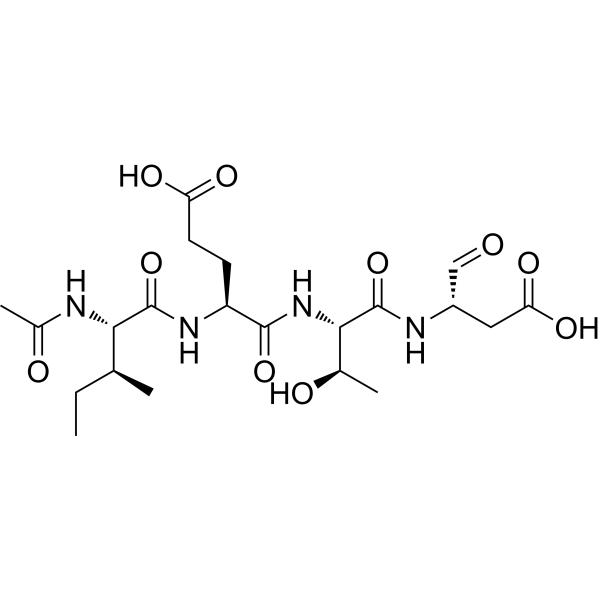
C21H34N4O10
|
|---|---|
| 分子量 |
502.52
|
| 精确质量 |
502.227
|
| CAS号 |
191338-86-0
|
| PubChem CID |
11466200
|
| 序列 |
Ac-Ile-Glu-Thr-Asp-al; Ac-Ile-Glu-Thr-Asp-CHO; N-acetyl-L-isoleucyl-L-alpha-glutamyl-L-threonyl-L-aspart-1-al
|
| 短序列 |
Ac-IETD-CHO; IETD
|
| 外观&性状 |
Typically exists as solid at room temperature
|
| 密度 |
1.3±0.1 g/cm3
|
| 沸点 |
971.9±65.0 °C at 760 mmHg
|
| 闪点 |
541.6±34.3 °C
|
| 蒸汽压 |
0.0±0.6 mmHg at 25°C
|
| 折射率 |
1.527
|
| LogP |
-0.55
|
| tPSA |
228.3
|
| 氢键供体(HBD)数目 |
7
|
| 氢键受体(HBA)数目 |
10
|
| 可旋转键数目(RBC) |
16
|
| 重原子数目 |
35
|
| 分子复杂度/Complexity |
803
|
| 定义原子立体中心数目 |
6
|
| SMILES |
CC[C@@H]([C@H](NC(C)=O)C(N[C@H](C(N[C@H](C(N[C@H](C=O)CC(O)=O)=O)[C@H](O)C)=O)CCC(O)=O)=O)C
|
| InChi Key |
AXTKTZHLZLOIIO-PBEPODTISA-N
|
| InChi Code |
InChI=1S/C21H34N4O10/c1-5-10(2)17(22-12(4)28)20(34)24-14(6-7-15(29)30)19(33)25-18(11(3)27)21(35)23-13(9-26)8-16(31)32/h9-11,13-14,17-18,27H,5-8H2,1-4H3,(H,22,28)(H,23,35)(H,24,34)(H,25,33)(H,29,30)(H,31,32)/t10-,11+,13-,14-,17-,18-/m0/s1
|
| 化学名 |
(4S)-4-[[(2S,3S)-2-acetamido-3-methylpentanoyl]amino]-5-[[(2S,3R)-1-[[(2S)-1-carboxy-3-oxopropan-2-yl]amino]-3-hydroxy-1-oxobutan-2-yl]amino]-5-oxopentanoic acid
|
| 别名 |
Ac-IETD-CHO; Acetyl-Ile-Glu-Thr-Asp-aldehyde; 191338-86-0; CHEMBL478695; Ac-?IETD-?CHO; (4S)-4-[[(2S,3S)-2-acetamido-3-methylpentanoyl]amino]-5-[[(2S,3R)-1-[[(2S)-1-carboxy-3-oxopropan-2-yl]amino]-3-hydroxy-1-oxobutan-2-yl]amino]-5-oxopentanoic acid; AC-ETD-HO; SCHEMBL20257131;
|
| HS Tariff Code |
2934.99.9001
|
| 存储方式 |
Powder -20°C 3 years 4°C 2 years In solvent -80°C 6 months -20°C 1 month |
| 运输条件 |
Room temperature (This product is stable at ambient temperature for a few days during ordinary shipping and time spent in Customs)
|
| 溶解度 (体外实验) |
May dissolve in DMSO (in most cases), if not, try other solvents such as H2O, Ethanol, or DMF with a minute amount of products to avoid loss of samples
|
|---|---|
| 溶解度 (体内实验) |
注意: 如下所列的是一些常用的体内动物实验溶解配方,主要用于溶解难溶或不溶于水的产品(水溶度<1 mg/mL)。 建议您先取少量样品进行尝试,如该配方可行,再根据实验需求增加样品量。
注射用配方
注射用配方1: DMSO : Tween 80: Saline = 10 : 5 : 85 (如: 100 μL DMSO → 50 μL Tween 80 → 850 μL Saline)(IP/IV/IM/SC等) *生理盐水/Saline的制备:将0.9g氯化钠/NaCl溶解在100 mL ddH ₂ O中,得到澄清溶液。 注射用配方 2: DMSO : PEG300 :Tween 80 : Saline = 10 : 40 : 5 : 45 (如: 100 μL DMSO → 400 μL PEG300 → 50 μL Tween 80 → 450 μL Saline) 注射用配方 3: DMSO : Corn oil = 10 : 90 (如: 100 μL DMSO → 900 μL Corn oil) 示例: 以注射用配方 3 (DMSO : Corn oil = 10 : 90) 为例说明, 如果要配制 1 mL 2.5 mg/mL的工作液, 您可以取 100 μL 25 mg/mL 澄清的 DMSO 储备液,加到 900 μL Corn oil/玉米油中, 混合均匀。 View More
注射用配方 4: DMSO : 20% SBE-β-CD in Saline = 10 : 90 [如:100 μL DMSO → 900 μL (20% SBE-β-CD in Saline)] 口服配方
口服配方 1: 悬浮于0.5% CMC Na (羧甲基纤维素钠) 口服配方 2: 悬浮于0.5% Carboxymethyl cellulose (羧甲基纤维素) 示例: 以口服配方 1 (悬浮于 0.5% CMC Na)为例说明, 如果要配制 100 mL 2.5 mg/mL 的工作液, 您可以先取0.5g CMC Na并将其溶解于100mL ddH2O中,得到0.5%CMC-Na澄清溶液;然后将250 mg待测化合物加到100 mL前述 0.5%CMC Na溶液中,得到悬浮液。 View More
口服配方 3: 溶解于 PEG400 (聚乙二醇400) 请根据您的实验动物和给药方式选择适当的溶解配方/方案: 1、请先配制澄清的储备液(如:用DMSO配置50 或 100 mg/mL母液(储备液)); 2、取适量母液,按从左到右的顺序依次添加助溶剂,澄清后再加入下一助溶剂。以 下列配方为例说明 (注意此配方只用于说明,并不一定代表此产品 的实际溶解配方): 10% DMSO → 40% PEG300 → 5% Tween-80 → 45% ddH2O (或 saline); 假设最终工作液的体积为 1 mL, 浓度为5 mg/mL: 取 100 μL 50 mg/mL 的澄清 DMSO 储备液加到 400 μL PEG300 中,混合均匀/澄清;向上述体系中加入50 μL Tween-80,混合均匀/澄清;然后继续加入450 μL ddH2O (或 saline)定容至 1 mL; 3、溶剂前显示的百分比是指该溶剂在最终溶液/工作液中的体积所占比例; 4、 如产品在配制过程中出现沉淀/析出,可通过加热(≤50℃)或超声的方式助溶; 5、为保证最佳实验结果,工作液请现配现用! 6、如不确定怎么将母液配置成体内动物实验的工作液,请查看说明书或联系我们; 7、 以上所有助溶剂都可在 Invivochem.cn网站购买。 |
| 制备储备液 | 1 mg | 5 mg | 10 mg | |
| 1 mM | 1.9900 mL | 9.9499 mL | 19.8997 mL | |
| 5 mM | 0.3980 mL | 1.9900 mL | 3.9799 mL | |
| 10 mM | 0.1990 mL | 0.9950 mL | 1.9900 mL |
1、根据实验需要选择合适的溶剂配制储备液 (母液):对于大多数产品,InvivoChem推荐用DMSO配置母液 (比如:5、10、20mM或者10、20、50 mg/mL浓度),个别水溶性高的产品可直接溶于水。产品在DMSO 、水或其他溶剂中的具体溶解度详见上”溶解度 (体外)”部分;
2、如果您找不到您想要的溶解度信息,或者很难将产品溶解在溶液中,请联系我们;
3、建议使用下列计算器进行相关计算(摩尔浓度计算器、稀释计算器、分子量计算器、重组计算器等);
4、母液配好之后,将其分装到常规用量,并储存在-20°C或-80°C,尽量减少反复冻融循环。
计算结果:
工作液浓度: mg/mL;
DMSO母液配制方法: mg 药物溶于 μL DMSO溶液(母液浓度 mg/mL)。如该浓度超过该批次药物DMSO溶解度,请首先与我们联系。
体内配方配制方法:取 μL DMSO母液,加入 μL PEG300,混匀澄清后加入μL Tween 80,混匀澄清后加入 μL ddH2O,混匀澄清。
(1) 请确保溶液澄清之后,再加入下一种溶剂 (助溶剂) 。可利用涡旋、超声或水浴加热等方法助溶;
(2) 一定要按顺序加入溶剂 (助溶剂) 。
 Degarelix acetate hydrate
 DDO-2728
 Vatalanib hydrochloride (Vatalanib hydrochloride; PTK787 hydrochloride; ZK-222584 hydrochloride; CGP-797870 hydrochloride)
 Tuspetinib hydrate (HM43239 hydrate)
InvivoChem的所有产品仅用于作科学研究,不面向患者销售
Copyright 2020 InvivoChem LLC | All Rights Reserved 粤ICP备20063088号-1


 粤公网安备 44011102003439号
 463611831
