| 规格 | 价格 | |
|---|---|---|
| 500mg | ||
| 1g | ||
| Other Sizes |
| 靶点 |
PP2A/protein phosphatase 2; PP1
|
|---|---|
| 体外研究 (In Vitro) |
斑蝥酸 (0-20 μM; 24 小时) 显著降低细胞活力,这表现为外在和内在凋亡途径中 caspase 活化的上调,以及 ERK1/2、p38 和 JNK1/2 通路的上调 [1]。
|
| 体内研究 (In Vivo) |
斑蝥酸(10mg/kg;腹腔注射;单次注射)可导致小鼠肝脏极度肿大和充血。血糖和糖原磷酸化酶水平升高,肝糖原含量和糖原合酶活性相应降低,表明肝糖原分解增加 [3]。
|
| 细胞实验 |
细胞活力测定[1]
细胞类型:HONE-1、NPC-39 和 NPC-BM 浓度:0、2.5 μM、5 μM、10 μM 或 20 μM 孵育时间:24 小时 实验结果:细胞活力显著降低。 Western Blot 分析[1] 细胞类型:HONE-1、NPC-39 浓度:0、2.5 μM、5 μM、10 μM 孵育时间:24 小时 实验结果:显示外在和内在凋亡途径中 caspase 活化上调,以及 ERK1/2、p38 和JNK1/2 通路。 细胞凋亡分析[1] 细胞类型:HONE-1、NPC-39 浓度:0、2.5 μM、5 μM、10 μM 孵育时间:24 小时 实验结果:通过上调 caspase 活化导致人鼻咽癌 (NPC) 细胞凋亡。 |
| 动物实验 |
Endothal and cantharidic acid were administered intraperitoneally to mice at 75 and 10 mg/kg, respectively, to compare their acute toxicity on liver tissue in vivo. Within 45 min both treatments caused extreme liver enlargement and congestion. Hepatic glycogenolysis was increased as evidenced by elevations in blood glucose and hepatic glycogen phosphorylase levels and by corresponding reductions in hepatic glycogen content and glycogen synthase activity. Endothal decreased hepatic ATP concentrations, although neither compound altered mitochondrial Mg2+-ATPase activity. Microsomal Mg2+-ATPase levels, however, were reduced by both treatments. There were no indications that reactive intermediates were involved in the toxicity of either compound. The results show that endothal and cantharidic acid act directly and cause similar biochemical changes in mouse liver in vivo.[3]
|
| 毒性/毒理 (Toxicokinetics/TK) |
The intraperitoneal LD50 of 121474 mice was 1800 ug/kg. (Journal of Agricultural and Food Chemistry, 35(823), 1987)
|
| 参考文献 |
|
| 其他信息 |
Cantharidin (CA) is a hydrolysis product of cantharidin anhydride, a natural toxin secreted by various cantharidins. Multiple studies have shown that CA, as an inhibitor of protein phosphatase 2 (PP2A), can induce apoptosis in various human cancer cells. However, the effects of CA on human nasopharyngeal carcinoma (NPC) cells and its underlying mechanisms remain unclear. In this study, we validated the hypothesis that CA treatment can reduce the viability of human nasopharyngeal carcinoma cells (HONE-1, NPC-39, and NPC-BM) by inducing apoptosis. The results showed that CA significantly reduced cell viability, manifested by the upregulation of caspase activation in both extrinsic and intrinsic apoptosis pathways, as well as the activation of extracellular signal-regulated kinase 1/2 (ERK1/2), p38, and c-Jun N-terminal kinase 1/2 (JNK1/2) pathways. Co-administration of CA with a p38 inhibitor (SB203580) eliminated caspase protein activation. These findings suggest that CA treatment induces apoptosis in human nasopharyngeal carcinoma cells by upregulating caspase activation, particularly p38 pathway-mediated activation. Therefore, CA is a promising therapeutic agent for human nasopharyngeal carcinoma. [1]
|
| 分子式 |
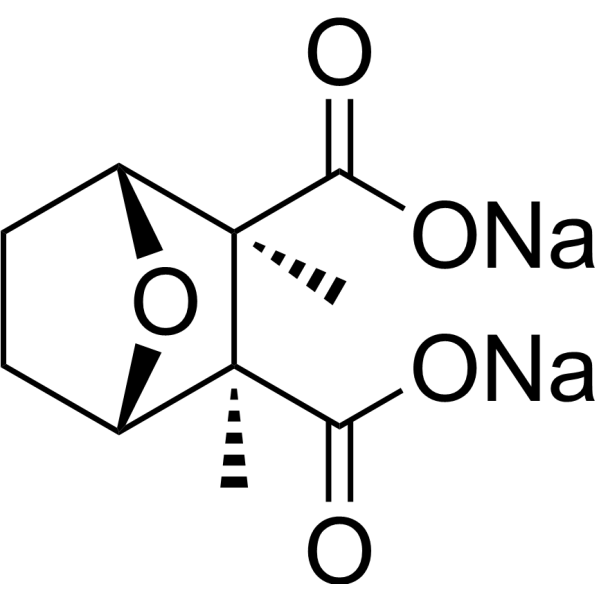
C10H12NA2O5
|
|---|---|
| 分子量 |
258.18
|
| 精确质量 |
258.048
|
| 元素分析 |
C, 46.52; H, 4.69; Na, 17.81; O, 30.98
|
| CAS号 |
1465-77-6
|
| 相关CAS号 |
1465-77-6 (sodium); 28874-45-5; 56-25-7 (lactone); 76970-77-9 (imide)
|
| PubChem CID |
121474
|
| 外观&性状 |
Typically exists as solid at room temperature
|
| 沸点 |
407.8ºC at 760 mmHg
|
| 闪点 |
164.1ºC
|
| 蒸汽压 |
8.62E-08mmHg at 25°C
|
| tPSA |
89.49
|
| 氢键供体(HBD)数目 |
0
|
| 氢键受体(HBA)数目 |
5
|
| 可旋转键数目(RBC) |
0
|
| 重原子数目 |
17
|
| 分子复杂度/Complexity |
296
|
| 定义原子立体中心数目 |
4
|
| SMILES |
C[C@]1([C@H]2CC[C@@H]([C@]1(C)C(=O)[O-])O2)C(=O)[O-].[Na+].[Na+]
|
| InChi Key |
JFALSOLNDKMHAL-CSYCBQNYSA-L
|
| InChi Code |
InChI=1S/C10H14O5.2Na/c1-9(7(11)12)5-3-4-6(15-5)10(9,2)8(13)14;;/h5-6H,3-4H2,1-2H3,(H,11,12)(H,13,14);;/q;2*+1/p-2/t5-,6+,9+,10-;;
|
| 化学名 |
disodium;(1S,2R,3S,4R)-2,3-dimethyl-7-oxabicyclo[2.2.1]heptane-2,3-dicarboxylate
|
| 别名 |
Disodium cantharidin; 1465-77-6; Cantharidin disodium; Disodium cantharidate; 8OIF7X5MK8; Cantharidic Acid (sodium salt); disodium (1R,2S,3R,4S)-2,3-dimethyl-7-oxabicyclo[2.2.1]heptane-2,3-dicarboxylate; disodium;(1R,2S,3R,4S)-2,3-dimethyl-7-oxabicyclo[2.2.1]heptane-2,3-dicarboxylate;
|
| HS Tariff Code |
2934.99.9001
|
| 存储方式 |
Powder -20°C 3 years 4°C 2 years In solvent -80°C 6 months -20°C 1 month |
| 运输条件 |
Room temperature (This product is stable at ambient temperature for a few days during ordinary shipping and time spent in Customs)
|
| 溶解度 (体外实验) |
May dissolve in DMSO (in most cases), if not, try other solvents such as H2O, Ethanol, or DMF with a minute amount of products to avoid loss of samples
|
|---|---|
| 溶解度 (体内实验) |
注意: 如下所列的是一些常用的体内动物实验溶解配方,主要用于溶解难溶或不溶于水的产品(水溶度<1 mg/mL)。 建议您先取少量样品进行尝试,如该配方可行,再根据实验需求增加样品量。
注射用配方
注射用配方1: DMSO : Tween 80: Saline = 10 : 5 : 85 (如: 100 μL DMSO → 50 μL Tween 80 → 850 μL Saline)(IP/IV/IM/SC等) *生理盐水/Saline的制备:将0.9g氯化钠/NaCl溶解在100 mL ddH ₂ O中,得到澄清溶液。 注射用配方 2: DMSO : PEG300 :Tween 80 : Saline = 10 : 40 : 5 : 45 (如: 100 μL DMSO → 400 μL PEG300 → 50 μL Tween 80 → 450 μL Saline) 注射用配方 3: DMSO : Corn oil = 10 : 90 (如: 100 μL DMSO → 900 μL Corn oil) 示例: 以注射用配方 3 (DMSO : Corn oil = 10 : 90) 为例说明, 如果要配制 1 mL 2.5 mg/mL的工作液, 您可以取 100 μL 25 mg/mL 澄清的 DMSO 储备液,加到 900 μL Corn oil/玉米油中, 混合均匀。 View More
注射用配方 4: DMSO : 20% SBE-β-CD in Saline = 10 : 90 [如:100 μL DMSO → 900 μL (20% SBE-β-CD in Saline)] 口服配方
口服配方 1: 悬浮于0.5% CMC Na (羧甲基纤维素钠) 口服配方 2: 悬浮于0.5% Carboxymethyl cellulose (羧甲基纤维素) 示例: 以口服配方 1 (悬浮于 0.5% CMC Na)为例说明, 如果要配制 100 mL 2.5 mg/mL 的工作液, 您可以先取0.5g CMC Na并将其溶解于100mL ddH2O中,得到0.5%CMC-Na澄清溶液;然后将250 mg待测化合物加到100 mL前述 0.5%CMC Na溶液中,得到悬浮液。 View More
口服配方 3: 溶解于 PEG400 (聚乙二醇400) 请根据您的实验动物和给药方式选择适当的溶解配方/方案: 1、请先配制澄清的储备液(如:用DMSO配置50 或 100 mg/mL母液(储备液)); 2、取适量母液,按从左到右的顺序依次添加助溶剂,澄清后再加入下一助溶剂。以 下列配方为例说明 (注意此配方只用于说明,并不一定代表此产品 的实际溶解配方): 10% DMSO → 40% PEG300 → 5% Tween-80 → 45% ddH2O (或 saline); 假设最终工作液的体积为 1 mL, 浓度为5 mg/mL: 取 100 μL 50 mg/mL 的澄清 DMSO 储备液加到 400 μL PEG300 中,混合均匀/澄清;向上述体系中加入50 μL Tween-80,混合均匀/澄清;然后继续加入450 μL ddH2O (或 saline)定容至 1 mL; 3、溶剂前显示的百分比是指该溶剂在最终溶液/工作液中的体积所占比例; 4、 如产品在配制过程中出现沉淀/析出,可通过加热(≤50℃)或超声的方式助溶; 5、为保证最佳实验结果,工作液请现配现用! 6、如不确定怎么将母液配置成体内动物实验的工作液,请查看说明书或联系我们; 7、 以上所有助溶剂都可在 Invivochem.cn网站购买。 |
| 制备储备液 | 1 mg | 5 mg | 10 mg | |
| 1 mM | 3.8733 mL | 19.3663 mL | 38.7327 mL | |
| 5 mM | 0.7747 mL | 3.8733 mL | 7.7465 mL | |
| 10 mM | 0.3873 mL | 1.9366 mL | 3.8733 mL |
1、根据实验需要选择合适的溶剂配制储备液 (母液):对于大多数产品,InvivoChem推荐用DMSO配置母液 (比如:5、10、20mM或者10、20、50 mg/mL浓度),个别水溶性高的产品可直接溶于水。产品在DMSO 、水或其他溶剂中的具体溶解度详见上”溶解度 (体外)”部分;
2、如果您找不到您想要的溶解度信息,或者很难将产品溶解在溶液中,请联系我们;
3、建议使用下列计算器进行相关计算(摩尔浓度计算器、稀释计算器、分子量计算器、重组计算器等);
4、母液配好之后,将其分装到常规用量,并储存在-20°C或-80°C,尽量减少反复冻融循环。
计算结果:
工作液浓度: mg/mL;
DMSO母液配制方法: mg 药物溶于 μL DMSO溶液(母液浓度 mg/mL)。如该浓度超过该批次药物DMSO溶解度,请首先与我们联系。
体内配方配制方法:取 μL DMSO母液,加入 μL PEG300,混匀澄清后加入μL Tween 80,混匀澄清后加入 μL ddH2O,混匀澄清。
(1) 请确保溶液澄清之后,再加入下一种溶剂 (助溶剂) 。可利用涡旋、超声或水浴加热等方法助溶;
(2) 一定要按顺序加入溶剂 (助溶剂) 。
 Claramine hydrochloride
 OncoACP3 TFA
 (GalNAc)3-CPT
 Deoxyfunicone
InvivoChem的所有产品仅用于作科学研究,不面向患者销售
Copyright 2020 InvivoChem LLC | All Rights Reserved 粤ICP备20063088号-1


 粤公网安备 44011102003439号
 463611831
