| 规格 | 价格 | 库存 | 数量 |
|---|---|---|---|
| 5mg |
|
||
| 500mg |
|
||
| Other Sizes |
|
| 靶点 |
- Dihydrofolate reductase (DHFR) (IC₅₀: 0.03 μM in Plasmodium falciparum)[2]
- 5-HT₃ receptors (Ki: 1.2 μM in human cloned receptors)[3] |
|---|---|
| 体外研究 (In Vitro) |
- 恶性疟原虫DHFR抑制:Proguanil 对恶性疟原虫DHFR的直接抑制IC₅₀为0.03 μM,通过阻断四氢叶酸合成干扰寄生虫DNA复制。活性代谢产物环氯胍的效力比母体药物高10倍[2]
- 5-HT₃受体拮抗:放射性配体结合实验显示,Proguanil 对人5-HT₃受体的竞争性拮抗Ki为1.2 μM。功能实验证实其可抑制5-HT诱导的HEK293细胞钙内流,表现为功能性拮抗[3] - 犬巴贝斯虫生长抑制:体外实验中,Proguanil (2 μM) 与阿托伐醌 (1 μM) 联用使巴贝斯虫血症减少>90%,协同作用指数 (FICI) 为0.4[5] 氯胍的体外抗疟活性较弱(IC50=2.4-19 μM),其功效依赖于其活性代谢物环胍,IC50为0.5-2.5 nM。二氢叶酸还原酶(DHFR)被环胍抑制。在体外观察到氯胍和阿托伐醌之间的协同作用。此外,这两种药物都能有效对抗配子细胞和红细胞前(肝脏)阶段的疟原虫[1]。通过充当双胍而不是其代谢物环胍(一种寄生虫二氢叶酸还原酶 [DHFR] 抑制剂),氯胍增强了阿托伐醌的作用。由于氯胍不会改变其他线粒体电子传递抑制剂(如粘噻唑和抗霉素)的作用,因此氯胍介导的增强作用仅限于阿托伐醌[2]。氯胍、代谢物 4-氯苯基-1-双胍 (CPB) 和活性代谢物环胍 (CG) 可逆地阻断 5-HT3 受体反应,IC50 分别为 1.81、1.48 和 4.36 μM [3]。 |
| 体内研究 (In Vivo) |
- 疟疾预防(小鼠模型):口服Proguanil (10 mg/kg/天) 可在感染伯氏疟原虫前2天开始给药,提供100%保护。保护效应与血浆环氯胍水平>50 ng/mL相关[1]
- 5-HT₃介导的止吐作用:在顺铂诱导的雪貂呕吐模型中,Proguanil (30 mg/kg,口服) 使干呕次数减少65%,效果与昂丹司琼 (1 mg/kg) 相当,且可被5-HT₃激动剂mCPBG逆转[3] - 犬巴贝斯虫治疗:口服Proguanil (5 mg/kg,每日两次) 联合阿托伐醌 (13.3 mg/kg,每日两次) 治疗7天,80%感染犬在7天内清除虫体,28天随访无复发,显著改善血细胞比容并缓解临床症状[5] 在Wistar品系白化大鼠中,氯胍(口服;2.9毫克/公斤体重;每天一次,持续5天和6周)引起轻度退行性变化持续5天,严重退行性变化持续6周。变更[4]。给予氯胍的大鼠血清睾酮水平显着下降[4]。当两只慢性期和三只急性期实验性感染吉本芽孢杆菌的狗服用马拉隆(阿托伐醌和氯胍)时,寄生虫血症减少,临床症状得到改善[5]。 |
| 酶活实验 |
- DHFR活性测定:重组恶性疟原虫DHFR与Proguanil (0.01–10 μM) 和NADPH孵育,加入二氢叶酸启动反应,340 nm分光光度法检测产物生成。IC₅₀通过非线性回归计算,环氯胍效力显著高于母体药物[2]
- 5-HT₃受体结合实验:表达人5-HT₃A受体的HEK293细胞膜蛋白与[³H]GR65630及递增浓度Proguanil (0.1–100 μM) 孵育,10 μM昂丹司琼定义非特异性结合。Ki通过Cheng-Prusoff方程计算[3] |
| 细胞实验 |
- 恶性疟原虫生长抑制:同步化恶性疟原虫培养物经Proguanil (0.01–10 μM) 处理48小时,[³H]次黄嘌呤掺入法评估寄生虫生长。EC₅₀与DHFR抑制数据一致[2]
- 5-HT₃功能实验:转染5-HT₃A受体的HEK293细胞负载Fura-2 AM,检测10 μM 5-HT刺激下的钙流。Proguanil (0.1–10 μM) 使5-HT浓度-反应曲线右移,证实拮抗作用[3] |
| 动物实验 |
疟疾预防研究:C57BL/6小鼠经腹腔注射感染伯氏疟原虫(P. berghei)。从感染前2天开始,连续7天口服丙胍(10 mg/kg/天)。通过血涂片监测寄生虫血症,并记录存活情况[1]
- 生殖毒性研究:雄性Sprague-Dawley大鼠经口灌胃给予丙胍(0、25、50、100 mg/kg/天),持续90天。评估睾丸重量、精子数量/活力和组织病理学。在≥50 mg/kg剂量下观察到精子参数呈显著剂量依赖性下降[4] - 吉氏巴贝虫病治疗:感染犬每日两次口服丙胍(5 mg/kg)和阿托伐醌(13.3 mg/kg),持续7天。每天采集血样进行寄生虫血症定量和血液学检查[5] |
| 药代性质 (ADME/PK) |
吸收、分布和排泄
口服剂量为 50 至 500 毫克后,人体吸收迅速且良好。 代谢/代谢物 在肝脏中经细胞色素 P450 同工酶代谢为活性三嗪代谢物环胍,但代谢程度不一。丙胍的这种代谢差异可能对代谢较慢的人群(例如易感染疟疾的亚洲和非洲人群)具有重要的临床意义。对于这些人群,使用丙胍进行预防可能无效,因为即使多次给药,他们也可能无法达到足够的活性化合物环胍的治疗浓度。 丙胍已知的代谢产物包括环胍和4-氯苯基双胍。 生物半衰期 约20小时 - 吸收:口服丙胍(100毫克)后,人体达峰时间(Tmax)为2-4小时,生物利用度为70-80%。食物可使Cmax增加30%,但不影响AUC[1] - 代谢:在肝脏中主要通过CYP2C19和CYP3A4代谢为环胍(主要活性代谢物)和其他非活性结合物。丙胍的血浆半衰期为 14–16 小时,而环胍的半衰期为 16–20 小时[1] - 排泄:约 60% 的剂量以代谢物的形式经尿液排出,30% 经粪便排出。尿液中检测到的原药不足 5%[1] |
| 毒性/毒理 (Toxicokinetics/TK) |
肝毒性
阿托伐醌和丙胍联合用药与少数患者出现短暂且轻微的血清转氨酶升高有关。更重要的是,有少数服用阿托伐醌/丙胍的患者出现特异性急性肝损伤的报道,但病例数太少,无法确定典型的临床过程。在一个已报道的病例中,损伤发生在用药3周后,表现为疲乏、黄疸和胆汁淤积型血清酶升高。停药后2个月内损伤消退(病例1)。在另一例氯喹和丙胍的病例报告中,肝损伤在开始联合用药数日内出现,血清酶升高模式混合。在这两个病例中,过敏症状均较轻微,且未检测到自身抗体。这两个病例均使用了联合治疗,两种药物中的任何一种都可能是导致损伤的原因。阿托伐醌和丙胍也与罕见的史蒂文斯-约翰逊综合征病例有关,该综合征通常伴有轻度肝损伤或肝酶升高。 可能性评分:E(未经证实,但有时被怀疑是临床上明显的肝损伤的原因)。 蛋白结合率 约75% - 急性毒性:大鼠的LD₅₀ >2000 mg/kg(口服)。临床症状包括镇静和胃肠道紊乱[1] - 生殖毒性:在雄性大鼠中,丙胍(50 mg/kg/天)在90天后导致睾丸萎缩、精子发生减少和异常精子形态增加。这些影响在 4 周洗脱后可逆[4] - 血液学影响:体外人淋巴细胞研究表明,丙胍 (520 ng/mL) 可诱导剂量依赖性的 DNA 损伤(彗星试验尾矩增加 40%),但不影响细胞活力。S9 混合物的代谢活化增强了其遗传毒性[8] |
| 参考文献 |
|
| 其他信息 |
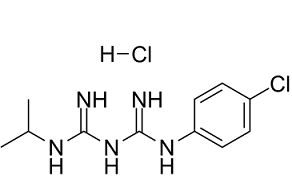
盐酸丙胍是丙胍的盐酸盐形式,丙胍是一种合成的嘧啶双胍衍生物,也是一种具有抗疟活性的叶酸拮抗剂。丙胍水解后,经细胞色素P450依赖性反应转化为其活性环状三嗪代谢物环胍。环胍选择性抑制疟原虫的双功能二氢叶酸还原酶-胸苷酸合成酶(DHFR-TS),从而破坏脱氧胸苷酸的合成,最终阻断疟原虫的DNA和蛋白质合成。
一种在体内代谢生成环胍(一种抗疟药)的双胍化合物。 另见:丙胍(注释已移至)。 |
| 分子式 |
C11H17CL2N5
|
|---|---|
| 分子量 |
290.19218
|
| 精确质量 |
289.086
|
| 元素分析 |
C, 45.53; H, 5.90; Cl, 24.43; N, 24.13
|
| CAS号 |
637-32-1
|
| 相关CAS号 |
Proguanil;500-92-5;Proguanil-d6 hydrochloride;Proguanil-d6;Proguanil-d4 hydrochloride;1189671-34-8
|
| PubChem CID |
9570076
|
| 外观&性状 |
White to off-white solid powder
|
| 沸点 |
402.7ºC at 760 mmHg
|
| 熔点 |
249-251ºC
|
| 闪点 |
197.4ºC
|
| LogP |
4.065
|
| tPSA |
83.79
|
| 氢键供体(HBD)数目 |
4
|
| 氢键受体(HBA)数目 |
1
|
| 可旋转键数目(RBC) |
4
|
| 重原子数目 |
18
|
| 分子复杂度/Complexity |
292
|
| 定义原子立体中心数目 |
0
|
| SMILES |
CC(C)N=C(N)/N=C(\N)/NC1=CC=C(C=C1)Cl.Cl
|
| InChi Key |
SARMGXPVOFNNNG-UHFFFAOYSA-N
|
| InChi Code |
InChI=1S/C11H16ClN5.ClH/c1-7(2)15-10(13)17-11(14)16-9-5-3-8(12)4-6-9/h3-7H,1-2H3,(H5,13,14,15,16,17)1H
|
| 化学名 |
(1E)-1-[amino-(4-chloroanilino)methylidene]-2-propan-2-ylguanidinehydrochloride
|
| 别名 |
Proguanil HCl; Proguanil hydrochloride; Chloroguanide hydrochloride; Chlorguanide hydrochloride; 637-32-1; Diguanyl; Paludrine; Chloroguanide hydrochloride; Chloroquanil
|
| HS Tariff Code |
2934.99.9001
|
| 存储方式 |
Powder -20°C 3 years 4°C 2 years In solvent -80°C 6 months -20°C 1 month |
| 运输条件 |
Room temperature (This product is stable at ambient temperature for a few days during ordinary shipping and time spent in Customs)
|
| 溶解度 (体外实验) |
May dissolve in DMSO (in most cases), if not, try other solvents such as H2O, Ethanol, or DMF with a minute amount of products to avoid loss of samples
|
|---|---|
| 溶解度 (体内实验) |
注意: 如下所列的是一些常用的体内动物实验溶解配方,主要用于溶解难溶或不溶于水的产品(水溶度<1 mg/mL)。 建议您先取少量样品进行尝试,如该配方可行,再根据实验需求增加样品量。
注射用配方
注射用配方1: DMSO : Tween 80: Saline = 10 : 5 : 85 (如: 100 μL DMSO → 50 μL Tween 80 → 850 μL Saline)(IP/IV/IM/SC等) *生理盐水/Saline的制备:将0.9g氯化钠/NaCl溶解在100 mL ddH ₂ O中,得到澄清溶液。 注射用配方 2: DMSO : PEG300 :Tween 80 : Saline = 10 : 40 : 5 : 45 (如: 100 μL DMSO → 400 μL PEG300 → 50 μL Tween 80 → 450 μL Saline) 注射用配方 3: DMSO : Corn oil = 10 : 90 (如: 100 μL DMSO → 900 μL Corn oil) 示例: 以注射用配方 3 (DMSO : Corn oil = 10 : 90) 为例说明, 如果要配制 1 mL 2.5 mg/mL的工作液, 您可以取 100 μL 25 mg/mL 澄清的 DMSO 储备液,加到 900 μL Corn oil/玉米油中, 混合均匀。 View More
注射用配方 4: DMSO : 20% SBE-β-CD in Saline = 10 : 90 [如:100 μL DMSO → 900 μL (20% SBE-β-CD in Saline)] 口服配方
口服配方 1: 悬浮于0.5% CMC Na (羧甲基纤维素钠) 口服配方 2: 悬浮于0.5% Carboxymethyl cellulose (羧甲基纤维素) 示例: 以口服配方 1 (悬浮于 0.5% CMC Na)为例说明, 如果要配制 100 mL 2.5 mg/mL 的工作液, 您可以先取0.5g CMC Na并将其溶解于100mL ddH2O中,得到0.5%CMC-Na澄清溶液;然后将250 mg待测化合物加到100 mL前述 0.5%CMC Na溶液中,得到悬浮液。 View More
口服配方 3: 溶解于 PEG400 (聚乙二醇400) 请根据您的实验动物和给药方式选择适当的溶解配方/方案: 1、请先配制澄清的储备液(如:用DMSO配置50 或 100 mg/mL母液(储备液)); 2、取适量母液,按从左到右的顺序依次添加助溶剂,澄清后再加入下一助溶剂。以 下列配方为例说明 (注意此配方只用于说明,并不一定代表此产品 的实际溶解配方): 10% DMSO → 40% PEG300 → 5% Tween-80 → 45% ddH2O (或 saline); 假设最终工作液的体积为 1 mL, 浓度为5 mg/mL: 取 100 μL 50 mg/mL 的澄清 DMSO 储备液加到 400 μL PEG300 中,混合均匀/澄清;向上述体系中加入50 μL Tween-80,混合均匀/澄清;然后继续加入450 μL ddH2O (或 saline)定容至 1 mL; 3、溶剂前显示的百分比是指该溶剂在最终溶液/工作液中的体积所占比例; 4、 如产品在配制过程中出现沉淀/析出,可通过加热(≤50℃)或超声的方式助溶; 5、为保证最佳实验结果,工作液请现配现用! 6、如不确定怎么将母液配置成体内动物实验的工作液,请查看说明书或联系我们; 7、 以上所有助溶剂都可在 Invivochem.cn网站购买。 |
| 制备储备液 | 1 mg | 5 mg | 10 mg | |
| 1 mM | 3.4460 mL | 17.2301 mL | 34.4602 mL | |
| 5 mM | 0.6892 mL | 3.4460 mL | 6.8920 mL | |
| 10 mM | 0.3446 mL | 1.7230 mL | 3.4460 mL |
1、根据实验需要选择合适的溶剂配制储备液 (母液):对于大多数产品,InvivoChem推荐用DMSO配置母液 (比如:5、10、20mM或者10、20、50 mg/mL浓度),个别水溶性高的产品可直接溶于水。产品在DMSO 、水或其他溶剂中的具体溶解度详见上”溶解度 (体外)”部分;
2、如果您找不到您想要的溶解度信息,或者很难将产品溶解在溶液中,请联系我们;
3、建议使用下列计算器进行相关计算(摩尔浓度计算器、稀释计算器、分子量计算器、重组计算器等);
4、母液配好之后,将其分装到常规用量,并储存在-20°C或-80°C,尽量减少反复冻融循环。
计算结果:
工作液浓度: mg/mL;
DMSO母液配制方法: mg 药物溶于 μL DMSO溶液(母液浓度 mg/mL)。如该浓度超过该批次药物DMSO溶解度,请首先与我们联系。
体内配方配制方法:取 μL DMSO母液,加入 μL PEG300,混匀澄清后加入μL Tween 80,混匀澄清后加入 μL ddH2O,混匀澄清。
(1) 请确保溶液澄清之后,再加入下一种溶剂 (助溶剂) 。可利用涡旋、超声或水浴加热等方法助溶;
(2) 一定要按顺序加入溶剂 (助溶剂) 。
InvivoChem的所有产品仅用于作科学研究,不面向患者销售
Copyright 2020 InvivoChem LLC | All Rights Reserved 粤ICP备20063088号-1


 粤公网安备 44011102003439号
 463611831
