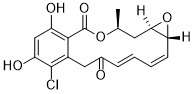
Radicicol (Monorden)

别名: Radicicol Monorden
目录号: V8531 纯度: ≥98%
Radicicol (Monorden) 是一种具有抗疟活性的抗真菌抗生素,是一种有效的 Hsp90 N 末端抑制剂,IC50 值为 1 μM。
Radicicol (Monorden) CAS号: 12772-57-5
产品类别: New1
产品仅用于科学研究,不针对患者销售
规格 价格 库存 数量
1mg
5mg
50mg
Other Sizes
点击了解更多
  • 与全球5000+客户建立关系
  • 覆盖全球主要大学、医院、科研院所、生物/制药公司等
  • 产品被大量CNS顶刊文章引用
InvivoChem产品被CNS等顶刊论文引用
纯度/质量控制文件

纯度: ≥98%

产品描述
Radicicol (Monorden) 是一种具有抗疟活性的抗真菌抗生素,是一种有效的 Hsp90 N 末端抑制剂,IC50 值为 1 μM。它与 Hsp90 的 ATPase 结构域结合,防止 Hsp90 客户成熟,导致蛋白酶体降解。 Radicicol 通过靶向恶性疟原虫拓扑异构酶 VIB 来损害线粒体复制。
生物活性&实验参考方法
体外研究 (In Vitro)
通过阻止 ATP 结合,radiiciccol(1 μM 或 100 μM)可抑制 Hsp90 和 Topo VI 的活性 [1]。在 100 μM 下持续 10 分钟,radicol 与 ATP 结合位点 PDK3 的 C 末端结构域结合,阻断 Hsp90 [1]。 0.25–18 μM 作用 48 小时,radicol 可抑制恶性疟原虫生长,IC50 值为 8.563 μM;8 μM 作用 50 小时,radicol 减慢裂解到环的转变 [2]。微米; 40 h) 荧光探针 DNA 复制,不会干扰质体基因组的底层细胞核 [2]。用 radiiciccol(0.001-5 μM;72 小时)以 0.1 μM 危险浓度诱导肌肉细胞 [5]。
体内研究 (In Vivo)
Radicicol(0.05 mg/20 g;皮下注射;单剂量)通过减少 NF-kB 激活来改善响尾蛇损伤的骨骼肌的再生。 Radicicol(20 mg/kg或60 mg/kg;腹腔注射;2次;左右各1 h)具有肾脏保护作用,改善肾缺血再灌注(I/R)损伤,并增加肾损伤肾损伤HSP70 mRNA [5]。
细胞实验
细胞活力测定[2]
细胞类型: 恶性疟原虫 3D7
测试浓度: 0.25 μM、0.75 μM、2 μM、4 μM、6 μM、 8 μM、10 μM、14 μM、17 μM
孵育持续时间: 48 小时
实验结果:显示剂量依赖性抑制寄生虫生长。

细胞毒性测定 [5]
细胞类型:原代成肌细胞(来自小鼠后肢肌肉)
测试浓度: 0.001、0.01、0.1 , 1, 5 μM
孵育时间: 72 hrs(小时)
实验结果: 诱导成肌细胞分化,但不诱导肌生成 细胞毒性最高浓度是0.1微米。
动物实验
动物/疾病模型:肾脏缺血/再灌注损伤模型和蛋白[4]。小鼠[4]
剂量:20 mg/kg 或 60 mg/kg
给药途径:腹腔注射;两次给药;双侧肾脏缺血再灌注(I/R)前后 1 小时
实验结果:通过诱导肾脏 HSP70 表达,显示出肾脏保护作用。

动物/疾病模型:雄性 C57B1/6 小鼠(3 月龄,25±2g)[5]
剂量:0.05mg/20g
给药途径:皮下注射;单次给药;损伤前(约 1 分钟)注射 CTX;注射后第 10 天评估结果:第 10 天,巴豆毒素损伤肌肉中热休克蛋白诱导和 NF-κB 活化减少。改善再生肌纤维的大小恢复并减少 NF-κB 活化。
参考文献
[1]. Kato M, et al. Distinct structural mechanisms for inhibition of pyruvate dehydrogenase kinase isoforms by AZD7545, dichloroacetate, and radicicol. Structure. 2007 Aug;15(8):992-1004. Epub 2007 Aug 2.
[2]. Chalapareddy S, et al. Radicicol confers mid-schizont arrest by inhibiting mitochondrial replication in Plasmodium falciparum. Antimicrob Agents Chemother. 2014 Aug;58(8):4341-52.
[3]. Wang R, et al. Identification of Natural Compound Radicicol as a Potent FTO Inhibitor. Mol Pharm. 2018 Sep 4;15(9):4092-4098.
[4]. Sonoda H, et al. The protective effect of radicicol against renal ischemia--reperfusion injury in mice. J Pharmacol Sci. 2010;112(2):242-6.
[5]. Nascimento TL, et al. Radicicol enhances the regeneration of skeletal muscle injured by crotoxin via decrease of NF-kB activation. Toxicon. 2019 Sep;167:6-9.
其他信息
雷迪西醇是一种抗真菌大环内酯类抗生素,提取自厚垣孢霉(Diheterospora chlamydosporia)和奇氏毛壳菌(Chaetomium chiversii),可抑制蛋白酪氨酸激酶和热休克蛋白90 (Hsp90)。它具有酪氨酸激酶抑制剂、抗真菌剂和代谢产物等多种功能。它是一种大环内酯类抗生素,属于环氧化物、烯酮、环酮、酚类和一氯苯类化合物。
据报道,雷迪西醇存在于新宇宙孢镰刀菌(Fusarium neocosmosporiellum)、奇氏毛壳菌(Floropilus chiversii)和其他一些有相关数据的生物体中。
雷迪西醇是一种大环抗真菌抗生素,可抑制信号依赖性转录激活并诱导白血病细胞分化。(NCI)
*注: 文献方法仅供参考, InvivoChem并未独立验证这些方法的准确性
化学信息 & 存储运输条件
分子式
C18H17CLO6
分子量
364.77698
精确质量
364.071
CAS号
12772-57-5
PubChem CID
6323491
外观&性状
White to off-white solid powder
密度
1.4±0.1 g/cm3
沸点
656.2±55.0 °C at 760 mmHg
熔点
190-194ºC
闪点
350.7±31.5 °C
蒸汽压
0.0±2.0 mmHg at 25°C
折射率
1.583
LogP
1.53
tPSA
96.36
氢键供体(HBD)数目
2
氢键受体(HBA)数目
6
可旋转键数目(RBC)
0
重原子数目
25
分子复杂度/Complexity
588
定义原子立体中心数目
3
SMILES
C[C@@H]1C[C@@H]2[C@@H](C=CC=CC(=O)CC3=C(C(=CC(=C3Cl)O)O)C(=O)O1)O2
InChi Key
WYZWZEOGROVVHK-RFVWBQTHSA-N
InChi Code
InChI=1S/C18H17ClO6/c1-9-6-15-14(25-15)5-3-2-4-10(20)7-11-16(18(23)24-9)12(21)8-13(22)17(11)19/h2-5,8-9,14-15,21-22H,6-7H2,1H3/b4-2+,5-3-/t9-,14+,15+/m0/s1
化学名
(1aR,2Z,4E,14S,15aR)-8-Chloro-9,11-dihydroxy-14-methyl-1a,14,15,15a-tetrahydro-6H-benzo[c]oxireno[2,3-k][1]oxacyclotetradecine-6,12(7H)-dione
别名
Radicicol Monorden
HS Tariff Code
2934.99.9001
存储方式

Powder      -20°C    3 years

                     4°C     2 years

In solvent   -80°C    6 months

                  -20°C    1 month

运输条件
Room temperature (This product is stable at ambient temperature for a few days during ordinary shipping and time spent in Customs)
溶解度数据
溶解度 (体外实验)
DMSO : ~100 mg/mL (~274.14 mM)
溶解度 (体内实验)
注意: 如下所列的是一些常用的体内动物实验溶解配方,主要用于溶解难溶或不溶于水的产品(水溶度<1 mg/mL)。 建议您先取少量样品进行尝试,如该配方可行,再根据实验需求增加样品量。

注射用配方
(IP/IV/IM/SC等)
注射用配方1: DMSO : Tween 80: Saline = 10 : 5 : 85 (如: 100 μL DMSO 50 μL Tween 80 850 μL Saline)
*生理盐水/Saline的制备:将0.9g氯化钠/NaCl溶解在100 mL ddH ₂ O中,得到澄清溶液。
注射用配方 2: DMSO : PEG300Tween 80 : Saline = 10 : 40 : 5 : 45 (如: 100 μL DMSO 400 μL PEG300 50 μL Tween 80 450 μL Saline)
注射用配方 3: DMSO : Corn oil = 10 : 90 (如: 100 μL DMSO 900 μL Corn oil)
示例: 注射用配方 3 (DMSO : Corn oil = 10 : 90) 为例说明, 如果要配制 1 mL 2.5 mg/mL的工作液, 您可以取 100 μL 25 mg/mL 澄清的 DMSO 储备液,加到 900 μL Corn oil/玉米油中, 混合均匀。
View More

注射用配方 4: DMSO : 20% SBE-β-CD in Saline = 10 : 90 [如:100 μL DMSO 900 μL (20% SBE-β-CD in Saline)]
*20% SBE-β-CD in Saline的制备(4°C,储存1周):将2g SBE-β-CD (磺丁基-β-环糊精) 溶解于10mL生理盐水中,得到澄清溶液。
注射用配方 5: 2-Hydroxypropyl-β-cyclodextrin : Saline = 50 : 50 (如: 500 μL 2-Hydroxypropyl-β-cyclodextrin (羟丙基环胡精) 500 μL Saline)
注射用配方 6: DMSO : PEG300 : Castor oil : Saline = 5 : 10 : 20 : 65 (如: 50 μL DMSO 100 μL PEG300 200 μL Castor oil 650 μL Saline)
注射用配方 7: Ethanol : Cremophor : Saline = 10: 10 : 80 (如: 100 μL Ethanol 100 μL Cremophor 800 μL Saline)
注射用配方 8: 溶解于Cremophor/Ethanol (50 : 50), 然后用生理盐水稀释。
注射用配方 9: EtOH : Corn oil = 10 : 90 (如: 100 μL EtOH 900 μL Corn oil)
注射用配方 10: EtOH : PEG300Tween 80 : Saline = 10 : 40 : 5 : 45 (如: 100 μL EtOH 400 μL PEG300 50 μL Tween 80 450 μL Saline)


口服配方
口服配方 1: 悬浮于0.5% CMC Na (羧甲基纤维素钠)
口服配方 2: 悬浮于0.5% Carboxymethyl cellulose (羧甲基纤维素)
示例: 口服配方 1 (悬浮于 0.5% CMC Na)为例说明, 如果要配制 100 mL 2.5 mg/mL 的工作液, 您可以先取0.5g CMC Na并将其溶解于100mL ddH2O中,得到0.5%CMC-Na澄清溶液;然后将250 mg待测化合物加到100 mL前述 0.5%CMC Na溶液中,得到悬浮液。
View More

口服配方 3: 溶解于 PEG400 (聚乙二醇400)
口服配方 4: 悬浮于0.2% Carboxymethyl cellulose (羧甲基纤维素)
口服配方 5: 溶解于0.25% Tween 80 and 0.5% Carboxymethyl cellulose (羧甲基纤维素)
口服配方 6: 做成粉末与食物混合


注意: 以上为较为常见方法,仅供参考, InvivoChem并未独立验证这些配方的准确性。具体溶剂的选择首先应参照文献已报道溶解方法、配方或剂型,对于某些尚未有文献报道溶解方法的化合物,需通过前期实验来确定(建议先取少量样品进行尝试),包括产品的溶解情况、梯度设置、动物的耐受性等。

请根据您的实验动物和给药方式选择适当的溶解配方/方案:
1、请先配制澄清的储备液(如:用DMSO配置50 或 100 mg/mL母液(储备液));
2、取适量母液,按从左到右的顺序依次添加助溶剂,澄清后再加入下一助溶剂。以 下列配方为例说明 (注意此配方只用于说明,并不一定代表此产品 的实际溶解配方):
10% DMSO → 40% PEG300 → 5% Tween-80 → 45% ddH2O (或 saline);
假设最终工作液的体积为 1 mL, 浓度为5 mg/mL: 取 100 μL 50 mg/mL 的澄清 DMSO 储备液加到 400 μL PEG300 中,混合均匀/澄清;向上述体系中加入50 μL Tween-80,混合均匀/澄清;然后继续加入450 μL ddH2O (或 saline)定容至 1 mL;

3、溶剂前显示的百分比是指该溶剂在最终溶液/工作液中的体积所占比例;
4、 如产品在配制过程中出现沉淀/析出,可通过加热(≤50℃)或超声的方式助溶;
5、为保证最佳实验结果,工作液请现配现用!
6、如不确定怎么将母液配置成体内动物实验的工作液,请查看说明书或联系我们;
7、 以上所有助溶剂都可在 Invivochem.cn网站购买。
制备储备液 1 mg 5 mg 10 mg
1 mM 2.7414 mL 13.7069 mL 27.4138 mL
5 mM 0.5483 mL 2.7414 mL 5.4828 mL
10 mM 0.2741 mL 1.3707 mL 2.7414 mL

1、根据实验需要选择合适的溶剂配制储备液 (母液):对于大多数产品,InvivoChem推荐用DMSO配置母液 (比如:5、10、20mM或者10、20、50 mg/mL浓度),个别水溶性高的产品可直接溶于水。产品在DMSO 、水或其他溶剂中的具体溶解度详见上”溶解度 (体外)”部分;

2、如果您找不到您想要的溶解度信息,或者很难将产品溶解在溶液中,请联系我们;

3、建议使用下列计算器进行相关计算(摩尔浓度计算器、稀释计算器、分子量计算器、重组计算器等);

4、母液配好之后,将其分装到常规用量,并储存在-20°C或-80°C,尽量减少反复冻融循环。

计算器

摩尔浓度计算器可计算特定溶液所需的质量、体积/浓度,具体如下:

  • 计算制备已知体积和浓度的溶液所需的化合物的质量
  • 计算将已知质量的化合物溶解到所需浓度所需的溶液体积
  • 计算特定体积中已知质量的化合物产生的溶液的浓度
使用摩尔浓度计算器计算摩尔浓度的示例如下所示:
假如化合物的分子量为350.26 g/mol,在5mL DMSO中制备10mM储备液所需的化合物的质量是多少?
  • 在分子量(MW)框中输入350.26
  • 在“浓度”框中输入10,然后选择正确的单位(mM)
  • 在“体积”框中输入5,然后选择正确的单位(mL)
  • 单击“计算”按钮
  • 答案17.513 mg出现在“质量”框中。以类似的方式,您可以计算体积和浓度。

稀释计算器可计算如何稀释已知浓度的储备液。例如,可以输入C1、C2和V2来计算V1,具体如下:

制备25毫升25μM溶液需要多少体积的10 mM储备溶液?
使用方程式C1V1=C2V2,其中C1=10mM,C2=25μM,V2=25 ml,V1未知:
  • 在C1框中输入10,然后选择正确的单位(mM)
  • 在C2框中输入25,然后选择正确的单位(μM)
  • 在V2框中输入25,然后选择正确的单位(mL)
  • 单击“计算”按钮
  • 答案62.5μL(0.1 ml)出现在V1框中
g/mol

分子量计算器可计算化合物的分子量 (摩尔质量)和元素组成,具体如下:

注:化学分子式大小写敏感:C12H18N3O4  c12h18n3o4
计算化合物摩尔质量(分子量)的说明:
  • 要计算化合物的分子量 (摩尔质量),请输入化学/分子式,然后单击“计算”按钮。
分子质量、分子量、摩尔质量和摩尔量的定义:
  • 分子质量(或分子量)是一种物质的一个分子的质量,用统一的原子质量单位(u)表示。(1u等于碳-12中一个原子质量的1/12)
  • 摩尔质量(摩尔重量)是一摩尔物质的质量,以g/mol表示。
/

配液计算器可计算将特定质量的产品配成特定浓度所需的溶剂体积 (配液体积)

  • 输入试剂的质量、所需的配液浓度以及正确的单位
  • 单击“计算”按钮
  • 答案显示在体积框中
动物体内实验配方计算器(澄清溶液)
第一步:请输入基本实验信息(考虑到实验过程中的损耗,建议多配一只动物的药量)
第二步:请输入动物体内配方组成(配方适用于不溶/难溶于水的化合物),不同的产品和批次配方组成不同,如对配方有疑问,可先联系我们提供正确的体内实验配方。此外,请注意这只是一个配方计算器,而不是特定产品的确切配方。
+
+
+

计算结果:

工作液浓度 mg/mL;

DMSO母液配制方法 mg 药物溶于 μL DMSO溶液(母液浓度 mg/mL)。如该浓度超过该批次药物DMSO溶解度,请首先与我们联系。

体内配方配制方法μL DMSO母液,加入 μL PEG300,混匀澄清后加入μL Tween 80,混匀澄清后加入 μL ddH2O,混匀澄清。

(1) 请确保溶液澄清之后,再加入下一种溶剂 (助溶剂) 。可利用涡旋、超声或水浴加热等方法助溶;
            (2) 一定要按顺序加入溶剂 (助溶剂) 。

生物数据图片
  • Inhibition of PDK1 and PDK3 Activities by AZD7545, Radicicol, and DCA (A) IC50 for AZD7545, SUMO-PDK1, or SUMO-PDK3 (50 nM each) in the presence of E1p bound to the E2p/E3BP core was titrated with increasing concentrations of AZD7545 in 2% DMSO as indicated. Following an incubation of 30 min, residual kinase activity was assayed as described in Experimental Procedures. PDK activity is expressed as % maximal (8.2 nmol/min/mg for PDK1; 63.6 nmol/min/mg for PDK3; both measured in 2% DMSO). Inhibition curves were fitted and IC50 values were obtained using the Prism program (GraphPad Software, San Diego, CA, USA). (B) IC50 for radicicol. For titrations with radicicol, 0.56 μM SUMO-PDK1 or 0.28 μM SUMO-PDK3 was used. The remaining conditions are also described in Experimental Procedures. (C) Inhibition of PDK1 and PDK3 by AZD7545, DCA, and radicicol with the E1p substrate on the E2p/E3BP core. Inhibitor concentrations used were 5- to 40-fold higher than the respective IC50 or Ki values. Following incubation for 30 min, kinase activity was assayed as in (A), and residual activity levels are expressed as % control. Control activities for PDK1 and PDK3 in 2% DMSO are as in (A). Control activity without DMSO for DCA inhibition is 9.7 nmol/min/mg for PDK1 and 91.9 nmol/min/mg for PDK3. The bars in (C) and (D) represent averages of two independent experiments.[1].Kato M, et al. Distinct structural mechanisms for inhibition of pyruvate dehydrogenase kinase isoforms by AZD7545, dichloroacetate, and radicicol. Structure. 2007 Aug;15(8):992-1004. Epub 2007 Aug 2.
  • Structures of PDK1 and PDK3-L2 in Complex with Inhibitors (A) The dimeric structures of apo-PDK1 with superimposed AZD7545 and DCA bound to PDK1. Each PDK1 subunit is represented as a ribbon model (green and cyan). AZD7545 and DCA molecules bound to each PDK1 subunit are shown in space-filling models. The fully ordered ATP lid is colored in yellow. The partially ordered C-terminal tails in the crossed configuration are colored in magenta. (B) The PDK3-L2 dimer with radicicol bound to the ATP-binding pocket. Both PDK3 subunits are shown in green and cyan. The bound L2 domains are colored in yellow, with the lipoyl group shown in a space-filling model. Radicicol molecules bound to each PDK3 subunit are also shown in the same model. The fully ordered C-terminal tails are in magenta. The red arrows in (A) and (B) indicate the active-site clefts of these kinases. Stereo figures of the Cα traces for the PDK1 and PDK3-L2 structures are shown in Figure S1.[1].Kato M, et al. Distinct structural mechanisms for inhibition of pyruvate dehydrogenase kinase isoforms by AZD7545, dichloroacetate, and radicicol. Structure. 2007 Aug;15(8):992-1004. Epub 2007 Aug 2.
  • Structure of the Radicicol-Binding Site in PDK3-L2 (A) The omit electron density map of radicicol bound to PDK3. The density is superimposed on the refined model of radicicol at the 3σ level in blue and the 9σ level in red. (B) Interactions between PDK3 residues and radicicol. H bonds are indicated by dashed lines. Water molecules are depicted as red balls. (C) Comparison between radicicol and ATP bound to PDK3. The structure of PDK3-L2-ATP (PDB ID code 1Y8P; Kato et al., 2005) (magenta) is superimposed on PDK3-L2-radicicol (cyan). (D) Superimposition of radicicol molecules bound to PDK1 (cyan), Hsp90 (PDB ID code 1BGQ; Roe et al., 1999) (pink), and Topo VI (PDB ID code 2HKJ; Corbett and Berger, 2005) (yellow). The three structures were superimposed based on the corresponding residues shown in the figure. Stereo figures of (B)–(D) are provided in Figure S4. (E) Comparison of the shape of the radicicol-binding pockets of PDK3, Hsp90, and Topo VI. The electrostatic surface of each protein is shown with the negative charge in red and the positive charge in blue.[1].Kato M, et al. Distinct structural mechanisms for inhibition of pyruvate dehydrogenase kinase isoforms by AZD7545, dichloroacetate, and radicicol. Structure. 2007 Aug;15(8):992-1004. Epub 2007 Aug 2.
相关产品
联系我们