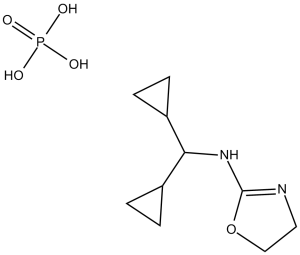
Rilmenidine Phosphate

别名: S 3341; S3341; S-3341 磷酸利美尼定; 2-((二环丙基甲基)氨基)-2-唑啉磷酸盐; 利美尼定系统适用性 EP标准品
目录号: V1921 纯度: ≥98%
Rilmenidine Phosphate 是 Rilmenidine 的水溶性形式,是一种有效的选择性咪唑啉受体激动剂,用于治疗高血压。
Rilmenidine Phosphate CAS号: 85409-38-7
产品类别: Imidazoline Receptor
产品仅用于科学研究,不针对患者销售
规格 价格 库存 数量
5mg
10mg
25mg
50mg
100mg
250mg
500mg
Other Sizes

Other Forms of Rilmenidine Phosphate:

  • Rilmenidine-d4
  • 利美尼啶
点击了解更多
InvivoChem产品被CNS等顶刊论文引用
纯度/质量控制文件

纯度: ≥98%

产品描述
磷酸利美尼定是利美尼定的水溶性形式,是一种有效的选择性咪唑啉受体激动剂,用于治疗高血压。在用0.5 mM油酸处理6小时和1μm利美尼定处理30分钟的Hep G2细胞中,油酸诱导的脂质积累减少。利美尼定刺激咪唑啉 I-1 受体激活 P38,诱导 FXR 的表达。饲喂 HFD(高脂肪饮食)的小鼠在服用 Rilmenidien 后通过激活咪唑啉 I-1 受体改善了肝脏脂肪变性。
生物活性&实验参考方法
靶点
Rilmenidine Phosphate targets I1-imidazoline receptors (Ki = 0.6 nM for human I1 receptors) [1]
Rilmenidine Phosphate targets α2-adrenergic receptors (Ki = 320 nM for human α2A-adrenergic receptors, low affinity) [1]
体外研究 (In Vitro)
利美尼定的降压功效与ACE抑制剂、β受体阻滞剂、钙通道阻滞剂和利尿剂相当[1]。 25–100 μM 磷酸雷美尼定可抑制 K562 细胞增殖 24 小时[2]。
利美尼定磷酸酯(Rilmenidine Phosphate) 以5–40 μM浓度处理人白血病K562细胞72小时,呈浓度依赖抑制增殖,IC50 = 12 μM;20 μM时克隆形成率降低70% [2]
利美尼定磷酸酯(Rilmenidine Phosphate) 以15 μM浓度处理K562细胞48小时,通过线粒体途径诱导凋亡:膜联蛋白V阳性细胞比例增至58%,Bax/Bcl-2比值上调3.2倍,蛋白质印迹检测显示caspase-3/-9激活水平分别升高2.8/3.5倍 [2]
利美尼定磷酸酯(Rilmenidine Phosphate) 以10 μM浓度减轻SH-SY5Y神经母细胞瘤细胞中聚谷氨酰胺(PolyQ)诱导的毒性:细胞活力提升45%,活性氧(ROS)水平降低50%,亨廷顿蛋白聚集物水平减少60% [3]
利美尼定磷酸酯(Rilmenidine Phosphate) 以20 μM浓度处理正常人外周血单个核细胞(PBMCs)72小时,无细胞毒性(细胞存活率>90%)[2]
体内研究 (In Vivo)
从 12 周龄到 22 周龄,用磷酸雷米地定治疗的 N171-82Q 小鼠(腹腔注射;每周四次)表现出前肢和所有肢体握力的显着增强[3]。磷酸利美尼定可减少亨廷顿突变[3]。
利美尼定磷酸酯(Rilmenidine Phosphate) 以50 μg/kg/天的剂量通过饮水给予自发性高血压大鼠(SHR)14天,收缩压降低25%,舒张压降低20%,血压恢复至135±8/85±5 mmHg [1]
利美尼定磷酸酯(Rilmenidine Phosphate) 以1 mg/kg/天的剂量口服给予R6/2亨廷顿舞蹈症(HD)小鼠8周,改善运动功能:转棒潜伏期从45±10秒延长至120±15秒,后肢蜷缩评分从3.0分降至1.2分(评分范围0–3分)[3]
利美尼定磷酸酯(Rilmenidine Phosphate) 以0.5 mg/kg/天的剂量口服给予HD小鼠,减少神经元丢失:纹状体神经元密度提升40%,脑组织中亨廷顿蛋白包涵体减少55% [3]
利美尼定磷酸酯(Rilmenidine Phosphate) 以200 μg/kg/天的剂量口服给予正常血压大鼠,对血压无显著影响,体现血压特异性调控作用 [1]
酶活实验
I1咪唑啉受体结合实验:制备富含I1受体的人血小板细胞膜,与利美尼定磷酸酯(Rilmenidine Phosphate)(0.01–100 nM)及[3H]-对碘可乐定(放射性配体)在25°C孵育60分钟;过滤去除未结合配体,液体闪烁计数法测定结合放射性;通过竞争结合曲线计算Ki值 [1]
α2肾上腺素能受体结合实验:大鼠脑皮质细胞膜与利美尼定磷酸酯(Rilmenidine Phosphate)(0.1–1000 nM)及[3H]-劳沃斯辛在37°C孵育45分钟;在过量育亨宾存在下测定非特异性结合;定量结合放射性以计算Ki值 [1]
细胞实验
细胞增殖测定[2]
细胞类型: K562 细胞
测试浓度: 25、50、100 μM
孵育时间: 24 小时
实验结果:剂量依赖性抑制 K562 集落形成。
K562细胞增殖实验:K562细胞接种于96孔板(5×10³细胞/孔),用利美尼定磷酸酯(Rilmenidine Phosphate)(1–50 μM)处理72小时;MTT实验(570 nm处吸光度)评估细胞活力,计算IC50值 [2]
凋亡实验:K562细胞用利美尼定磷酸酯(Rilmenidine Phosphate)(10–25 μM)处理48小时;膜联蛋白V-FITC/PI染色流式细胞术分析凋亡细胞;蛋白质印迹检测Bax、Bcl-2、活化型caspase-3/-9蛋白 [2]
神经保护实验:转染PolyQ表达质粒的SH-SY5Y细胞用利美尼定磷酸酯(Rilmenidine Phosphate)(5–20 μM)处理72小时;CCK-8实验检测细胞活力,DCFH-DA荧光检测ROS水平,免疫荧光检测亨廷顿蛋白聚集物 [3]
动物实验
Hypertensive rat model: Spontaneously hypertensive rats (SHR) were randomly divided into control and treatment groups; treatment group received Rilmenidine Phosphate (25–100 μg/kg/day, dissolved in drinking water) for 14 days; blood pressure was measured by tail-cuff plethysmography every 3 days [1]
Huntington's disease mouse model: R6/2 transgenic mice (6 weeks old) were administered Rilmenidine Phosphate (0.5–2 mg/kg/day, dissolved in saline) via oral gavage for 8 weeks; motor function was evaluated by rotarod test and hindlimb clasping scoring; brain tissues were collected for immunohistochemical analysis of neuronal density and huntingtin inclusions [3]
药代性质 (ADME/PK)
Rilmenidine Phosphate has high oral bioavailability of ~80% in humans and rats [1]
Peak plasma concentration (Cmax) of 15 ng/mL is achieved 1–2 hours after oral administration of 1 mg in humans; elimination half-life (t1/2) is 8–12 hours [1]
Volume of distribution (Vd) is 1.5 L/kg in humans; the drug distributes widely to tissues, with highest concentrations in brain and kidney [1]
It is minimally metabolized in the liver (<10%), with 70–80% excreted unchanged in urine [1]
Plasma protein binding rate is ~10% in human plasma [1]
毒性/毒理 (Toxicokinetics/TK)
Rilmenidine Phosphate shows low acute toxicity: mouse oral LD50 = 1500 mg/kg, intravenous LD50 = 300 mg/kg [1]
Chronic administration (2 mg/kg/day for 6 months) in rats caused no significant changes in serum ALT, AST, BUN, or creatinine levels, indicating no obvious hepatotoxicity or nephrotoxicity [1][3]
Common side effects at therapeutic doses (1–2 mg/day in humans) include dry mouth (8%), fatigue (5%), and headache (3%), which are mild and transient [1]
参考文献

[1]. Reid JL. Rilmenidine: a clinical overview. Am J Hypertens. 2000;13(6 Pt 2):106S-111S.

[2]. Rilmenidine suppresses proliferation and promotes apoptosis via the mitochondrial pathway in human leukemic K562 cells. Eur J Pharm Sci. 2016;81:172-180.

[3]. Rilmenidine attenuates toxicity of polyglutamine expansions in a mouse model of Huntington's disease. Hum Mol Genet. 2010;19(11):2144-2153.

其他信息
Oxazole derivative that acts as an agonist for ALPHA-2 ADRENERGIC RECEPTORS and IMIDAZOLINE RECEPTORS. It is used in the treatment of HYPERTENSION.
See also: Rilmenidine (annotation moved to).
Rilmenidine Phosphate is a centrally acting antihypertensive drug that acts as a selective I1-imidazoline receptor agonist [1]
Its antihypertensive mechanism involves activating I1 receptors in the rostral ventrolateral medulla, reducing sympathetic nerve activity and peripheral vascular resistance [1]
It exhibits antiproliferative and pro-apoptotic effects on K562 leukemic cells via mitochondrial pathway, suggesting potential antitumor applications [2]
In Huntington's disease mouse models, it attenuates PolyQ-induced neurotoxicity by reducing oxidative stress and huntingtin aggregation, exerting neuroprotective effects [3]
Clinically approved for the treatment of essential hypertension; recommended oral dose in adults is 1–2 mg once daily [1]
It has a favorable safety profile with minimal central nervous system side effects compared to α2-adrenergic receptor agonists (e.g., clonidine) [1]
*注: 文献方法仅供参考, InvivoChem并未独立验证这些方法的准确性
化学信息 & 存储运输条件
分子式
C10H19N2O5P
分子量
278.24
精确质量
278.103
CAS号
85409-38-7
相关CAS号
Rilmenidine;54187-04-1
PubChem CID
198614
外观&性状
White to off-white solid powder
沸点
609.1ºC at 760 mmHg
闪点
322.1ºC
LogP
0.048
tPSA
121.19
氢键供体(HBD)数目
4
氢键受体(HBA)数目
6
可旋转键数目(RBC)
4
重原子数目
18
分子复杂度/Complexity
269
定义原子立体中心数目
0
InChi Key
ZJCOWRFWZOAVFY-UHFFFAOYSA-N
InChi Code
InChI=1S/C10H16N2O.H3O4P/c1-2-7(1)9(8-3-4-8)12-10-11-5-6-13-10;1-5(2,3)4/h7-9H,1-6H2,(H,11,12);(H3,1,2,3,4)
化学名
N-(dicyclopropylmethyl)-4,5-dihydro-1,3-oxazol-2-amine;phosphoric acid
别名
S 3341; S3341; S-3341
HS Tariff Code
2934.99.9001
存储方式

Powder      -20°C    3 years

                     4°C     2 years

In solvent   -80°C    6 months

                  -20°C    1 month

注意: 请将本产品存放在密封且受保护的环境中,避免吸湿/受潮。
运输条件
Room temperature (This product is stable at ambient temperature for a few days during ordinary shipping and time spent in Customs)
溶解度数据
溶解度 (体外实验)
DMSO:55 mg/mL (197.67 mM)
Water:<1 mg/mL
Ethanol:1 mg/mL warmed (3.59 mM)
溶解度 (体内实验)
注意: 如下所列的是一些常用的体内动物实验溶解配方,主要用于溶解难溶或不溶于水的产品(水溶度<1 mg/mL)。 建议您先取少量样品进行尝试,如该配方可行,再根据实验需求增加样品量。

注射用配方
(IP/IV/IM/SC等)
注射用配方1: DMSO : Tween 80: Saline = 10 : 5 : 85 (如: 100 μL DMSO 50 μL Tween 80 850 μL Saline)
*生理盐水/Saline的制备:将0.9g氯化钠/NaCl溶解在100 mL ddH ₂ O中,得到澄清溶液。
注射用配方 2: DMSO : PEG300Tween 80 : Saline = 10 : 40 : 5 : 45 (如: 100 μL DMSO 400 μL PEG300 50 μL Tween 80 450 μL Saline)
注射用配方 3: DMSO : Corn oil = 10 : 90 (如: 100 μL DMSO 900 μL Corn oil)
示例: 注射用配方 3 (DMSO : Corn oil = 10 : 90) 为例说明, 如果要配制 1 mL 2.5 mg/mL的工作液, 您可以取 100 μL 25 mg/mL 澄清的 DMSO 储备液,加到 900 μL Corn oil/玉米油中, 混合均匀。
View More

注射用配方 4: DMSO : 20% SBE-β-CD in Saline = 10 : 90 [如:100 μL DMSO 900 μL (20% SBE-β-CD in Saline)]
*20% SBE-β-CD in Saline的制备(4°C,储存1周):将2g SBE-β-CD (磺丁基-β-环糊精) 溶解于10mL生理盐水中,得到澄清溶液。
注射用配方 5: 2-Hydroxypropyl-β-cyclodextrin : Saline = 50 : 50 (如: 500 μL 2-Hydroxypropyl-β-cyclodextrin (羟丙基环胡精) 500 μL Saline)
注射用配方 6: DMSO : PEG300 : Castor oil : Saline = 5 : 10 : 20 : 65 (如: 50 μL DMSO 100 μL PEG300 200 μL Castor oil 650 μL Saline)
注射用配方 7: Ethanol : Cremophor : Saline = 10: 10 : 80 (如: 100 μL Ethanol 100 μL Cremophor 800 μL Saline)
注射用配方 8: 溶解于Cremophor/Ethanol (50 : 50), 然后用生理盐水稀释。
注射用配方 9: EtOH : Corn oil = 10 : 90 (如: 100 μL EtOH 900 μL Corn oil)
注射用配方 10: EtOH : PEG300Tween 80 : Saline = 10 : 40 : 5 : 45 (如: 100 μL EtOH 400 μL PEG300 50 μL Tween 80 450 μL Saline)


口服配方
口服配方 1: 悬浮于0.5% CMC Na (羧甲基纤维素钠)
口服配方 2: 悬浮于0.5% Carboxymethyl cellulose (羧甲基纤维素)
示例: 口服配方 1 (悬浮于 0.5% CMC Na)为例说明, 如果要配制 100 mL 2.5 mg/mL 的工作液, 您可以先取0.5g CMC Na并将其溶解于100mL ddH2O中,得到0.5%CMC-Na澄清溶液;然后将250 mg待测化合物加到100 mL前述 0.5%CMC Na溶液中,得到悬浮液。
View More

口服配方 3: 溶解于 PEG400 (聚乙二醇400)
口服配方 4: 悬浮于0.2% Carboxymethyl cellulose (羧甲基纤维素)
口服配方 5: 溶解于0.25% Tween 80 and 0.5% Carboxymethyl cellulose (羧甲基纤维素)
口服配方 6: 做成粉末与食物混合


注意: 以上为较为常见方法,仅供参考, InvivoChem并未独立验证这些配方的准确性。具体溶剂的选择首先应参照文献已报道溶解方法、配方或剂型,对于某些尚未有文献报道溶解方法的化合物,需通过前期实验来确定(建议先取少量样品进行尝试),包括产品的溶解情况、梯度设置、动物的耐受性等。

请根据您的实验动物和给药方式选择适当的溶解配方/方案:
1、请先配制澄清的储备液(如:用DMSO配置50 或 100 mg/mL母液(储备液));
2、取适量母液,按从左到右的顺序依次添加助溶剂,澄清后再加入下一助溶剂。以 下列配方为例说明 (注意此配方只用于说明,并不一定代表此产品 的实际溶解配方):
10% DMSO → 40% PEG300 → 5% Tween-80 → 45% ddH2O (或 saline);
假设最终工作液的体积为 1 mL, 浓度为5 mg/mL: 取 100 μL 50 mg/mL 的澄清 DMSO 储备液加到 400 μL PEG300 中,混合均匀/澄清;向上述体系中加入50 μL Tween-80,混合均匀/澄清;然后继续加入450 μL ddH2O (或 saline)定容至 1 mL;

3、溶剂前显示的百分比是指该溶剂在最终溶液/工作液中的体积所占比例;
4、 如产品在配制过程中出现沉淀/析出,可通过加热(≤50℃)或超声的方式助溶;
5、为保证最佳实验结果,工作液请现配现用!
6、如不确定怎么将母液配置成体内动物实验的工作液,请查看说明书或联系我们;
7、 以上所有助溶剂都可在 Invivochem.cn网站购买。
制备储备液 1 mg 5 mg 10 mg
1 mM 3.5940 mL 17.9701 mL 35.9402 mL
5 mM 0.7188 mL 3.5940 mL 7.1880 mL
10 mM 0.3594 mL 1.7970 mL 3.5940 mL

1、根据实验需要选择合适的溶剂配制储备液 (母液):对于大多数产品,InvivoChem推荐用DMSO配置母液 (比如:5、10、20mM或者10、20、50 mg/mL浓度),个别水溶性高的产品可直接溶于水。产品在DMSO 、水或其他溶剂中的具体溶解度详见上”溶解度 (体外)”部分;

2、如果您找不到您想要的溶解度信息,或者很难将产品溶解在溶液中,请联系我们;

3、建议使用下列计算器进行相关计算(摩尔浓度计算器、稀释计算器、分子量计算器、重组计算器等);

4、母液配好之后,将其分装到常规用量,并储存在-20°C或-80°C,尽量减少反复冻融循环。

计算器

摩尔浓度计算器可计算特定溶液所需的质量、体积/浓度,具体如下:

  • 计算制备已知体积和浓度的溶液所需的化合物的质量
  • 计算将已知质量的化合物溶解到所需浓度所需的溶液体积
  • 计算特定体积中已知质量的化合物产生的溶液的浓度
使用摩尔浓度计算器计算摩尔浓度的示例如下所示:
假如化合物的分子量为350.26 g/mol,在5mL DMSO中制备10mM储备液所需的化合物的质量是多少?
  • 在分子量(MW)框中输入350.26
  • 在“浓度”框中输入10,然后选择正确的单位(mM)
  • 在“体积”框中输入5,然后选择正确的单位(mL)
  • 单击“计算”按钮
  • 答案17.513 mg出现在“质量”框中。以类似的方式,您可以计算体积和浓度。

稀释计算器可计算如何稀释已知浓度的储备液。例如,可以输入C1、C2和V2来计算V1,具体如下:

制备25毫升25μM溶液需要多少体积的10 mM储备溶液?
使用方程式C1V1=C2V2,其中C1=10mM,C2=25μM,V2=25 ml,V1未知:
  • 在C1框中输入10,然后选择正确的单位(mM)
  • 在C2框中输入25,然后选择正确的单位(μM)
  • 在V2框中输入25,然后选择正确的单位(mL)
  • 单击“计算”按钮
  • 答案62.5μL(0.1 ml)出现在V1框中
g/mol

分子量计算器可计算化合物的分子量 (摩尔质量)和元素组成,具体如下:

注:化学分子式大小写敏感:C12H18N3O4  c12h18n3o4
计算化合物摩尔质量(分子量)的说明:
  • 要计算化合物的分子量 (摩尔质量),请输入化学/分子式,然后单击“计算”按钮。
分子质量、分子量、摩尔质量和摩尔量的定义:
  • 分子质量(或分子量)是一种物质的一个分子的质量,用统一的原子质量单位(u)表示。(1u等于碳-12中一个原子质量的1/12)
  • 摩尔质量(摩尔重量)是一摩尔物质的质量,以g/mol表示。
/

配液计算器可计算将特定质量的产品配成特定浓度所需的溶剂体积 (配液体积)

  • 输入试剂的质量、所需的配液浓度以及正确的单位
  • 单击“计算”按钮
  • 答案显示在体积框中
动物体内实验配方计算器(澄清溶液)
第一步:请输入基本实验信息(考虑到实验过程中的损耗,建议多配一只动物的药量)
第二步:请输入动物体内配方组成(配方适用于不溶/难溶于水的化合物),不同的产品和批次配方组成不同,如对配方有疑问,可先联系我们提供正确的体内实验配方。此外,请注意这只是一个配方计算器,而不是特定产品的确切配方。
+
+
+

计算结果:

工作液浓度 mg/mL;

DMSO母液配制方法 mg 药物溶于 μL DMSO溶液(母液浓度 mg/mL)。如该浓度超过该批次药物DMSO溶解度,请首先与我们联系。

体内配方配制方法μL DMSO母液,加入 μL PEG300,混匀澄清后加入μL Tween 80,混匀澄清后加入 μL ddH2O,混匀澄清。

(1) 请确保溶液澄清之后,再加入下一种溶剂 (助溶剂) 。可利用涡旋、超声或水浴加热等方法助溶;
            (2) 一定要按顺序加入溶剂 (助溶剂) 。

临床试验信息
NCT Number Recruitment interventions Conditions Sponsor/Collaborators Start Date Phases
NCT00892892 WITHDRAWN Drug:Rilmenidine
Drug:Nitrendipine
Chronic Kidney Disease
Hypertension
University of Erlangen-Nürnberg
Medical School
2009-11 Phase 4
NCT02539810 TERMINATED Device:Renal artery Angioplasty plus stenting.
Drug:Anti hypertensive, statin and
antiplatelet medication.
Hypertension
Hypertension Resistant to
Conventional Therapy
Assistance Publique-
Hôpitaux de Paris
2015-09 Phase 4
生物数据图片
  • Rilmenidine enhances autophagy in wild-type mice. (A) Endogenous LC3-II levels were measured in stable inducible PC12 cells 48 h after switching on expression of either huntingtin exon 1 with 23 polyglutamine repeats (htt-23Q) or 74 polyglutamine repeats (htt-74Q) in the presence or absence of rilmenidine (for the final 24 h). Actin was used as a loading control. (B) LC3-II levels were measured using fluorescent intensity of the bands by Li-Cor Odyssey. Results are shown as a percentage of control in each individual cell line (n = 5, *P < 0.05 by t-test). The increase in LC3-II levels in rilmenidine treated, htt-74Q is not significantly greater than in htt-23Q treated cells, and possible differences may be due to variations between the clonal cell lines used. (C) LC3-II levels in muscle lysates from rilmenidine-treated and placebo-treated wild-type mice after 24 weeks of treatment. Western blots were also probed for tubulin as a loading control (D) Densitometric analysis of LC3-II-levels relative to tubulin. Control condition is set to 100%. Error bars show SEM (*P = 0.036, t-test, n = 4 for rilmenidine, n = 5 for control). (E) In cultured primary cortical neurons, LC3-II levels were assessed by western blot. Two exposures are shown to allow comparison of weaker bands in non-bafilomycin A1-treated lanes (−Baf A1) and stronger bands in bafilomycin A1-treated lanes without saturation. (F) Densitometric quantification of LC3-II levels relative to actin in triplicate experiments. (*P < 0.05 by t-test). Effect of rilmenidine treatment on phosphorylation of downstream mTOR targets was investigated by western blotting, (G) phosphorylated p70 S6 kinase levels, (H) phosphorylated S6 ribosomal protein and (I) phosphorylated 4EBP1. In these experiments, rapamycin treatment was used as a control for the inactivation of mTOR where the effects of treatment can be clearly seen. Hum Mol Genet . 2010 Jun 1;19(11):2144-53.
  • Rilmenidine treatment improved overall performance at the wire manoeuvre task as well as the severity of tremors at certain time points in N171-82Q mice. (A) Mice were scored on their ability to perform the wire manoeuvre, score: 0, active grip with hind legs; 1, difficulty grasping with hind legs; 2, unable to lift hind legs; 3, falls within 30 s; 4, falls immediately. The percentage of animals obtaining each score is shown in the graphs, black bars represent rilmenidine-treated animals and white bars represent control, placebo-treated animals. Significant differences between treatment groups were seen at 12 weeks (P = 0.002), 14 weeks (P = 0.017), 16 weeks (P = 0.0246), 18 weeks (P = 0.0211) and 20 weeks (P=0.0056) of age (Mann–Whitney U test). No significant differences were seen pre-treatment at 4 weeks as well as at 22 weeks (P = 0.1495) of age. (B) The severity of tremors in N171-82Q mice was significantly improved by rilmenidine treatment at 16 weeks (P = 0.0403) and 18 weeks (P = 0.0293) of age, and a trend towards an improvement was also evident at the age of 12 weeks (P = 0.0583) in comparison to the control group. No significant differences were seen at 14 weeks (P = 0.1762), 20 weeks (P = 0.2987) and 22 weeks (P = 0.3367) of age. Score: 0, no tremor; 1, mild tremor; 2, severe tremor.Hum Mol Genet . 2010 Jun 1;19(11):2144-53.
相关产品
联系我们