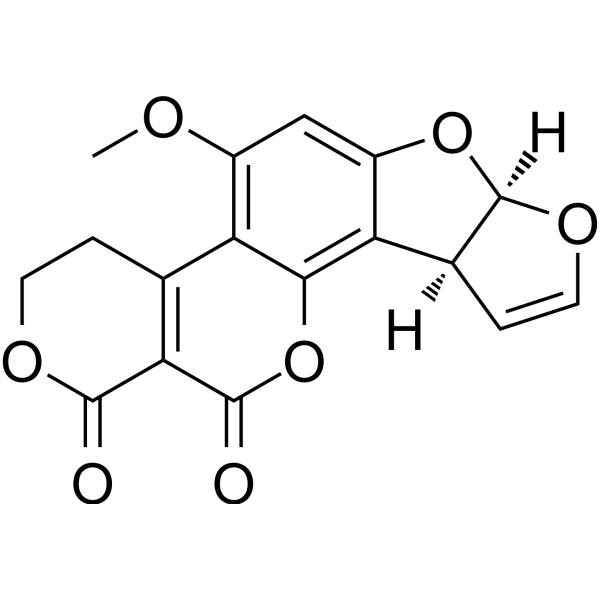
Aflatoxin G1

别名: AFLATOXIN G1; Aflatoxin; 1165-39-5; 1402-68-2; AFLATOXINS; Aflatoxin G; Aflatoxin, crude; Aflatoxin G1-d3; 黄曲霉毒素 G1;黄曲霉素G1;AFTG1标准品;黄曲霉毒素 g;黄曲霉毒素 G1 标准品;黄曲霉毒素 G1 标准品 Aflatoxin G1;黄曲霉毒素G1标准溶液;黄曲霉素 G1 标准溶液;乙酸-2,2,2-d3;黄曲霉毒素 G1;黄曲霉毒素G1
目录号: V33726 纯度: ≥98%
黄曲霉毒素 G1 是一种天然存在的黄曲霉毒素,由黄曲霉和寄生曲霉等霉菌产生。
Aflatoxin G1 CAS号: 1165-39-5
产品类别: New2
产品仅用于科学研究,不针对患者销售
规格 价格 库存 数量
1mg
5mg
100mg
Other Sizes

Other Forms of Aflatoxin G1:

  • 黄曲霉毒素 G1-13C17
点击了解更多
InvivoChem产品被CNS等顶刊论文引用
产品描述
黄曲霉毒素 G1 是一种天然存在的黄曲霉毒素,由黄曲霉和寄生曲霉等霉菌产生。黄曲霉毒素是饲料、坚果、葡萄酒、香料和其他粮食作物中发现的具有肝毒性、致畸性和致癌性的真菌代谢物。
生物活性&实验参考方法
靶点
Secondary metabolite from Aspergillus flavus and Aspergillus parasiticus
体外研究 (In Vitro)
黄曲霉毒素(AFs)是一种致肝、致畸、免疫抑制和致癌的真菌代谢物,存在于饲料、坚果、酿酒葡萄、香料和其他谷物作物中。人类通过食用受真菌毒素污染的食物而接触到AFs。本研究旨在确定三留尔法销售的红辣椒粉中AF污染的流行程度。从零售商店、超市、露天集市和养蜂场随机抽取42份样本,检测AFB1、AFB2、AFG1和AFG2毒素的发生和水平。免疫亲和柱预分离后,采用高效液相色谱系统测定AFs。16个样品的AFs含量低于2.5 μg/kg, 13个样品的AFs含量在2.5至10 μg/kg之间,13个样品的AFs含量高于土耳其食品法典和欧盟委员会规定的可容忍限量(10 μg/kg)。还对红辣椒粉加工过程中AF组分的发生情况进行了评价。本研究结果发现,红辣椒粉在接触土壤表面加工产品的排汗和最终干燥过程中AF积累量最高,而在混凝土表面生产的样品中黄曲霉毒素污染没有限值超过[2]。
体内研究 (In Vivo)
曲霉和其他真菌孢子的环境发生对人类和动物都是有害的。它们会引起广泛的临床并发症。黄曲霉毒素在农业食品和饲料中的污染是由于黄曲霉和寄生在人类和动物的毒性。曲霉基因组学和黄曲霉毒素管理实践的最新进展令人鼓舞,有助于解决重要曲霉物种[1]带来的挑战。
酶活实验
HPLC分析黄曲霉毒素[2]
采用高效液相色谱(HPLC)和荧光检测器自动进样器对样品中AFB1、AFB2、AFG1和AFG2进行检测和定量。HPLC设备为Shimadzu系统,配备Shimadzu LC-20AD泵、Shimadzu SIL-20 ADHT自动进样器、CTO-20AC柱式烤箱、Shimadzu RF-10AXL荧光检测器(FLD),激发波长为360 nm,发射波长为460 nm。色谱柱为ODS3柱(ODS3 250 mm × 5 μm × 4.6 mm)。流动相为蒸馏水/乙腈(90:10),流速为1 ml/min;注射量为100 μl (AOAC, 999.07)。
药代性质 (ADME/PK)
Absorption, Distribution and Excretion
Most of the aflatoxin administered to sheep appears to be destroyed in the body, only 8% of the amount given being recovered in the milk, urine and feces.
Analysis of 64 cord blood samples from pregnant women in Sierra Leone revealed the presence of ochratoxin A (OTA) and aflatoxins in 25% and 58% of samples, respectively. Of the eight maternal blood samples collected during delivery, one contained OTA and aflatoxins were detected in six. There was no relationship between mycotoxins in maternal and cord blood. The effect these toxins might have had on the birthweight of infants is discussed.
After a single oral administration of aflatoxin about 90% of the total amount eliminated by sheep is excreted during 48 hr after treatment. It cannot be detected in their milk after 6 days or in their urine or feces after 8 and 9 days respectively. Only 8.1% of a single oral dose of 1 mg/kg bw of mixed aflatoxin was recovered in an identifiable form in this species, the milk containing 0.1%, the urine 6.4% and the feces 1.6%.
Aflatoxin is excreted in the form of its metabolite aflatoxin M1 in the milk of lactating animals. In cattle given a single oral dose of aflatoxin, 85% of the total amount found in the milk and urine were detected in the first 48 hours after treatment. There was none in the milk after four days, nor in the urine or feces after six days. The total aflatoxin found in the milk was 0.39% of that ingested. ... Less than 0.6% of administered aflatoxin B1 was excreted in the milk. The amount of aflatoxin excreted in milk is unrelated to milk yield, and it disappears from the milk three to four days after the feeding of toxic meal is discontinued.
For more Absorption, Distribution and Excretion (Complete) data for AFLATOXINS (8 total), please visit the HSDB record page.
Aflatoxins B1 & G1 & their metabolites exist in systemic blood as protein conjugates. This conjugation is specific to plasma albumin & proceeds enzymatically by liver & kidney cells. The albumin-aflatoxin conjugate is permanent & conjugation is an irreversible one.
Three groups of four Large White sows were fed diets containing either 800 ppb purified aflatoxin B1 (group 1), 800 ppb purified aflatoxin G1 (group 2) or 400 ppb B1 and 400 ppb G1 (group 3) throughout gestation and lactation. A control group of four sows was fed a diet free of aflatoxins. Aflatoxins B1 and M1 were found in milk samples taken five and 25 days after parturition from the sows of group 1, aflatoxin G1 was present in the milk of the sows of group 2 and all three aflatoxins were present in samples from the sows of group 3. The concentration of aflatoxin in the milk was about 1000-fold lower than that in the feed, but increased over the 25 days after parturition.
Metabolism / Metabolites
... Aflatoxins are metabolized by the liver to epoxides that have very short half-lives & act mainly on the liver.
Current research using both in vivo and in vitro studies has shown that the differences in response to aflatoxin in different animals can be attributed to their differential metabolism. The rates of metabolism and intermediate products formed are important factors in determining the type of toxic action of aflatoxin B1. According to these criteria, monkey and man are more susceptible to acute aflatoxicosis and relatively resistant to carcinogenic effects. On the other hand, animals, such as sheep and rat, are more susceptible to carcinogenic effects.
Aflatoxin B1 requires metabolic activation by the cytochrome p450 dependent mixed-function oxidase to be converted to the reactive 2,3-epoxide, the ultimate carcinogen. The aflatoxins, eg, aflatoxin B1, are genotoxic carcinogens and the reactive metabolites react with DNA. The major adduct formed with DNA in intracellular reactions is formed from the 2-position of aflatoxin B1 and the N-7 position of guanine in DNA. /B1/
CYP1A2, 2B6, 3A4, 3A5, 3A7 and GSTM1 are enzymes that mediate aflatoxin metabolism in humans. The overall contribution of these enzymes to aflatoxin-B1 metabolism in vivo will depend not only on their affinity but also on their expression level in human liver, where CYP3A4 is predominant. This enzyme mediates the formation of the exo-epoxide and aflatoxin Q1, while CYP1A2 can generate some exo-epoxide but also a high proportion of endo-epoxide and aflatoxin M1. In vitro evidence that both these enzymes are responsible for aflatoxin metabolism in humans has been substantiated by biomarker studies. Aflatoxins M1 and Q1, produced by CYP1A2 and 3A4, respectively, are present in the urine of individuals exposed to aflatoxin.
Aflatoxins are secondary metabolites produced by a group of strains, mainly Aspergillus and Penicillium species. These mycotoxins are bifurano-coumarin derivatives group with four major products B1, B2, G1 and G2 according to blue or green fluorescence emitted in ultraviolet light and according to chromatographic separation. After metabolism of aflatoxin B1 and B2 in the mammalian body, result two metabolites M1 and M2 as hydroxylated derivatives of the parent compound...
Yields aflatoxin B3 in rhizopus ... yields aflatoxin gm1 in rat. From table/
Aflatoxin B1, aflatoxin B2, & aflatoxin G1 admin iv to rats were rapidly metabolized to 7 groups of metabolites each, 6 of which were excreted in the bile. All 3 toxins were hydroxylated at the 2- & 4-positions. Bile from the rats that had received aflatoxin G1 contained glucuronide.
...The incubation of human liver microsomes with aflatoxin B1 /or/ aflatoxin G1 ...yielded genotoxic metabolites that induced umuC gene expression in Salmonella typhimurium (TA-1535/psK1002). The rank order of genotoxic potency was ...aflatoxin B1>aflatoxin G1. Microsomal activation of the ...aflatoxins was completely inhibited upon incubation with polyclonal antibodies against p450NF, and immunochemical determinations of p450NF /(nifedipine oxidase)/ in the liver microsomal preparations were correlated with the microsomal activation of ...aflatoxin G1 and aflatoxin B1. P450NF converted the ...aflatoxins to genotoxic metabolites in a reconstituted monooxygenase system containing the purified enzyme and an NADPH generating system. ...
Aflatoxins are metabolized in the liver by the cytochrome P-450-dependent polysubstrate mono-oxygenase system to less toxic metabolites. The main reactions in aflatoxin metabolism are hydroxylation, oxidation, and demethylation. (A2973)
毒性/毒理 (Toxicokinetics/TK)
Toxicity Summary
Aflatoxins produce singlet oxygen upon their exposure to UV (365-nm) light. Singlet oxygen in turn activates them to mutagens and DNA binding species. Aflatoxin metabolites can intercalate into DNA and alkylate the bases through their epoxide moiety, binding particularity to N7-guanine bases. In addition to randomly mutating DNA, this is thought to cause mutations in the p53 gene, an important gene in preventing cell cycle progression when there are DNA mutations, or signaling apoptosis. (L1877, A2859, A2972)
Interactions
Aflatoxins B1, B2, G1 and G2 were administered in a low concentration (100 ppb of each aflatoxin [AN] in a mash offered to Baladi rabbits. An other group of rabbits were fed on the same contaminated mash in addition to 0.25% charcoal (CC). The two groups were compared to control animals fed on AN-free mash. Inclusion of AN in the diet decreased feed and water consumption, body weight and survival rate. Charcoal improved somewhat feed and water consumption and growth rate than AN-group. However, CC-group affected digestibility of organic matter more than AN-group. Relative weights of liver, kidneys, heart and adrenal glands were significantly higher in AN and CC groups than the control group. Blood hemoglobin content, packed cell volume percentage and sedimentation rate were lower in AN group. Although there were an increase in each of serum, calcium, inorganic phosphorus, cholesterol, phospholipids and glutamic-pyruvic transaminase in AN group, yet the serum nitrogen and glutamic-oxalacetic transaminase were reduced. Charcoal had alleviated AN-effects concerning N, GPT and phospholipids. Chemical analysis revealed elevation of water, ash and silica contents of liver and water content of muscles from AN-animals. On the other hand, fat content, GOT and vitamin A in the liver as well as muscles ash were reduced. Addition of CC to the diet reduced AN-effects on liver fat, ash and silica but resulted in a rise of the water content of liver and muscles and liver GPT activity. Charcoal also resulted in a sharp decrease in vitamin A content of the liver. Aflatoxin treatments (in AN and CC groups) reduced bone ash, silica and magnesium as well as bone volume. Charcoal administration increased Ca-content of bones. Aflatoxin feeding (in AN group) resulted in a high residual percentage of AN in muscles, serum, liver, heart and kidneys with relationships of 51 :24 : 3 :2 : 1, respectively. Only 1.42% of the fed AN was excreted in the feces. Charcoal usage had a good effect as it prevented AN to accumulate in the organs. Aflatoxin contaminated diets (in AN and CC groups) resulted in paralysis, disorder of fat deposition, discoloration and hemorrhages of some organs. Scanning electron microscopic examination revealed no ill effect on the surface structure of the small intestine due to either AN or AN + CC. Pathological examination showed that the main affected organs were liver, heart and spleen, ... . The changes include hepatic round cell infiltration, irregularities of lobular plats, focal necrosis and periportal fibrosis.
More subtle ... /effect/ of aflatoxin ingestion ... /is/ synergism or antagonism with various vitamins.
Mink were fed diets that contained 0, 34, or 102 ppb (ug/kg) aflatoxins with or without 0.5% hydrated sodium calcium aluminosilicate and/or 1.0% activated charcoal for 77 days. Consumption of the diet that contained 34 ppb aflatoxins was lethal to 20% of the mink, while 102 ppb dietary aflatoxins resulted in 100% mortality within 53 days. The addition of activated charcoal to the diet containing 102 ppb aflatoxins reduced mortality and increased survival time of the mink while the addition of hydrated sodium calcium aluminosilicate, alone or in combination with activated charcoal, prevented mortality. Histologic examination of livers and kidneys from the mink demonstrated liver lesions ranging from extremely severe in mink fed 102 ppb aflatoxin to mild to moderate in those that received 34 ppb aflatoxins. The addition of hydrated sodium calcium aluminosilicate and/or activated charcoal to the diets that contained 102 ppb aflatoxins reduced or essentially eliminated histopathologic lesions in the livers. No histopathologic alterations associated with the dietary treatments were observed in the kidneys.
The efficacy of detoxication by ammoniation of aflatoxin contaminated groundnut oil cakes was determined in long-term (18 month) feeding experiments with rats. The aflatoxin content of the cake was reduced very considerably by the pressurized application of ammonia, dropping from 1,000 to 140 ppb at a gas pressure of 2 bar and to 60 ppb at 3 bar. No reversion was noted during the experiment. The percentage of hepatic tumors obtained was very high for the untreated cakes, but fell sharply with medium treatment and was reduced to zero by the treatment at 3 bar. A satisfactory dose-effect relationship was shown between the residual aflatoxin content of the cakes and the observed incidence of tumors. The results show that ammonia treatment is a practical solution to the problem of the carcinogenic potency of contaminated oil cakes.
For more Interactions (Complete) data for AFLATOXINS (11 total), please visit the HSDB record page.
Non-Human Toxicity Values
LD50 Monkey oral 1750 ug/kg
LD50 Monkey intramuscular 2020 mg/kg
LD50 Rat intraperitoneal 14,900 ug/kg.
The Committee reaffirmed the conclusions of the forty-ninth meeting of JECFA that aflatoxins are among the most potent mutagenic and carcinogenic substances known, based on studies in test species and human epidemiological studies, and that hepatitis B virus (HBV) infection is a critical contributor to the potency of aflatoxins in inducing liver cancer. At the eighty-third meeting the Committee also evaluated co-exposure to aflatoxins and fumonisins. Fumonisins and aflatoxins are both frequent contaminants in cereals and cerealbased foods. Aflatoxins are common contaminants in groundnuts and tree nuts. Co-exposure to both mycotoxins is likely in areas where these foods are regularly consumed. Although evidence in laboratory animals from the previous and the present evaluations has suggested an additive or synergistic effect of fumonisin and aflatoxin co-exposure in the development of preneoplastic lesions or hepatocellular carcinoma, currently no data are available on such effects in humans. The Committee concluded that there are few data available to support co-exposure as a contributing factor in human disease. However, the interaction between AFB1, a compound with known genotoxic properties, and fumonisins, which have the potential to induce regenerative cell proliferation (particularly at exposures above the PMTDI), remains a concern. This is due to the fact that the incidences of chronic liver disease and stunting are high in the areas of the world where the exposures to both mycotoxins are high and the co-exposure has been confirmed with biomarkers.
参考文献

[1]. Aflatoxins: Implications on Health. Indian J Clin Biochem. 2017 Jun;32(2):124-133.

[2]. Aflatoxins B1, B2, G1, and G2 contamination in ground red peppers commercialized in Sanliurfa, Turkey. Environ Monit Assess. 2015 Apr;187(4):184.

其他信息
Aflatoxin G is a member of coumarins.
Aflatoxin G1 has been reported in Zea mays, Aspergillus flavus, and Aspergillus parasiticus with data available.
Aflatoxin is a group of mycotoxins, which are most commonly produced by Aspergillus flavus and A. parasiticus, and their toxic metabolites that are comprised of a fused coumarin-bis(dihydrofuran) ring structure, with potential acute and chronic toxic effects. Acute exposure to high levels of aflatoxins can cause liver damage. Chronic aflatoxin exposure results in an increased risk for liver cancer potentially caused by DNA intercalation and epoxide-mediated alkylation of nucleobases by aflatoxin metabolites, leading to increased levels of DNA damage, which may cause mutations.
Aflatoxin G is a mycotoxin produced by Aspergillus flavus and Aspergillus parasiticus

Aflatoxin G belongs to the family of Difurocoumarolactone Series. These are polycyclic aromatic compounds containing a delta-valerolactone ring fused to the coumarin moiety of the difurocoumarin skeleton. Difurocoumarolactones are a subgroup of the aflatoxins and related compounds.
See also: Aflatoxin G1 (annotation moved to).
Mechanism of Action
It has been suggested that the most probable mode of action of aflatoxins involve an interaction with DNA and inhibition of the polymerases responsible for DNA and RNA syntheis.
... Covalent binding of aflatoxin 8,9-oxide to N-7 of guanine results in pairing of the adduct-bearing guanine with adenine rather than cytosine, leading to the formation of an incorrect codon and the insertion of an incorrect amino acid into the protein. Such events are involved in the aflatoxin-induced mutation of the ras proto-oncogene and the p53 tumor suppressor gene. /Aflatoxin 8,9-oxide/
...In the present study ...isoprenaline (ISO, 4x10⁻⁹), AFB(1) (3x10⁻⁶ and 6x10⁻⁵ M) and AFG(1) (3x10⁻⁶ and 6x10⁻⁶ M) contracted the isolated guinea pig atria, leaving the preparation hyperresponsive to ISO. These properties of AF are of interest as they could be responsible for certain cardiotoxic effects described in the literature.
G to T transversions in codon 249 of the p53 tumor-suppressor gene have been found in human liver tumors from geographic areas with high risk of aflatoxin exposure and in experimental animals.
Ability of aflatoxin B1, aflatoxin B2, & aflatoxin G1 to inhibit RNA polymerase activity & decr RNA content in rat hepatocyte nuclei was qualitatively similar to the carcinogenic & acute & subacute toxic actions of these compounds. Aflatoxin g1 induced a rapid macrosegregation of the fibrillar & granular portions of the hepatocyte nucleolus.
In vitro studies with human liver indicate that the major catalyst involved in the bioactivation of the hepato-carcinogen aflatoxin B1 to its genotoxic 2,3-epoxide derivative is cytochrome P-450NF, a previously characterized protein that also catalyzes the oxidation of nifedipine and other dihydropyridines, quinidine, macrolide antibiotics, various steroids, and other compounds. ...Cytochrome p-450NF or a closely related protein also appears to be the major catalyst involved in the activation of aflatoxin G1 and sterigmatocystin, the latter compound being more genotoxic than aflatoxin B1 in these systems. Several drugs and conditions are known to influence the levels and activity of cytochrome p-450NF in human liver, and the activity of the enzyme can be estimated by noninvasive assays. These findings provide a test system for the hypothesis that a specific human disease state (liver cancer) is linked to the level of oxidative metabolism in populations in which aflatoxin ingestion is high.
Aflatoxin B1, aflatoxin G1 & aflatoxin G2 inhibited incorporation of (14)carbon labeled orotic acid into the RNA of rat liver slices at toxin concentrations of 100 umole/3 mL. Respective percent inhibitions were approx 90, 40, & 20. Aflatoxin B1, 20 umole/3 mL, aflatoxin G1, 150 umole/3 mL, & aflatoxin G2, 230 umole/3 mL inhibited the incorporation of (14)carbon labeled dl-leucine into proteins of rat liver slices by 32%, 35%, & 38%, respectively.
Phagocytosis, intracellular killing of Candida albicans, and superoxide production by rat peritoneal macrophages exposed to aflatoxins B1, B2, G1, G2, B2a, and M1 at several times and concn were analyzed to evaluate the intensity of a depressive effect for each mycotoxin. All aflatoxins used at very low concn had a depressive effect on the functions of macrophages. The biggest impairment of phagocytosis, intracellular killing, and spontaneous superoxide production was observed in macrophages exposed to aflatoxins B1 and M1.
Among the toxic aflatoxins, aflatoxins B1 and G1 are the most biologically active, but other derivatives also exhibit carcinogenicity. Aflatoxin B1 requires metabolic activation by the cytochrome p450 dependent mixed-function oxidase to be converted to the reactive 2,3-epoxide, the ultimate carcinogen. The aflatoxins, eg, aflatoxin B1, are genotoxic carcinogens and the reactive metabolites react with DNA. The major adduct formed with DNA in intracellular reactions is formed from the 2-position of aflatoxin B1 and the N-7 position of guanine in DNA.
*注: 文献方法仅供参考, InvivoChem并未独立验证这些方法的准确性
化学信息 & 存储运输条件
分子式
C17H12O7
分子量
328.27298
精确质量
328.058
CAS号
1165-39-5
相关CAS号
Aflatoxin G1-13C17;1217444-07-9
PubChem CID
14421
外观&性状
White to off-white solid powder
密度
1.6±0.1 g/cm3
沸点
612.1±55.0 °C at 760 mmHg
熔点
244-246ºC
闪点
274.1±31.5 °C
蒸汽压
0.0±1.8 mmHg at 25°C
折射率
1.680
LogP
-0.17
tPSA
84.2
氢键供体(HBD)数目
0
氢键受体(HBA)数目
7
可旋转键数目(RBC)
1
重原子数目
24
分子复杂度/Complexity
666
定义原子立体中心数目
0
SMILES
COC1=C2C3=C(C(=O)OCC3)C(=O)OC2=C4C5C=COC5OC4=C1
InChi Key
XWIYFDMXXLINPU-UHFFFAOYSA-N
InChi Code
InChI=1S/C17H12O7/c1-20-9-6-10-12(8-3-5-22-17(8)23-10)14-11(9)7-2-4-21-15(18)13(7)16(19)24-14/h3,5-6,8,17H,2,4H2,1H3
化学名
11-methoxy-6,8,16,20-tetraoxapentacyclo[10.8.0.02,9.03,7.013,18]icosa-1,4,9,11,13(18)-pentaene-17,19-dione
别名
AFLATOXIN G1; Aflatoxin; 1165-39-5; 1402-68-2; AFLATOXINS; Aflatoxin G; Aflatoxin, crude; Aflatoxin G1-d3;
HS Tariff Code
2934.99.9001
存储方式

Powder      -20°C    3 years

                     4°C     2 years

In solvent   -80°C    6 months

                  -20°C    1 month

运输条件
Room temperature (This product is stable at ambient temperature for a few days during ordinary shipping and time spent in Customs)
溶解度数据
溶解度 (体外实验)
DMSO : ~10 mg/mL (~30.46 mM)
溶解度 (体内实验)
注意: 如下所列的是一些常用的体内动物实验溶解配方,主要用于溶解难溶或不溶于水的产品(水溶度<1 mg/mL)。 建议您先取少量样品进行尝试,如该配方可行,再根据实验需求增加样品量。

注射用配方
(IP/IV/IM/SC等)
注射用配方1: DMSO : Tween 80: Saline = 10 : 5 : 85 (如: 100 μL DMSO 50 μL Tween 80 850 μL Saline)
*生理盐水/Saline的制备:将0.9g氯化钠/NaCl溶解在100 mL ddH ₂ O中,得到澄清溶液。
注射用配方 2: DMSO : PEG300Tween 80 : Saline = 10 : 40 : 5 : 45 (如: 100 μL DMSO 400 μL PEG300 50 μL Tween 80 450 μL Saline)
注射用配方 3: DMSO : Corn oil = 10 : 90 (如: 100 μL DMSO 900 μL Corn oil)
示例: 注射用配方 3 (DMSO : Corn oil = 10 : 90) 为例说明, 如果要配制 1 mL 2.5 mg/mL的工作液, 您可以取 100 μL 25 mg/mL 澄清的 DMSO 储备液,加到 900 μL Corn oil/玉米油中, 混合均匀。
View More

注射用配方 4: DMSO : 20% SBE-β-CD in Saline = 10 : 90 [如:100 μL DMSO 900 μL (20% SBE-β-CD in Saline)]
*20% SBE-β-CD in Saline的制备(4°C,储存1周):将2g SBE-β-CD (磺丁基-β-环糊精) 溶解于10mL生理盐水中,得到澄清溶液。
注射用配方 5: 2-Hydroxypropyl-β-cyclodextrin : Saline = 50 : 50 (如: 500 μL 2-Hydroxypropyl-β-cyclodextrin (羟丙基环胡精) 500 μL Saline)
注射用配方 6: DMSO : PEG300 : Castor oil : Saline = 5 : 10 : 20 : 65 (如: 50 μL DMSO 100 μL PEG300 200 μL Castor oil 650 μL Saline)
注射用配方 7: Ethanol : Cremophor : Saline = 10: 10 : 80 (如: 100 μL Ethanol 100 μL Cremophor 800 μL Saline)
注射用配方 8: 溶解于Cremophor/Ethanol (50 : 50), 然后用生理盐水稀释。
注射用配方 9: EtOH : Corn oil = 10 : 90 (如: 100 μL EtOH 900 μL Corn oil)
注射用配方 10: EtOH : PEG300Tween 80 : Saline = 10 : 40 : 5 : 45 (如: 100 μL EtOH 400 μL PEG300 50 μL Tween 80 450 μL Saline)


口服配方
口服配方 1: 悬浮于0.5% CMC Na (羧甲基纤维素钠)
口服配方 2: 悬浮于0.5% Carboxymethyl cellulose (羧甲基纤维素)
示例: 口服配方 1 (悬浮于 0.5% CMC Na)为例说明, 如果要配制 100 mL 2.5 mg/mL 的工作液, 您可以先取0.5g CMC Na并将其溶解于100mL ddH2O中,得到0.5%CMC-Na澄清溶液;然后将250 mg待测化合物加到100 mL前述 0.5%CMC Na溶液中,得到悬浮液。
View More

口服配方 3: 溶解于 PEG400 (聚乙二醇400)
口服配方 4: 悬浮于0.2% Carboxymethyl cellulose (羧甲基纤维素)
口服配方 5: 溶解于0.25% Tween 80 and 0.5% Carboxymethyl cellulose (羧甲基纤维素)
口服配方 6: 做成粉末与食物混合


注意: 以上为较为常见方法,仅供参考, InvivoChem并未独立验证这些配方的准确性。具体溶剂的选择首先应参照文献已报道溶解方法、配方或剂型,对于某些尚未有文献报道溶解方法的化合物,需通过前期实验来确定(建议先取少量样品进行尝试),包括产品的溶解情况、梯度设置、动物的耐受性等。

请根据您的实验动物和给药方式选择适当的溶解配方/方案:
1、请先配制澄清的储备液(如:用DMSO配置50 或 100 mg/mL母液(储备液));
2、取适量母液,按从左到右的顺序依次添加助溶剂,澄清后再加入下一助溶剂。以 下列配方为例说明 (注意此配方只用于说明,并不一定代表此产品 的实际溶解配方):
10% DMSO → 40% PEG300 → 5% Tween-80 → 45% ddH2O (或 saline);
假设最终工作液的体积为 1 mL, 浓度为5 mg/mL: 取 100 μL 50 mg/mL 的澄清 DMSO 储备液加到 400 μL PEG300 中,混合均匀/澄清;向上述体系中加入50 μL Tween-80,混合均匀/澄清;然后继续加入450 μL ddH2O (或 saline)定容至 1 mL;

3、溶剂前显示的百分比是指该溶剂在最终溶液/工作液中的体积所占比例;
4、 如产品在配制过程中出现沉淀/析出,可通过加热(≤50℃)或超声的方式助溶;
5、为保证最佳实验结果,工作液请现配现用!
6、如不确定怎么将母液配置成体内动物实验的工作液,请查看说明书或联系我们;
7、 以上所有助溶剂都可在 Invivochem.cn网站购买。
制备储备液 1 mg 5 mg 10 mg
1 mM 3.0463 mL 15.2314 mL 30.4627 mL
5 mM 0.6093 mL 3.0463 mL 6.0925 mL
10 mM 0.3046 mL 1.5231 mL 3.0463 mL

1、根据实验需要选择合适的溶剂配制储备液 (母液):对于大多数产品,InvivoChem推荐用DMSO配置母液 (比如:5、10、20mM或者10、20、50 mg/mL浓度),个别水溶性高的产品可直接溶于水。产品在DMSO 、水或其他溶剂中的具体溶解度详见上”溶解度 (体外)”部分;

2、如果您找不到您想要的溶解度信息,或者很难将产品溶解在溶液中,请联系我们;

3、建议使用下列计算器进行相关计算(摩尔浓度计算器、稀释计算器、分子量计算器、重组计算器等);

4、母液配好之后,将其分装到常规用量,并储存在-20°C或-80°C,尽量减少反复冻融循环。

计算器

摩尔浓度计算器可计算特定溶液所需的质量、体积/浓度,具体如下:

  • 计算制备已知体积和浓度的溶液所需的化合物的质量
  • 计算将已知质量的化合物溶解到所需浓度所需的溶液体积
  • 计算特定体积中已知质量的化合物产生的溶液的浓度
使用摩尔浓度计算器计算摩尔浓度的示例如下所示:
假如化合物的分子量为350.26 g/mol,在5mL DMSO中制备10mM储备液所需的化合物的质量是多少?
  • 在分子量(MW)框中输入350.26
  • 在“浓度”框中输入10,然后选择正确的单位(mM)
  • 在“体积”框中输入5,然后选择正确的单位(mL)
  • 单击“计算”按钮
  • 答案17.513 mg出现在“质量”框中。以类似的方式,您可以计算体积和浓度。

稀释计算器可计算如何稀释已知浓度的储备液。例如,可以输入C1、C2和V2来计算V1,具体如下:

制备25毫升25μM溶液需要多少体积的10 mM储备溶液?
使用方程式C1V1=C2V2,其中C1=10mM,C2=25μM,V2=25 ml,V1未知:
  • 在C1框中输入10,然后选择正确的单位(mM)
  • 在C2框中输入25,然后选择正确的单位(μM)
  • 在V2框中输入25,然后选择正确的单位(mL)
  • 单击“计算”按钮
  • 答案62.5μL(0.1 ml)出现在V1框中
g/mol

分子量计算器可计算化合物的分子量 (摩尔质量)和元素组成,具体如下:

注:化学分子式大小写敏感:C12H18N3O4  c12h18n3o4
计算化合物摩尔质量(分子量)的说明:
  • 要计算化合物的分子量 (摩尔质量),请输入化学/分子式,然后单击“计算”按钮。
分子质量、分子量、摩尔质量和摩尔量的定义:
  • 分子质量(或分子量)是一种物质的一个分子的质量,用统一的原子质量单位(u)表示。(1u等于碳-12中一个原子质量的1/12)
  • 摩尔质量(摩尔重量)是一摩尔物质的质量,以g/mol表示。
/

配液计算器可计算将特定质量的产品配成特定浓度所需的溶剂体积 (配液体积)

  • 输入试剂的质量、所需的配液浓度以及正确的单位
  • 单击“计算”按钮
  • 答案显示在体积框中
动物体内实验配方计算器(澄清溶液)
第一步:请输入基本实验信息(考虑到实验过程中的损耗,建议多配一只动物的药量)
第二步:请输入动物体内配方组成(配方适用于不溶/难溶于水的化合物),不同的产品和批次配方组成不同,如对配方有疑问,可先联系我们提供正确的体内实验配方。此外,请注意这只是一个配方计算器,而不是特定产品的确切配方。
+
+
+

计算结果:

工作液浓度 mg/mL;

DMSO母液配制方法 mg 药物溶于 μL DMSO溶液(母液浓度 mg/mL)。如该浓度超过该批次药物DMSO溶解度,请首先与我们联系。

体内配方配制方法μL DMSO母液,加入 μL PEG300,混匀澄清后加入μL Tween 80,混匀澄清后加入 μL ddH2O,混匀澄清。

(1) 请确保溶液澄清之后,再加入下一种溶剂 (助溶剂) 。可利用涡旋、超声或水浴加热等方法助溶;
            (2) 一定要按顺序加入溶剂 (助溶剂) 。

联系我们