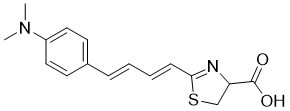
AkaLumine

别名: 2-[(1,3)-4-[4-(二甲氨基)苯基]-1,3-丁二烯-1-基]-4,5-二氢-(4)-4-噻唑羧酸盐酸盐
目录号: V5568 纯度: ≥98%
AkaLumine 是 CycLuc1 的开环类似物,是一种新型荧光素类似物和萤火虫荧光素酶的底物。
AkaLumine CAS号: 1176235-08-7
产品类别: New12
产品仅用于科学研究,不针对患者销售
规格 价格 库存 数量
50mg
100mg
Other Sizes

Other Forms of AkaLumine:

  • 盐酸阿卡鲁明
点击了解更多
InvivoChem产品被CNS等顶刊论文引用
顾客使用InvivoChem 产品阿卡鲁明发表2篇科研文献
产品描述
AkaLumine 是 CycLuc1 的开环类似物,是一种新型荧光素类似物和萤火虫荧光素酶的底物。 AkaLumine 与天然萤火虫荧光素酶反应时产生的生物发光处于近红外波长范围 (λmax=677 nm),与 D 相比,深层组织的目标检测灵敏度显着提高,在极低浓度下即可获得最大信号-荧光素和新兴的合成荧光素 CycLuc1。
生物活性&实验参考方法
靶点
Recombinant Fluc protein (Km = 2.06 μM )
体外研究 (In Vitro)
用 AkaLumine HCl 处理的 LLC/luc 和 MDA-MB-231/luc 细胞中的信号在较低浓度 (2.5 μM) 时达到峰值,而 D-荧光素和 CycLuc1 在较高剂量下产生更多的生物发光。上升,即使在 250 μM 时也没有达到最大信号 [1]。
体内研究 (In Vivo)
AkaLumine 盐酸盐显示来自肺转移的信号显着升高,与 D-荧光素给药相比增强了 8.1 倍。为了评估 AkaLumine HCl 在检测深部组织靶点方面相对于 CycLuc1 的优越性,以 5 mM 剂量(最大剂量)静脉注射 LLC/luc 细胞 15 分钟后,AkaLumine HCl 和 CycLuc1 处理的小鼠的生物发光 比较图像 CycLuc1 的浓度由于其水溶性较低,因此其含量较高。与 CycLuc1 相比,AkaLumine 盐酸盐对播散性肺癌细胞的检测灵敏度提高了 3.3 倍。通过按照 CycLuc1 和 AkaLumine 盐酸盐的顺序腹腔注射 5 mM 底物,并以相反的顺序每 8 小时注射一次,对具有肺转移的相同小鼠进行成像,进一步验证了 AkaLumine 盐酸盐的优越性。成像。与 CycLuc1 相比,AkaLumine 盐酸盐的肺转移信号增加了约四倍 [1]。
可在小鼠体内实现高灵敏度的深部组织成像。将AkaLumine腹腔注射到小鼠体内后,其可与荧光素酶反应,产生的近红外生物发光能够穿透组织,使深部组织如大脑和腹部器官等结构清晰成像,为无创监测活体动物体内生物过程提供了有力工具[1]
酶活实验
生物发光发射光谱的测量[1]
使用ATTO AB-1850分光光度计测量d-荧光素、CycLuc1和AkaLumine-HCl的生物发光发射光谱。通过将5 μl基质(100 μM),5 μl QuantiLum重组萤光素酶溶液(1 毫克 ml−1)和5 μl磷酸钾缓冲液(500 mM、pH 8.0)。然后通过注射10 μl ATP Mg(200 μM)加入反应混合物中。生物发光发射光谱在1 nm从400增加到780 nm使用3 最小积分时间。[1]

K m值的测量[1]
除底物浓度外,在与生物发光光谱测量相同的条件下测量d-荧光素、CycLuc1和AkaLumine HCl的生物发光强度。基质的最终浓度在0.2到500之间变化 μM和0.1至100 μM。底物的Km和Vmax值由生物发光强度的积分值确定,并使用市售SigmaPlot 9.0软件包中的酶动力学向导通过Lineweaver–Burk图计算。
细胞实验
使用生物组织的生物发光透射测定[1]
用IVIS Spectrum 1测量来自孔的生物发光信号 基质后分钟(最终浓度为2.5 μM,对于d-葡糖苷和AkaLumine HCl,50 CycLuc1的nM)与重组Fluc蛋白(20 μg ml−1)在ATP Mg(最终浓度为20 μM)在黑色96孔板中。将生物组织(4mm厚的牛肉片)放置在孔上,以测量通过组织的生物发光信号,然后通过两层生物组织获取生物发光图像。以下条件用于图像采集:曝光时间=10 s、 装仓=中等:8,视野=12.9×12.9 并且f/stop=1。通过IVIS系统专用的Living Image 4.3软件(PerkinElmer)分析生物发光图像。穿透效率(%)是通过将牛肉覆盖井的信号强度除以相应的未覆盖井的那些信号强度来计算的。[1]

稳定表达luc报告基因的癌症细胞系的分离[1]
小鼠肺癌细胞LLC、人乳腺癌症细胞MDA-MB-231和人癌症细胞PC-3从ATCC获得。LLC/luc和MDA-MB-231/luc细胞在用质粒pEF/luc转染后通过磷酸钙法分离,如先前所述19,20。PC-3/κB-luc也如先前所述被分离21。细胞维持在37 °C的5%FCS-DMEM(Nacalai Tesque,Kyoto,Japan)中添加青霉素(100单位/ml)和链霉素(100 μg ml−1),并通过支原体检查试剂盒定期检查支原体污染。对于每个实验,所有细胞系都被独立地存储并每次从原始库存中回收。[1]

体外BLI[1]
底物在黑色96孔板中与LLC/luc或MDA-MB-231/luc细胞(4×105个细胞/孔)反应。使用IVIS Spectrum 1测量生物发光 分钟后加入基质。以下条件用于图像采集:对总生物发光开放或680±10 用于近红外生物发光的发射滤光片的nm,暴露时间=10 s、 装仓=中等:8,视野=12.9×12.9 cm和f/stop=1。通过IVIS系统专用的Living Image 4.3软件对生物发光图像进行分析。
动物实验
Tumour models
For subcutaneous tumour models, LLC/luc (3 × 10⁵ cells per 10 μl) or PC-3/κB-luc (1 × 10⁶ cells per 10 μl) suspended in PBS was mixed with an equal volume of Geltrex and subcutaneously or intratibially injected into C57B/6 albino mice (female) or severe combined immunodeficient mice (male), respectively. The experiments were performed 4 days after engraftment. For a model with disseminated cancer cells in the lung, C57B/6 albino mice (male) were intravenously injected with LLC/luc (1 × 10⁵ cells per 100 μl PBS) 15 min before in vivo BLI. For lung metastasis model, LLC/luc (5 × 10⁵ cells per 100 μl) suspended in PBS was injected from tail vein of C57B/6 albino mice (male). The experiments were performed 10–20 days after intravenous injection. These tumour models are well established and tumour growth is stable. Therefore, six samples are adequate sample size for evaluation of tumour growth in each experiment.

In vivo BLI
Bioluminescence images of subcutaneous tumours were acquired with IVIS Spectrum 15 min (unless otherwise indicated) after intraperitoneal injection with indicated amount of the substrates. As bioluminescence intensities from lung metastasis peaked at various time after a substrate injection, bioluminescence images of lung metastasis were sequentially acquired with IVIS Spectrum every 3 min for 30 min after intraperitoneal injection with the substrates and the highest bioluminescence intensities among the acquired images were selected for analysis. For comparing bioluminescence production between different substrates using the same mice, the images for AkaLumine-HCl were acquired 4 and 8 h after injection of d-luciferin and CycLucl, respectively. The following conditions were used for image acquisition: open emission filter, exposure time=60 s, binning=medium: 8, field of view=12.9 × 12.9 cm and f/stop=1. For three-dimensional BLI in lung metastasis model, a mouse injected with AkaLumine-HCl was subjected to BLI with three different wavelengths (660±10, 680±10 and 700±10 nm) of bioluminescence filters. The following conditions were used for imaging acquisition: exposure time=60 s, binning=medium: 8, field of view=12.9 × 12.9 cm and f/stop=1. The bioluminescence images were analysed by Living Image 4.3 software specialized for IVIS system.

Ex vivo BLI
A mouse was scarified immediately after in vivo BLI by using AkaLumine-HCl and the lung was removed. Bioluminescence image of the lung was obtained with the following conditions: open emission filter, exposure time=30 s, binning=medium: 8, field of view=12.9 × 12.9 cm and f/stop=1. The bioluminescence images were analysed by Living Image 4.3 software specialized for IVIS system.
Dissolve AkaLumine in dimethyl sulfoxide (DMSO) first, and then dilute it with physiological saline. Intraperitoneally inject the prepared solution into mice at a dose of 10 mg/kg. Observe the bioluminescence signal of mice with an in - vivo imaging system at different time points after injection to perform deep - tissue imaging [1]
毒性/毒理 (Toxicokinetics/TK)
No significant toxic effects were observed in mice after intraperitoneal injection of AkaLumine. The general condition of the mice did not change significantly, and no liver or kidney function damage was found, indicating that AkaLumine has good biocompatibility and low toxicity[1].
参考文献

[1]. A luciferin analogue generating near-infrared bioluminescence achieves highly sensitive deep-tissue imaging. Nat Commun. 2016 Jun 14;7:11856.

其他信息
AkaLumine is a luciferin analog. Traditional luciferin-luciferase systems are limited in in vivo signal detection because their short-wavelength light is easily absorbed by tissues. AkaLumine can produce near-infrared bioluminescence and has better tissue penetration, thus enabling high-sensitivity deep tissue imaging. It can be used for non-invasive monitoring of gene expression and biological processes in living animals, providing a new method for biological research and preclinical studies [1].
*注: 文献方法仅供参考, InvivoChem并未独立验证这些方法的准确性
化学信息 & 存储运输条件
分子式
C16H18N2O2S
分子量
302.391322612762
精确质量
302.108
元素分析
C, 63.55; H, 6.00; N, 9.26; O, 10.58; S, 10.60
CAS号
1176235-08-7
相关CAS号
1176235-08-7; 2558205-28-8 (HCl)
PubChem CID
139329217
外观&性状
Typically exists as solid at room temperature
密度
1.2±0.1 g/cm3
沸点
541.4±60.0 °C at 760 mmHg
闪点
281.2±32.9 °C
蒸汽压
0.0±1.5 mmHg at 25°C
折射率
1.598
LogP
2.06
tPSA
78.2
氢键供体(HBD)数目
1
氢键受体(HBA)数目
5
可旋转键数目(RBC)
5
重原子数目
21
分子复杂度/Complexity
449
定义原子立体中心数目
0
SMILES
S1C(/C=C/C=C/C2C=CC(=CC=2)N(C)C)=NC(C(=O)O)C1
InChi Key
ULTVSKXCSMDCHR-GGWOSOGESA-N
InChi Code
InChI=1S/C16H18N2O2S/c1-18(2)13-9-7-12(8-10-13)5-3-4-6-15-17-14(11-21-15)16(19)20/h3-10,14H,11H2,1-2H3,(H,19,20)/b5-3+,6-4+
化学名
2-[(1E,3E)-4-[4-(dimethylamino)phenyl]buta-1,3-dienyl]-4,5-dihydro-1,3-thiazole-4-carboxylic acid
HS Tariff Code
2934.99.9001
存储方式

Powder      -20°C    3 years

                     4°C     2 years

In solvent   -80°C    6 months

                  -20°C    1 month

运输条件
Room temperature (This product is stable at ambient temperature for a few days during ordinary shipping and time spent in Customs)
溶解度数据
溶解度 (体外实验)
May dissolve in DMSO (in most cases), if not, try other solvents such as H2O, Ethanol, or DMF with a minute amount of products to avoid loss of samples
溶解度 (体内实验)
注意: 如下所列的是一些常用的体内动物实验溶解配方,主要用于溶解难溶或不溶于水的产品(水溶度<1 mg/mL)。 建议您先取少量样品进行尝试,如该配方可行,再根据实验需求增加样品量。

注射用配方
(IP/IV/IM/SC等)
注射用配方1: DMSO : Tween 80: Saline = 10 : 5 : 85 (如: 100 μL DMSO 50 μL Tween 80 850 μL Saline)
*生理盐水/Saline的制备:将0.9g氯化钠/NaCl溶解在100 mL ddH ₂ O中,得到澄清溶液。
注射用配方 2: DMSO : PEG300Tween 80 : Saline = 10 : 40 : 5 : 45 (如: 100 μL DMSO 400 μL PEG300 50 μL Tween 80 450 μL Saline)
注射用配方 3: DMSO : Corn oil = 10 : 90 (如: 100 μL DMSO 900 μL Corn oil)
示例: 注射用配方 3 (DMSO : Corn oil = 10 : 90) 为例说明, 如果要配制 1 mL 2.5 mg/mL的工作液, 您可以取 100 μL 25 mg/mL 澄清的 DMSO 储备液,加到 900 μL Corn oil/玉米油中, 混合均匀。
View More

注射用配方 4: DMSO : 20% SBE-β-CD in Saline = 10 : 90 [如:100 μL DMSO 900 μL (20% SBE-β-CD in Saline)]
*20% SBE-β-CD in Saline的制备(4°C,储存1周):将2g SBE-β-CD (磺丁基-β-环糊精) 溶解于10mL生理盐水中,得到澄清溶液。
注射用配方 5: 2-Hydroxypropyl-β-cyclodextrin : Saline = 50 : 50 (如: 500 μL 2-Hydroxypropyl-β-cyclodextrin (羟丙基环胡精) 500 μL Saline)
注射用配方 6: DMSO : PEG300 : Castor oil : Saline = 5 : 10 : 20 : 65 (如: 50 μL DMSO 100 μL PEG300 200 μL Castor oil 650 μL Saline)
注射用配方 7: Ethanol : Cremophor : Saline = 10: 10 : 80 (如: 100 μL Ethanol 100 μL Cremophor 800 μL Saline)
注射用配方 8: 溶解于Cremophor/Ethanol (50 : 50), 然后用生理盐水稀释。
注射用配方 9: EtOH : Corn oil = 10 : 90 (如: 100 μL EtOH 900 μL Corn oil)
注射用配方 10: EtOH : PEG300Tween 80 : Saline = 10 : 40 : 5 : 45 (如: 100 μL EtOH 400 μL PEG300 50 μL Tween 80 450 μL Saline)


口服配方
口服配方 1: 悬浮于0.5% CMC Na (羧甲基纤维素钠)
口服配方 2: 悬浮于0.5% Carboxymethyl cellulose (羧甲基纤维素)
示例: 口服配方 1 (悬浮于 0.5% CMC Na)为例说明, 如果要配制 100 mL 2.5 mg/mL 的工作液, 您可以先取0.5g CMC Na并将其溶解于100mL ddH2O中,得到0.5%CMC-Na澄清溶液;然后将250 mg待测化合物加到100 mL前述 0.5%CMC Na溶液中,得到悬浮液。
View More

口服配方 3: 溶解于 PEG400 (聚乙二醇400)
口服配方 4: 悬浮于0.2% Carboxymethyl cellulose (羧甲基纤维素)
口服配方 5: 溶解于0.25% Tween 80 and 0.5% Carboxymethyl cellulose (羧甲基纤维素)
口服配方 6: 做成粉末与食物混合


注意: 以上为较为常见方法,仅供参考, InvivoChem并未独立验证这些配方的准确性。具体溶剂的选择首先应参照文献已报道溶解方法、配方或剂型,对于某些尚未有文献报道溶解方法的化合物,需通过前期实验来确定(建议先取少量样品进行尝试),包括产品的溶解情况、梯度设置、动物的耐受性等。

请根据您的实验动物和给药方式选择适当的溶解配方/方案:
1、请先配制澄清的储备液(如:用DMSO配置50 或 100 mg/mL母液(储备液));
2、取适量母液,按从左到右的顺序依次添加助溶剂,澄清后再加入下一助溶剂。以 下列配方为例说明 (注意此配方只用于说明,并不一定代表此产品 的实际溶解配方):
10% DMSO → 40% PEG300 → 5% Tween-80 → 45% ddH2O (或 saline);
假设最终工作液的体积为 1 mL, 浓度为5 mg/mL: 取 100 μL 50 mg/mL 的澄清 DMSO 储备液加到 400 μL PEG300 中,混合均匀/澄清;向上述体系中加入50 μL Tween-80,混合均匀/澄清;然后继续加入450 μL ddH2O (或 saline)定容至 1 mL;

3、溶剂前显示的百分比是指该溶剂在最终溶液/工作液中的体积所占比例;
4、 如产品在配制过程中出现沉淀/析出,可通过加热(≤50℃)或超声的方式助溶;
5、为保证最佳实验结果,工作液请现配现用!
6、如不确定怎么将母液配置成体内动物实验的工作液,请查看说明书或联系我们;
7、 以上所有助溶剂都可在 Invivochem.cn网站购买。
制备储备液 1 mg 5 mg 10 mg
1 mM 3.3070 mL 16.5349 mL 33.0699 mL
5 mM 0.6614 mL 3.3070 mL 6.6140 mL
10 mM 0.3307 mL 1.6535 mL 3.3070 mL

1、根据实验需要选择合适的溶剂配制储备液 (母液):对于大多数产品,InvivoChem推荐用DMSO配置母液 (比如:5、10、20mM或者10、20、50 mg/mL浓度),个别水溶性高的产品可直接溶于水。产品在DMSO 、水或其他溶剂中的具体溶解度详见上”溶解度 (体外)”部分;

2、如果您找不到您想要的溶解度信息,或者很难将产品溶解在溶液中,请联系我们;

3、建议使用下列计算器进行相关计算(摩尔浓度计算器、稀释计算器、分子量计算器、重组计算器等);

4、母液配好之后,将其分装到常规用量,并储存在-20°C或-80°C,尽量减少反复冻融循环。

计算器

摩尔浓度计算器可计算特定溶液所需的质量、体积/浓度,具体如下:

  • 计算制备已知体积和浓度的溶液所需的化合物的质量
  • 计算将已知质量的化合物溶解到所需浓度所需的溶液体积
  • 计算特定体积中已知质量的化合物产生的溶液的浓度
使用摩尔浓度计算器计算摩尔浓度的示例如下所示:
假如化合物的分子量为350.26 g/mol,在5mL DMSO中制备10mM储备液所需的化合物的质量是多少?
  • 在分子量(MW)框中输入350.26
  • 在“浓度”框中输入10,然后选择正确的单位(mM)
  • 在“体积”框中输入5,然后选择正确的单位(mL)
  • 单击“计算”按钮
  • 答案17.513 mg出现在“质量”框中。以类似的方式,您可以计算体积和浓度。

稀释计算器可计算如何稀释已知浓度的储备液。例如,可以输入C1、C2和V2来计算V1,具体如下:

制备25毫升25μM溶液需要多少体积的10 mM储备溶液?
使用方程式C1V1=C2V2,其中C1=10mM,C2=25μM,V2=25 ml,V1未知:
  • 在C1框中输入10,然后选择正确的单位(mM)
  • 在C2框中输入25,然后选择正确的单位(μM)
  • 在V2框中输入25,然后选择正确的单位(mL)
  • 单击“计算”按钮
  • 答案62.5μL(0.1 ml)出现在V1框中
g/mol

分子量计算器可计算化合物的分子量 (摩尔质量)和元素组成,具体如下:

注:化学分子式大小写敏感:C12H18N3O4  c12h18n3o4
计算化合物摩尔质量(分子量)的说明:
  • 要计算化合物的分子量 (摩尔质量),请输入化学/分子式,然后单击“计算”按钮。
分子质量、分子量、摩尔质量和摩尔量的定义:
  • 分子质量(或分子量)是一种物质的一个分子的质量,用统一的原子质量单位(u)表示。(1u等于碳-12中一个原子质量的1/12)
  • 摩尔质量(摩尔重量)是一摩尔物质的质量,以g/mol表示。
/

配液计算器可计算将特定质量的产品配成特定浓度所需的溶剂体积 (配液体积)

  • 输入试剂的质量、所需的配液浓度以及正确的单位
  • 单击“计算”按钮
  • 答案显示在体积框中
动物体内实验配方计算器(澄清溶液)
第一步:请输入基本实验信息(考虑到实验过程中的损耗,建议多配一只动物的药量)
第二步:请输入动物体内配方组成(配方适用于不溶/难溶于水的化合物),不同的产品和批次配方组成不同,如对配方有疑问,可先联系我们提供正确的体内实验配方。此外,请注意这只是一个配方计算器,而不是特定产品的确切配方。
+
+
+

计算结果:

工作液浓度 mg/mL;

DMSO母液配制方法 mg 药物溶于 μL DMSO溶液(母液浓度 mg/mL)。如该浓度超过该批次药物DMSO溶解度,请首先与我们联系。

体内配方配制方法μL DMSO母液,加入 μL PEG300,混匀澄清后加入μL Tween 80,混匀澄清后加入 μL ddH2O,混匀澄清。

(1) 请确保溶液澄清之后,再加入下一种溶剂 (助溶剂) 。可利用涡旋、超声或水浴加热等方法助溶;
            (2) 一定要按顺序加入溶剂 (助溶剂) 。

生物数据图片
  • Properties of AkaLumine-HCl. (a) Chemical structures of AkaLumine-HCl, d-luciferin and CycLuc1. (b) Bioluminescence emission spectra of d-luciferin (d-luci), CycLuc1 or AkaLumine-HCl (Aka-HCl). (c) Biological tissue penetration efficiency of bioluminescence generated by d-luci, CycLuc1 or Aka-HCl. Penetration efficiency indicates the relative bioluminescence intensities of the wells covered with a biological tissue (4- or 8-mm thick) versus open wells (open). n=3, *P<0.05 (t-test). Error bars indicate s.e.m. Kuchimaru T, Iwano S, Kiyama M, Mitsumata S, Kadonosono T, Niwa H, Maki S, Kizaka-Kondoh S. A luciferin analogue generating near-infrared bioluminescence achieves highly sensitive deep-tissue imaging. Nat Commun. 2016 Jun 14;7:11856. doi: 10.1038/ncomms11856. PubMed PMID: 27297211; PubMed Central PMCID: PMC4911627.
  • Cellular imaging using AkaLumine-HCl. Substrate dose dependency of total (a,c) or NIR (b,d) bioluminescence production in LLC/luc (a,b) or MDA-MB-231/luc (c,d) cells. The cells (4 × 10⁵ cells per well) were treated with the substrate at indicated concentrations. Images were acquired with 680±10 nm emission filter (right panels) or without a filter (left panels), to measure NIR bioluminescence or total bioluminescence signals, respectively. n=3, *P<0.05 (t-test). Error bars indicate s.e.m. Kuchimaru T, Iwano S, Kiyama M, Mitsumata S, Kadonosono T, Niwa H, Maki S, Kizaka-Kondoh S. A luciferin analogue generating near-infrared bioluminescence achieves highly sensitive deep-tissue imaging. Nat Commun. 2016 Jun 14;7:11856. doi: 10.1038/ncomms11856. PubMed PMID: 27297211; PubMed Central PMCID: PMC4911627.
  • Cell-membrane permeability of AkaLumine-HCl. (a) Cell-membrane permeability of the substrates. Ratio of bioluminescence (BL) intensity indicates relative bioluminescence intensity of intact cells versus lysed cells treated with indicated substrates at 2.5 μM. n=3, *P<0.05 (t-test). (b) BL production in LLC/luc cells with or without pretreatment with 0.1% Triton X-100 (TX). BL intensity was measured every 10 s after addition of CycLuc1 or AkaLumine-HCl (Aka-HCl) (final concentration of 25 μM). BL intensity at each time point was normalized to the peak intensity. n=3. (c) BL production with recombinant Fluc protein. The substrates (final concentration of 25 μM) were reacted with recombinant Fluc proteins (20 μg ml−1). The reaction was initiated by the addition of ATP-Mg (final concentration of 80 μM). Data are representative of three independent experiments. Error bars indicate s.e.m. Kuchimaru T, Iwano S, Kiyama M, Mitsumata S, Kadonosono T, Niwa H, Maki S, Kizaka-Kondoh S. A luciferin analogue generating near-infrared bioluminescence achieves highly sensitive deep-tissue imaging. Nat Commun. 2016 Jun 14;7:11856. doi: 10.1038/ncomms11856. PubMed PMID: 27297211; PubMed Central PMCID: PMC4911627.
相关产品
联系我们