| 规格 | 价格 | 库存 | 数量 |
|---|---|---|---|
| 1mg |
|
||
| 1g |
|
||
| Other Sizes |
|
| 靶点 |
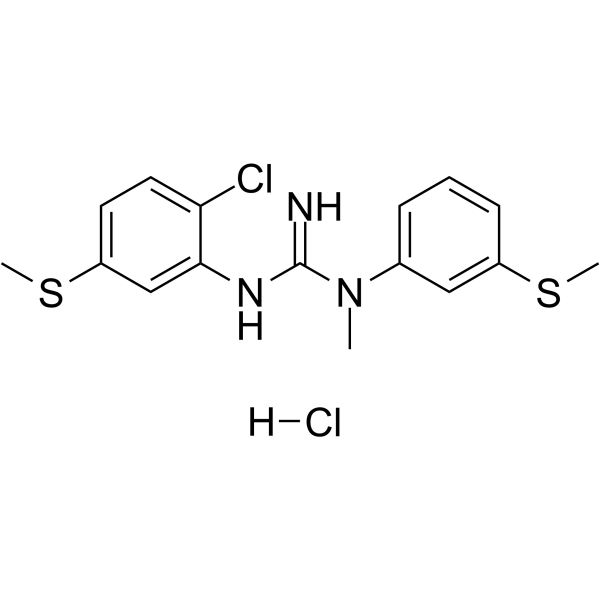
CNS-5161 (CNS 5161) is a unique selective non-competitive antagonist of a subset of glutamate receptors NMDA in the mammalian brain. CNS-5161 shows significant inhibitory effect on NMDA ion channels in vitro and is able to displace [3H]MK-801 binding in rat brain synaptosomal membrane preparations with a Ki of 1.8 nM [1].
|
|---|---|
| 体外研究 (In Vitro) |
CNS-5161 (CNS 5161) 是哺乳动物大脑中谷氨酸受体 NMDA 子集的独特选择性非竞争性拮抗剂。 CNS-5161 在体外显示出对 NMDA 离子通道的显着抑制作用,并且能够取代大鼠脑突触体膜制剂中的 [3H]MK-801 结合,Ki 为 1.8 nM [1]。
CNS-5161 hydrochloride 在体外对 NMDA 离子通道表现出强效的抑制活性。[1] 在使用大鼠脑突触体膜的放射性配体结合实验中,它能以 1.8 nM 的 Ki 值置换 [³H]MK-801。[1] |
| 体内研究 (In Vivo) |
在新生大鼠体内 NMDA 兴奋性毒性模型中,CNS-5161 (CNS 5161) 通过腹膜内 (ip) 途径阻止外源性 N-甲基-D-天冬氨酸的坏死作用,ED80 为 4 mg/kg。 CNS-5161 还表明,DBA/2 小鼠腹腔注射 4 mg/kg 可以预防 91% 的听源性癫痫发作,并且对新生大鼠缺氧/缺血性脑损伤后具有神经保护作用 [1]。
在新生大鼠 NMDA 兴奋性毒性模型中,腹腔注射 (i.p.) CNS-5161 hydrochloride 能保护其免受外源性 NMDA 的坏死性影响,ED₈₀ 为 4 mg/kg。[1] 在 DBA/2 小鼠中,腹腔注射 4 mg/kg 的 CNS-5161 hydrochloride 对听源性癫痫发作的抑制率达到 91%。[1] 在成年雄性 Sprague-Dawley 大鼠的局灶性脑缺血模型(大脑中动脉阻塞,MCAO)中,静脉注射 (i.v.) CNS-5161 hydrochloride(总剂量分别为 0.88、1.75 或 3.5 mg/kg)能显著且剂量依赖性地减少总脑梗死体积(分别减少 35%、42% 和 46%)和皮层梗死体积(分别减少 43%、50% 和 52%)。[1] 在新生大鼠缺氧/缺血性脑损伤模型中,CNS-5161 hydrochloride 显示出神经保护作用。[1] 在一项首次人体、随机、双盲、安慰剂对照的 I 期研究中,健康男性志愿者接受单次静脉输注 CNS-5161 hydrochloride(剂量范围 30 µg 至 2000 µg)。药物耐受性良好。观察到收缩压、平均动脉压和舒张压呈剂量依赖性升高,最高达 23/19 mmHg,最大效应出现在输注后 60 至 120 分钟之间。[1] |
| 动物实验 |
In the neonatal rat NMDA excitotoxicity model, CNS-5161 hydrochloride was administered intraperitoneally (i.p.).[1]
In the adult rat focal cerebral ischaemia model, male Sprague-Dawley rats underwent middle cerebral artery occlusion (MCAO). Ten minutes after occlusion, they received an intravenous (i.v.) bolus of CNS-5161 hydrochloride (0.275, 0.55, or 1.1 mg/kg) followed by a 3-hour i.v. infusion (0.2, 0.4, or 0.8 mg/kg/h, resulting in total doses of 0.88, 1.75, or 3.5 mg/kg). Control animals received vehicle (0.3 M mannitol).[1] For pharmacokinetic analysis in rats, plasma samples were collected from vehicle and drug-treated animals (0.88 and 1.75 mg/kg total dose groups) and analyzed using a validated HPLC method with electrochemical detection.[1] |
| 药代性质 (ADME/PK) |
In a rat focal ischemia study, after 3 hours of infusion, the mean plasma concentration of CNS-5161 hydrochloride was 9.7 ± 0.9 ng/mL in the 0.88 mg/kg dose group and 19.6 ± 1.2 ng/mL in the 1.75 mg/kg dose group. [1] In a phase I human study, the pharmacokinetics of CNS-5161 hydrochloride best conformed to a two-compartment model 15 minutes after intravenous infusion. [1] The mean elimination half-life (t₁/₂) was 2.95 hours (standard deviation, sd, 0.75). [1] The mean clearance (CL) was 106 L/h (sd 17.8). [1] The mean steady-state volume of distribution (Vss) was 296 L (standard deviation 69). [1]
Maximum plasma concentration (Cmax) and area under the concentration-time curve (AUC) increased linearly with dose. [1] In the higher dose group, the human body briefly reached the estimated neuroprotective plasma concentration. [1] |
| 毒性/毒理 (Toxicokinetics/TK) |
In a focal ischemia study in adult rats, some dose-dependent mortality was observed (up to 25% in the highest dose group), attributed to sudden respiratory failure during continuous intravenous infusion of the drug under anesthesia without mechanical ventilation. None of the animals died upon recovery from anesthesia. [1] Rats treated with CNS-5161 hydrochloride showed dose-dependent behavioral changes, such as agitation and impaired motor coordination, upon recovery from anesthesia. [1] In a Phase I human study, CNS-5161 hydrochloride was well tolerated at doses up to 2000 µg. Side effects were dose-related, self-limiting, and mild. [1] Reported adverse events included mild subjective sensory symptoms (e.g., paresthesia, sensory disturbances, numbness in the extremities and perioral region), dizziness, loss of reality, somnolence, flushing, vertigo, and headache. No serious adverse events, priapism, or significant ECG abnormalities were observed. [1]
A dose-dependent increase in systolic blood pressure, mean arterial pressure, and diastolic blood pressure was observed, which returned to baseline levels within 24 hours. [1] No significant abnormalities were found in biochemical, hematological, or urinalysis results. [1] |
| 参考文献 |
[1]. Walters MR, et al. Early clinical experience with the novel NMDA receptor antagonist CNS 5161. Br J Clin Pharmacol. 2002 Mar;53(3):305-11.
|
| 其他信息 |
CNS-5161 hydrochloride is a non-competitive NMDA receptor ion channel antagonist, chemically named N-(2-chloro-5-(methimio)phenyl)-N'-(3-(methimio)phenyl)-N'-methylguanidine monohydrochloride. [1] Its mechanism of action is believed to be the blocking of NMDA receptor-associated ion channels, thereby inhibiting excessive calcium ion influx and neuronal excitotoxicity associated with diseases such as stroke. [1] Preclinical data suggest good central nervous system penetration. [1] Potential clinical applications include neuroprotection (e.g., in stroke, hypoxic-ischemic brain injury) and analgesia. [1] Cardiovascular effects (elevated blood pressure) observed in humans have been predicted in animal models and may be a dose-limiting factor, especially in elderly stroke patients. [1]
|
| 分子式 |
C16H19CL2N3S2
|
|---|---|
| 分子量 |
388.3782
|
| 精确质量 |
387.039
|
| CAS号 |
160756-38-7
|
| 相关CAS号 |
CNS 5161;160754-76-7
|
| PubChem CID |
9886565
|
| 外观&性状 |
Typically exists as solid at room temperature
|
| tPSA |
92.2
|
| 氢键供体(HBD)数目 |
2
|
| 氢键受体(HBA)数目 |
3
|
| 可旋转键数目(RBC) |
5
|
| 重原子数目 |
23
|
| 分子复杂度/Complexity |
380
|
| 定义原子立体中心数目 |
0
|
| SMILES |
ClC1C([H])=C([H])C(=C([H])C=1/N=C(\N([H])[H])/N(C([H])([H])[H])C1C([H])=C([H])C([H])=C(C=1[H])SC([H])([H])[H])SC([H])([H])[H].Cl[H]
|
| InChi Key |
ZTVHYOCKPFPHFF-UHFFFAOYSA-N
|
| InChi Code |
InChI=1S/C16H18ClN3S2.ClH/c1-20(11-5-4-6-12(9-11)21-2)16(18)19-15-10-13(22-3)7-8-14(15)17;/h4-10H,1-3H3,(H2,18,19);1H
|
| 化学名 |
2-(2-chloro-5-methylsulfanylphenyl)-1-methyl-1-(3-methylsulfanylphenyl)guanidine;hydrochloride
|
| HS Tariff Code |
2934.99.9001
|
| 存储方式 |
Powder -20°C 3 years 4°C 2 years In solvent -80°C 6 months -20°C 1 month |
| 运输条件 |
Room temperature (This product is stable at ambient temperature for a few days during ordinary shipping and time spent in Customs)
|
| 溶解度 (体外实验) |
May dissolve in DMSO (in most cases), if not, try other solvents such as H2O, Ethanol, or DMF with a minute amount of products to avoid loss of samples
|
|---|---|
| 溶解度 (体内实验) |
注意: 如下所列的是一些常用的体内动物实验溶解配方,主要用于溶解难溶或不溶于水的产品(水溶度<1 mg/mL)。 建议您先取少量样品进行尝试,如该配方可行,再根据实验需求增加样品量。
注射用配方
注射用配方1: DMSO : Tween 80: Saline = 10 : 5 : 85 (如: 100 μL DMSO → 50 μL Tween 80 → 850 μL Saline)(IP/IV/IM/SC等) *生理盐水/Saline的制备:将0.9g氯化钠/NaCl溶解在100 mL ddH ₂ O中,得到澄清溶液。 注射用配方 2: DMSO : PEG300 :Tween 80 : Saline = 10 : 40 : 5 : 45 (如: 100 μL DMSO → 400 μL PEG300 → 50 μL Tween 80 → 450 μL Saline) 注射用配方 3: DMSO : Corn oil = 10 : 90 (如: 100 μL DMSO → 900 μL Corn oil) 示例: 以注射用配方 3 (DMSO : Corn oil = 10 : 90) 为例说明, 如果要配制 1 mL 2.5 mg/mL的工作液, 您可以取 100 μL 25 mg/mL 澄清的 DMSO 储备液,加到 900 μL Corn oil/玉米油中, 混合均匀。 View More
注射用配方 4: DMSO : 20% SBE-β-CD in Saline = 10 : 90 [如:100 μL DMSO → 900 μL (20% SBE-β-CD in Saline)] 口服配方
口服配方 1: 悬浮于0.5% CMC Na (羧甲基纤维素钠) 口服配方 2: 悬浮于0.5% Carboxymethyl cellulose (羧甲基纤维素) 示例: 以口服配方 1 (悬浮于 0.5% CMC Na)为例说明, 如果要配制 100 mL 2.5 mg/mL 的工作液, 您可以先取0.5g CMC Na并将其溶解于100mL ddH2O中,得到0.5%CMC-Na澄清溶液;然后将250 mg待测化合物加到100 mL前述 0.5%CMC Na溶液中,得到悬浮液。 View More
口服配方 3: 溶解于 PEG400 (聚乙二醇400) 请根据您的实验动物和给药方式选择适当的溶解配方/方案: 1、请先配制澄清的储备液(如:用DMSO配置50 或 100 mg/mL母液(储备液)); 2、取适量母液,按从左到右的顺序依次添加助溶剂,澄清后再加入下一助溶剂。以 下列配方为例说明 (注意此配方只用于说明,并不一定代表此产品 的实际溶解配方): 10% DMSO → 40% PEG300 → 5% Tween-80 → 45% ddH2O (或 saline); 假设最终工作液的体积为 1 mL, 浓度为5 mg/mL: 取 100 μL 50 mg/mL 的澄清 DMSO 储备液加到 400 μL PEG300 中,混合均匀/澄清;向上述体系中加入50 μL Tween-80,混合均匀/澄清;然后继续加入450 μL ddH2O (或 saline)定容至 1 mL; 3、溶剂前显示的百分比是指该溶剂在最终溶液/工作液中的体积所占比例; 4、 如产品在配制过程中出现沉淀/析出,可通过加热(≤50℃)或超声的方式助溶; 5、为保证最佳实验结果,工作液请现配现用! 6、如不确定怎么将母液配置成体内动物实验的工作液,请查看说明书或联系我们; 7、 以上所有助溶剂都可在 Invivochem.cn网站购买。 |
| 制备储备液 | 1 mg | 5 mg | 10 mg | |
| 1 mM | 2.5748 mL | 12.8740 mL | 25.7480 mL | |
| 5 mM | 0.5150 mL | 2.5748 mL | 5.1496 mL | |
| 10 mM | 0.2575 mL | 1.2874 mL | 2.5748 mL |
1、根据实验需要选择合适的溶剂配制储备液 (母液):对于大多数产品,InvivoChem推荐用DMSO配置母液 (比如:5、10、20mM或者10、20、50 mg/mL浓度),个别水溶性高的产品可直接溶于水。产品在DMSO 、水或其他溶剂中的具体溶解度详见上”溶解度 (体外)”部分;
2、如果您找不到您想要的溶解度信息,或者很难将产品溶解在溶液中,请联系我们;
3、建议使用下列计算器进行相关计算(摩尔浓度计算器、稀释计算器、分子量计算器、重组计算器等);
4、母液配好之后,将其分装到常规用量,并储存在-20°C或-80°C,尽量减少反复冻融循环。
计算结果:
工作液浓度: mg/mL;
DMSO母液配制方法: mg 药物溶于 μL DMSO溶液(母液浓度 mg/mL)。如该浓度超过该批次药物DMSO溶解度,请首先与我们联系。
体内配方配制方法:取 μL DMSO母液,加入 μL PEG300,混匀澄清后加入μL Tween 80,混匀澄清后加入 μL ddH2O,混匀澄清。
(1) 请确保溶液澄清之后,再加入下一种溶剂 (助溶剂) 。可利用涡旋、超声或水浴加热等方法助溶;
(2) 一定要按顺序加入溶剂 (助溶剂) 。
 匹伐加宾
匹伐加宾
 磷酸氢化可的松
 BAY-784
 Gly-PEG3-endo-BCN
InvivoChem的所有产品仅用于作科学研究,不面向患者销售
Copyright 2020 InvivoChem LLC | All Rights Reserved 粤ICP备20063088号-1


 粤公网安备 44011102003439号
 463611831
