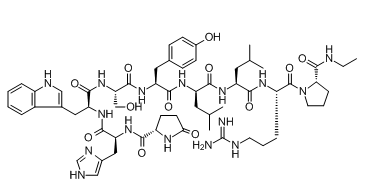
Leuprorelin DEA controlled substance

别名: NSC-377526 NSC 377526 LeuprorelinA-43818 A 43818 A43818 NSC377526 leuprolide acetate Leuprorelinum Eligard 亮丙瑞林; 醋酸亮丙瑞林;亮丙瑞林(LEUPRORELIN);5-氧代-L脯氨酰-L组氨酰-L色氨酰-L丝氨酰-L酪氨酰-D亮氨酰-L亮氨酰-L精氨酰-N-乙基-L脯氨酰胺单醋酸盐;醋酸亮氨酰基脯氨酸;利普安;醋酸亮丙瑞林 Leuprorelin Acetate;醋酸亮丙瑞林 LeuprorelinAcetate;亮丙瑞林 EP标准品
目录号: V18098 纯度: ≥98%
Leuprorelin (A43818; NSC377526;A-43818; NSC-377526;醋酸亮丙瑞林;Leuprorelinum; Eligard) 是促性腺激素释放激素 (GnRH) 类似物,作为垂体 GnRH 受体的激动剂。
Leuprorelin CAS号: 53714-56-0
产品类别: New12
产品仅用于科学研究,不针对患者销售
规格 价格 库存 数量
50mg
100mg
250mg
500mg
Other Sizes

Other Forms of Leuprorelin:

  • 醋酸亮丙瑞林
点击了解更多
InvivoChem产品被CNS等顶刊论文引用
纯度/质量控制文件

纯度: =99.4%

产品描述
Leuprorelin (A43818; NSC377526; A-43818; NSC-377526; 醋酸亮丙瑞林; Leuprorelinum; Eligard) 是一种促性腺激素释放激素 (GnRH) 类似物,作为垂体 GnRH 受体的激动剂。它已被用于治疗多种与性激素相关的疾病,例如晚期前列腺癌、子宫内膜异位症和性早熟。它主要作用于垂体前叶,引起促性腺激素释放的短暂早期增加。持续使用亮丙瑞林会导致垂体脱敏和/或下调,导致促性腺激素和性激素的循环水平受到抑制。
生物活性&实验参考方法
药代性质 (ADME/PK)
Absorption, Distribution and Excretion
Leuprolide is typically administered as a single-dose long-acting formulation employing either microsphere or biodegradable solid depot technologies. Regardless of the exact formulation and initial dose strength, the Cmax is typically achieved by 4-5 hours post-injection and displays large variability in the range of 4.6 - 212 ng/mL. Eventual steady-state kinetics are typically achieved by four weeks, with a narrower range of 0.1 - 2 ng/mL. No studies on the effects of food on absorption have been carried out.
Following administration of 3.75 mg leuprolide depot suspension to three patients, less than 5% of the initial dose was recovered as unchanged or pentapeptide metabolite in the urine.
Leuprolide has an apparent steady-state volume of distribution of 27 L following intravenous bolus administration to healthy males. The volume of distribution for indicated routes of subcutaneous or intramuscular injection has not been reported.
Leuprolide administered as a 1 mg intravenous bolus in healthy males has a mean systemic clearance between 7.6 and 8.3 L/h.
Bioavailablity after intramuscular injection of the depot formulation is estimated to be about 90%.
The pharmacological effects of leuprolide acetate depot microspheres were studied in rats and dogs following subcutaneous and intramuscular injection. After injection the microspheres provided similar linear drug release and sustained serum drug levels for 3 months. Persistent suppression of serum luteinizing hormone, follicle stimulating hormone in rats, and testosterone in rats and dogs for over 16 wk was achieved with microspheres at a dose of 100 ug/kg/day in rats and 25.6 ug/kg/day in dogs. Responses upon periodic challenge tests revealed that a single injection of microspheres dramatically suppressed the function of the pituitary-gonadal system for 15 wks in rats. The growth of genital organs was also suppressed dose-dependently for over 3 months. It was concluded that persistent pharmacological effects are obtained with an injection of leuprolide 3-month depot microspheres.
The effect of formulation adjuvants on the absorption of leuprolide acetate after intraduodenal injection and oral administration to male castrate rats is reported. Absorption was low, approximately 0.01% and 0.08% by oral and intraduodenal administration, respectively, compared with intravenous controls. An aqueous formulation and a water-in-oil emulsion of a lipophilic salt, a decane sulfonic acid derivative of leuprolide gave intraduodenal bioavailabilities of approximately 0.2% and 1% respectively. Evaluation of formulation effects on the oral absorption of the drug showed that lipophilicity, surfactant, and vehicle properties significantly affected intraduodenal absorption of leuprolide. Absolute bioavailability of the drug in typical emulsion systems ranged from approximately 3-10% and represented an improvement of about 100-fold in gastrointestinal bioavailability of this peptide. The implications of these findings relative to the effect of formulation adjuvants on oral absorption of leuprolide and other peptides following intraduodenal administration are discussed.
The bioavailability of leuprolide acetate was studied in rats and in healthy males (ages 19-39 yr) after inhalation and intranasal administration, compared with intravenous and subcutaneous injection. Intranasal bioavailability in rats was significantly increased by alpha-cyclodextrin, eidetic acid, and solution volume. Intra-animal variability was 30-60% and absorption ranged from 8 to 46% compared with intravenous controls. In humans, the subcutaneous injection was 94% bioavailable compared with intravenous. Intranasal bioavailability averaged 2.4%, with significant intersubject variability. Plasma peak concentrations for one and 3 mg dosages were 0.24-1.6 and 0.1-11 ng/ml, respectively. Mean plasma peak concentrations of one mg aerosol and 2 mg suspension aerosols, respectively. Bioavailability of suspension aerosols was fourfold greater than that of the solution aerosol. /Leuprolide acetate/
Metabolism / Metabolites
Radiolabeling studies suggest that leuprolide is primarily metabolized to inactive penta-, tri-, and dipeptide entities, which are likely further metabolized. It is expected that various peptidases encountered throughout systemic circulation are responsible for leuprolide metabolism.
Biological Half-Life
Leuprolide has a terminal elimination half-life of approximately three hours.
毒性/毒理 (Toxicokinetics/TK)
Hepatotoxicity
Leuprolide has been associated with mild serum enzyme elevations during therapy in 3% to 5% of patients, but values above 3 times the upper limit of normal are rare, being reported in less than 1% of recipients. The serum enzyme elevations during leuprolide therapy have generally been transient and asymptomatic, resolving even with drug continuation and rarely requiring dose modification or discontinuation. Despite use for several decades, leuprolide has not been linked to convincing cases of clinically apparent liver injury. Routine monitoring of patients for liver test abnormalities is not recommended.
Likelihood score: E (unlikely cause of clinically apparent liver injury).
Protein Binding
Leuprolide displays _in vitro_ binding to human plasma proteins between 43% and 49%.
Interactions
OBJECTIVE: To assess the efficacy of combining sodium etidronate with low doses of the 19-nor-testosterone progestin norethindrone or using high doses of norethindrone alone as prophylaxis against the vasomotor instability and bone density loss induced by GnRH agonists alone. METHODS: Eleven patients enrolled in this randomized study received the long-acting GnRH agonist leuprolide acetate 3.75 mg intramuscularly every 4 weeks for 24 weeks. Six patients (group I) self-administered sodium etidronate 400 mg/day orally for 14 days followed by calcium carbonate 500 mg/day orally for the next 42 days during three 56-day cycles. This regimen was supplemented by norethindrone 2.5 mg/day orally. Five patients (group II) self-administered norethindrone 10 mg/day orally. Two sets of controls were used. Group III consisted of ten previously reported patients who received the same GnRH agonist only. Group IV comprised 12 regularly cycling untreated controls. Bone mineral density, vasomotor symptoms, circulating estrogens, and lipids were assessed serially. RESULTS: The significant vasomotor instability (P < .Ol) and bone mineral density loss (-4.8 +/- 0.9%; P < .05) experienced by patients in group III was prevented in those ln groups I and II despite maintenance of a persistent hypoestrogenlc state. Bone density changes ln groups I and II were similar to those in untreated controls (group IV). Persistent decreases in high-density lipoprotein (HDL) cholesterol (P = .005) and increases in the low-density lipoprotein-to-HDL ratio (P < .05) were noted only in group II patients receiving supplemental high-dose norethindrone. CONCLUSION: These preliminary data suggest that the addition of cyclic sodium etidronate in combination with low-dose norethindrone to GnRH agonists is an effective means of ameliorating the hypoestrogenic side effects induced by GnRH agonist alone.
参考文献
Drugs. 1994 Dec;48(6):930-67. doi: 10.2165/00003495-199448060-00008.
其他信息
Therapeutic Uses
Antineoplastic Agents, Hormonal; Fertility Agents, Female
Leuprolide is indicated for the palliative treatment of advanced prostatic cancer, especially as an alternative to orchiectomy or estrogen administration. /Included in US product labeling/
Leuprolide is indicated for management of endometriosis, including pain relief and reduction of endometriotic lesions. /Included in US product labeling/
Leuprolide is about 30 times more active than natural gonadotropin-releasing hormone ... and 100 times more active than gonadorelin.
For more Therapeutic Uses (Complete) data for LEUPROLIDE (15 total), please visit the HSDB record page.
Drug Warnings
Patients sensitive to other synthetic gonadotropin-releasing hormone analogs may also be sensitive to leuprolide.
In males: Suppression of testosterone secretion results in impairment of fertility. Although it is not known whether fertility is restored after leuprolide is withdrawn, reversal of fertility suppression does occur after withdrawal of similar analogs.
Leuprolide is not recommended during pregnancy. Because the effects on fetal mortality would logically result from the hormonal effects of leuprolide, it can be concluded that there is a risk of spontaneous abortion if leuprolide is administered during pregnancy.
It is not known whether leuprolide passes into breast milk. However, because of potential adverse effects in the infant, breast-feeding is usually not recommended during treatment with leuprolide.
For more Drug Warnings (Complete) data for LEUPROLIDE (14 total), please visit the HSDB record page.
Pharmacodynamics
Leuprolide is a gonadotropin-releasing hormone (GnRH) analogue that functions as a GnRH receptor superagonist. After an initial spike in GnRH-mediated steroidal production, including testosterone and estradiol, prolonged use results in a significant drop in circulating steroid levels, in line with those produced through other forms of androgen-deprivation therapy (ADT). The corresponding hormonal/steroidal changes produce specific adverse effects in different patient populations. In women undergoing treatment for endometriosis or uterine leiomyomata, careful consideration regarding pregnancy status is advised. The initial increase in estradiol levels may worsen symptoms such as pain and bleeding. Long-term use of leuprolide is associated with loss of bone mineral density. Patients co-administered with [norethisterone] may experience sudden vision loss, proptosis, diplopia, migraine, thrombophlebitis, and pulmonary embolism and may also be at higher risk of cardiovascular disease. Patients with a history of depression may experience severe recurrence of depressive symptoms. In men undergoing palliative treatment for advanced/metastatic prostate cancer, short-term spikes in testosterone levels may cause tumour flare and associated symptoms such as bone pain, hematuria, neuropathy, bladder and/or ureteral obstruction, and spinal cord compression. In addition, patients are at increased risk of developing hyperglycemia, diabetes, and cardiovascular disease, which may manifest through myocardial infarction, stroke, cardiac death, or prolonged QT/QTc interval. In addition, Leuprolide may cause convulsions and embryo-fetal toxicity. In pediatric patients undergoing treatment for central precocious puberty (CPP), the initial steroidal spike may be associated with increased clinical signs of puberty within 2-4 weeks of treatment initiation. In addition, leuprolide may cause convulsions and psychiatric symptoms, including irritability, impatience, aggression, anger, and crying.
*注: 文献方法仅供参考, InvivoChem并未独立验证这些方法的准确性
化学信息 & 存储运输条件
分子式
C59H84N16O12
分子量
1209.42
精确质量
1208.645
CAS号
53714-56-0
相关CAS号
74381-53-6 (monoacetate)
PubChem CID
657181
外观&性状
Fluffy solid
密度
1.4±0.1 g/cm3
熔点
150-155
折射率
1.682
LogP
0.41
tPSA
466.34
氢键供体(HBD)数目
15
氢键受体(HBA)数目
14
可旋转键数目(RBC)
32
重原子数目
87
分子复杂度/Complexity
2390
定义原子立体中心数目
9
SMILES
O=C([C@]([H])(C([H])([H])C([H])([H])C([H])([H])/N=C(\N([H])[H])/N([H])[H])N([H])C([C@]([H])(C([H])([H])C([H])(C([H])([H])[H])C([H])([H])[H])N([H])C([C@@]([H])(C([H])([H])C([H])(C([H])([H])[H])C([H])([H])[H])N([H])C([C@]([H])(C([H])([H])C1C([H])=C([H])C(=C([H])C=1[H])O[H])N([H])C([C@]([H])(C([H])([H])O[H])N([H])C([C@]([H])(C([H])([H])C1=C([H])N([H])C2=C([H])C([H])=C([H])C([H])=C12)N([H])C([C@]([H])(C([H])([H])C1=C([H])N=C([H])N1[H])N([H])C([C@]1([H])C([H])([H])C([H])([H])C(N1[H])=O)=O)=O)=O)=O)=O)=O)=O)N1C([H])([H])C([H])([H])C([H])([H])[C@@]1([H])C(N([H])C([H])([H])C([H])([H])[H])=O.O([H])C(C([H])([H])[H])=O
InChi Key
GFIJNRVAKGFPGQ-LIJARHBVSA-N
InChi Code
InChI=1S/C59H84N16O12/c1-6-63-57(86)48-14-10-22-75(48)58(87)41(13-9-21-64-59(60)61)68-51(80)42(23-32(2)3)69-52(81)43(24-33(4)5)70-53(82)44(25-34-15-17-37(77)18-16-34)71-56(85)47(30-76)74-54(83)45(26-35-28-65-39-12-8-7-11-38(35)39)72-55(84)46(27-36-29-62-31-66-36)73-50(79)40-19-20-49(78)67-40/h7-8,11-12,15-18,28-29,31-33,40-48,65,76-77H,6,9-10,13-14,19-27,30H2,1-5H3,(H,62,66)(H,63,86)(H,67,78)(H,68,80)(H,69,81)(H,70,82)(H,71,85)(H,72,84)(H,73,79)(H,74,83)(H4,60,61,64)/t40-,41-,42-,43+,44-,45-,46-,47-,48-/m0/s1
化学名
(2S)-N-[(2S)-1-[[(2S)-1-[[(2S)-1-[[(2S)-1-[[(2R)-1-[[(2S)-1-[[(2S)-5-(diaminomethylideneamino)-1-[(2S)-2-(ethylcarbamoyl)pyrrolidin-1-yl]-1-oxopentan-2-yl]amino]-4-methyl-1-oxopentan-2-yl]amino]-4-methyl-1-oxopentan-2-yl]amino]-3-(4-hydroxyphenyl)-1-oxopropan-2-yl]amino]-3-hydroxy-1-oxopropan-2-yl]amino]-3-(1H-indol-3-yl)-1-oxopropan-2-yl]amino]-3-(1H-imidazol-5-yl)-1-oxopropan-2-yl]-5-oxopyrrolidine-2-carboxamide
别名
NSC-377526 NSC 377526 LeuprorelinA-43818 A 43818 A43818 NSC377526 leuprolide acetate Leuprorelinum Eligard
HS Tariff Code
2934.99.9001
存储方式

Powder      -20°C    3 years

                     4°C     2 years

In solvent   -80°C    6 months

                  -20°C    1 month

运输条件
Room temperature (This product is stable at ambient temperature for a few days during ordinary shipping and time spent in Customs)
溶解度数据
溶解度 (体外实验)
May dissolve in DMSO (in most cases), if not, try other solvents such as H2O, Ethanol, or DMF with a minute amount of products to avoid loss of samples
溶解度 (体内实验)
注意: 如下所列的是一些常用的体内动物实验溶解配方,主要用于溶解难溶或不溶于水的产品(水溶度<1 mg/mL)。 建议您先取少量样品进行尝试,如该配方可行,再根据实验需求增加样品量。

注射用配方
(IP/IV/IM/SC等)
注射用配方1: DMSO : Tween 80: Saline = 10 : 5 : 85 (如: 100 μL DMSO 50 μL Tween 80 850 μL Saline)
*生理盐水/Saline的制备:将0.9g氯化钠/NaCl溶解在100 mL ddH ₂ O中,得到澄清溶液。
注射用配方 2: DMSO : PEG300Tween 80 : Saline = 10 : 40 : 5 : 45 (如: 100 μL DMSO 400 μL PEG300 50 μL Tween 80 450 μL Saline)
注射用配方 3: DMSO : Corn oil = 10 : 90 (如: 100 μL DMSO 900 μL Corn oil)
示例: 注射用配方 3 (DMSO : Corn oil = 10 : 90) 为例说明, 如果要配制 1 mL 2.5 mg/mL的工作液, 您可以取 100 μL 25 mg/mL 澄清的 DMSO 储备液,加到 900 μL Corn oil/玉米油中, 混合均匀。
View More

注射用配方 4: DMSO : 20% SBE-β-CD in Saline = 10 : 90 [如:100 μL DMSO 900 μL (20% SBE-β-CD in Saline)]
*20% SBE-β-CD in Saline的制备(4°C,储存1周):将2g SBE-β-CD (磺丁基-β-环糊精) 溶解于10mL生理盐水中,得到澄清溶液。
注射用配方 5: 2-Hydroxypropyl-β-cyclodextrin : Saline = 50 : 50 (如: 500 μL 2-Hydroxypropyl-β-cyclodextrin (羟丙基环胡精) 500 μL Saline)
注射用配方 6: DMSO : PEG300 : Castor oil : Saline = 5 : 10 : 20 : 65 (如: 50 μL DMSO 100 μL PEG300 200 μL Castor oil 650 μL Saline)
注射用配方 7: Ethanol : Cremophor : Saline = 10: 10 : 80 (如: 100 μL Ethanol 100 μL Cremophor 800 μL Saline)
注射用配方 8: 溶解于Cremophor/Ethanol (50 : 50), 然后用生理盐水稀释。
注射用配方 9: EtOH : Corn oil = 10 : 90 (如: 100 μL EtOH 900 μL Corn oil)
注射用配方 10: EtOH : PEG300Tween 80 : Saline = 10 : 40 : 5 : 45 (如: 100 μL EtOH 400 μL PEG300 50 μL Tween 80 450 μL Saline)


口服配方
口服配方 1: 悬浮于0.5% CMC Na (羧甲基纤维素钠)
口服配方 2: 悬浮于0.5% Carboxymethyl cellulose (羧甲基纤维素)
示例: 口服配方 1 (悬浮于 0.5% CMC Na)为例说明, 如果要配制 100 mL 2.5 mg/mL 的工作液, 您可以先取0.5g CMC Na并将其溶解于100mL ddH2O中,得到0.5%CMC-Na澄清溶液;然后将250 mg待测化合物加到100 mL前述 0.5%CMC Na溶液中,得到悬浮液。
View More

口服配方 3: 溶解于 PEG400 (聚乙二醇400)
口服配方 4: 悬浮于0.2% Carboxymethyl cellulose (羧甲基纤维素)
口服配方 5: 溶解于0.25% Tween 80 and 0.5% Carboxymethyl cellulose (羧甲基纤维素)
口服配方 6: 做成粉末与食物混合


注意: 以上为较为常见方法,仅供参考, InvivoChem并未独立验证这些配方的准确性。具体溶剂的选择首先应参照文献已报道溶解方法、配方或剂型,对于某些尚未有文献报道溶解方法的化合物,需通过前期实验来确定(建议先取少量样品进行尝试),包括产品的溶解情况、梯度设置、动物的耐受性等。

请根据您的实验动物和给药方式选择适当的溶解配方/方案:
1、请先配制澄清的储备液(如:用DMSO配置50 或 100 mg/mL母液(储备液));
2、取适量母液,按从左到右的顺序依次添加助溶剂,澄清后再加入下一助溶剂。以 下列配方为例说明 (注意此配方只用于说明,并不一定代表此产品 的实际溶解配方):
10% DMSO → 40% PEG300 → 5% Tween-80 → 45% ddH2O (或 saline);
假设最终工作液的体积为 1 mL, 浓度为5 mg/mL: 取 100 μL 50 mg/mL 的澄清 DMSO 储备液加到 400 μL PEG300 中,混合均匀/澄清;向上述体系中加入50 μL Tween-80,混合均匀/澄清;然后继续加入450 μL ddH2O (或 saline)定容至 1 mL;

3、溶剂前显示的百分比是指该溶剂在最终溶液/工作液中的体积所占比例;
4、 如产品在配制过程中出现沉淀/析出,可通过加热(≤50℃)或超声的方式助溶;
5、为保证最佳实验结果,工作液请现配现用!
6、如不确定怎么将母液配置成体内动物实验的工作液,请查看说明书或联系我们;
7、 以上所有助溶剂都可在 Invivochem.cn网站购买。
制备储备液 1 mg 5 mg 10 mg
1 mM 0.8268 mL 4.1342 mL 8.2684 mL
5 mM 0.1654 mL 0.8268 mL 1.6537 mL
10 mM 0.0827 mL 0.4134 mL 0.8268 mL

1、根据实验需要选择合适的溶剂配制储备液 (母液):对于大多数产品,InvivoChem推荐用DMSO配置母液 (比如:5、10、20mM或者10、20、50 mg/mL浓度),个别水溶性高的产品可直接溶于水。产品在DMSO 、水或其他溶剂中的具体溶解度详见上”溶解度 (体外)”部分;

2、如果您找不到您想要的溶解度信息,或者很难将产品溶解在溶液中,请联系我们;

3、建议使用下列计算器进行相关计算(摩尔浓度计算器、稀释计算器、分子量计算器、重组计算器等);

4、母液配好之后,将其分装到常规用量,并储存在-20°C或-80°C,尽量减少反复冻融循环。

计算器

摩尔浓度计算器可计算特定溶液所需的质量、体积/浓度,具体如下:

  • 计算制备已知体积和浓度的溶液所需的化合物的质量
  • 计算将已知质量的化合物溶解到所需浓度所需的溶液体积
  • 计算特定体积中已知质量的化合物产生的溶液的浓度
使用摩尔浓度计算器计算摩尔浓度的示例如下所示:
假如化合物的分子量为350.26 g/mol,在5mL DMSO中制备10mM储备液所需的化合物的质量是多少?
  • 在分子量(MW)框中输入350.26
  • 在“浓度”框中输入10,然后选择正确的单位(mM)
  • 在“体积”框中输入5,然后选择正确的单位(mL)
  • 单击“计算”按钮
  • 答案17.513 mg出现在“质量”框中。以类似的方式,您可以计算体积和浓度。

稀释计算器可计算如何稀释已知浓度的储备液。例如,可以输入C1、C2和V2来计算V1,具体如下:

制备25毫升25μM溶液需要多少体积的10 mM储备溶液?
使用方程式C1V1=C2V2,其中C1=10mM,C2=25μM,V2=25 ml,V1未知:
  • 在C1框中输入10,然后选择正确的单位(mM)
  • 在C2框中输入25,然后选择正确的单位(μM)
  • 在V2框中输入25,然后选择正确的单位(mL)
  • 单击“计算”按钮
  • 答案62.5μL(0.1 ml)出现在V1框中
g/mol

分子量计算器可计算化合物的分子量 (摩尔质量)和元素组成,具体如下:

注:化学分子式大小写敏感:C12H18N3O4  c12h18n3o4
计算化合物摩尔质量(分子量)的说明:
  • 要计算化合物的分子量 (摩尔质量),请输入化学/分子式,然后单击“计算”按钮。
分子质量、分子量、摩尔质量和摩尔量的定义:
  • 分子质量(或分子量)是一种物质的一个分子的质量,用统一的原子质量单位(u)表示。(1u等于碳-12中一个原子质量的1/12)
  • 摩尔质量(摩尔重量)是一摩尔物质的质量,以g/mol表示。
/

配液计算器可计算将特定质量的产品配成特定浓度所需的溶剂体积 (配液体积)

  • 输入试剂的质量、所需的配液浓度以及正确的单位
  • 单击“计算”按钮
  • 答案显示在体积框中
动物体内实验配方计算器(澄清溶液)
第一步:请输入基本实验信息(考虑到实验过程中的损耗,建议多配一只动物的药量)
第二步:请输入动物体内配方组成(配方适用于不溶/难溶于水的化合物),不同的产品和批次配方组成不同,如对配方有疑问,可先联系我们提供正确的体内实验配方。此外,请注意这只是一个配方计算器,而不是特定产品的确切配方。
+
+
+

计算结果:

工作液浓度 mg/mL;

DMSO母液配制方法 mg 药物溶于 μL DMSO溶液(母液浓度 mg/mL)。如该浓度超过该批次药物DMSO溶解度,请首先与我们联系。

体内配方配制方法μL DMSO母液,加入 μL PEG300,混匀澄清后加入μL Tween 80,混匀澄清后加入 μL ddH2O,混匀澄清。

(1) 请确保溶液澄清之后,再加入下一种溶剂 (助溶剂) 。可利用涡旋、超声或水浴加热等方法助溶;
            (2) 一定要按顺序加入溶剂 (助溶剂) 。

临床试验信息
Antiandrogen Therapy and Radiation Therapy With or Without Docetaxel in Treating Patients With Prostate Cancer That Has Been Removed by Surgery
CTID: NCT03070886
Phase: Phase 2/Phase 3    Status: Active, not recruiting
Date: 2024-11-29
Two Studies for Patients With High Risk Prostate Cancer Testing Less Intense Treatment for Patients With a Low Gene Risk Score and Testing a More Intense Treatment for Patients With a High Gene Risk Score, The PREDICT-RT Trial
CTID: NCT04513717
Phase: Phase 3    Status: Recruiting
Date: 2024-11-27
Two Studies for Patients With Unfavorable Intermediate Risk Prostate Cancer Testing Less Intense Treatment for Patients With a Low Gene Risk Score and Testing a More Intense Treatment for Patients With a Higher Gene Risk Score
CTID: NCT05050084
Phase: Phase 3    Status: Recruiting
Date: 2024-11-27
Stereotactic Body Radiation Therapy Plus Androgen Receptor Pathway Inhibitor and Androgen Deprivation Therapy for Treatment of Metastatic, Recurrent Hormone-Sensitive Prostate Cancer, DIVINE Trial
CTID: NCT06378866
Phase: Phase 2    Status: Recruiting
Date: 2024-11-26
A Study of ELIGARD® in Hormone-dependent Prostate Cancer Patients
CTID: NCT03035032
Phase: Phase 4    Status: Completed
Date: 2024-11-26
View More

Micro RNAs to Predict Response to Androgen Deprivation Therapy
CTID: NCT02366494
Phase:    Status: Completed
Date: 2024-11-25


Phase IIIb Study of Ribociclib + ET in Early Breast Cancer
CTID: NCT05827081
Phase: Phase 3    Status: Not yet recruiting
Date: 2024-11-15
Study Assessing the Efficacy and Safety of Alpelisib Plus Fulvestrant or Letrozole, Based on Prior Endocrine Therapy, in Patients With PIK3CA Mutant, HR+, HER2- Advanced Breast Cancer Who Have Progressed on or After Prior Treatments
CTID: NCT03056755
Phase: Phase 2    Status: Active, not recruiting
Date: 2024-11-14
A Multi-Center Trial of Androgen Suppression With Abiraterone Acetate, Leuprolide, PARP Inhibition and Stereotactic Body Radiotherapy in Prostate Cancer
CTID: NCT04194554
Phase: Phase 1/Phase 2    Status: Active, not recruiting
Date: 2024-11-06
REVELUTION-2: Relugolix+Abiraterone Acetate (AA) Versus Leuprolide+AA Cardiac Trial
CTID: NCT06650579
Phase: Phase 3    Status: Not yet recruiting
Date: 2024-10-23
COACTION Trial - COmbination Androgen bloCkade in inTermediate to hIgh-risk prOstate caNcer
CTID: NCT06627530
Phase: Phase 4    Status: Not yet recruiting
Date: 2024-10-04
Systemic and Tumor-Directed Therapy for Oligometastatic Prostate Cancer
CTID: NCT03298087
Phase: Phase 2    Status: Completed
Date: 2024-09-25
Effects of Relugolix vs Leuprolide on Cardiac Function in Patients With Prostate Cancer
CTID: NCT06330805
Phase: Phase 2    Status: Recruiting
Date: 2024-09-19
Neoadjuvant And Adjuvant Abiraterone Acetate + Apalutamide Prostate Cancer Undergoing Prostatectomy
CTID: NCT02903368
Phase: Phase 2    Status: Active, not recruiting
Date: 2024-07-24
Detect V / CHEVENDO (Chemo vs. Endo)
CTID: NCT02344472
Phase: Phase 3    Status: Active, not recruiting
Date: 2024-06-04
RElugolix VErsus LeUprolide Cardiac Trial
CTID: NCT05320406
Phase: Phase 4    Status: Active, not recruiting
Date: 2024-06-03
AASUR in High Risk Prostate Cancer
CTID: NCT02772588
Phase: Phase 2    Status: Active, not recruiting
Date: 2024-05-21
Real World Evidence Study on Metastatic Prostate Cancer in the Pirkanmaa Hospital District in Finland
CTID: NCT05701007
Phase:    Status: Completed
Date: 2024-04-24
Comparison of the Therapeutic Effects of Vaginal Repair With Leuprorelin and Vaginal Repair in the Treatment of Cesarean Section Scar Defect
CTID: NCT05206682
Phase: N/A    Status: Recruiting
Date: 2024-04-23
A Phase II Study of Advanced Salivary Gland Carcinoma Based on Molecular Typing
CTID: NCT05924256
Phase: Phase 2    Status: Recruiting
Date: 2024-03-15
Androgen Deprivation Therapy for Oligo-recurrent Prostate Cancer in Addition to radioTherapy
CTID: NCT04302454
Phase: Phase 3    Status: Recruiting
Date: 2024-02-28
RecoverPC: Relugolix vs GnRH Agonist in Quality of Life
CTID: NCT05765500
Phase: Phase 2    Status: Recruiting
Date: 2024-02-14
Anti-Androgens and Cabazitaxel in Defining Complete Response in Prostatectomy (ACDC Trial)
CTID: NCT02543255
Phase: Phase 2    Status: Completed
Date: 2024-01-31
Comparing the Safety and Efficacy in the Use of Hormonal Therapy on Endometriosis Patients After Conservative Surgery
CTID: NCT06145438
Phase: Phase 3    Status: Recruiting
Date: 2023-11-24
Study to Assess the Safety and Efficacy of Ribociclib (LEE011) in Combination With Letrozole for the Treatment of Men and Pre/Postmenopausal Women With HR+ HER2- aBC
CTID: NCT02941926
Phase: Phase 3    Status: Completed
Date: 2023-10-24
Ipilimumab + Androgen Depravation Therapy in Prostate Cancer
CTID: NCT01377389
Phase: Phase 2    Status: Terminated
Date: 2023-09-29
A Clinical Study of KLH-2109 in Uterine Fibroids Patient With Menorrhagia
CTID: NCT05440383
Phase: Phase 3    Status: Active, not recruiting
Date: 2023-09-21
Prediction of the PRONOUNCE Prostate Cancer Trial in Healthcare Claims Data
CTID: NCT04897958
Phase:    Status: Completed
Date: 2023-07-27
A Treatment Study for Premenstrual Syndrome (PMS)
CTID: NCT00001259
Phase: Phase 1    Status: Completed
Date: 2023-03-02
A Multicenter Open-label Clinical Study on the Prevention of Premature Ovarian Failure After HSCT
CTID: NCT05667428
Phase: N/A    Status: Not yet recruiting
Date: 2023-02-23
Adjuvant Ovarian Suppression Plus Aromatase Inhibitor or Tamoxifen
An experimental pilot study on immune and inflammatory biomarkers in patients with advanced prostatecancer treated with degarelix vs. GnRH agonist and with cardiovascular disease
CTID: null
Phase: Phase 2    Status: Completed
Date: 2017-03-13
DETECT V/CHEVENDO: A multicenter, randomized phase III study to compare chemo- versus endocrine therapy in combination with dual HER2-targeted therapy of Herceptin® (trastuzumab) and Perjeta® (pertuzumab) plus Kisqali® (ribociclib) in patients with HER2 positive and hormone-receptor positive metastatic breast cancer.
CTID: null
Phase: Phase 3    Status: Ongoing
Date: 2015-07-15
A prospective, randomised multi-centre phase II study evaluating the adjuvant, neoadjuvant or palliative treatment with tamoxifen +/- GnRH analogue versus aromatase inhibitor + GnRH analogue in
CTID: null
Phase: Phase 2    Status: Completed
Date: 2012-08-27
A PHASE IV, RANDOMISED, OPEN-LABEL, MULTI-CENTRE STUDY TO ASSESS THE IMPACT ON DISEASE CONTROL, SAFETY, PATIENT AND CLINICIAN EXPERIENCE OF CHANGING PATIENTS WITH ADVANCED PROSTATE CANCER FROM A 3-MONTHLY LHRH AGONIST TO 6-MONTHLY INJECTIONS OF DECAPEPTYL® SR 22.5 MG
CTID: null
Phase: Phase 4    Status: Prematurely Ended
Date: 2012-05-01
Phase III randomised trial to evaluate the benefit of adjuvant hormonal treatment with leuprorelin acetate (Eligard® 45 mg) for 24 months after radical prostatectomy in patients with high risk of recurrence.
CTID: null
Phase: Phase 3    Status: Trial now transitioned, Ongoing
Date: 2011-01-31
A PHASE III PROSPECTIVE RANDOMIZED TRIAL OF DOSE-ESCALATED
CTID: null
Phase: Phase 3    Status: Ongoing
Date: 2010-11-08
ANDROGEN DEPRIVATION THERAPY WITHDRAWAL VERSUS MAINTENANCE AND INTERMITTENT DOCETAXEL THERAPY VERSUS CONTINUOUS ADMINISTRATION IN PATIENTS WITH PROSTATE CANCER RESISTANT TO CHEMICAL CASTRATION
CTID: null
Phase: Phase 3    Status: Ongoing
Date: 2010-04-30
A Phase 1/2, Open-Label Study in Men with Prostate Cancer to Assess the Safety, Pharmacokinetics, and Testosterone-Lowering Efficacy of TAK-448, Administered as a 1 Month Depot, Including a Randomized Portion With a Group Administered Leuprorelin
CTID: null
Phase: Phase 1, Phase 2    Status: Completed
Date: 2010-04-29
An open label, parallel group, multiple dose Phase III clinical study in patients with prostate cancer to investigate the clinical efficacy and safety of two new GnRH implants (AMW Goserelin 3.6 mg Implant and AMW Leuprorelin 3.6 mg Implant) applied every 28 days for 84 days
CTID: null
Phase: Phase 3    Status: Ongoing
Date: 2010-02-12
Sospension of androgen hormonal deprivation in patients with high levels of CgA
CTID: null
Phase: Phase 3    Status: Prematurely Ended
Date: 2009-06-05
ROLE OF PAROXETINE AS ADD-ON THERAPY TO GNRH AGONIST IN THE TREATMENT OF ENDOMETRIOSIS-RELATED CHRONIC PELVIC PAIN
CTID: null
Phase: Phase 2    Status: Ongoing
Date: 2009-04-20
Tratamiento neoadyuvante con quimioterapia (Taxotere) y hormonoterapia en cáncer de próstata localizado de alto riesgo.
CTID: null
Phase: Phase 4    Status: Ongoing
Date: 2008-10-17
A Phase III, randomised, parallel group, double-blind, double-dummy, active comparator -controlled, multi-center study to assess the efficacy and safety of PGL4001 (ulipristal) versus GnRH-agonist (leuprorelin 3.75mg) for pre-operative treatment of symptomatic uterine myomas.
CTID: null
Phase: Phase 3    Status: Completed
Date: 2008-07-28
An open label, parallel group phase III clinical study in patients with prostate cancer to demonstrate the non-inferiority of a new Novosis Leuprorelin 10.72 mg implant versus the reference product Trenantone
CTID: null
Phase: Phase 3    Status: Completed
Date: 2008-07-08
An open label, parallel group, multiple dose Phase III clinical study in patients with prostate cancer to demonstrate the non-inferiority of a new Novosis Leuprorelin 3.57 mg implant versus the reference product Enantone Monats-Depot
CTID: null
Phase: Phase 3    Status: Ongoing
Date: 2008-05-08
Efficacy and Safety of Somatropin in Combination with Leuprorelin Compared to Somatropin Alone and to an Untreated Control Group in Pubertal Children with Idiopathic Short Stature
CTID: null
Phase: Phase 3    Status: Completed
Date: 2007-03-22
GnRH-Agonisten-Therapie bei Frauen mit Endometriose der Stadien III-IV nach rASRM-Kriterien vor reproduktionsmedizinischen Techniken (IVF / ICSI) (GARTE-Studie)
CTID: null
Phase: Phase 4    Status: Completed
Date: 2007-02-15
Ensayo clínico fase IV-III multicéntrico, prospectivo, aleatorizado, abierto y paralelo de 36 meses para evaluar la eficacia del bloqueo androgénico intermitente versus continuo en el tratamiento de la recidiva bioquímica del cáncer de próstata tratado con radioterapia.
CTID: null
Phase: Phase 4    Status: Ongoing
Date: 2006-12-13
A phase IIIb randomized study of intermittent versus continuous androgen deprivation therapy using ELIGARD 22.5 mg 3-month depot in subjects with relapsing and locally advanced prostate cancer who are responsive to such therapy
CTID: null
Phase: Phase 3    Status: Prematurely Ended, Completed
Date: 2006-01-05
A DOUBLE-BLIND PLACEBO- CONTROLLED STUDY OF VP4896 FOR THE TREATMENT OF MILD-TO-MODERATE ALZHEIMER'S DISEASE
CTID: null
Phase: Phase 3    Status: Ongoing, GB - no longer in EU/EEA, Prematurely Ended, Completed
Date: 2005-12-12
A Phase III, multi-center, randomized, double-blind comparator study to evaluate the efficacy and safety of 50 mg and 100 mg of TAK-013 tablets administered twice daily versus 3.75mg of Leuprolide administered monthly for 24 weeks in subjects with symptomatic endometriosis.
CTID: null
Phase: Phase 3    Status: GB - no longer in EU/EEA
Date: 2004-12-24

相关产品
联系我们