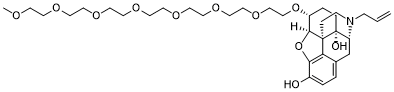
Naloxegol

别名: AZ13337019 NKTR118NKTR-118 AZ-13337019PEGylated naloxol Movantik Moventig 商品名Movantik, FDA批准的首个治疗阿片诱导的便秘的μ-阿片受体拮抗剂
目录号: V29078 纯度: ≥98%
Naloxegol(以前称为 NKTR-118;AZ-13337019;聚乙二醇化纳洛醇;Movantik;Moventig)是一种外周活性/选择性 μ-阿片拮抗剂,于 2014 年批准用于治疗阿片类药物引起的便秘。
Naloxegol CAS号: 854601-70-0
产品类别: New12
产品仅用于科学研究,不针对患者销售
规格 价格 库存 数量
50mg
100mg
250mg
500mg
Other Sizes

Other Forms of Naloxegol:

  • 聚乙二醇纳诺醇
点击了解更多
InvivoChem产品被CNS等顶刊论文引用
产品描述
Naloxegol(以前称为 NKTR-118;AZ-13337019;聚乙二醇化纳洛醇;Movantik;Moventig)是一种外周活性/选择性 μ-阿片拮抗剂,于 2014 年批准用于治疗阿片类药物引起的便秘。它于 2014 年获得 FDA 批准,用于治疗非癌症引起的慢性疼痛的成年人因阿片类止痛药物引起的便秘。从结构上看,naloxegol 是 α-naloxol 的聚乙二醇化类似物。
生物活性&实验参考方法
药代性质 (ADME/PK)
Absorption, Distribution and Excretion
Following oral administration, naloxixol is absorbed and reaches peak concentration (Cmax) within 2 hours. 68% is excreted in feces after oral administration; 16% is excreted in urine. The volume of distribution ranges from 968 to 2140 liters. Feces (68%), urine (16%). In healthy volunteers, the mean apparent volume of distribution (Vz/F) at the terminal phase ranged from 968 to 2140 liters across different dose groups and studies. Naloxixol has low plasma protein binding in humans (approximately 4.2%). A high-fat diet increases the extent and rate of naloxixol absorption. Cmax and AUC increase by approximately 30% and 45%, respectively. In clinical trials, naloxixol was taken on an empty stomach approximately 1 hour before the first meal in the morning. Following oral administration, Movantik is absorbed and reaches peak concentration (Cmax) within 2 hours. In most subjects, plasma concentrations of naloxixol showed a second peak approximately 0.4 to 3 hours after the first peak. Within the assessed dose range, both peak plasma concentrations and the area under the plasma concentration-time curve (AUC) increased in a dose-proportional or near-dose-proportional manner. Drug accumulation was minimal following multiple daily doses of naloxixol. /Breast Milk/ It is unclear whether Movantik enters human breast milk; however, naloxixol is present in rat milk and can be absorbed by lactating pups. For more complete data on the absorption, distribution, and excretion of naloxixol (a total of 8 metabolites), please visit the HSDB record page.
Metabolism/Metabolites
Naloxixol is primarily metabolized via the CYP P450 3A4 enzyme system and undergoes enterohepatic circulation. In a human mass balance study, 6 metabolites were identified in plasma, urine, and feces. These metabolites are formed through N-dealkylation, O-demethylation, oxidation, and partial loss of the PEG chain. Human metabolic data indicate that no major metabolites exist. The activity of these metabolites on opioid receptors has not been determined. Naloxixol is primarily metabolized via the CYP3A enzyme system. In a human mass balance study, six metabolites were identified in plasma, urine, and feces. These metabolites are formed through N-dealkylation, O-demethylation, oxidation, and partial loss of the PEG chain. Human metabolic data indicate that no major metabolites exist. The activity of these metabolites on opioid receptors has not been determined. Biological half-life: 6–11 hours. In a clinical pharmacology study, the half-life of naloxixol at therapeutic doses was 6–11 hours. …The plasma pharmacokinetics of a single oral dose of 25 mg naloxixol were evaluated in patients with mild (Child-Pugh A) or moderate (Child-Pugh B) hepatic impairment and compared with healthy volunteers. Participants were matched for sex, age, and body mass index. The mean apparent terminal half-life was shorter in patients with mild hepatic impairment (9.6 hours) and moderate hepatic impairment (7.5 hours) than in healthy subjects (11.3 hours).
毒性/毒理 (Toxicokinetics/TK)
Toxicity Summary
Identification and Use: Naloxicillin is an opioid receptor antagonist indicated for the treatment of opioid-induced constipation in adult patients with chronic non-cancer pain. Human Exposure and Toxicity: In a clinical study of patients with opioid-induced constipation (OIC), daily administration of 50 mg (twice the recommended dose) for 4 weeks was associated with an increased incidence of gastrointestinal adverse reactions, such as abdominal pain, diarrhea, and nausea. These adverse reactions typically occurred within 1–2 days after administration. Animal Studies: In a 104-week mouse carcinogenicity study, naloxicillin was not tumorigenic at oral doses up to 100 mg/kg/day in male mice and up to 160 mg/kg/day in female mice (43 and 27 times the AUC at the maximum recommended human dose, respectively, for male and female mice, respectively). In a rat carcinogenicity study, naloxicillin was administered orally at doses of 40, 120, and 400 mg/kg/day for at least 93 weeks. Naloxixol did not increase the incidence of tumors in female rats. In male rats, an increased incidence of Leydig cell adenomas was observed at naloxixol doses up to 400 mg/kg/day (equivalent to 818 times the AUC at the maximum recommended human dose). The dose levels at which no increase in tumor incidence was observed were 120 mg/kg/day in male rats and 400 mg/kg/day in female rats (246 times and 1030 times the AUC at the maximum recommended human dose, respectively). Leydig cell tumors in rats are considered unlikely to be relevant to humans. During organogenesis, oral administration of naloxixol up to 750 mg/kg/day in rats (equivalent to 1452 times the AUC at the maximum recommended human dose) and up to 450 mg/kg/day in rabbits (equivalent to 409 times the AUC at the maximum recommended human dose) did not have adverse effects on embryo-fetal development. During organogenesis and lactation, oral administration of naloxixol up to 500 mg/kg/day (equivalent to 195 times the maximum recommended human dose based on body surface area) to rats did not have adverse effects on parturition or offspring. At oral doses up to 1000 mg/kg/day (more than 1000 times the AUC at the maximum recommended human dose), naloxixol had no effect on fertility or reproductive function in male and female rats. No genotoxicity of naloxixol was found in in vitro bacterial reverse mutation (Ames) assays, mouse lymphoma TK+/- mutation assays, or in vivo mouse micronucleus assays.
Hepatotoxicity
Naloxixol treatment was not associated with elevated serum enzymes or clinically significant liver injury. In pre-registration studies, less than 1% of treated patients experienced abnormal liver function, but these abnormalities were transient, mild, and asymptomatic. No cases of liver injury with jaundice or other symptoms have been reported. Since the approval and widespread use of naloxixol, there have been no published reports of hepatotoxicity.
Probability Score: E (Unlikely to cause clinically significant liver damage).
Effects during pregnancy and lactation
◉ Overview of use during lactation
There is currently no information on whether naloxixol is excreted into breast milk. Because naloxixol may induce opioid withdrawal symptoms in breastfed infants, the manufacturer recommends against breastfeeding while receiving naloxixol treatment.
◉ Effects on breastfed infants
No published information found as of the revision date.
◉ Effects on lactation and breast milk
No published information found as of the revision date.
Protein binding rate
~4.2%
Interactions
Naloxixol is a pegylated, orally administered, peripherally acting μ-opioid receptor antagonist approved in the United States for the treatment of opioid-induced constipation in patients with non-cancer pain. Naloxixol is metabolized by CYP3A, and its role as a substrate for the P-glycoprotein (PGP) transporter limits its permeability to the central nervous system (CNS). This double-blind, randomized, two-part crossover study in healthy volunteers evaluated the effects of the CYP3A/PGP transporter inhibitor quinidine (600 mg, orally) on the pharmacokinetics and CNS distribution of naloxixol (25 mg, orally). Furthermore, the effects of quinidine on morphine (5 mg/70 kg, intravenously)-induced pupillary constriction and naloxixol exposure were assessed. Co-administration of quinidine with naloxixol increased naloxixol's AUC by 1.4-fold and Cmax by 2.5-fold, but did not antagonize morphine-induced pupillary constriction, indicating that PGP inhibition does not increase naloxixol's CNS permeability. Co-administration of morphine with either quinidine or placebo did not alter the pharmacokinetics of naloxixol. Conversely, the pharmacokinetics of morphine and its metabolites (in the presence of quinidine) are not affected by concomitant use with naloxixol. Naloxixol is safe and well-tolerated when used alone or in combination with quinidine, morphine, or both. The increased naloxixol exposure observed in the presence of quinidine is primarily attributed to quinidine's characteristics as a weak CYP3A inhibitor. This study evaluated the effects of CYP3A inhibition and induction on the pharmacokinetics, safety, and tolerability of naloxixol. Multiple open-label, non-randomized, fixed-sequence, 3-cycle, 3-treatment-group crossover studies were conducted in healthy volunteers to evaluate the efficacy of naloxixol (25 mg, orally) in the presence or absence of the inhibitor ketoconazole (400 mg, orally) and diltiazem extended-release tablets (240 mg, orally) or the inducer rifampin (600 mg, orally). Compared with Naloxegol alone, concomitant use with ketoconazole (12.9-fold) or diltiazem (3.4-fold) increased the area under the curve (AUCinf) of Naloxegol, while concomitant use with rifampin reduced it by 89%. Naloxegol is generally safe and well-tolerated, either alone or in combination with its corresponding CYP3A modulators; one subject withdrew from the study due to elevated liver enzymes caused by rifampin. Ketoconazole, diltiazem, and rifampin significantly affected Naloxegol exposure, indicating that it is a sensitive substrate for CYP3A4 in vivo. Concomitant use of St. John's wort may significantly reduce Naloxegol exposure; therefore, concomitant use should be avoided. Grapefruit juice is listed as a CYP3A4 inhibitor. Avoid consuming grapefruit or grapefruit juice while taking movantac. For more complete data on Naloxegol drug interactions (9 in total), please visit the HSDB record page.
参考文献

[1] Am J Hosp Palliat Care . 2016 Nov;33(9):875-880.

[2] J Clin Pharmacol. 2016\nApr;56(4):508.

其他信息
Naloxegol is an organic heteropentacyclic compound, a derivative of naloxone in which the keto group is replaced by a polyethylene glycol (PEG) group. It is used to treat opioid-induced constipation. It is a μ-opioid receptor antagonist and laxative. It belongs to the organic heteropentacyclic compounds, specifically the phenolic, aromatic ether, tertiary alcohol, and polyether classes. Its function is related to naloxone. It is derived from the hydride of morphine. Naloxegol, or "polyethylene glycolated naloxone," is a peripherally selective opioid receptor antagonist developed by AstraZeneca. It was approved by the U.S. Food and Drug Administration (FDA) in September 2014 for the treatment of opioid-induced constipation (OIC) in adults with chronic non-cancer pain. Naloxegol's advantage over the opioid antagonist naloxone lies in its PEGylated structure, which gives it high selectivity for peripheral opioid receptors and prevents it from crossing the blood-brain barrier into the central nervous system. Naloxegol is an opioid antagonist. Its mechanism of action is as an opioid antagonist. Naloxicol is a peripherally acting opioid antagonist used to treat constipation caused by long-term opioid use for non-cancer pain. No increase in serum enzymes or clinically significant liver injury has been observed with naloxicol during treatment. Naloxicol is a PEGylated derivative of naloxone, a peripherally acting μ-opioid receptor antagonist used to relieve opioid-induced symptoms. After administration, naloxicol binds to and blocks the action of μ-opioid receptors in the peripheral nervous system. This prevents peripheral opioid receptor activation and eliminates opioid-induced side effects such as opioid-induced constipation (OIC). The PEGylation of naloxone reduces its permeability across the blood-brain barrier (BBB), thus preventing the drug from interfering with the analgesic activity of opioid receptor agonists. See also: naloxicol oxalate (in salt form).
Drug Indications
Indicated for the treatment of opioid-induced constipation (OIC) in adult patients with chronic non-cancer pain.

FDA Label

Indicated for the treatment of opioid-induced constipation (OIC) in adult patients who have an inadequate response to laxatives.

Treatment of opioid-induced constipationMechanism of Action
Naloxicol is a μ-opioid receptor antagonist. When administered at recommended doses, naloxicol acts as a peripheral μ-opioid receptor antagonist, acting on tissues such as the gastrointestinal tract to alleviate the constipating effect of opioids. Naloxicol has a selectivity for peripheral μ-receptors that is more than 6000 times higher than that of opioids, and its PEGylated form limits its action to the periphery, without affecting the analgesic mechanism of opioids in the central nervous system.
Naloxicol is a μ-opioid receptor antagonist.
At recommended doses, Naloxegol acts as a peripheral μ-opioid receptor antagonist, acting on tissues such as the gastrointestinal tract to alleviate the constipating effects of opioids. Naloxegol is a polyethylene glycol derivative of naloxone and a substrate of the P-glycoprotein transporter (P-gp). Furthermore, the presence of the polyethylene glycol (PEG) group in Naloxegol reduces its passive permeability compared to naloxone. Due to its P-gp substrate properties, Naloxegol's permeability across the blood-brain barrier is reduced and its efflux is increased; therefore, at recommended dose levels, its central nervous system permeability is expected to be negligible, thus limiting its interference with centrally mediated opioid analgesics.
Therapeutic Use
Anesthetic Antagonist
/Clinical Trials/ ClinicalTrials.gov is a registry and results database that includes publicly and privately funded human clinical studies worldwide. This website is maintained by the National Library of Medicine (NLM) and the National Institutes of Health (NIH). Each record on ClinicalTrials.gov provides summary information about the study protocol, including: the disease or condition; the intervention (e.g., the medical product, behavior, or procedure being studied); the study title, description, and design; participation requirements (eligibility criteria); the location of the study; contact information for the study location; and links to relevant information from other health websites, such as the NLM's MedlinePlus (which provides patient health information) and PubMed (which provides citations and abstracts of academic articles in the medical field). Naloxegol is indexed in this database. Movantik (Naloxegol) is indicated for the treatment of opioid-induced constipation (OIC) in adult patients with chronic non-cancer pain. /Included on US product label/
Drug Warning
There have been reports of gastrointestinal perforation when using other peripherally acting opioid antagonists in patients with diseases that may be associated with localized or diffuse impairment of gastrointestinal wall structural integrity (e.g., peptic ulcer, Ogilvy syndrome, diverticulosis, invasive gastrointestinal malignancies, or peritoneal metastases). When using Movantik in patients with these diseases or other diseases that may impair gastrointestinal wall integrity (e.g., Crohn's disease), the overall risk-benefit ratio should be weighed. Monitor for severe, persistent, or worsening abdominal pain; if this symptom occurs, discontinue Movantik.
Patients treated with Movantik have experienced a range of symptoms consistent with opioid withdrawal symptoms, including excessive sweating, chills, diarrhea, abdominal pain, anxiety, irritability, and yawning. Furthermore, clinical trials have observed that patients receiving methadone for pain treatment are more likely to experience gastrointestinal adverse reactions than those receiving other opioid treatments, which may be related to opioid withdrawal. Patients with impaired blood-brain barrier function may face a higher risk of opioid withdrawal or reduced analgesic effect. The overall risk-benefit ratio should be weighed when using Movantik in these patients. Opioid withdrawal symptoms should be monitored in these patients.
The effect of severe hepatic impairment (Child-Pugh C) on naloxixol pharmacokinetics has not been evaluated. Movantik should be avoided in patients with severe hepatic impairment, as the dosage for these patients has not been determined. No dose adjustment is required for patients with mild or moderate hepatic impairment.
Some subjects with creatinine clearance (CLcr) values < 60 mL/min (i.e., moderate, severe, or end-stage renal disease) have significantly higher systemic exposures to naloxixol than subjects with normal renal function. The reasons for these higher exposures are unclear. However, because higher systemic exposures correspond to a greater risk of adverse reactions, a starting dose of 12.5 mg once daily is recommended. No dose adjustment is required for patients with mild renal impairment.
For more complete (15) drug warnings for naloxixol, please visit the HSDB record page.
Pharmacodynamics
Opioid use slows gastrointestinal motility and transit. Unlike many other opioid side effects, patients do not develop tolerance to these effects. Naloxicol antagonizes μ, δ, and κ opioid receptors, with the highest affinity for μ receptors. Naloxicol's antagonistic effect on gastrointestinal μ opioid receptors inhibits opioid-induced gastrointestinal transit time prolongation.
*注: 文献方法仅供参考, InvivoChem并未独立验证这些方法的准确性
化学信息 & 存储运输条件
分子式
C₃₄H₅₃NO₁₁
分子量
651.78
精确质量
651.362
CAS号
854601-70-0
相关CAS号
854601-70-0; 1354744-91-4 (oxalate);
PubChem CID
56959087
外观&性状
Typically exists as solid at room temperature
LogP
1.801
tPSA
126.77
氢键供体(HBD)数目
2
氢键受体(HBA)数目
12
可旋转键数目(RBC)
24
重原子数目
46
分子复杂度/Complexity
899
定义原子立体中心数目
5
SMILES
O[C@]12[C@@H]3N(CC[C@@]41[C@H]([C@H](CC2)OCCOCCOCCOCCOCCOCCOCCOC)OC1C(=CC=C(C4=1)C3)O)CC=C
InChi Key
XNKCCCKFOQNXKV-ZRSCBOBOSA-N
InChi Code
InChI=1S/C34H53NO11/c1-3-9-35-10-8-33-30-26-4-5-27(36)31(30)46-32(33)28(6-7-34(33,37)29(35)25-26)45-24-23-44-22-21-43-20-19-42-18-17-41-16-15-40-14-13-39-12-11-38-2/h3-5,28-29,32,36-37H,1,6-25H2,2H3/t28-,29+,32-,33-,34+/m0/s1
化学名
(4R,4aS,7S,7aR,12bS)-7-[2-[2-[2-[2-[2-[2-(2-methoxyethoxy)ethoxy]ethoxy]ethoxy]ethoxy]ethoxy]ethoxy]-3-prop-2-enyl-1,2,4,5,6,7,7a,13-octahydro-4,12-methanobenzofuro[3,2-e]isoquinoline-4a,9-diol
别名
AZ13337019 NKTR118NKTR-118 AZ-13337019PEGylated naloxol Movantik Moventig
HS Tariff Code
2934.99.9001
存储方式

Powder      -20°C    3 years

                     4°C     2 years

In solvent   -80°C    6 months

                  -20°C    1 month

运输条件
Room temperature (This product is stable at ambient temperature for a few days during ordinary shipping and time spent in Customs)
溶解度数据
溶解度 (体外实验)
May dissolve in DMSO (in most cases), if not, try other solvents such as H2O, Ethanol, or DMF with a minute amount of products to avoid loss of samples
溶解度 (体内实验)
注意: 如下所列的是一些常用的体内动物实验溶解配方,主要用于溶解难溶或不溶于水的产品(水溶度<1 mg/mL)。 建议您先取少量样品进行尝试,如该配方可行,再根据实验需求增加样品量。

注射用配方
(IP/IV/IM/SC等)
注射用配方1: DMSO : Tween 80: Saline = 10 : 5 : 85 (如: 100 μL DMSO 50 μL Tween 80 850 μL Saline)
*生理盐水/Saline的制备:将0.9g氯化钠/NaCl溶解在100 mL ddH ₂ O中,得到澄清溶液。
注射用配方 2: DMSO : PEG300Tween 80 : Saline = 10 : 40 : 5 : 45 (如: 100 μL DMSO 400 μL PEG300 50 μL Tween 80 450 μL Saline)
注射用配方 3: DMSO : Corn oil = 10 : 90 (如: 100 μL DMSO 900 μL Corn oil)
示例: 注射用配方 3 (DMSO : Corn oil = 10 : 90) 为例说明, 如果要配制 1 mL 2.5 mg/mL的工作液, 您可以取 100 μL 25 mg/mL 澄清的 DMSO 储备液,加到 900 μL Corn oil/玉米油中, 混合均匀。
View More

注射用配方 4: DMSO : 20% SBE-β-CD in Saline = 10 : 90 [如:100 μL DMSO 900 μL (20% SBE-β-CD in Saline)]
*20% SBE-β-CD in Saline的制备(4°C,储存1周):将2g SBE-β-CD (磺丁基-β-环糊精) 溶解于10mL生理盐水中,得到澄清溶液。
注射用配方 5: 2-Hydroxypropyl-β-cyclodextrin : Saline = 50 : 50 (如: 500 μL 2-Hydroxypropyl-β-cyclodextrin (羟丙基环胡精) 500 μL Saline)
注射用配方 6: DMSO : PEG300 : Castor oil : Saline = 5 : 10 : 20 : 65 (如: 50 μL DMSO 100 μL PEG300 200 μL Castor oil 650 μL Saline)
注射用配方 7: Ethanol : Cremophor : Saline = 10: 10 : 80 (如: 100 μL Ethanol 100 μL Cremophor 800 μL Saline)
注射用配方 8: 溶解于Cremophor/Ethanol (50 : 50), 然后用生理盐水稀释。
注射用配方 9: EtOH : Corn oil = 10 : 90 (如: 100 μL EtOH 900 μL Corn oil)
注射用配方 10: EtOH : PEG300Tween 80 : Saline = 10 : 40 : 5 : 45 (如: 100 μL EtOH 400 μL PEG300 50 μL Tween 80 450 μL Saline)


口服配方
口服配方 1: 悬浮于0.5% CMC Na (羧甲基纤维素钠)
口服配方 2: 悬浮于0.5% Carboxymethyl cellulose (羧甲基纤维素)
示例: 口服配方 1 (悬浮于 0.5% CMC Na)为例说明, 如果要配制 100 mL 2.5 mg/mL 的工作液, 您可以先取0.5g CMC Na并将其溶解于100mL ddH2O中,得到0.5%CMC-Na澄清溶液;然后将250 mg待测化合物加到100 mL前述 0.5%CMC Na溶液中,得到悬浮液。
View More

口服配方 3: 溶解于 PEG400 (聚乙二醇400)
口服配方 4: 悬浮于0.2% Carboxymethyl cellulose (羧甲基纤维素)
口服配方 5: 溶解于0.25% Tween 80 and 0.5% Carboxymethyl cellulose (羧甲基纤维素)
口服配方 6: 做成粉末与食物混合


注意: 以上为较为常见方法,仅供参考, InvivoChem并未独立验证这些配方的准确性。具体溶剂的选择首先应参照文献已报道溶解方法、配方或剂型,对于某些尚未有文献报道溶解方法的化合物,需通过前期实验来确定(建议先取少量样品进行尝试),包括产品的溶解情况、梯度设置、动物的耐受性等。

请根据您的实验动物和给药方式选择适当的溶解配方/方案:
1、请先配制澄清的储备液(如:用DMSO配置50 或 100 mg/mL母液(储备液));
2、取适量母液,按从左到右的顺序依次添加助溶剂,澄清后再加入下一助溶剂。以 下列配方为例说明 (注意此配方只用于说明,并不一定代表此产品 的实际溶解配方):
10% DMSO → 40% PEG300 → 5% Tween-80 → 45% ddH2O (或 saline);
假设最终工作液的体积为 1 mL, 浓度为5 mg/mL: 取 100 μL 50 mg/mL 的澄清 DMSO 储备液加到 400 μL PEG300 中,混合均匀/澄清;向上述体系中加入50 μL Tween-80,混合均匀/澄清;然后继续加入450 μL ddH2O (或 saline)定容至 1 mL;

3、溶剂前显示的百分比是指该溶剂在最终溶液/工作液中的体积所占比例;
4、 如产品在配制过程中出现沉淀/析出,可通过加热(≤50℃)或超声的方式助溶;
5、为保证最佳实验结果,工作液请现配现用!
6、如不确定怎么将母液配置成体内动物实验的工作液,请查看说明书或联系我们;
7、 以上所有助溶剂都可在 Invivochem.cn网站购买。
制备储备液 1 mg 5 mg 10 mg
1 mM 1.5343 mL 7.6713 mL 15.3426 mL
5 mM 0.3069 mL 1.5343 mL 3.0685 mL
10 mM 0.1534 mL 0.7671 mL 1.5343 mL

1、根据实验需要选择合适的溶剂配制储备液 (母液):对于大多数产品,InvivoChem推荐用DMSO配置母液 (比如:5、10、20mM或者10、20、50 mg/mL浓度),个别水溶性高的产品可直接溶于水。产品在DMSO 、水或其他溶剂中的具体溶解度详见上”溶解度 (体外)”部分;

2、如果您找不到您想要的溶解度信息,或者很难将产品溶解在溶液中,请联系我们;

3、建议使用下列计算器进行相关计算(摩尔浓度计算器、稀释计算器、分子量计算器、重组计算器等);

4、母液配好之后,将其分装到常规用量,并储存在-20°C或-80°C,尽量减少反复冻融循环。

计算器

摩尔浓度计算器可计算特定溶液所需的质量、体积/浓度,具体如下:

  • 计算制备已知体积和浓度的溶液所需的化合物的质量
  • 计算将已知质量的化合物溶解到所需浓度所需的溶液体积
  • 计算特定体积中已知质量的化合物产生的溶液的浓度
使用摩尔浓度计算器计算摩尔浓度的示例如下所示:
假如化合物的分子量为350.26 g/mol,在5mL DMSO中制备10mM储备液所需的化合物的质量是多少?
  • 在分子量(MW)框中输入350.26
  • 在“浓度”框中输入10,然后选择正确的单位(mM)
  • 在“体积”框中输入5,然后选择正确的单位(mL)
  • 单击“计算”按钮
  • 答案17.513 mg出现在“质量”框中。以类似的方式,您可以计算体积和浓度。

稀释计算器可计算如何稀释已知浓度的储备液。例如,可以输入C1、C2和V2来计算V1,具体如下:

制备25毫升25μM溶液需要多少体积的10 mM储备溶液?
使用方程式C1V1=C2V2,其中C1=10mM,C2=25μM,V2=25 ml,V1未知:
  • 在C1框中输入10,然后选择正确的单位(mM)
  • 在C2框中输入25,然后选择正确的单位(μM)
  • 在V2框中输入25,然后选择正确的单位(mL)
  • 单击“计算”按钮
  • 答案62.5μL(0.1 ml)出现在V1框中
g/mol

分子量计算器可计算化合物的分子量 (摩尔质量)和元素组成,具体如下:

注:化学分子式大小写敏感:C12H18N3O4  c12h18n3o4
计算化合物摩尔质量(分子量)的说明:
  • 要计算化合物的分子量 (摩尔质量),请输入化学/分子式,然后单击“计算”按钮。
分子质量、分子量、摩尔质量和摩尔量的定义:
  • 分子质量(或分子量)是一种物质的一个分子的质量,用统一的原子质量单位(u)表示。(1u等于碳-12中一个原子质量的1/12)
  • 摩尔质量(摩尔重量)是一摩尔物质的质量,以g/mol表示。
/

配液计算器可计算将特定质量的产品配成特定浓度所需的溶剂体积 (配液体积)

  • 输入试剂的质量、所需的配液浓度以及正确的单位
  • 单击“计算”按钮
  • 答案显示在体积框中
动物体内实验配方计算器(澄清溶液)
第一步:请输入基本实验信息(考虑到实验过程中的损耗,建议多配一只动物的药量)
第二步:请输入动物体内配方组成(配方适用于不溶/难溶于水的化合物),不同的产品和批次配方组成不同,如对配方有疑问,可先联系我们提供正确的体内实验配方。此外,请注意这只是一个配方计算器,而不是特定产品的确切配方。
+
+
+

计算结果:

工作液浓度 mg/mL;

DMSO母液配制方法 mg 药物溶于 μL DMSO溶液(母液浓度 mg/mL)。如该浓度超过该批次药物DMSO溶解度,请首先与我们联系。

体内配方配制方法μL DMSO母液,加入 μL PEG300,混匀澄清后加入μL Tween 80,混匀澄清后加入 μL ddH2O,混匀澄清。

(1) 请确保溶液澄清之后,再加入下一种溶剂 (助溶剂) 。可利用涡旋、超声或水浴加热等方法助溶;
            (2) 一定要按顺序加入溶剂 (助溶剂) 。

临床试验信息
Methylnaltrexone vs Naloxegol in the Treatment of Opioid-Induced Constipation
CTID: NCT03523520
Phase: Phase 4    Status: Completed
Date: 2024-09-19
Naloxegol Health Outcome Post Authorisation Safety Study
CTID: NCT02813369
Phase:    Status: Terminated
Date: 2024-07-23
Naloxegol Drug Utilization Post Authorisation Safety Study
CTID: NCT02813148
Phase:    Status: Completed
Date: 2024-07-23
Real World Observational Study of Naloxegol for Patients With Cancer Pain Diagnosed With OIC.
CTID: NCT03638440
Phase:    Status: Completed
Date: 2024-06-17
Phase I Pharmacokinetics and Safety Study of Naloxegol in Paediatric OIC Patients
CTID: NCT02099591
Phase: Phase 1    Status: Completed
Date: 2024-06-17
View More

The NIPA Study Naloxegol Administration to Prevent Opioids Induced Gastrointestinal Motility Disturbance in Brain Injured PAtients
CTID: NCT05008926
Phase: Phase 3    Status: Recruiting
Date: 2024-01-30


Ancillary Effects of Oral Naloxegol (Movantik)
CTID: NCT03235739
Phase: Phase 4    Status: Completed
Da
A Randomized, Double-Blind, Placebo-Controlled 12-Week Extension Study to Assess the Safety and Tolerability of NKTR-118 in Patients with Non-Cancer-Related Pain and Opioid-Induced Constipation (OIC)
CTID: null
Phase: Phase 3    Status: Completed
Date: 2011-11-04
A Randomized, Double-Blind, Placebo-Controlled Study to Assess the Efficacy and Safety of NKTR-118 in Relieving Opioid-Induced Constipation (OIC) in Patients with Cancer-Related Pain.
CTID: null
Phase: Phase 3    Status: Prematurely Ended, Completed
Date: 2011-09-09
A Randomized, Double-Blind, Placebo-Controlled Study to Assess the Efficacy and Safety of NKTR-118 in Patients with Non-Cancer-Related Pain and Opioid-Induced Constipation (OIC)
CTID: null
Phase: Phase 3    Status: Completed
Date: 2011-08-22
A Phase 2, Double-Blind, Randomized, Placebo-Controlled, Multiple-Dose, Dose Escalation Study to Evaluate the Efficacy, Safety and Tolerability of NKTR-118 in Patients with Opioid-Induced Constipation (OIC)
CTID: null
Phase: Phase 2    Status: Prematurely Ended
Date: 2008-04-17

相关产品
联系我们