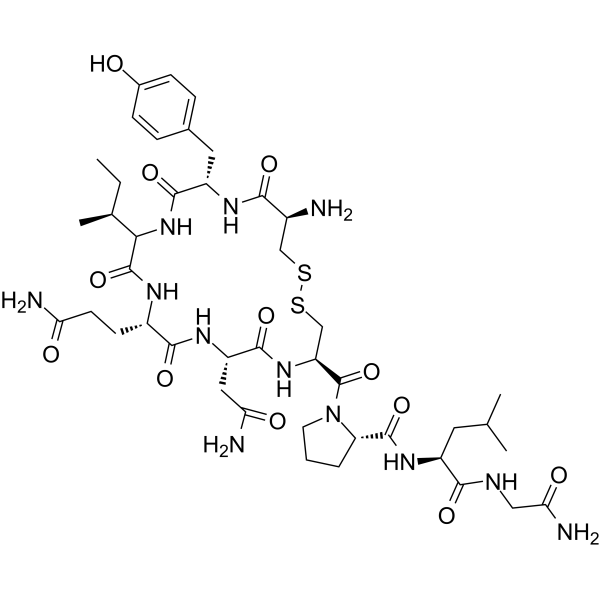
Oxytocin

别名: α-Hypophamine; Oxytocic hormone; Uteracon; Syntocinone; Pitocin; Synpitan 催产素;缩宫素;醋酸催产素;N-苄氧羰基-S-苄基半胱氨酰酪氨酰异亮氨酰谷氨酰胺酰天冬酰胺酰(S-苄基)半胱氨酰脯氨酰亮氨酰甘氨酰胺;催产素(OXYTOCIN);催产素酒石酸盐;N-苄氧羰基-S-苄基半胱氨酰酪氨酰异亮氨酰谷氨酰胺酰天冬酰胺酰(S-苄基)半胱氨酰脯氨酰;缩宫素,醋酸催产素;N-苄氧羰基-S-苄基半胱氨酰酪氨;Oxytocin Acetate 醋酸催产素;Oxytocin,缩宫素;醋酸催产素 Oxytocin Acetate;醋酸催产素 OxytocinAcetate;醋酸缩宫素;催产素 GL BIOCHEM;催产素,Oxytocin(2mg);催产素、 缩宫素 催产素;缩宫素标准品(JP)
目录号: V30374 纯度: =98.76%
催产素是一种神经垂体激素。
Oxytocin CAS号: 50-56-6
产品类别: Peptides
产品仅用于科学研究,不针对患者销售
规格 价格 库存 数量
1mg
2mg
5mg
10mg
25mg
50mg
100mg
250mg
500mg
1g
Other Sizes

Other Forms of Oxytocin:

  • 缩宫素
点击了解更多
InvivoChem产品被CNS等顶刊论文引用
纯度/质量控制文件

纯度: =98.76%

产品描述
催产素是一种神经垂体激素。它是一种发挥重要生理作用的九肽多效性激素。众所周知,它能刺激分娩和哺乳,但对代谢和心血管功能、性行为和母性行为、伴侣关系、社会认知和恐惧条件也有重要的生理影响。值得注意的是,催产素受体不仅限于生殖系统,而且可以在许多外周组织和中枢神经系统结构中发现,包括脑干和杏仁核。
生物活性&实验参考方法
靶点
Endogenous Metabolite
- The primary target of Oxytocin is the oxytocin receptor (OTR) [1]
- The primary target of Oxytocin is the oxytocin receptor (OTR) [2]
体外研究 (In Vitro)
催产素是一种多效肽激素,对一般健康、适应、发育、繁殖和社会行为有广泛的影响。内源性催产素和催产素受体的刺激支持生长、恢复和愈合模式。催产素可以作为一种压力应对分子、抗炎药和抗氧化剂发挥作用,尤其是在面对逆境或创伤时具有保护作用。催产素影响自主神经系统和免疫系统。催产素的这些特性可能有助于解释积极社会体验的好处,并引起人们对这种分子的关注,认为它可能是一种治疗多种疾病的药物。然而,如本文所述,催产素的独特化学性质,包括活性二硫键,以及其改变化学形式和与其他分子结合的能力,使该分子难以使用和测量。催产素的作用也依赖于环境,性二态性,并因经验而改变。在一定程度上,这是因为催产素的许多作用依赖于它与更古老的肽分子血管加压素和血管加压素受体相互作用的能力。此外,催产素受体通过经验进行表观遗传学调节,尤其是在生命早期。G蛋白偶联受体的刺激触发亚细胞级联反应,使这些神经肽具有多种功能。催产素的适应性使这种古老的分子对人类进化以及现代医学和健康具有特殊的重要性;这些相同的特征也对使用催产素样分子作为药物提出了挑战,而这些药物现在才被认识到。意义声明:催产素是一种古老的分子,在哺乳动物的行为和健康中起着重要作用。尽管催产素有能力作为一种“天然药物”来抵御压力和疾病,但催产素分子及其受体的独特特性及其与相关激素血管加压素的关系,给其作为治疗药物的使用带来了挑战[2]。
体内研究 (In Vivo)
垂体神经肽催产素促进社会行为,是精神分裂症和自闭症社会缺陷的潜在辅助疗法。催产素可以通过调节边缘和皮层区域的单胺释放来介导亲社会效应,本文使用体内微透析对其进行了研究,在确定了一个不会产生可能同时影响行为的镇静或体温调节作用的剂量后。使用选择性拮抗剂测定催产素和加压素V1a受体的作用,研究了催产素(0.03-0.3 mg/kg皮下注射)对成年雄性利斯特帽大鼠运动活动、核心体温和社交行为(社交互动和超声波发声)的影响。使用微透析法评估清醒大鼠前额叶皮层和伏隔核中多巴胺和血清素的流出。0.3mg/kg催产素适度降低活性并引起体温过低,但只有后者被V1a受体拮抗剂SR49059(腹膜内1mg/kg)减弱。0.1 mg/kg的催产素不会改变活动,对温度也几乎没有影响,它显著减弱了苯环利定诱导的多动,并增加了陌生大鼠之间的社交互动,而不会改变超声波发声的数量或模式。在同一只大鼠中,催产素(0.1 mg/kg)选择性地提高伏隔核的多巴胺溢出,但不影响前额叶皮层,而不会影响血清素的流出。全身催产素给药减轻了苯环利定诱导的多动,增加了亲社会行为,但没有降低核心体温,并选择性地增强了伏隔核多巴胺的释放,这与调节关联/奖励行为的中皮质边缘回路的激活一致。这突出了催产素在治疗精神分裂症等精神疾病中的社会行为缺陷方面的治疗潜力[1]。
- 在大鼠模型中,给予催产素(Oxytocin)可减轻苯环利定(PCP)诱导的过度活动,增加社交互动行为,并促进伏隔核内多巴胺的释放 [1]
酶活实验
单胺分析[1]
如前所述,使用具有电化学检测的高效液相色谱法分析微透析样品。注射前将解冻的样本保存在冰上(15 µl)注入Targa C18 3 µM柱(100 × 1 m) 使用Perkin Elmer Series 200自动进样器。多巴胺、5-羟色胺及其主要代谢产物;使用流动相(20 mM磷酸二氢钾,20 mM乙酸钠,0.1 mM乙二胺四乙酸,0.15 mM辛烷磺酸和10%甲醇,pH 3.9)在0.4 ml/min(Dionex P680泵),并使用DECADE II SDC Detector I和Clarity软件对照标准进行测量+ 0.75 V.计算每只大鼠的每种微透析物分子与基线的百分比变化。一只大鼠因探针放置不正确而被排除在PFC样本之外,另外两只大鼠因血流中断而被排除。在一只大鼠中,NAc多巴胺低于检测限;n = PFC中每组6/7,n = 在NAc中为7/8。
动物实验
催产素对核心体温和运动活性的剂量-反应及拮抗剂研究[1]
为了确定合适的催产素剂量,使其在微透析研究中不会抑制运动活性(LMA)或导致体温过低,我们采用受试者内设计,对12只大鼠进行了四次测试。每次测试前,大鼠均先注射赋形剂,然后以伪随机顺序皮下注射不同剂量的催产素(0.03、0.1或0.3 mg/kg),作为自身对照。之所以选择该剂量范围,是因为之前的研究表明,在其他品系的大鼠中,皮下或腹腔注射的催产素剂量高于0.3 mg/kg会抑制自发运动,因此我们纳入了较低剂量,以确定哪些剂量不会产生这种不良反应。为了确定催产素和血管加压素V1a受体对最高剂量引起的体温过低的相对贡献,另外12只大鼠在有或无非肽类选择性V1a受体拮抗剂SR49059(1 mg/kg,腹腔注射)或选择性催产素拮抗剂L-368,899(2 mg/kg,腹腔注射)的情况下,每周接受一次给药,共6次(组内设计)。尽管这些受体的原始肽类拮抗剂稳定性差且选择性低,但非肽类拮抗剂的开发极大地改善了其药代动力学特性。选择目前的非肽类拮抗剂(SR49059和L-368,889)是因为它们在市售的催产素和V1a受体拮抗剂中具有最佳的综合特性。这些拮抗剂具有高亲和力、相对选择性、良好的血脑屏障穿透性和血浆半衰期,且不具有部分激动剂活性。这些可穿透血脑屏障的拮抗剂的剂量是根据既往研究选择的,这些研究显示其在啮齿动物中起效时间小于15分钟,持续时间为2-4小时。SR49059可抑制催产素诱导的亲社会行为和体温过低,而L-368,899(PET研究已证实其可穿透血脑屏障)可抑制催产素在开放场中的抗焦虑作用,减少雄性大鼠在社交互动中的条件性厌恶行为,并减弱其性动机。交叉重复受试者内设计用于剂量反应和拮抗剂研究,大大减少了所需的实验大鼠数量,并降低了测量结果的个体间差异,符合3R原则。
剂量和给药途径:
化合物溶解于0.154 M生理盐水(拮抗剂的溶剂中还含有5%二甲基亚砜),并以1 ml/kg的体积皮下(sc)给药(催产素)。
催产素对PCP诱导的活动过度、社交互动以及前额叶皮层(PFC)和伏隔核(NAc)多巴胺和5-羟色胺(5-HT)外流的影响[1]
选择0.03和0.1 mg/kg的催产素进行进一步研究,因为这些剂量在上述剂量反应研究中未对活动和体温产生混淆效应。另取一组大鼠(n = 32,图 S1)研究这两种剂量对 PCP 诱导的活动过度的影响。基于这些结果,在评估社交互动和超声波发声 (USV) 之前,于 7 天后给予 0.1 mg/kg 催产素。接下来的一周,对大鼠进行立体定位手术,将微透析探针植入前额叶皮层 (PFC) 和伏隔核 (NAc)。术后 7 天恢复期后,评估催产素对这些脑区多巴胺外流的影响。三个实验方案之间间隔一周(图 S1),以确保药物完全清除,并最大限度地减少先前操作的任何残留效应。
运动活性[1]
如上所述,仅评估一次运动活性。动物在适应场地 30 分钟后接受催产素或载体,30 分钟后接受载体或 PCP(5.6 mg/kg 腹腔注射;用于检验“抗精神病样”活性的既定剂量),从而得到四种治疗组合:载体 + 载体、PCP + 载体、PCP + 0.03 mg/kg 催产素、PCP + 0.1 mg/kg(每组 n = 8;组间设计)。
药代性质 (ADME/PK)
吸收、分布和排泄

催产素通过肠外途径给药,具有完全的生物利用度。肠外给药后,催产素在血浆中达到稳态浓度大约需要 40 分钟。

催产素酶主要负责妊娠期间催产素水平的代谢和调节;只有一小部分神经激素以原形经尿液排出。

在一项观察 10 名接受催产素引产的妇女的研究中,平均代谢清除率为 7.87 mL/min。

催产素在胃肠道中被胰凝乳蛋白酶破坏。静脉注射催产素后,子宫反应几乎立即出现,并在 1 小时内消退。肌注催产素后,子宫反应在 3-5 分钟内出现,并持续 2-3 小时。鼻内滴注10-20单位催产素(美国已不再销售鼻用制剂)后,乳腺肺泡周围的肌上皮组织会在几分钟内开始收缩,并持续20分钟;静脉注射100-200毫单位的催产素也能产生相同的效果。
与血管加压素类似,催产素分布于细胞外液中。少量催产素可能进入胎儿循环。
目前尚不清楚该药物是否会分泌到人乳中。
其从血浆中的快速清除主要通过肾脏和肝脏完成。只有少量催产素以原形经尿液排出。
有关催产素(共7种)的更多吸收、分布和排泄(完整)数据,请访问HSDB记录页面。

代谢/代谢物
催产素主要通过肝脏和肾脏从血浆中清除。催产素主要负责妊娠期间催产素水平的代谢和调节,只有少量神经激素以原形经尿液排出。催产素酶在整个妊娠期间逐渐增加,并在接近足月时在血浆、胎盘和子宫中达到峰值。催产素酶活性。胎盘是妊娠期间催产素酶的主要来源,并随着母体催产素水平的增加而产生越来越多的酶。乳腺、心脏、肾脏和小肠也表达催产素酶。催产素存在于大脑、脾脏、肝脏、骨骼肌、睾丸和结肠中,活性较低。在非妊娠女性、男性和脐带血中,催产素的降解可以忽略不计。
催产素酶是一种在妊娠早期产生的循环酶,也能使该多肽失活。
在妊娠期间,“催产素酶”能够通过裂解1-半胱氨酸与2-酪氨酸之间的肽键使催产素失活。

生物半衰期
催产素的血浆半衰期为1-6分钟。在妊娠晚期和哺乳期,半衰期会缩短。
催产素的血浆半衰期约为3至5分钟。
毒性/毒理 (Toxicokinetics/TK)
相互作用

据报道,在预防性使用血管收缩剂并联合尾部阻滞麻醉后 3-4 小时给予催产素,可引起严重高血压。

可能改变催产素的心血管效应,与单独使用催产素相比,可引起较轻微的心动过速,但低血压更严重;当催产素与环丙烷麻醉同时使用时,曾观察到孕妇窦性心动过缓伴房室节律异常。

催产素可引起静脉痉挛,导致硫喷妥钠在外周积聚,从而延迟硫喷妥钠麻醉的诱导;然而,这种相互作用尚未得到最终证实。据报道,催产素。
参考文献

[1]. Oxytocin attenuates phencyclidine hyperactivity and increases social interaction and nucleus accumben dopamine release in rats. Neuropsychopharmacology. 2019 Jan;44(2):295-305.

[2]. Is Oxytocin "Nature's Medicine"? Pharmacol Rev. 2020 Oct;72(4):829-861.

其他信息
治疗用途
本品适用于医疗用途而非选择性引产。催产素。现有信息不足以明确本品用于选择性引产的获益风险比。本品定义为:对于无医疗指征的足月妊娠妇女,为方便起见而启动分娩。选择性引产。/美国产品标签包含/
本品适用于启动或增强子宫收缩,在出于胎儿或母亲健康考虑而需要且认为合适时,以期实现早期阴道分娩。催产素。适用于有医学指征需要引产的患者,例如Rh血型不合、妊娠期糖尿病、妊娠晚期或接近妊娠期的先兆子痫,以及分娩符合母婴最佳利益或胎膜早破且需要分娩的情况。/美国产品标签包含/
适用于刺激或加强宫缩,例如在某些子宫收缩乏力的情况下。催产素……/美国产品标签包含/
适用于作为辅助疗法,用于治疗不完全流产或不可避免的流产。在妊娠早期,刮宫术通常被认为是首选疗法。在妊娠中期流产中,催产素输注通常可以成功排空子宫。然而,在这些情况下,可能需要其他治疗方法。 /包含于美国产品标签/
有关催产素(共11种)的更多治疗用途(完整)数据,请访问HSDB记录页面。
药物警告
当催产素过量使用、与堕胎药合用或用于敏感患者时,可能会出现子宫过度刺激,表现为强烈的(高张性)和/或持续的(强直性)宫缩,或宫缩间期子宫静息张力为15-20 mm H2O,可能导致子宫破裂、宫颈和阴道撕裂、产后出血、胎盘早剥、子宫血流受损、羊水栓塞以及胎儿创伤(包括颅内出血)。
可能对胎儿造成不良影响,包括窦性心动过缓、心动过速、室性早搏和其他心律失常,以及永久性损伤。中枢神经系统或脑损伤,以及窒息导致的死亡。子宫活动度增加。或者,对敏感女性使用该药物还可能导致子宫胎盘灌注不足和胎心率变异性减速、胎儿缺氧、围产期肝坏死和胎儿高碳酸血症。母体剂量过大。曾有盆腔血肿的报道,但这些可能也与初产妇阴道助产率高、盆腔静脉充血脆弱(尤其是静脉曲张时)以及会阴切开术修复不当有关。罕见事件。
当使用大量催产素时,可能会出现母体收缩压和舒张压严重下降、心率加快、全身静脉回流和心输出量增加以及心律失常;这些副作用可能对患有瓣膜性心脏病的患者以及接受脊髓和硬膜外麻醉的患者尤其危险。
催产素的使用可能会增强这些副作用;这种副作用可能与催产素诱发的血小板减少症、无纤维蛋白原血症和低凝血酶原血症的报告有关。产后出血。通过严格控制分娩,可以最大限度地减少产后出血的发生率。
有关催产素(共22条)的更多药物警告(完整)数据,请访问HSDB记录页面。
药效学
催产素是一种九肽类多效性激素,具有重要的生理作用。它最广为人知的作用是刺激分娩和泌乳,但它对代谢和心血管功能、性行为和母性行为、配偶关系、社会认知和恐惧条件反射也有重要的生理影响。值得注意的是,催产素受体不仅限于生殖系统,还存在于许多外周组织和中枢神经系统结构中,包括脑干和杏仁核。
- 参与调节大鼠脑内PCP诱导的行为异常和多巴胺能传递,这可能与其在治疗神经精神疾病中的潜在作用有关。催产素[1]
- 探讨了催产素是否是“天然良药”,并总结了其在生理和病理过程(例如,社会行为、情绪调节)中的作用以及在神经精神疾病中的潜在治疗应用。该综述[2]
*注: 文献方法仅供参考, InvivoChem并未独立验证这些方法的准确性
化学信息 & 存储运输条件
分子式
C43H66N12O12S2
分子量
1007.1873
精确质量
1006.436
CAS号
50-56-6
相关CAS号
6233-83-6 (acetate)
PubChem CID
439302
序列
L-Cysteinyl-L-tyrosyl-L-isoleucyl-L-glutaminyl-L-asparaginyl-L-cysteinyl-L-prolyl-L-leucylglycinamide cyclic (1®6)-disulfide; or Cys-Tyr-Ile-Gln-Asn-Cys-Pro-Leu-Gly-NH2 (Disulfide bridge:Cys1-Cys6)
短序列
CYIQNCPLG-NH2 (Disulfide bridge:Cys1-Cys6)
外观&性状
White to off-white solid powder
密度
1.3±0.1 g/cm3
沸点
1533.3±65.0 °C at 760 mmHg
熔点
192-194°C
闪点
881.1±34.3 °C
蒸汽压
0.0±0.3 mmHg at 25°C
折射率
1.554
来源
Endogenous Metabolite
LogP
-4.26
tPSA
450.13
氢键供体(HBD)数目
12
氢键受体(HBA)数目
15
可旋转键数目(RBC)
17
重原子数目
69
分子复杂度/Complexity
1870
定义原子立体中心数目
9
SMILES
S1C([H])([H])[C@@]([H])(C(N2C([H])([H])C([H])([H])C([H])([H])[C@@]2([H])C(N([H])[C@]([H])(C(N([H])C([H])([H])C(N([H])[H])=O)=O)C([H])([H])C([H])(C([H])([H])[H])C([H])([H])[H])=O)=O)N([H])C([C@]([H])(C([H])([H])C(N([H])[H])=O)N([H])C([C@]([H])(C([H])([H])C([H])([H])C(N([H])[H])=O)N([H])C([C@]([H])([C@@]([H])(C([H])([H])[H])C([H])([H])C([H])([H])[H])N([H])C([C@]([H])(C([H])([H])C2C([H])=C([H])C(=C([H])C=2[H])O[H])N([H])C([C@]([H])(C([H])([H])S1)N([H])[H])=O)=O)=O)=O)=O
InChi Key
XNOPRXBHLZRZKH-DSZYJQQASA-N
InChi Code
InChI=1S/C43H66N12O12S2/c1-5-22(4)35-42(66)49-26(12-13-32(45)57)38(62)51-29(17-33(46)58)39(63)53-30(20-69-68-19-25(44)36(60)50-28(40(64)54-35)16-23-8-10-24(56)11-9-23)43(67)55-14-6-7-31(55)41(65)52-27(15-21(2)3)37(61)48-18-34(47)59/h8-11,21-22,25-31,35,56H,5-7,12-20,44H2,1-4H3,(H2,45,57)(H2,46,58)(H2,47,59)(H,48,61)(H,49,66)(H,50,60)(H,51,62)(H,52,65)(H,53,63)(H,54,64)/t22-,25-,26-,27-,28-,29-,30-,31-,35-/m0/s1
化学名
(2S)-1-({(4R,7S,10S,13S,16S,19R)-19-amino-7-(2-amino-2-oxoethyl)-10-(3-amino-3-oxopropyl)-16-(4-hydroxybenzyl)-13-[(1S)-1-methylpropyl]-6,9,12,15,18-pentaoxo-1,2-dithia-5,8,11,14,17-pentaazacycloicosan-4-yl}carbonyl)-N-{(1S)-1-[(2-amino-2-oxoethyl)carbamoyl]-3-methylbutyl}pyrrolidine-2-carboxamide
别名
α-Hypophamine; Oxytocic hormone; Uteracon; Syntocinone; Pitocin; Synpitan
HS Tariff Code
2934.99.9001
存储方式

Powder      -20°C    3 years

                     4°C     2 years

In solvent   -80°C    6 months

                  -20°C    1 month

注意: 请将本产品存放在密封且受保护的环境中,避免吸湿/受潮。
运输条件
Room temperature (This product is stable at ambient temperature for a few days during ordinary shipping and time spent in Customs)
溶解度数据
溶解度 (体外实验)
DMSO: ~100 mg/mL (99.3 mM)
溶解度 (体内实验)
注意: 如下所列的是一些常用的体内动物实验溶解配方,主要用于溶解难溶或不溶于水的产品(水溶度<1 mg/mL)。 建议您先取少量样品进行尝试,如该配方可行,再根据实验需求增加样品量。

注射用配方
(IP/IV/IM/SC等)
注射用配方1: DMSO : Tween 80: Saline = 10 : 5 : 85 (如: 100 μL DMSO 50 μL Tween 80 850 μL Saline)
*生理盐水/Saline的制备:将0.9g氯化钠/NaCl溶解在100 mL ddH ₂ O中,得到澄清溶液。
注射用配方 2: DMSO : PEG300Tween 80 : Saline = 10 : 40 : 5 : 45 (如: 100 μL DMSO 400 μL PEG300 50 μL Tween 80 450 μL Saline)
注射用配方 3: DMSO : Corn oil = 10 : 90 (如: 100 μL DMSO 900 μL Corn oil)
示例: 注射用配方 3 (DMSO : Corn oil = 10 : 90) 为例说明, 如果要配制 1 mL 2.5 mg/mL的工作液, 您可以取 100 μL 25 mg/mL 澄清的 DMSO 储备液,加到 900 μL Corn oil/玉米油中, 混合均匀。
View More

注射用配方 4: DMSO : 20% SBE-β-CD in Saline = 10 : 90 [如:100 μL DMSO 900 μL (20% SBE-β-CD in Saline)]
*20% SBE-β-CD in Saline的制备(4°C,储存1周):将2g SBE-β-CD (磺丁基-β-环糊精) 溶解于10mL生理盐水中,得到澄清溶液。
注射用配方 5: 2-Hydroxypropyl-β-cyclodextrin : Saline = 50 : 50 (如: 500 μL 2-Hydroxypropyl-β-cyclodextrin (羟丙基环胡精) 500 μL Saline)
注射用配方 6: DMSO : PEG300 : Castor oil : Saline = 5 : 10 : 20 : 65 (如: 50 μL DMSO 100 μL PEG300 200 μL Castor oil 650 μL Saline)
注射用配方 7: Ethanol : Cremophor : Saline = 10: 10 : 80 (如: 100 μL Ethanol 100 μL Cremophor 800 μL Saline)
注射用配方 8: 溶解于Cremophor/Ethanol (50 : 50), 然后用生理盐水稀释。
注射用配方 9: EtOH : Corn oil = 10 : 90 (如: 100 μL EtOH 900 μL Corn oil)
注射用配方 10: EtOH : PEG300Tween 80 : Saline = 10 : 40 : 5 : 45 (如: 100 μL EtOH 400 μL PEG300 50 μL Tween 80 450 μL Saline)


口服配方
口服配方 1: 悬浮于0.5% CMC Na (羧甲基纤维素钠)
口服配方 2: 悬浮于0.5% Carboxymethyl cellulose (羧甲基纤维素)
示例: 口服配方 1 (悬浮于 0.5% CMC Na)为例说明, 如果要配制 100 mL 2.5 mg/mL 的工作液, 您可以先取0.5g CMC Na并将其溶解于100mL ddH2O中,得到0.5%CMC-Na澄清溶液;然后将250 mg待测化合物加到100 mL前述 0.5%CMC Na溶液中,得到悬浮液。
View More

口服配方 3: 溶解于 PEG400 (聚乙二醇400)
口服配方 4: 悬浮于0.2% Carboxymethyl cellulose (羧甲基纤维素)
口服配方 5: 溶解于0.25% Tween 80 and 0.5% Carboxymethyl cellulose (羧甲基纤维素)
口服配方 6: 做成粉末与食物混合


注意: 以上为较为常见方法,仅供参考, InvivoChem并未独立验证这些配方的准确性。具体溶剂的选择首先应参照文献已报道溶解方法、配方或剂型,对于某些尚未有文献报道溶解方法的化合物,需通过前期实验来确定(建议先取少量样品进行尝试),包括产品的溶解情况、梯度设置、动物的耐受性等。

请根据您的实验动物和给药方式选择适当的溶解配方/方案:
1、请先配制澄清的储备液(如:用DMSO配置50 或 100 mg/mL母液(储备液));
2、取适量母液,按从左到右的顺序依次添加助溶剂,澄清后再加入下一助溶剂。以 下列配方为例说明 (注意此配方只用于说明,并不一定代表此产品 的实际溶解配方):
10% DMSO → 40% PEG300 → 5% Tween-80 → 45% ddH2O (或 saline);
假设最终工作液的体积为 1 mL, 浓度为5 mg/mL: 取 100 μL 50 mg/mL 的澄清 DMSO 储备液加到 400 μL PEG300 中,混合均匀/澄清;向上述体系中加入50 μL Tween-80,混合均匀/澄清;然后继续加入450 μL ddH2O (或 saline)定容至 1 mL;

3、溶剂前显示的百分比是指该溶剂在最终溶液/工作液中的体积所占比例;
4、 如产品在配制过程中出现沉淀/析出,可通过加热(≤50℃)或超声的方式助溶;
5、为保证最佳实验结果,工作液请现配现用!
6、如不确定怎么将母液配置成体内动物实验的工作液,请查看说明书或联系我们;
7、 以上所有助溶剂都可在 Invivochem.cn网站购买。
制备储备液 1 mg 5 mg 10 mg
1 mM 0.9929 mL 4.9643 mL 9.9286 mL
5 mM 0.1986 mL 0.9929 mL 1.9857 mL
10 mM 0.0993 mL 0.4964 mL 0.9929 mL

1、根据实验需要选择合适的溶剂配制储备液 (母液):对于大多数产品,InvivoChem推荐用DMSO配置母液 (比如:5、10、20mM或者10、20、50 mg/mL浓度),个别水溶性高的产品可直接溶于水。产品在DMSO 、水或其他溶剂中的具体溶解度详见上”溶解度 (体外)”部分;

2、如果您找不到您想要的溶解度信息,或者很难将产品溶解在溶液中,请联系我们;

3、建议使用下列计算器进行相关计算(摩尔浓度计算器、稀释计算器、分子量计算器、重组计算器等);

4、母液配好之后,将其分装到常规用量,并储存在-20°C或-80°C,尽量减少反复冻融循环。

计算器

摩尔浓度计算器可计算特定溶液所需的质量、体积/浓度,具体如下:

  • 计算制备已知体积和浓度的溶液所需的化合物的质量
  • 计算将已知质量的化合物溶解到所需浓度所需的溶液体积
  • 计算特定体积中已知质量的化合物产生的溶液的浓度
使用摩尔浓度计算器计算摩尔浓度的示例如下所示:
假如化合物的分子量为350.26 g/mol,在5mL DMSO中制备10mM储备液所需的化合物的质量是多少?
  • 在分子量(MW)框中输入350.26
  • 在“浓度”框中输入10,然后选择正确的单位(mM)
  • 在“体积”框中输入5,然后选择正确的单位(mL)
  • 单击“计算”按钮
  • 答案17.513 mg出现在“质量”框中。以类似的方式,您可以计算体积和浓度。

稀释计算器可计算如何稀释已知浓度的储备液。例如,可以输入C1、C2和V2来计算V1,具体如下:

制备25毫升25μM溶液需要多少体积的10 mM储备溶液?
使用方程式C1V1=C2V2,其中C1=10mM,C2=25μM,V2=25 ml,V1未知:
  • 在C1框中输入10,然后选择正确的单位(mM)
  • 在C2框中输入25,然后选择正确的单位(μM)
  • 在V2框中输入25,然后选择正确的单位(mL)
  • 单击“计算”按钮
  • 答案62.5μL(0.1 ml)出现在V1框中
g/mol

分子量计算器可计算化合物的分子量 (摩尔质量)和元素组成,具体如下:

注:化学分子式大小写敏感:C12H18N3O4  c12h18n3o4
计算化合物摩尔质量(分子量)的说明:
  • 要计算化合物的分子量 (摩尔质量),请输入化学/分子式,然后单击“计算”按钮。
分子质量、分子量、摩尔质量和摩尔量的定义:
  • 分子质量(或分子量)是一种物质的一个分子的质量,用统一的原子质量单位(u)表示。(1u等于碳-12中一个原子质量的1/12)
  • 摩尔质量(摩尔重量)是一摩尔物质的质量,以g/mol表示。
/

配液计算器可计算将特定质量的产品配成特定浓度所需的溶剂体积 (配液体积)

  • 输入试剂的质量、所需的配液浓度以及正确的单位
  • 单击“计算”按钮
  • 答案显示在体积框中
动物体内实验配方计算器(澄清溶液)
第一步:请输入基本实验信息(考虑到实验过程中的损耗,建议多配一只动物的药量)
第二步:请输入动物体内配方组成(配方适用于不溶/难溶于水的化合物),不同的产品和批次配方组成不同,如对配方有疑问,可先联系我们提供正确的体内实验配方。此外,请注意这只是一个配方计算器,而不是特定产品的确切配方。
+
+
+

计算结果:

工作液浓度 mg/mL;

DMSO母液配制方法 mg 药物溶于 μL DMSO溶液(母液浓度 mg/mL)。如该浓度超过该批次药物DMSO溶解度,请首先与我们联系。

体内配方配制方法μL DMSO母液,加入 μL PEG300,混匀澄清后加入μL Tween 80,混匀澄清后加入 μL ddH2O,混匀澄清。

(1) 请确保溶液澄清之后,再加入下一种溶剂 (助溶剂) 。可利用涡旋、超声或水浴加热等方法助溶;
            (2) 一定要按顺序加入溶剂 (助溶剂) 。

临床试验信息
Comparative Efficacy of Carbetocin and Oxytocin in Parturients at Risk of Atonic Postpartum Hemorrhage Undergoing Elective Cesarean Delivery
CTID: NCT06333340
Phase: N/A    Status: Recruiting
Date: 2024-11-29
Evaluating the Efficacy of Intranasal Oxytocin on Chronic Pain
CTID: NCT04903002
Phase: Phase 2/Phase 3    Status: Recruiting
Date: 2024-11-20
Effects of Carbetocin and Oxytocin Used in Cesarean Sections on Postoperative Pain
CTID: NCT06692621
Phase:    Status: Recruiting
Date: 2024-11-18
Effect of Intranasal Oxytocin on Emotion Recognition and Acute Psycho-Social Stress-induced Cortisol Increase in Patients With Central Diabetes Insipidus and Healthy Controls
CTID: NCT06676774
Phase: Phase 2    Status: Not yet recruiting
Date: 2024-11-06
Dog Presence and Oxytocin on Trust Towards Therapists
CTID: NCT06248710
Phase: Phase 2/Phase 3    Status: Recruiting
Date: 2024-11-05
View More

Examining Intranasal Oxytocin Augmentation of Brief Couples Therapy for Veterans With PTSD
CTID: NCT06194851
Phase: Phase 2    Status: Recruiting
Date: 2024-10-31


Apply the PD Model of Peripheral Oxytocin Action to a Multimodal Stimulus
CTID: NCT04433741
Phase: Phase 2    Status: Withdrawn
Date: 2024-10-26
A Randomized Controlled Trial to Test the Effects Oxytocin and Vibration Have on Heat Pain Threshold After UV-B Burn
CTID: NCT06651476
Phase: Phase 2    Status: Not yet recruiting
Date: 2024-10-24
Ocytocine and Cerebral Activation in Relation With Attachement
CTID: NCT02847143
Phase: Phase 2    Status: Completed
Date: 2024-10-02
Effect of Ephedrine, Phenylepinephrine, and Norepinephrine on Myometrial Contractility in Pregnant People With Type II and Gestational Diabetes During Cesarean Section: An In-vitro Study
CTID: NCT06285396
Phase: N/A    Status: Recruiting
Date: 2024-09-19
In Vitro Evaluation of Spontaneous and Oxytocin-induced Contractility of Pregnant Human Myometrium During Exposure to Dexmedetomidine
CTID: NCT05511415
Phase: N/A    Status: Recruiting
Date: 2024-09-19
Validate a Pharmacodynamic Model of Oxytocin for Peripheral Analgesic Effects
CTID: NCT04435704
Phase: Phase 2    Status: Withdrawn
Date: 2024-09-19
Comparing Intramyometrial Tranexamic Acid and Oxytocin for Blood Loss in Cesarean Section
CTID: NCT06010368
Phase: Phase 3    Status: Not yet recruiting
Date: 2024-09-05
Is There an Interest in Repeating the Vaginal Administration of Dinoprostone (Propess®), to Promote Induction of Labor of Pregnant Women at Term?
CTID: NCT02888041
Phase: Phase 3    Status: Terminated
Date: 2024-08-28
Recovery of Oxytocin Responsiveness in Pregnant Human Myometrial Explants After Oxytocin-Induced Desensitization: an In-vitro Analysis of Oxytocin Receptor Expression and Signaling
CTID: NCT02762669
Phase: N/A    Status: Terminated
Date: 2024-08-27
Oxytocin Maintenance Infusion in Labouring Women Undergoing Cesarean Delivery: an Up-down Sequential Allocation Study
CTID: NCT05290129
Phase: N/A    Status: Recruiting
Date: 2024-08-27
Standard Oxytocin Versus High Dose Oxytocin to Control Postpartum Hemorrhage in High Risk Pregnancy During Elective Cesarean Section
CTID: NCT06560099
Phase: N/A    Status: Not yet recruiting
Date: 2024-08-19
Oxytocin Effectiveness in First Trimester Dilatation and Curettage
CTID: NCT06469203
Phase: N/A    Status: Not yet recruiting
Date: 2024-08-13
High Or Low Dose pOstpartUm Oxytocin at the Time of Cesarean Birth
CTID: NCT06550089
Phase: Phase 2    Status: Not yet recruiting
Date: 2024-08-12
Different Medications to Induce Labor
CTID: NCT06259097
Phase: Phase 3    Status: Recruiting
Date: 2024-08-05
Defining a PK and PD Model for Peripheral Analgesia After IV Oxytocin
CTID: NCT05929339
Phase: Phase 2    Status: Recruiting
Date: 2024-08-05
The Efficacy of Topical Vaginal Oxytocin Gel in Postmenopausal Women With Vulvovaginal Atrophy
CTID: NCT06514586
Phase: Phase 3    Status: Not yet recruiting
Date: 2024-07-23
Intranasal Oxytocin for Methamphetamine Withdrawal in Women
CTID: NCT05760807
Phase: N/A    Status: Recruiting
Date: 2024-07-16
Oxytocin to Treat PTSD
CTID: NCT04228289
Phase: Phase 2    Status: Recruiting
Date: 2024-07-15
Role of Uterotonics in Reducing Intraoperative Blood Loss in Patients With PASD Undergoing Cesarean Hysterectomy
CTID: NCT06493968
Phase: N/A    Status: Recruiting
Date: 2024-07-10
Intravenous Oxytocin for Post Operative Pain After Minimally Invasive Hysterectomy
CTID: NCT06483659
Phase: Phase 2    Status: Not yet recruiting
Date: 2024-07-03
Oxytocin for Hypermobile Ehlers-Danlos Syndrome
CTID: NCT05405257
Phase: Phase 1/Phase 2    Status: Recruiting
Date: 2024-06-25
Intranasal Oxytocin in Youth With Autism
CTID: NCT05934812
Phase: Phase 2    Status: Not yet recruiting
Date: 2024-06-24
Oxytocin to Enhance Alcohol Behavioral Couple Therapy (ABCT)
CTID: NCT03846505
Phase: Phase 2    Status: Completed
Date: 2024-06-18
Mindfulness Training Plus Oxytocin Effects on Smoking Behavior
CTID: NCT03819231
Phase: Phase 2/Phase 3    Status: Terminated
Date: 2024-06-14
Oxytocin for Weight Loss in Adolescents
CTID: NCT04551482
Phase: Phase 2    Status: Recruiting
Date: 2024-05-16
The Role of Oxytocin-receptor Signalling in Physiological Regulation of Eating Behaviour in Individuals With Obesity
CTID: NCT06189001
Phase: N/A    Status: Recruiting
Date: 2024-05-14
Alcohol and Cigarette Craving During Oxytocin Treatment
CTID: NCT04071119
Phase: Phase 1    Status: Completed
Date: 2024-05-14
Low-Dose Versus High-Dose Oxytocin Dosing for Induction and Augmentation of Labor
CTID: NCT05782816
Phase: Phase 4    Status: Recruiting
Date: 2024-05-08
Oxytocin and Cognitive Control in Adult ADHD
CTID: NCT03136263
PhaseEarly Phase 1    Status: Completed
Date: 2024-05-03
Pitocin or Oral Misoprostol for PROM IOL
CTID: NCT04028765
Phase: Phase 4    Status: Completed
Date: 2024-04-30
Generate and Test the Reliability of a PD Model of OXT on Pupillary Hippus as a Measure of CNS Activity
CTID: NCT04427709
Phase: Phase 2    Status: Recruiting
Date: 2024-04-26
A Pharmaco-imaging Approach to Predicting Social Functioning and Clinical Responses to Oxytocin Administration in Schizophrenia
CTID: NCT03900754
Phase: Phase 2    Status: Terminated
Date: 2024-04-24
Understanding Cognition, Oxytocin & Pain in Elders
CTID: NCT03878589
Phase: Phase 2/Phase 3    Status: Recruiting
Date: 2024-04-24
Management of Prelabor Rupture of the Membranes at Term
CTID: NCT04307069
Phase: N/A    Status: Recruiting
Date: 2024-04-12
Comparing the Dose-response Profiles of Uterotonics After Initial Carbetocin Administration - an Ex-vivo Study in Desensitized Human Myometrium
CTID: NCT06285409
Phase: N/A    Status: Recruiting
Date: 2024-04-12
Oxytocin and Social Cognitive Skills Groups
CTID: NCT02918864
Phase: Phase 2    Status: Completed
Date: 2024-04-05
The Role of Oxytocin in Regulating Blood Glucose
CTID: NCT06334172
Phase: N/A    Status: Recruiting
Date: 2024-04-04
Oxytocin and Naltrexone: Investigation of Combined Effects on Stress- and Alcohol Cue-induced Craving in Alcohol Use Disorder
CTID: NCT05093296
Phase: Phase 2/Phase 3    Status: Completed
Date: 2024-03-29
Oxytocin Administration to Therapists and Its Effects on Patient-perceived Attunement and Responsiveness
CTID: NCT06332066
Phase: Phase 1    Status: Not yet recruiting
Date: 2024-03-27
Randomized Control Trial of Intracervical Balloon Placement vs Oxytocin in Women With Term PROM and Unripe Cervices
CTID: NCT03172858
Phase: N/A    Status: Withdrawn
Date: 2024-03-26
Misoprostol Versus Oxytocin Infusion On Reducing Blood Loss During Abdominal Myomectomy
CTID: NCT06325501
Phase: Phase 3    Status: Recruiting
Date: 2024-03-22
Dose Ranging Study of Intravenous Oxytocin for Analgesia to Heat Pain
CTID: NCT05179421
Phase: Phase 2    Status: Completed
Date: 2024-03-19
Target Engagement and Response to Oxytocin
CTID: NCT03245437
Phase: Phase 4    Status: Active, not recruiting
Date: 2024-03-15
A Study to Evaluate the Efficacy and Safety of TNX-1900 in Patients With Chronic Migraine
CTID: NCT05679908
Phase: Phase 2    Status: Completed
Date: 2024-03-07
Generate a Pharmacodynamic Model of Oxytocin for Peripheral Analgesic Effects
CTID: NCT04431206
Phase: Phase 2    Status: Recruiting
Date: 2024-02-28
Oxytocin on Cold Water Task Performance and Recovery
CTID: NCT04738838
Phase: Phase 2    Status: Completed
Date: 2024-02-22
Oxytocin for Oxidative Stress and Inflammation
CTID: NCT04732247
Phase: Phase 2    Status: Completed
Date: 2024-02-22
Evaluation of Tolerance, Suckling and Food Intake After Repeated Nasals Administrations of Oxytocin in PWS Infants
CTID: NCT02205034
Phase: Phase 1/Phase 2    Status: Completed
Date: 2024-02-21
Clinical Study to Assess the Equivalence of Tranexamic Acid vs Oxytocin in Reducing the PPH
CTID: NCT02775773
Phase: Phase 3    Status: Completed
Date: 2024-02-08
Clinical Study to Assess the Equivalence of Tranexamic Acid vs Oxytocin in Reducing the PPH (TRANOXY2015)
CTID: NCT02503319
Phase: Phase 3    Status: Withdrawn
Date: 2024-02-08
The Effects of Oxytocin in Obese Adults
CTID: NCT03043053
Phase: Phase 2    Status: Completed
Date: 2024-02-07
Effect of Oxytocin Nasal Inhalation on Empathy Analgesia
CTID: NCT05823441
Phase: Phase 4    Status: Completed
Date: 2024-02-01
Experimental Study on Alcohol Use and Behavior in Young Adults
CTID: NCT06199076
Phase: Phase 2    Status: Recruiting
Date: 2024-01-10
Time of Oxytocin Initiation at 2nd Stage of Labor and Adverse Outcomes
CTID: NCT06181396
Phase: N/A    Status: Recruiting
Date: 2023-12-26
Intranasal Oxytocin for Frontotemporal Dementia
CTID: NCT03260920
Phase: Phase 2    Status: Active, not recruiting
Date: 2023-12-15
Opioid-Sparing and Pain-Reducing Properties of Syntocinon: A Dose-Effect Determination
CTID: NCT04218409
PhaseEarly Phase 1    Status: Recruiting
Date: 2023-12-08
The Potential of Oxytocin to Reduce Opioid Abuse Liability and Pain Among Older Adults
CTID: NCT05761860
PhaseEarly Phase 1    Status: Recruiting
Date: 2023-12-01
A Pilot Study: High Versus Low Oxytocin Dosing for Induction of Labor in Pregnant Patients With Obesity
CTID: NCT05289869
Phase: Phase 4    Status: Completed
Date: 2023-11-29
Peripheral Oxytocin and Touch
CTID: NCT05326776
Phase: Phase 2    Status: Completed
Date: 2023-11-29
Oxytocin on HR in Sleep Apnea Patient
CTID: NCT02564068
PhaseEarly Phase 1    Status: Completed
Date: 2023-11-27
Changes in Hemorrhage With Prophylactic Oxytocin for Dilation and Evacuation
CTID: NCT06141447
Phase: Phase 2    Status: Not yet recruiting
Date: 2023-11-21
Hemostatic Effect of Intrauterine Instillation of Oxytocin in Hysteroscopic Myomectomy
CTID: NCT04996498
Phase: N/A    Status: Completed
Date: 2023-11-07
Foley Bulb With Low Dose Pitocin Versus Foley Bulb With a Standard Incremental Infusion Protocol for the Induction of Labor
CTID: NCT02150954
Phase: Phase 4    Status: Completed
Date: 2023-10-26
Role of Local Skin Incision Infiltration by Oxytocin On Wound Healing
CTID: NCT05745935
Phase: N/A    Status: Recruiting
Date: 2023-10-17
Oxytocin on Irritability/Emotional Dysregulation of Disruptive Behavior and Mood Disorders
CTID: NCT02824627
Phase: Phase 2    Status: Completed
Date: 2023-10-05
Efficacy of Intrathecal Oxytocin in Patients With Neuropathic Pain
CTID: NCT02100956
Phase: Phase 2    Status: Terminated
Date: 2023-10-03
Deciphering the Role of Oxytocin in Motivation: an fMRI Study. Part II
CTID: NCT02652195
Phase: Phase 2    Status: Active, not recruiting
Date: 2023-09-26
Effects of Oxytocin and Vasopressin on Moral Decision Making
CTID: NCT04890470
Phase: N/A    Status: Completed
Date: 2023-09-21
Efficacy of Spinal Oxytocin in Healthy Volunteers
CTID: NCT01996605
Phase: Phase 2    Status: Terminated
Date: 2023-09-14
Continuous Versus Intermittent Oxytocin Infusion for Induction of Labor
CTID: NCT04017247
Phase: N/A    Status: Completed
Date: 2023-09-13
Effects of Vaginal Oxytocin Gel on Vaginal Cytologic Parameters in Postmenopausal Woman
CTID: NCT05627791
Phase: Phase 2/Phase 3    Status: Terminated
Date: 2023-08-31
Amniotomy for Second-trimester Pregnancy Termination
CTID: NCT04906278
Phase: N/A    Status: Completed
Date: 2023-08-29
----------------------
Oxytocin and the development of attachment: Looking beyond the expected?
CTID: null
Phase: Phase 2    Status: Ongoing
Date: 2022-02-25
EFFECT OF INTRANASAL OXYTOCIN ON DYSPHAGIA RELATED TO OROPHARYNGO-OESOPHAGEAL DYSMOTILITY TRANSIT IN CHILDREN AND ADOLESCENTS WITH PRADER-WILLI SYNDROME: A PHASE 3 STUDY (DYSMOT)
CTID: null
Phase: Phase 3    Status: Ongoing
Date: 2022-01-25
Oxytocin versus Prostaglandins for labor Induction of women with an unfavorable Cervix after 24 hours of cervical ripening: a multicenter non inferiority randomized trial
CTID: null
Phase: Phase 3    Status: Ongoing
Date: 2021-07-28
LONG -TERM INTERVENTIONAL FOLLOW-UP STUDY UP TO 4 YEARS OF AGE OF CHILDREN WITH PRADER-WILLI SYNDROME INCLUDED IN THE OTBB3 CLINICAL TRIAL AND COMPARISON WITH AN UNTREATED COHORT OF CHILDREN WITH PRADER-WILLI SYNDROME
CTID: null
Phase: Phase 3    Status: Ongoing
Date: 2021-06-23
Effect of increased oxytocin doses on the mode of delivery in obese primiparous women with spontaneous labour. A double-blind, randomised, controlled trial
CTID: null
Phase: Phase 4    Status: Ongoing
Date: 2020-12-14
Combining emotion recognition training with oxytocin administration: A psychobiological approach
CTID: null
Phase: Phase 2    Status: Ongoing
Date: 2020-06-09
OXYTOCIN TREATMENT IN NEONATES AND INFANTS AGED FROM 0 TO 3 MONTHS WITH PRADER-WILLI SYNDROME: A STUDY OF THE SAFETY AND EFFICACY ON ORAL AND SOCIAL SKILLS AND, FEEDING BEHAVIOR OF INTRANASAL ADMINISTRATIONS OF OXYTOCIN VS. PLACEBO (PHASE III CLINICAL TRIAL)
CTID: null
Phase: Phase 3    Status: Ongoing, Prematurely Ended, Completed
Date: 2019-08-27
OXYTOCIN RESEARCH FOR BEHAVIORAL IMPAIRMENT SYMPTOMS IN DEMENTIA: Potential clinical efficacy of intranasal oxytocin in the treatment of frontotemporal dementia. A randomized, double-blind, placebo-controlled crossover trial.
CTID: null
Phase: Phase 2    Status: Ongoing
Date: 2019-07-25
Oxytocin and social attention in healthy controls and patients with Parkinson's disease. A randomised, double-blind, placebo-controlled, crossover eye tracking study.
CTID: null
Phase: Phase 2    Status: Prematurely Ended
Date: 2019-01-21
In search for an innovative neural marker and intervention for socio-communicative difficulties in children with and without autism spectrum disorders
CTID: null
Phase: Phase 3    Status: Completed
Date: 2018-09-27
Oxytocin in mr guided focused ultrasound treatment (MRI-HIFU)
CTID: null
Phase: Phase 4    Status: Completed
Date: 2018-06-13
Randomized, double-blind, placebo-controlled oxytocin and dose-response trial in children with Prader-Willi syndrome.
CTID: null
Phase: Phase 2, Phase 3    Status: Ongoing
Date: 2017-12-12
A randomised double blind placebo controlled pilot trial of oxytocin efficacy in treating detoxified opioid dependent individuals
CTID: null
Phase: Phase 2    Status: Prematurely Ended
Date: 2017-06-28
Oxytocin, friendship and dealing with emotions
CTID: null
Phase: Phase 4    Status: Ongoing
Date: 2017-05-01
The effect of oxytocin administration on empathy and emotion recognition in healthy and antisocial adolescents
CTID: null
Phase: Phase 4    Status: Prematurely Ended
Date: 2017-03-23
Effects of oxytocin on suggestibility and consciousness
CTID: null
Phase: Phase 2    Status: Completed
Date: 2017-02-17
A single-center, randomized, double-blind, placebo-controlled, cross-over study of intranasal oxytocin in young adults with Autism Spectrum Disorder
CTID: null
Phase: Phase 2    Status: Ongoing
Date: 2017-01-25
Intranasal administration of oxytocin in children with Prader-Willi Syndrome. A randomized, open-label, cross-over trial of different treatment regimens of oxytocin administration. Effects on eating behaviour and social behaviour.
CTID: null
Phase: Phase 3    Status: Not Authorised
Date: 2016-12-22
Effects of intranasal administrations of oxytocin on beahvioural troubles, hyperphagia and social skills in children with Prader-Willi syndrome aged from 3 to 12 years.
CTID: null
Phase: Phase 3    Status: Completed
Date: 2016-11-14
Father Trials: Hormonal Experiments on Prenatal and Postnatal Parenting
CTID: null
Phase: Phase 4    Status: Ongoing
Date: 2016-03-23
A Phase 2b, Double-blind, Randomized, Parallel, Placebo-Controlled Study to Evaluate the 12-week Efficacy of Vagitocin in Postmenopausal Women with Symptoms of Vulvovaginal Atrophy
CTID: null
Phase: Phase 2    Status: Completed
Date: 2016-03-18
CONDISOX: Continued versus discontinued oxytocin stimulation of labour in a double-blind randomised controlled trial
CTID: null
Phase: Phase 4    Status: Completed
Date: 2015-12-10
The effect of oxytocin on the training of attachment-related interpretation bias
CTID: null
Phase: Phase 4    Status: Ongoing
Date: 2015-08-07
A phase III, randomized, double-blind, active, controlled, multinational, multicentre, non-inferiority trial using Carbetocin room temperature stable (RTS) for the prevention of postpartum haemorrhage during the third stage of labour in women delivering vaginally.
CTID: null
Phase: Phase 3    Status: Completed
Date: 2015-03-27
NO
CTID: null
Phase: Phase 2    Status: Completed
Date: 2015-03-26
Effects of maternal oxytocin on social information processing in mothers and infants
CTID: null
Phase: Phase 4    Status: Completed
Date: 2015-01-13
Effects of maternal oxytocin on social information processing in mothers
CTID: null
Phase: Phase 4    Status: Completed
Date: 2014-12-16
Intramuscular oxytocics: A multi-centre randomised comparison study of intramuscular Carbetocin, Syntocinon and Syntometrine for the third stage of labour following vaginal birth
CTID: null
Phase: Phase 3    Status: Completed
Date: 2014-10-30
Intranasal administration of oxytocin in children and young adults with Prader-Willi Syndrome. A randomized, double-blind, placebo-controlled trial. Effects on satiety and food intake, and social behaviour.
CTID: null
Phase: Phase 3    Status: Completed
Date: 2014-07-15
Effect of oxytocin on therapy results of a group based social skill training in adolescents with Autism Spectrum Disorder
CTID: null
Phase: Phase 3    Status: Completed
Date: 2014-04-24
Effets de l'administration intranasale répétée d'ocytocine chez des patients adultes présentant un syndrome de Prader-Willi.
CTID: null
Phase: Phase 3    Status: Completed
Date: 2014-03-18
Study of the effect of oxytocin on emotion regulation in adolescents with insecure attachment
CTID: null
Phase: Phase 2    Status: Completed
Date: 2013-08-30
A pharmacokinetic study of vaginally and intravenously administered oxytocin in postmenopausal women with vaginal atrophy
CTID: null
Phase: Phase 3    Status: Completed
Date: 2013-08-21
(Grand)parenting, oxytocin, and the oxytocin receptor gene: an fMRI and observational study
CTID: null
Phase: Phase 4    Status: Ongoing
Date: 2013-08-21
The full scope of oxytocinergic influences on the parental brain: Maternal
CTID: null
Phase: Phase 4    Status: Ongoing
Date: 2013-06-19
Evaluation of tolerance, suckling and food intake after repeated nasals administrations of Oxytocin in PWS infants
CTID: null
Phase: Phase 2    Status: Ongoing
Date: 2013-04-30
Delay in labour due to ineffective uterine contractions is still a major problem in modern obstetric care. It is one of the main reasons for the increased rate of operative deliveries, particularly among nulliparous women, and also associated with other childbirth complications and negative childbirth experiences.
CTID: null
Phase: Phase 4    Status: Prematurely Ended
Date: 2013-03-27
A placebo-controlled, double blind, randomised trial with crossover-design investigating the effect of oxytocin nasal spray on neuronal processes of empathy
CTID: null
Phase:    Status: Completed
Date: 2013-02-14
The influence of oxytocin on automatic imitation
CTID: null
Phase: Phase 3    Status: Completed
Date: 2012-09-21
Dopamine modulation of oxytocin prosocial effects
CTID: null
Phase: Phase 2    Status: Ongoing
Date: 2012-07-11
Randomized prospectic clinical trial for delivery induction in patients with unfavoreable obstetric conditions.
CTID: null
Phase: Phase 3    Status: Ongoing
Date: 2012-06-25
Boosting oxytocin after trauma: The effects of intranasal oxytocin administration on emotional and motivational brain processes in PTSD
CTID: null
Phase: Phase 2    Status: Completed
Date: 2012-05-21
A double-blind, placebo controlled single centre trial to evaluate the dose-relationship of the effects of vaginally administered oxytocin on the vaginal mucosal membrane in postmenopausal women
CTID: null
Phase: Phase 2    Status: Completed
Date: 2012-01-27
Boosting the oxytocin system in acute trauma: The effectiveness of intranasal oxytocin treatments and stimulation of social support on preventing trauma related psychopathology
CTID: null
Phase: Phase 2    Status: Prematurely Ended
Date: 2011-11-14
Short- and long-term effects of oxytocin on empathy and social behaviour in autistic and antisocial male adults.
CTID: null
Phase: Phase 4    Status: Ongoing
Date: 2011-08-25
Female Sexual Dysfunction in the Peri and Postmenopause: Effect of intranasal Oxytocin administration on sexual function and activity
CTID: null
Phase: Phase 2    Status: Completed
Date: 2011-08-11
Effects of Oxytocin on opioide withdrawal symptoms
CTID: null
Phase: Phase 2    Status: Completed
Date: 2011-08-02
Behavioral effects and neural correlates of oxytocin on social attention [Verhaltenseffekte und neuronales Korrelat von Oxytocin im Kontext sozialer Aufmerksamkeit]
CTID: null
Phase: Phase 2    Status: Completed
Date: 2011-04-05
Pilot study: performance of the Progensa PCA3 test in post-oxytocin urine specimens
CTID: null
Phase: Phase 4    Status: Completed
Date: 2011-04-05
Effekte von Oxytocin bei Patientinnen und Patienten mit Borderline-Persönlichkeitsstörung
CTID: null
Phase: Phase 2    Status: Completed
Date: 2011-02-23
A double-blind, placebo controlled multi-centre study to evaluate the effects of topical Oxytocin on vaginal atrophy in postmenopausal women.
CTID: null
Phase: Phase 1, Phase 2    Status: Completed
Date: 2010-06-14
Effect of intranasal oxytocin on social approach in patients with social phobia and healthy control
CTID: null
Phase: Phase 4    Status: Completed
Date: 2010-04-21
Effects of intranasal application of oxytocin on empathy and mentalising in patients with psychotic disorders and severe personality disorders
CTID: null
Phase: Phase 2    Status: Completed
Date: 2009-11-05
Lack of Empathy as a Symptom in various Psychiatric Disorders
CTID: null
Phase: Phase 1, Phase 2    Status: Completed
Date: 2009-09-10
SYNERGIC EFFECTS OF OXYTOCIN AND PSYCHOTHERAPY IN POSTPARTUM DEPRESSION. RANDOMIZED CONTROLLED STUDY.
CTID: null
Phase: Phase 3    Status: Ongoing
Date: 2009-03-23
Phase III study protocol to compare conservative and active treatment during the third stage of labour in physiological childbirth
CTID: null
Phase: Phase 3    Status: Ongoing
Date: 2008-05-05
Randomised controlled trial comparing the effects of oxytocin 5 units IV bolus vs oxytocin 5 units IV infusion on cardiac output during caesarean section
CTID: null
Phase: Phase 4    Status: Completed
Date: 2008-04-28
A randomised trial of oxytocin bolus versus oxytocin bolus and infusion for the control of blood loss at elective caesarean section.
CTID: null
Phase: Phase 4    Status: Completed
Date: 2007-11-29
Hvor længe skal oxytocin anvendes ved stimulation af fødsler
CTID: null
Phase: Phase 4    Status: Completed
Date: 2007-02-22
Randomised trial of carbetocin versus oxytocin for the prevention of postpartum haemorrhage after caesarean section
CTID: null
Phase: Phase 4    Status: Completed
Date: 2005-09-09
Cardiac effects of oxytocin administrated during cesarean section, signs of myocardial ischaemia.
CTID: null
Phase: Phase 4    Status: Completed
Date: 2005-08-25
A randomised controlled trial of oxytocin 5 IU versus oxytocin 5 IU and 30 IU infusion for the control of blood loss at elective caesarean section - pilot study.
CTID: null
Phase: Phase 4    Status: Completed
Date: 2005-04-26
High Or Low Dose Syntocinon® for delay in labour: the HOLDS trial
CTID: null
Phase: Phase 4    Status: GB - no longer in EU/EEA
Date:
Evaluation de la tolérance d'une administration intra-nasale d'ocytocine chez des nourrissons présentant un syndrome de Prader-Willi et de son effet sur la succion et la prise alimentaire.
CTID: null
Phase: Phase 2    Status: Ongoing
Date:
Intranasal oxytocin in the treatment of schizophrenia
CTID: UMIN000014650
Phase: Phase II,III    Status: Complete: follow-up complete
Date: 2014-08-01
A research of efficacy and safety of oxytocin treatment in children and adolescents with reactive attachment disorder using functional magnetic resonance imaging (fMRI).
CTID: UMIN000013215
Phase:    Status: Complete: follow-up complete
Date: 2014-02-21
Comparison of the cerebral function before and after the oxytocin administration for patients with autism spectrum disorder: open study using positron emission tomography and magnetoencephalography.
CTID: UMIN000011077
PhaseNot applicable    Status: Complete: follow-up complete
Date: 2013-08-20
Effects of long-term administration of intranasal oxytocin on autism spectrum disorders
CTID: UMIN000009075
PhaseNot applicable    Status: Complete: follow-up complete
Date: 2012-11-01
The effects and side effects of oxytocin: a randomized double-blind comparison of intramyometrial oxytocin and intravenous oxytocin during elective Cesarean section
CTID: UMIN000007577
Phase:    Status: Complete: follow-up complete
Date: 2012-03-28
A randomized, double-blind, placebo-controlled, cross-over trial of oxytocin in patients with autism spectrum disorder
CTID: UMIN000007250
Phase: Phase II    Status: Complete: follow-up complete
Date: 2012-02-09
A randomized, double-blind and cross-over trial to examine effects of continuous administration of intranasal oxytocin on social dysfunction in subjects with autism spectrum disorders
CTID: UMIN000007122
Phase: Phase II    Status: Complete: follow-up complete
Date: 2012-02-01
A single-blind and crossover study examining the efficacy of intranasal oxytocin administration for social impairments in subjects with pervasive developmental disorders
CTID: UMIN000005809
Phase:    Status: R e.querySelector("font strong").innerText = 'View More' } else if(up_display === 'none' || up_display === '') {

相关产品
联系我们