| 规格 | 价格 | 库存 | 数量 |
|---|---|---|---|
| 100mg |
|
||
| 500mg |
|
||
| 1g |
|
||
| Other Sizes |
|

| 药代性质 (ADME/PK) |
Absorption, Distribution and Excretion
The decline of the concentration of perfluorochemicals (PFC) after a single injection of three different doses was studied in the circulation of rats. The doses used amounted to 4.4, 10 and 14 g/kg body weight of Fluosol-DA, an emulsion of 7 parts of perfluorodecalin (FDC) and 3 parts of perfluorotripropylamine (FTPA). This also allowed testing of the composition of the emulsion remaining in the circulation and of that found in the liver. After two days a decrease of the half life from 34.0 +/- 0.7 to 17.1 +/- 4.3 h was found within the circulation at the highest dose. At the same time a change in the composition of the emulsion in the blood stream occurred, favouring the fraction of FTPA. FTPA increased from 28.3 +/- 1.4 to 54.4 +/- 8.1% on the fourth day. Whereas in the cells of the liver PFC droplets may be broken up, freed from their surfactant layer and handled according to their individual components, for PFC in the blood stream an unchanged composition should be assumed. Both results, the decreasing half life and the change in composition of the circulating emulsion may best be explained by a shrinking and instability of the emulgator film, showing the necessity for development of a superior surfactant. /Fluosol-DA/ The effect of an emulsion of perfluorochemicals (PFC) (7 parts perfluorodecalin and 3 parts perfluorotripropylamine, 4.4 g PFC/kg body weight) on organ function was determined. Whereas maximal storage of PFC was reached in the spleen as early as 12 h after PFC administration, the liver attained a maximal PFC content only after 2 days. Biological Half-Life Organ retention of the blood substitute component, perfluorotripropylamine (FTPA)... /was examined/. Various dosages of an emulsion of FTPA were administered to five rats. At intervals up to 86 weeks after infusion, (19F) MRI was used to measure the amount of FTPA in liver and spleen. The data were fit to both linear and exponential elimination models, and organ retention half-lives were calculated. The exponential half-lives for combined liver and spleen FTPA ranged from 110 to 190 days. Linear half-lives ranged from 175 to 300 days. /In anemic patients/ the half-life of /fluosol-DA/ was 24.3+-4.3 hr. |
|---|---|
| 其他信息 |
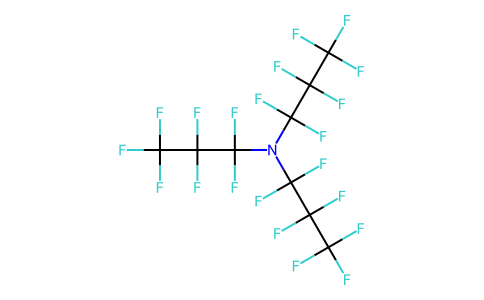
Perfluorotripropylamine is an organofluorine compound. It has a role as a blood substitute. It is functionally related to a tripropylamine.
Therapeutic Uses Blood substitute. /Exptl Ther/ Emulsions of perfluorocarbons (PFCs) have been tested as blood substitutes. /Exptl Ther/ Eight male rabbits were divided into the test (n=5) and control (n=3) groups. Each underwent intrajejunal, ip, and iv (artery, portal vein) catheter placements along with ligation of the duodenum and the terminal ileum under general anesthesia. The test group received oxygen-saturated perfluorotripropylamine (FTPA), and the control group received oxygen desaturated FTPA. The oxygen delivery was assessed by serial blood gas measurements before and after the admin of FTPA. The admin of oxygen-saturated FTPA significantly increased the partial pressure of oxygen within both the arterial and the portal venous blood (PaO2, PpVO2) without significant changes in PCO2 values. Oxygen desaturated FTPA failed to show any effects on blood gas values. Compared with oxygen desaturated FTPA, oxygen-saturated FTPA increased PaO2, PpVO2, and oxygen saturation (artery, portal vein) significantly at some, but not all of the time-points measured. The intraabdominal admin of saturated FTPA improved both the portal venous and the arterial oxygenation. This new mode of oxygenation may be helpful as an adjunct to conventional oxygen delivery systems. /Exptl Ther/ Perfluorodecalin and perfluorotripropylamine which have N2 solubility coefficients of 28.4 and 35.7 ml/dl, respectively, were used for treatment of decompression sickness in this study. Rats with chronically implanted venous catheters were held for 30 min at 800 kPa (7 bar, 8 ATA) by introducing compressed air into a chamber in which they were kept; a relatively short period of decompression followed (200 kPa/min). Immediately thereafter injections of the perfluorochemicals (PFCs) in a dose of 10 g/kg were given, controls received saline in the same volume or remained without treatment. An observation period of 2 h followed; after this time the incidence of death amongst the experimental animals (as compared with controls tested by the chi 2-test) showed that PFC treatment increased the likelihood of survival. Probit-log time relationship for the incidence of death also revealed a significant decrease in lethality in treated rats 30 min after the end of decompression. The mean lethal times Lt50 differed significantly, too. A still greater effect might be expected if the PFC emulsion were deprived of its normal nitrogen content by oxygenation before administration. Under the conditions of the present experiments PFCs produced an improvement in N2 exhalation at least in terms of the survival rate after compression followed by a very short decompression time. For more Therapeutic Uses (Complete) data for PERFLUAMINE (7 total), please visit the HSDB record page. Drug Warnings Emulsions of perfluorocarbons (PFCs) have been tested as blood substitutes. However, evidence exists that there is long-term retention of some PFCs by the organs of the reticuloendothelial system (RES). Since PFCs have a profound influence on several important neutrophil functions, patients receiving PFC should be monitored closely for possible infectious complications. It was concluded that the data in this select group of patients refusing blood products suggest that, after blood loss, ... /fluosol-DA/ is unnecessary in moderate anemia and ineffective in severe anemia. |
| 分子式 |
C9NF21
|
|---|---|
| 分子量 |
521.0694
|
| 精确质量 |
520.969
|
| CAS号 |
338-83-0
|
| PubChem CID |
67645
|
| 外观&性状 |
Colorless to light yellow liquid(Density:1.822 g/cm3)
|
| 密度 |
1.7±0.1 g/cm3
|
| 沸点 |
130.0±35.0 °C at 760 mmHg
|
| 闪点 |
32.4±25.9 °C
|
| 蒸汽压 |
9.9±0.2 mmHg at 25°C
|
| 折射率 |
1.269
|
| LogP |
15.38
|
| tPSA |
3.24
|
| 氢键供体(HBD)数目 |
0
|
| 氢键受体(HBA)数目 |
22
|
| 可旋转键数目(RBC) |
6
|
| 重原子数目 |
31
|
| 分子复杂度/Complexity |
555
|
| 定义原子立体中心数目 |
0
|
| SMILES |
C(C(F)(F)F)(C(F)(F)N(C(C(C(F)(F)F)(F)F)(F)F)C(C(C(F)(F)F)(F)F)(F)F)(F)F
|
| InChi Key |
JAJLKEVKNDUJBG-UHFFFAOYSA-N
|
| InChi Code |
InChI=1S/C9F21N/c10-1(11,4(16,17)18)7(25,26)31(8(27,28)2(12,13)5(19,20)21)9(29,30)3(14,15)6(22,23)24
|
| 化学名 |
1,1,2,2,3,3,3-heptafluoro-N,N-bis(1,1,2,2,3,3,3-heptafluoropropyl)propan-1-amine
|
| HS Tariff Code |
2934.99.9001
|
| 存储方式 |
Powder -20°C 3 years 4°C 2 years In solvent -80°C 6 months -20°C 1 month |
| 运输条件 |
Room temperature (This product is stable at ambient temperature for a few days during ordinary shipping and time spent in Customs)
|
| 溶解度 (体外实验) |
May dissolve in DMSO (in most cases), if not, try other solvents such as H2O, Ethanol, or DMF with a minute amount of products to avoid loss of samples
|
|---|---|
| 溶解度 (体内实验) |
注意: 如下所列的是一些常用的体内动物实验溶解配方,主要用于溶解难溶或不溶于水的产品(水溶度<1 mg/mL)。 建议您先取少量样品进行尝试,如该配方可行,再根据实验需求增加样品量。
注射用配方
注射用配方1: DMSO : Tween 80: Saline = 10 : 5 : 85 (如: 100 μL DMSO → 50 μL Tween 80 → 850 μL Saline)(IP/IV/IM/SC等) *生理盐水/Saline的制备:将0.9g氯化钠/NaCl溶解在100 mL ddH ₂ O中,得到澄清溶液。 注射用配方 2: DMSO : PEG300 :Tween 80 : Saline = 10 : 40 : 5 : 45 (如: 100 μL DMSO → 400 μL PEG300 → 50 μL Tween 80 → 450 μL Saline) 注射用配方 3: DMSO : Corn oil = 10 : 90 (如: 100 μL DMSO → 900 μL Corn oil) 示例: 以注射用配方 3 (DMSO : Corn oil = 10 : 90) 为例说明, 如果要配制 1 mL 2.5 mg/mL的工作液, 您可以取 100 μL 25 mg/mL 澄清的 DMSO 储备液,加到 900 μL Corn oil/玉米油中, 混合均匀。 View More
注射用配方 4: DMSO : 20% SBE-β-CD in Saline = 10 : 90 [如:100 μL DMSO → 900 μL (20% SBE-β-CD in Saline)] 口服配方
口服配方 1: 悬浮于0.5% CMC Na (羧甲基纤维素钠) 口服配方 2: 悬浮于0.5% Carboxymethyl cellulose (羧甲基纤维素) 示例: 以口服配方 1 (悬浮于 0.5% CMC Na)为例说明, 如果要配制 100 mL 2.5 mg/mL 的工作液, 您可以先取0.5g CMC Na并将其溶解于100mL ddH2O中,得到0.5%CMC-Na澄清溶液;然后将250 mg待测化合物加到100 mL前述 0.5%CMC Na溶液中,得到悬浮液。 View More
口服配方 3: 溶解于 PEG400 (聚乙二醇400) 请根据您的实验动物和给药方式选择适当的溶解配方/方案: 1、请先配制澄清的储备液(如:用DMSO配置50 或 100 mg/mL母液(储备液)); 2、取适量母液,按从左到右的顺序依次添加助溶剂,澄清后再加入下一助溶剂。以 下列配方为例说明 (注意此配方只用于说明,并不一定代表此产品 的实际溶解配方): 10% DMSO → 40% PEG300 → 5% Tween-80 → 45% ddH2O (或 saline); 假设最终工作液的体积为 1 mL, 浓度为5 mg/mL: 取 100 μL 50 mg/mL 的澄清 DMSO 储备液加到 400 μL PEG300 中,混合均匀/澄清;向上述体系中加入50 μL Tween-80,混合均匀/澄清;然后继续加入450 μL ddH2O (或 saline)定容至 1 mL; 3、溶剂前显示的百分比是指该溶剂在最终溶液/工作液中的体积所占比例; 4、 如产品在配制过程中出现沉淀/析出,可通过加热(≤50℃)或超声的方式助溶; 5、为保证最佳实验结果,工作液请现配现用! 6、如不确定怎么将母液配置成体内动物实验的工作液,请查看说明书或联系我们; 7、 以上所有助溶剂都可在 Invivochem.cn网站购买。 |
| 制备储备液 | 1 mg | 5 mg | 10 mg | |
| 1 mM | 1.9191 mL | 9.5956 mL | 19.1913 mL | |
| 5 mM | 0.3838 mL | 1.9191 mL | 3.8383 mL | |
| 10 mM | 0.1919 mL | 0.9596 mL | 1.9191 mL |
1、根据实验需要选择合适的溶剂配制储备液 (母液):对于大多数产品,InvivoChem推荐用DMSO配置母液 (比如:5、10、20mM或者10、20、50 mg/mL浓度),个别水溶性高的产品可直接溶于水。产品在DMSO 、水或其他溶剂中的具体溶解度详见上”溶解度 (体外)”部分;
2、如果您找不到您想要的溶解度信息,或者很难将产品溶解在溶液中,请联系我们;
3、建议使用下列计算器进行相关计算(摩尔浓度计算器、稀释计算器、分子量计算器、重组计算器等);
4、母液配好之后,将其分装到常规用量,并储存在-20°C或-80°C,尽量减少反复冻融循环。
计算结果:
工作液浓度: mg/mL;
DMSO母液配制方法: mg 药物溶于 μL DMSO溶液(母液浓度 mg/mL)。如该浓度超过该批次药物DMSO溶解度,请首先与我们联系。
体内配方配制方法:取 μL DMSO母液,加入 μL PEG300,混匀澄清后加入μL Tween 80,混匀澄清后加入 μL ddH2O,混匀澄清。
(1) 请确保溶液澄清之后,再加入下一种溶剂 (助溶剂) 。可利用涡旋、超声或水浴加热等方法助溶;
(2) 一定要按顺序加入溶剂 (助溶剂) 。
 匹伐加宾
匹伐加宾
 磷酸氢化可的松
 BAY-784
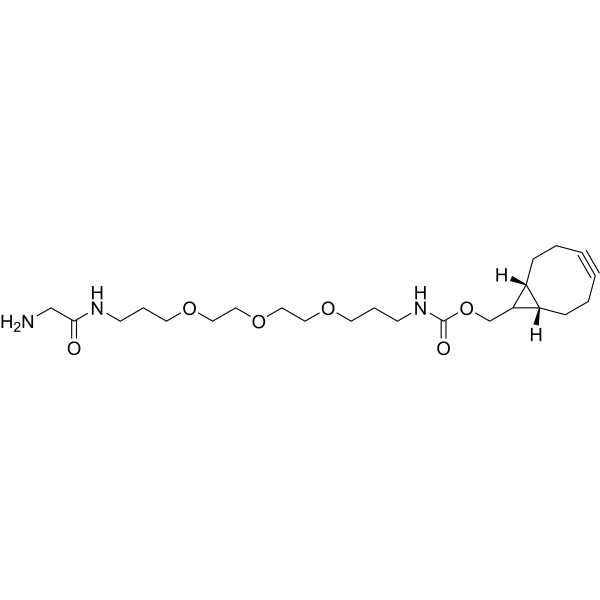 Gly-PEG3-endo-BCN
InvivoChem的所有产品仅用于作科学研究,不面向患者销售
Copyright 2020 InvivoChem LLC | All Rights Reserved 粤ICP备20063088号-1


 粤公网安备 44011102003439号
 463611831
