| 规格 | 价格 | |
|---|---|---|
| 500mg | ||
| 1g | ||
| Other Sizes |

| 体外研究 (In Vitro) |
在腹水肝癌细胞中,2-脱氧-D-半乳糖(1 mM/L;5 小时)在前 30 分钟内快速磷酸化,然后在接下来的几个小时内降至该速率的 20% 左右[4]。
|
|---|---|
| 体内研究 (In Vivo) |
2-Deoxy-D-galactose(380 mg/kg;腹腔注射;六次)显着降低大鼠肝脏中 UDP 半乳糖、UMP 和 UDPG 的含量[1]。 2-脱氧-D-半乳糖(2-8 μM;脑室内注射;一次)在剂量为 4 μM 的 do-gal 给药后 15 分钟和采集试验前 30 分钟表现出 PAR 损伤[3]。
|
| 动物实验 |
动物/疾病模型: 雄性成年 Wistar 大鼠被动回避反应 (PAR) 习得试验[3] ]
剂量: 2、4 和 8 μM 给药途径: 脑室内注射;2-8 μM;一次 实验结果: 证明 4 μM 剂量可破坏 PAR。 |
| 药代性质 (ADME/PK) |
吸收、分布和排泄
当采用常规清除率和停流技术研究犬和鼠肾脏对2-脱氧葡萄糖的排泄时,发现其在肾小管中被重吸收的比例平均为滤过负荷的68-89%,重吸收部位位于近端小管。 代谢/代谢物 连续7天,每天腹腔注射50 mg/kg体重的2-脱氧-D-葡萄糖后,小鼠睾丸和肝脏中2-脱氧-D-葡萄糖转化为6-磷酸。 |
| 毒性/毒理 (Toxicokinetics/TK) |
相互作用
向大鼠腹腔注射大剂量2-脱氧葡萄糖可引起视网膜电图变化,表现为α波和β波均下降。D-葡萄糖可拮抗此效应。 同时给予超过其最大肾小管转运能力的葡萄糖剂量可抑制肾小管对2-脱氧葡萄糖的重吸收。因此,肾小管重吸收过程可能与葡萄糖的重吸收过程相同。 在乏情绵羊中,2-脱氧葡萄糖输注抑制了雌二醇诱导的LH释放,但对LH-RH诱导的LH释放没有抑制作用。 2-脱氧-D-葡萄糖抑制了小鼠艾氏腹水肿瘤细胞中X射线诱导的潜在致命损伤的修复。 有关2-脱氧-D-葡萄糖的更多相互作用(完整)数据(共6项),请访问HSDB记录页面。 |
| 参考文献 |
[1]. Keppler DO, et al. The trapping of uridine phosphates by D-galactosamine. D-glucosamine, and 2-deoxy-D-galactose. A study on the mechanism of galactosamine hepatitis. Eur J Biochem. 1970 Dec;17(2):246-53.
[2]. Krug M, et al. The amnesic substance 2-deoxy-D-galactose suppresses the maintenance of hippocampal LTP. Brain Res. 1991 Feb 1;540(1-2):237-42. [3]. Lorenzini CG, et al. 2-Deoxy-D-galactose effects on passive avoidance memorization in the rat. Neurobiol Learn Mem. 1997 Nov;68(3):317-24. [4]. Smith DF, Keppler DO. 2-Deoxy-D-galactose metabolism in ascites hepatoma cells results in phosphate trapping and glycolysis inhibition. Eur J Biochem. 1977 Feb 15;73(1):83-92. |
| 其他信息 |
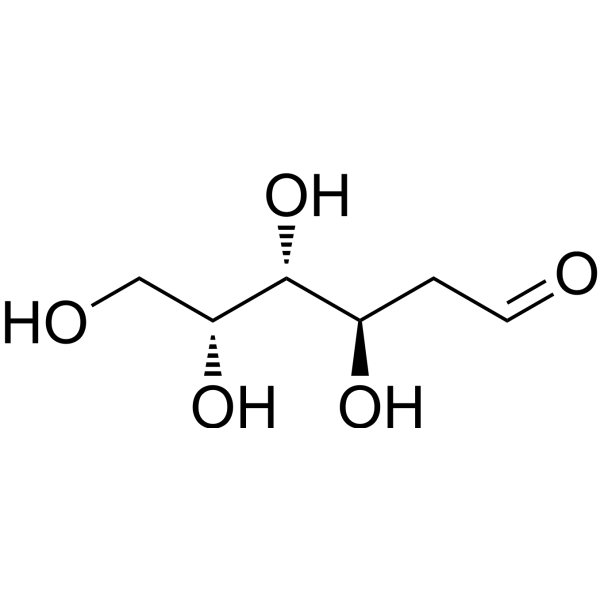
2-脱氧-D-半乳糖是一种脱氧半乳糖。它在功能上与醛基-D-半乳糖和D-半乳糖相关。
2-脱氧-D-葡萄糖是一种不可代谢的葡萄糖类似物,其中葡萄糖2位上的羟基被氢原子取代,具有潜在的糖酵解抑制和抗肿瘤活性。尽管其确切的作用机制尚未完全阐明,但给予2-脱氧-D-葡萄糖(2-DG)后,该药物会与葡萄糖竞争增殖细胞(例如肿瘤细胞)的摄取。2-DG抑制糖酵解的第一步,从而阻止细胞能量产生,这可能导致肿瘤细胞增殖减少。 另见:2-脱氧-来苏糖(注释已移至)。 治疗用途 抗代谢药物;抗病毒药物 药物(兽医):用琼脂糖凝胶中的 2-脱氧-D-葡萄糖或硝酸咪康唑软膏对雌性豚鼠生殖器疱疹进行局部治疗,未能阻止生殖器病变的发生,也未能降低感染动物阴道拭子中可回收病毒的平均滴度。 |
| 分子式 |
C6H12O5
|
|---|---|
| 分子量 |
164.16
|
| 精确质量 |
164.068
|
| CAS号 |
1949-89-9
|
| PubChem CID |
102191
|
| 外观&性状 |
Off-white to light yellow solid powder
|
| 密度 |
1.4±0.1 g/cm3
|
| 沸点 |
456.7±45.0 °C at 760 mmHg
|
| 熔点 |
107-110 °C(lit.)
|
| 闪点 |
244.1±25.2 °C
|
| 蒸汽压 |
0.0±2.5 mmHg at 25°C
|
| 折射率 |
1.534
|
| LogP |
-3.07
|
| tPSA |
90.15
|
| 氢键供体(HBD)数目 |
4
|
| 氢键受体(HBA)数目 |
5
|
| 可旋转键数目(RBC) |
5
|
| 重原子数目 |
11
|
| 分子复杂度/Complexity |
116
|
| 定义原子立体中心数目 |
3
|
| SMILES |
O([H])[C@@]([H])([C@@]([H])(C([H])([H])O[H])O[H])[C@@]([H])(C([H])([H])C([H])=O)O[H]
|
| InChi Key |
VRYALKFFQXWPIH-UHFFFAOYSA-N
|
| InChi Code |
InChI=1S/C6H12O5/c7-2-1-4(9)6(11)5(10)3-8/h2,4-6,8-11H,1,3H2
|
| 化学名 |
3,4,5,6-tetrahydroxyhexanal
|
| HS Tariff Code |
2934.99.9001
|
| 存储方式 |
Powder -20°C 3 years 4°C 2 years In solvent -80°C 6 months -20°C 1 month 注意: 本产品在运输和储存过程中需避光。 |
| 运输条件 |
Room temperature (This product is stable at ambient temperature for a few days during ordinary shipping and time spent in Customs)
|
| 溶解度 (体外实验) |
H2O: 250 mg/mL (1522.90 mM)
Methanol: 125 mg/mL (761.45 mM) |
|---|---|
| 溶解度 (体内实验) |
注意: 如下所列的是一些常用的体内动物实验溶解配方,主要用于溶解难溶或不溶于水的产品(水溶度<1 mg/mL)。 建议您先取少量样品进行尝试,如该配方可行,再根据实验需求增加样品量。
注射用配方
注射用配方1: DMSO : Tween 80: Saline = 10 : 5 : 85 (如: 100 μL DMSO → 50 μL Tween 80 → 850 μL Saline)(IP/IV/IM/SC等) *生理盐水/Saline的制备:将0.9g氯化钠/NaCl溶解在100 mL ddH ₂ O中,得到澄清溶液。 注射用配方 2: DMSO : PEG300 :Tween 80 : Saline = 10 : 40 : 5 : 45 (如: 100 μL DMSO → 400 μL PEG300 → 50 μL Tween 80 → 450 μL Saline) 注射用配方 3: DMSO : Corn oil = 10 : 90 (如: 100 μL DMSO → 900 μL Corn oil) 示例: 以注射用配方 3 (DMSO : Corn oil = 10 : 90) 为例说明, 如果要配制 1 mL 2.5 mg/mL的工作液, 您可以取 100 μL 25 mg/mL 澄清的 DMSO 储备液,加到 900 μL Corn oil/玉米油中, 混合均匀。 View More
注射用配方 4: DMSO : 20% SBE-β-CD in Saline = 10 : 90 [如:100 μL DMSO → 900 μL (20% SBE-β-CD in Saline)] 口服配方
口服配方 1: 悬浮于0.5% CMC Na (羧甲基纤维素钠) 口服配方 2: 悬浮于0.5% Carboxymethyl cellulose (羧甲基纤维素) 示例: 以口服配方 1 (悬浮于 0.5% CMC Na)为例说明, 如果要配制 100 mL 2.5 mg/mL 的工作液, 您可以先取0.5g CMC Na并将其溶解于100mL ddH2O中,得到0.5%CMC-Na澄清溶液;然后将250 mg待测化合物加到100 mL前述 0.5%CMC Na溶液中,得到悬浮液。 View More
口服配方 3: 溶解于 PEG400 (聚乙二醇400) 请根据您的实验动物和给药方式选择适当的溶解配方/方案: 1、请先配制澄清的储备液(如:用DMSO配置50 或 100 mg/mL母液(储备液)); 2、取适量母液,按从左到右的顺序依次添加助溶剂,澄清后再加入下一助溶剂。以 下列配方为例说明 (注意此配方只用于说明,并不一定代表此产品 的实际溶解配方): 10% DMSO → 40% PEG300 → 5% Tween-80 → 45% ddH2O (或 saline); 假设最终工作液的体积为 1 mL, 浓度为5 mg/mL: 取 100 μL 50 mg/mL 的澄清 DMSO 储备液加到 400 μL PEG300 中,混合均匀/澄清;向上述体系中加入50 μL Tween-80,混合均匀/澄清;然后继续加入450 μL ddH2O (或 saline)定容至 1 mL; 3、溶剂前显示的百分比是指该溶剂在最终溶液/工作液中的体积所占比例; 4、 如产品在配制过程中出现沉淀/析出,可通过加热(≤50℃)或超声的方式助溶; 5、为保证最佳实验结果,工作液请现配现用! 6、如不确定怎么将母液配置成体内动物实验的工作液,请查看说明书或联系我们; 7、 以上所有助溶剂都可在 Invivochem.cn网站购买。 |
| 制备储备液 | 1 mg | 5 mg | 10 mg | |
| 1 mM | 6.0916 mL | 30.4581 mL | 60.9162 mL | |
| 5 mM | 1.2183 mL | 6.0916 mL | 12.1832 mL | |
| 10 mM | 0.6092 mL | 3.0458 mL | 6.0916 mL |
1、根据实验需要选择合适的溶剂配制储备液 (母液):对于大多数产品,InvivoChem推荐用DMSO配置母液 (比如:5、10、20mM或者10、20、50 mg/mL浓度),个别水溶性高的产品可直接溶于水。产品在DMSO 、水或其他溶剂中的具体溶解度详见上”溶解度 (体外)”部分;
2、如果您找不到您想要的溶解度信息,或者很难将产品溶解在溶液中,请联系我们;
3、建议使用下列计算器进行相关计算(摩尔浓度计算器、稀释计算器、分子量计算器、重组计算器等);
4、母液配好之后,将其分装到常规用量,并储存在-20°C或-80°C,尽量减少反复冻融循环。
计算结果:
工作液浓度: mg/mL;
DMSO母液配制方法: mg 药物溶于 μL DMSO溶液(母液浓度 mg/mL)。如该浓度超过该批次药物DMSO溶解度,请首先与我们联系。
体内配方配制方法:取 μL DMSO母液,加入 μL PEG300,混匀澄清后加入μL Tween 80,混匀澄清后加入 μL ddH2O,混匀澄清。
(1) 请确保溶液澄清之后,再加入下一种溶剂 (助溶剂) 。可利用涡旋、超声或水浴加热等方法助溶;
(2) 一定要按顺序加入溶剂 (助溶剂) 。
 Lalistat 2
 D-(-)-3-Phosphoglyceric acid disodium (3-Phospho-D-glyceric acid disodium)
 STC-15
 TSR-033
InvivoChem的所有产品仅用于作科学研究,不面向患者销售
Copyright 2020 InvivoChem LLC | All Rights Reserved 粤ICP备20063088号-1


 粤公网安备 44011102003439号
 463611831
