| 规格 | 价格 | 库存 | 数量 |
|---|---|---|---|
| 100mg |
|
||
| 500mg |
|
||
| Other Sizes |
|

| 药代性质 (ADME/PK) |
Absorption, Distribution and Excretion
...In mice injected with 2,4-D isooctyl ester disappears faster than 2,4-D acid. Leaves most readily absorb the nonpolar (ester) form of 2,4-D. ...2,4-D esters are not easily eluted from the plant and are rapidly converted to acid by the plant. ...After absorption by leaves, 2,4-D is transported within the phloem and may move with nutrients. After absorption by roots, it may be transported upwards with transpiration. The plant's growth status affects its transport. Herbicides accumulate primarily in the meristematic regions of stems and roots. /2,4-D or its esters/ Under atmospheric 2,4-D ester concentrations of 0.1 to 0.2 mg/L, the 2,4-D concentration in the plasma of workers exposed to this ester did not exceed 0.2 mg/L; no accumulation was observed during the work week. ...One day after exposure, workers had urinary 2,4-D concentrations ranging from 3 to 14 mg/L. /2,4-Dichlorophenoxyacetic acid or its esters/ After subcutaneous injection of 2,4-D and its butyl and isooctyl esters at a dose of 100 mg/kg, the esters were rapidly cleared, with only 5-10% of 2,4-D remaining after 1 day. ...In the milk of dairy cows raised on pastures treated with 2,4-D or its butyl or isooctyl esters, 2,4-D is excreted. For more complete data on the absorption, distribution, and excretion of 2,4-D isooctyl esters (7 in total), please visit the HSDB record page. Metabolism/Metabolites Plants hydrolyze 2,4-D esters to 2,4-D, which is an active herbicide. ...Further metabolism...occurs through three mechanisms: side-chain degradation, aromatic ring hydroxylation, and binding to plant components. /2,4-D Esters/ The herbicidal activity of esters, nitriles, amines (and of course, salts) is similar to, or even the same as, that of the parent acid. This is clearly due to the presence of hydrolytic enzymes in plants and soil microorganisms that can convert these derivatives into the parent acid. /SRP: 2,4-D or its esters/ 2,4-D esters are hydrolyzed in animals. Phenoxy acid compounds are mainly excreted unchanged in rat urine after oral administration, with small amounts conjugated with the amino acids glycine and taurine, as well as glucuronic acid. /2,4-D and its esters/ Apart from the conjugates, no other metabolites of 2,4-D have been detected in human urine. Biological Half-Life These herbicides do not accumulate in animals. They are not widely metabolized but are actively excreted into urine…their plasma half-life in humans is approximately 1 day. /Chlorophenoxy compounds/ The hydrolysis half-life of 2,4-D n-butyl ester in neutral water was determined to be 100 hours, while it was much shorter in water-soluble soil suspensions. Smith (1976) reported that 2,4-D n-butyl ester was almost completely hydrolyzed to 2,4-D in moist soil in less than 24 hours. Similar results were obtained for the hydrolysis of 2,4,5-T n-butyl ester and isooctyl ester to 2,4,5-T. 2,4-D ester was completely hydrolyzed to 2,4-D in lake water within 9 days. Therefore, the rate of biological hydrolysis appears to be higher than that of chemical hydrolysis. |
|---|---|
| 毒性/毒理 (Toxicokinetics/TK) |
Interactions
We treated Salmo clarki with six different mixtures of herbicides, including dicamba, cyprodinil, 2,4-D butyl ester, 2,4-D isooctyl ester, and 2,4-D propylene glycol butyl ether ester. Except for 2,4-D isooctyl ester, the LC50 values of the mixtures of 2,4-D esters and cyprodinil were all lower than the LC50 values of the individual herbicides when used alone. Dicamba and 2,4-D isooctyl ester showed the lowest toxicity when used alone, and the combination of dicamba or 2,4-D isooctyl ester with other herbicides did not increase toxicity. These results reflect the importance of a combined exposure approach when determining the biological significance of the co-occurrence of multiple herbicides in surface water. Non-human Toxicity Values Rabbit dermal absorption LD50 > 4000 mg/kg Rats oral LD50 982 mg/kg |
| 参考文献 | |
| 其他信息 |
Herbicide lv-69 67% 2,4-d isooctyl ester is available in commercially available products as white crystals or as a brown or dark brown liquid. (NTP, 1992) Mechanism of Action: .../Chlorophenoxy compounds (including 2,4-d esters)/ exert their herbicidal action by acting as plant growth hormones. /Chlorophenoxy compounds/
|
| 分子式 |
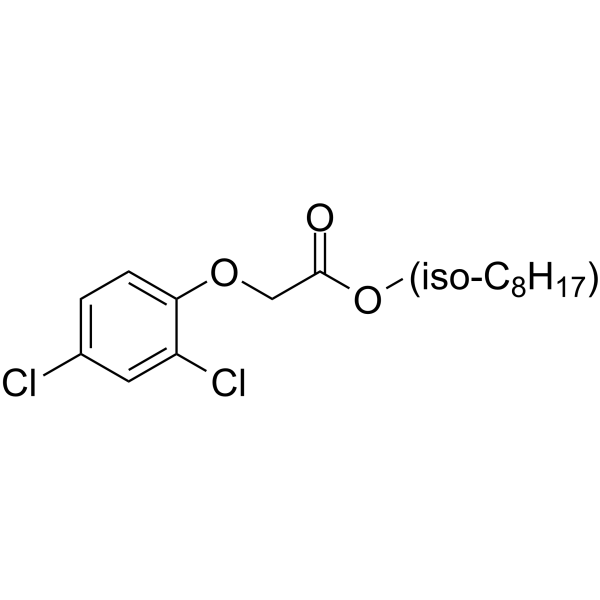
C16H22CL2O3
|
|---|---|
| 分子量 |
333.25
|
| 精确质量 |
332.095
|
| CAS号 |
25168-26-7
|
| PubChem CID |
24678
|
| 外观&性状 |
Colorless to light yellow liquid
|
| 密度 |
1.15 g/cm3
|
| 沸点 |
396.9ºC at 760 mmHg
|
| 熔点 |
12ºC
|
| 闪点 |
48ºC
|
| 蒸汽压 |
1.65E-06mmHg at 25°C
|
| 折射率 |
1.506
|
| LogP |
5.131
|
| tPSA |
35.53
|
| 氢键供体(HBD)数目 |
0
|
| 氢键受体(HBA)数目 |
3
|
| 可旋转键数目(RBC) |
10
|
| 重原子数目 |
21
|
| 分子复杂度/Complexity |
297
|
| 定义原子立体中心数目 |
0
|
| SMILES |
CCCCC(COC(COC1=CC=C(Cl)C=C1Cl)=O)CC
|
| InChi Key |
BBPLSOGERZQYQC-UHFFFAOYSA-N
|
| InChi Code |
InChI=1S/C16H22Cl2O3/c1-12(2)6-4-3-5-9-20-16(19)11-21-15-8-7-13(17)10-14(15)18/h7-8,10,12H,3-6,9,11H2,1-2H3
|
| 化学名 |
6-methylheptyl 2-(2,4-dichlorophenoxy)acetate
|
| HS Tariff Code |
2934.99.9001
|
| 存储方式 |
Powder -20°C 3 years 4°C 2 years In solvent -80°C 6 months -20°C 1 month |
| 运输条件 |
Room temperature (This product is stable at ambient temperature for a few days during ordinary shipping and time spent in Customs)
|
| 溶解度 (体外实验) |
May dissolve in DMSO (in most cases), if not, try other solvents such as H2O, Ethanol, or DMF with a minute amount of products to avoid loss of samples
|
|---|---|
| 溶解度 (体内实验) |
注意: 如下所列的是一些常用的体内动物实验溶解配方,主要用于溶解难溶或不溶于水的产品(水溶度<1 mg/mL)。 建议您先取少量样品进行尝试,如该配方可行,再根据实验需求增加样品量。
注射用配方
注射用配方1: DMSO : Tween 80: Saline = 10 : 5 : 85 (如: 100 μL DMSO → 50 μL Tween 80 → 850 μL Saline)(IP/IV/IM/SC等) *生理盐水/Saline的制备:将0.9g氯化钠/NaCl溶解在100 mL ddH ₂ O中,得到澄清溶液。 注射用配方 2: DMSO : PEG300 :Tween 80 : Saline = 10 : 40 : 5 : 45 (如: 100 μL DMSO → 400 μL PEG300 → 50 μL Tween 80 → 450 μL Saline) 注射用配方 3: DMSO : Corn oil = 10 : 90 (如: 100 μL DMSO → 900 μL Corn oil) 示例: 以注射用配方 3 (DMSO : Corn oil = 10 : 90) 为例说明, 如果要配制 1 mL 2.5 mg/mL的工作液, 您可以取 100 μL 25 mg/mL 澄清的 DMSO 储备液,加到 900 μL Corn oil/玉米油中, 混合均匀。 View More
注射用配方 4: DMSO : 20% SBE-β-CD in Saline = 10 : 90 [如:100 μL DMSO → 900 μL (20% SBE-β-CD in Saline)] 口服配方
口服配方 1: 悬浮于0.5% CMC Na (羧甲基纤维素钠) 口服配方 2: 悬浮于0.5% Carboxymethyl cellulose (羧甲基纤维素) 示例: 以口服配方 1 (悬浮于 0.5% CMC Na)为例说明, 如果要配制 100 mL 2.5 mg/mL 的工作液, 您可以先取0.5g CMC Na并将其溶解于100mL ddH2O中,得到0.5%CMC-Na澄清溶液;然后将250 mg待测化合物加到100 mL前述 0.5%CMC Na溶液中,得到悬浮液。 View More
口服配方 3: 溶解于 PEG400 (聚乙二醇400) 请根据您的实验动物和给药方式选择适当的溶解配方/方案: 1、请先配制澄清的储备液(如:用DMSO配置50 或 100 mg/mL母液(储备液)); 2、取适量母液,按从左到右的顺序依次添加助溶剂,澄清后再加入下一助溶剂。以 下列配方为例说明 (注意此配方只用于说明,并不一定代表此产品 的实际溶解配方): 10% DMSO → 40% PEG300 → 5% Tween-80 → 45% ddH2O (或 saline); 假设最终工作液的体积为 1 mL, 浓度为5 mg/mL: 取 100 μL 50 mg/mL 的澄清 DMSO 储备液加到 400 μL PEG300 中,混合均匀/澄清;向上述体系中加入50 μL Tween-80,混合均匀/澄清;然后继续加入450 μL ddH2O (或 saline)定容至 1 mL; 3、溶剂前显示的百分比是指该溶剂在最终溶液/工作液中的体积所占比例; 4、 如产品在配制过程中出现沉淀/析出,可通过加热(≤50℃)或超声的方式助溶; 5、为保证最佳实验结果,工作液请现配现用! 6、如不确定怎么将母液配置成体内动物实验的工作液,请查看说明书或联系我们; 7、 以上所有助溶剂都可在 Invivochem.cn网站购买。 |
| 制备储备液 | 1 mg | 5 mg | 10 mg | |
| 1 mM | 3.0008 mL | 15.0038 mL | 30.0075 mL | |
| 5 mM | 0.6002 mL | 3.0008 mL | 6.0015 mL | |
| 10 mM | 0.3001 mL | 1.5004 mL | 3.0008 mL |
1、根据实验需要选择合适的溶剂配制储备液 (母液):对于大多数产品,InvivoChem推荐用DMSO配置母液 (比如:5、10、20mM或者10、20、50 mg/mL浓度),个别水溶性高的产品可直接溶于水。产品在DMSO 、水或其他溶剂中的具体溶解度详见上”溶解度 (体外)”部分;
2、如果您找不到您想要的溶解度信息,或者很难将产品溶解在溶液中,请联系我们;
3、建议使用下列计算器进行相关计算(摩尔浓度计算器、稀释计算器、分子量计算器、重组计算器等);
4、母液配好之后,将其分装到常规用量,并储存在-20°C或-80°C,尽量减少反复冻融循环。
计算结果:
工作液浓度: mg/mL;
DMSO母液配制方法: mg 药物溶于 μL DMSO溶液(母液浓度 mg/mL)。如该浓度超过该批次药物DMSO溶解度,请首先与我们联系。
体内配方配制方法:取 μL DMSO母液,加入 μL PEG300,混匀澄清后加入μL Tween 80,混匀澄清后加入 μL ddH2O,混匀澄清。
(1) 请确保溶液澄清之后,再加入下一种溶剂 (助溶剂) 。可利用涡旋、超声或水浴加热等方法助溶;
(2) 一定要按顺序加入溶剂 (助溶剂) 。
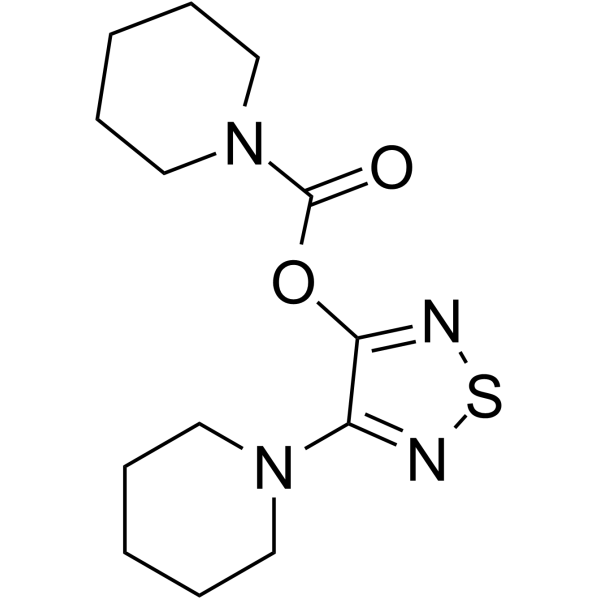 Lalistat 2
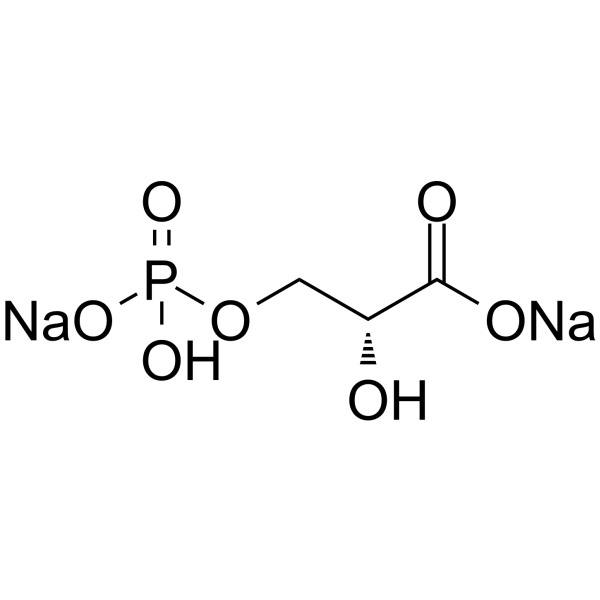 D-(-)-3-Phosphoglyceric acid disodium (3-Phospho-D-glyceric acid disodium)
 STC-15
 TSR-033
InvivoChem的所有产品仅用于作科学研究,不面向患者销售
Copyright 2020 InvivoChem LLC | All Rights Reserved 粤ICP备20063088号-1


 粤公网安备 44011102003439号
 463611831
