
| 规格 | 价格 | |
|---|---|---|
| 500mg | ||
| 1g | ||
| Other Sizes |

| 药代性质 (ADME/PK) |
Absorption, Distribution and Excretion
Methyl bromide is absorbed by roots and leaves… Different urea herbicides exhibit different migration patterns in plant systems. This study investigated the absorption and translocation of chlorfluazuron, flufluazuron, and methyl bromide in legumes when supplied at equivalent concentrations (essentially equimolar) and radioactive levels in nutrient media. Results showed that under short-term conditions, the movement of chlorfluazuron to the aboveground parts was limited, while both flufluazuron and methyl bromide were rapidly translocated to the leaves. However, the distribution patterns of the latter two compounds within the leaves differed significantly. Unlike methyl bromide, which is mainly distributed in the tracheal veins, flufluazuron was almost entirely translocated to the mesophyll tissue. Although there are currently no extensive comparative studies on the structural movement of different urea compounds, their distribution in the extracellular space of plants appears to be partially regulated by the same physicochemical phenomena controlling the migration and availability of compounds in the soil. Metabolism/Metabolites Methyl bromide is metabolized in plants and animals via N-demethylation and N-demethoxylation, respectively. ……Applying ring-labeled (14)C-methylbromopropylate to potato and maize seedlings. ……The following metabolites……/identified/: 3-(4-bromophenyl)-1-methoxyurea, 3-(4-bromophenyl)-1-methylurea, and 4-bromophenylurea. Methylbromopropylate produces 3-(p-bromophenyl)-1-methylurea and 3-(p-bromophenyl)-1-methoxyurea in Tarrasque. /Excerpt from Table/ (14)C-methylbromopropylate was incubated with human embryonic lung (HEL) cells. More than 95% of the marker was recovered as unchanged methylbromopropylate. Of the four metabolites, three were identified: 3-(4-bromophenyl)-1-methylurea; 4-bromophenylurea; and 3-(4-bromophenyl)-1-methylurea. |
|---|---|
| 毒性/毒理 (Toxicokinetics/TK) |
Toxicity Data
LC50 (Rat) > 1,100 mg/m³/4hr Non-human Toxicity Values LD50 Female rat, oral administration 3000 ± 800 mg/kg LD50 Rat, transdermal administration > 3000 mg/kg LD50 Male rat, oral administration 2700 ± 300 mg/kg LD50 Rabbit, transdermal administration > 10200 mg/kg For more complete non-human toxicity data for metobromide (6 items in total), please visit the HSDB records page. |
| 参考文献 |
[1]. Metobromuron. Handbook of Analytical Separations, 2003.
|
| 其他信息 |
Methbromourea belongs to the urea class of compounds.
|
| 分子式 |
C9H11N2O2BR
|
|---|---|
| 分子量 |
259.10
|
| 精确质量 |
258
|
| CAS号 |
3060-89-7
|
| PubChem CID |
18290
|
| 外观&性状 |
CRYSTALS FROM CYCLOHEXANE
WHITE CRYSTALS |
| 密度 |
1.5±0.1 g/cm3
|
| 熔点 |
95.5-96ºC
|
| 闪点 |
2 °C
|
| 折射率 |
1.607
|
| LogP |
2.32
|
| tPSA |
41.57
|
| 氢键供体(HBD)数目 |
1
|
| 氢键受体(HBA)数目 |
2
|
| 可旋转键数目(RBC) |
2
|
| 重原子数目 |
14
|
| 分子复杂度/Complexity |
193
|
| 定义原子立体中心数目 |
0
|
| SMILES |
CON(C(NC1C=CC(Br)=CC=1)=O)C
|
| InChi Key |
WLFDQEVORAMCIM-UHFFFAOYSA-N
|
| InChi Code |
InChI=1S/C9H11BrN2O2/c1-12(14-2)9(13)11-8-5-3-7(10)4-6-8/h3-6H,1-2H3,(H,11,13)
|
| 化学名 |
3-(4-bromophenyl)-1-methoxy-1-methylurea
|
| HS Tariff Code |
2934.99.9001
|
| 存储方式 |
Powder -20°C 3 years 4°C 2 years In solvent -80°C 6 months -20°C 1 month |
| 运输条件 |
Room temperature (This product is stable at ambient temperature for a few days during ordinary shipping and time spent in Customs)
|
| 溶解度 (体外实验) |
May dissolve in DMSO (in most cases), if not, try other solvents such as H2O, Ethanol, or DMF with a minute amount of products to avoid loss of samples
|
|---|---|
| 溶解度 (体内实验) |
注意: 如下所列的是一些常用的体内动物实验溶解配方,主要用于溶解难溶或不溶于水的产品(水溶度<1 mg/mL)。 建议您先取少量样品进行尝试,如该配方可行,再根据实验需求增加样品量。
注射用配方
注射用配方1: DMSO : Tween 80: Saline = 10 : 5 : 85 (如: 100 μL DMSO → 50 μL Tween 80 → 850 μL Saline)(IP/IV/IM/SC等) *生理盐水/Saline的制备:将0.9g氯化钠/NaCl溶解在100 mL ddH ₂ O中,得到澄清溶液。 注射用配方 2: DMSO : PEG300 :Tween 80 : Saline = 10 : 40 : 5 : 45 (如: 100 μL DMSO → 400 μL PEG300 → 50 μL Tween 80 → 450 μL Saline) 注射用配方 3: DMSO : Corn oil = 10 : 90 (如: 100 μL DMSO → 900 μL Corn oil) 示例: 以注射用配方 3 (DMSO : Corn oil = 10 : 90) 为例说明, 如果要配制 1 mL 2.5 mg/mL的工作液, 您可以取 100 μL 25 mg/mL 澄清的 DMSO 储备液,加到 900 μL Corn oil/玉米油中, 混合均匀。 View More
注射用配方 4: DMSO : 20% SBE-β-CD in Saline = 10 : 90 [如:100 μL DMSO → 900 μL (20% SBE-β-CD in Saline)] 口服配方
口服配方 1: 悬浮于0.5% CMC Na (羧甲基纤维素钠) 口服配方 2: 悬浮于0.5% Carboxymethyl cellulose (羧甲基纤维素) 示例: 以口服配方 1 (悬浮于 0.5% CMC Na)为例说明, 如果要配制 100 mL 2.5 mg/mL 的工作液, 您可以先取0.5g CMC Na并将其溶解于100mL ddH2O中,得到0.5%CMC-Na澄清溶液;然后将250 mg待测化合物加到100 mL前述 0.5%CMC Na溶液中,得到悬浮液。 View More
口服配方 3: 溶解于 PEG400 (聚乙二醇400) 请根据您的实验动物和给药方式选择适当的溶解配方/方案: 1、请先配制澄清的储备液(如:用DMSO配置50 或 100 mg/mL母液(储备液)); 2、取适量母液,按从左到右的顺序依次添加助溶剂,澄清后再加入下一助溶剂。以 下列配方为例说明 (注意此配方只用于说明,并不一定代表此产品 的实际溶解配方): 10% DMSO → 40% PEG300 → 5% Tween-80 → 45% ddH2O (或 saline); 假设最终工作液的体积为 1 mL, 浓度为5 mg/mL: 取 100 μL 50 mg/mL 的澄清 DMSO 储备液加到 400 μL PEG300 中,混合均匀/澄清;向上述体系中加入50 μL Tween-80,混合均匀/澄清;然后继续加入450 μL ddH2O (或 saline)定容至 1 mL; 3、溶剂前显示的百分比是指该溶剂在最终溶液/工作液中的体积所占比例; 4、 如产品在配制过程中出现沉淀/析出,可通过加热(≤50℃)或超声的方式助溶; 5、为保证最佳实验结果,工作液请现配现用! 6、如不确定怎么将母液配置成体内动物实验的工作液,请查看说明书或联系我们; 7、 以上所有助溶剂都可在 Invivochem.cn网站购买。 |
| 制备储备液 | 1 mg | 5 mg | 10 mg | |
| 1 mM | 3.8595 mL | 19.2976 mL | 38.5951 mL | |
| 5 mM | 0.7719 mL | 3.8595 mL | 7.7190 mL | |
| 10 mM | 0.3860 mL | 1.9298 mL | 3.8595 mL |
1、根据实验需要选择合适的溶剂配制储备液 (母液):对于大多数产品,InvivoChem推荐用DMSO配置母液 (比如:5、10、20mM或者10、20、50 mg/mL浓度),个别水溶性高的产品可直接溶于水。产品在DMSO 、水或其他溶剂中的具体溶解度详见上”溶解度 (体外)”部分;
2、如果您找不到您想要的溶解度信息,或者很难将产品溶解在溶液中,请联系我们;
3、建议使用下列计算器进行相关计算(摩尔浓度计算器、稀释计算器、分子量计算器、重组计算器等);
4、母液配好之后,将其分装到常规用量,并储存在-20°C或-80°C,尽量减少反复冻融循环。
计算结果:
工作液浓度: mg/mL;
DMSO母液配制方法: mg 药物溶于 μL DMSO溶液(母液浓度 mg/mL)。如该浓度超过该批次药物DMSO溶解度,请首先与我们联系。
体内配方配制方法:取 μL DMSO母液,加入 μL PEG300,混匀澄清后加入μL Tween 80,混匀澄清后加入 μL ddH2O,混匀澄清。
(1) 请确保溶液澄清之后,再加入下一种溶剂 (助溶剂) 。可利用涡旋、超声或水浴加热等方法助溶;
(2) 一定要按顺序加入溶剂 (助溶剂) 。
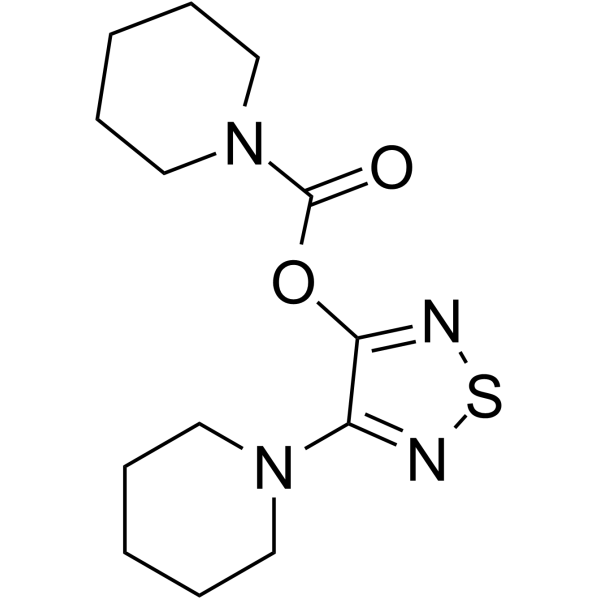 Lalistat 2
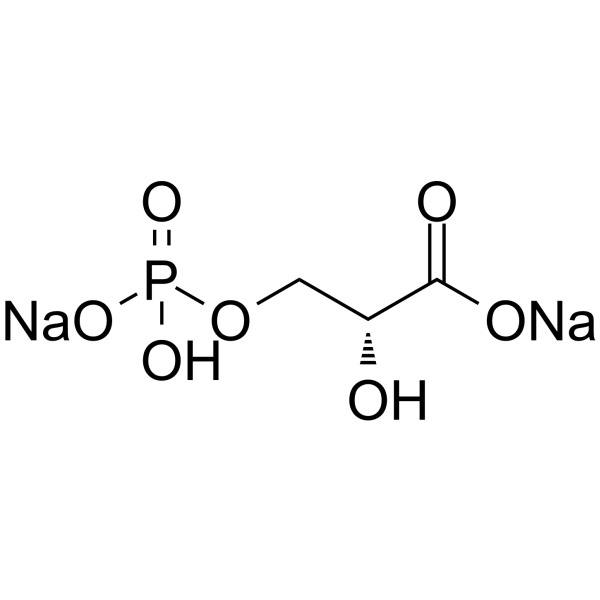 D-(-)-3-Phosphoglyceric acid disodium (3-Phospho-D-glyceric acid disodium)
 STC-15
 TSR-033
InvivoChem的所有产品仅用于作科学研究,不面向患者销售
Copyright 2020 InvivoChem LLC | All Rights Reserved 粤ICP备20063088号-1


 粤公网安备 44011102003439号
 463611831
