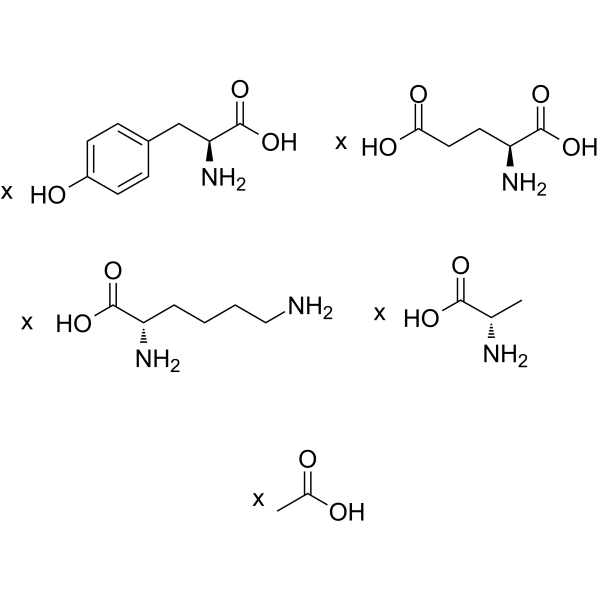
Glatiramer acetate

别名: 醋酸格拉替雷;L-丙氨酸-L-谷氨酸-L-赖氨酸-L-酪氨酸多肽聚合物醋酸盐; 格拉默-D7; 格拉替雷; 格拉替美; 醋酸格卡替雷;格拉替雷-D7
目录号: V64328 纯度: ≥98%
醋酸格拉替雷是髓磷脂碱性蛋白的合成类似物,也是一种可用于多发性硬化症研究的免疫调节剂。
Glatiramer acetate CAS号: 147245-92-9
产品类别: Others 12
产品仅用于科学研究,不针对患者销售
规格 价格 库存 数量
1mg
5mg
10mg
50mg
100mg
Other Sizes
点击了解更多
  • 与全球5000+客户建立关系
  • 覆盖全球主要大学、医院、科研院所、生物/制药公司等
  • 产品被大量CNS顶刊文章引用
InvivoChem产品被CNS等顶刊论文引用
产品描述
醋酸格拉替雷是一种合成的髓鞘碱性蛋白类似物,也是一种可用于多发性硬化症研究的免疫调节剂。醋酸格拉替雷与主要组织相容性复合体(MHC)分子具有强效且广泛的结合能力,因此能够与多种髓鞘抗原竞争性地呈递给T细胞。醋酸格拉替雷作用的另一个方面是能够有效诱导T辅助细胞2(Th2)特异性抑制细胞的产生,这些细胞迁移至大脑并导致原位旁观者抑制。
醋酸格拉替雷(CAS 147245-92-9)是一种合成的髓鞘碱性蛋白多肽类似物,由四种氨基酸(L-谷氨酸、L-丙氨酸、L-酪氨酸和L-赖氨酸)的无规共聚物组成。该免疫调节剂的平均分子量约为6400 Da,是复发缓解型多发性硬化症(RRMS)研究的基石。该化合物配制成用于皮下注射的无菌溶液,因其对降低复发率的明显益处而获得批准。其生物活性取决于其阻断实验性自身免疫性脑脊髓炎(EAE,多发性硬化症的主要动物模型)诱导的能力。
生物活性&实验参考方法
靶点
Glatiramer acetate exerts its effects through a complex, multifaceted mechanism of action that is not fully understood, though it is believed to modify immune processes responsible for MS pathogenesis. It exhibits strong and promiscuous binding to MHC class II molecules. By competing with various myelin antigens for presentation to T cells, it prevents the binding of myelin basic protein (MBP) to MHC molecules in the periphery. This interaction induces potent, specific suppressor T-cells of the T helper 2 (Th2) type, which migrate to the brain and lead to in situ bystander suppression.
体外研究 (In Vitro)
戊二醛乙酸酯(25–100 mg/kg;皮下注射;5 天)可提高脑源性神经营养因子(BDNF)水平[3]。亨廷顿病(HD)动物模型中使用的 N171-82Q 转基因小鼠品系表现出更快的疾病进展。从 8 周龄开始,持续到 20 周龄(接近该疾病导致死亡的年龄),小鼠每周接受 5 次皮下注射(1 mg/只)。多项运动功能评估显示,戊二醛乙酸酯给药后小鼠的运动能力有所改善。对 15 周龄的 N171-82Q 转基因小鼠进行为期 4 天的转棒测试,结果显示戊二醛乙酸酯给药后小鼠的运动能力显著提高[3]。体外实验表明,戊二醛乙酸酯具有多种活性。它通过抑制髓鞘碱性蛋白(MBP)反应性T细胞的增殖并改变其细胞因子谱来调节T细胞反应,促进向抗炎性Th2/Th3反应的转变。在25-100 mg/kg的浓度下,它可以提高脑源性神经营养因子(BDNF)的水平。在亨廷顿病小鼠模型中,以1 mg/只的剂量连续五周给予格拉替雷醋酸盐治疗,可显著改善小鼠的运动功能。
体内研究 (In Vivo)
在体内,醋酸格拉替雷是一种用于研究多发性硬化症的高效药物。它能显著降低复发率并延缓复发缓解型多发性硬化症(RRMS)的疾病进展。除多发性硬化症外,它在其他模型中也显示出有益作用,例如改善亨廷顿病N171-82Q转基因小鼠模型的运动功能。其治疗作用主要源于其免疫调节作用,包括诱导调节性T细胞、使促炎性Th1细胞因子谱向抗炎性Th2/Th3细胞因子谱转变,以及抑制中枢神经系统内的炎症过程。
酶活实验
格拉替雷醋酸盐的非细胞检测主要集中于其与MHC II类分子的相互作用。可采用表面等离子共振(SPR)或基于ELISA的结合试验来研究其与不同MHC等位基因的亲和力。竞争性试验用于评估其从MHC分子上置换髓鞘碱性蛋白的能力。此外,还可以使用等温滴定量热法(ITC)等技术来表征该化合物与MHC的相互作用。
细胞实验
基于细胞的检测是研究醋酸格拉替雷作用机制的核心。T细胞增殖实验是在化合物存在的情况下,使用髓鞘碱性蛋白(MBP)反应性T细胞系或克隆进行。细胞因子分泌谱通过酶联免疫吸附试验(ELISA)或多重检测进行分析,以测量IL-10、TGF-β、IFN-γ和IL-4的水平。调节性T细胞的诱导通过流式细胞术进行评估,使用CD4+、CD25+和FoxP3等标记物。
动物实验
体内动物实验主要采用实验性自身免疫性脑脊髓炎(EAE)模型。EAE是通过用髓鞘抗原免疫易感小鼠或大鼠诱导产生的,并给予醋酸格拉替雷以评估其抑制疾病发生或进展的能力。通过临床评分评估疾病严重程度,并对中枢神经系统进行组织学分析以评估炎症和脱髓鞘情况。
药代性质 (ADME/PK)
皮下注射后,大部分醋酸格拉替雷会在局部水解。部分注射药物(完整或部分水解)预计会进入淋巴循环,从而到达区域淋巴结。较大的片段可被醋酸格拉替雷反应性抗体识别。该药物在全身循环中的半衰期相对较短,重复给药后药物蓄积量极少。
毒性/毒理 (Toxicokinetics/TK)
醋酸格拉替雷具有良好的安全性。在一项为期两年的小鼠致癌性研究中,未观察到全身性肿瘤发生率增加。然而,在接受最高剂量的雄性小鼠中,注射部位纤维肉瘤的发生率有所增加,这归因于重复注射造成的皮肤损伤。在大鼠中,未观察到肿瘤发生率增加。体外试验(Ames试验、小鼠淋巴瘤Tk试验)表明其不具有致突变性。
参考文献
[1]. McKeage K. Glatiramer Acetate 40 mg/mL in Relapsing-Remitting Multiple Sclerosis: A Review. CNS Drugs. 2015;29(5):425-432.
[2]. Arnon R, et al. Mechanism of action of glatiramer acetate in multiple sclerosis and its potential for the development of new applications. Proc Natl Acad Sci U S A. 2004;101 Suppl 2(Suppl 2):14593-14598.
[3]. Corey-Bloom J, et al. Beneficial effects of glatiramer acetate in Huntington's disease mouse models: Evidence for BDNF-elevating and immunomodulatory mechanisms. Brain Res. 2017;1673:102-110.
[4]. Aharoni R, et al. Glatiramer acetate-specific T cells in the brain express T helper 2/3 cytokines and brain-derived neurotrophic factor in situ [published correction appears in Proc Natl Acad Sci U S A. 2005 Aug 23;102(34):12288]. Proc Natl Acad Sci U S A
其他信息
一种由L-丙氨酸、L-谷氨酸、L-赖氨酸和L-酪氨酸组成的无规聚合物,其结构与髓鞘碱性蛋白相似。它用于治疗复发缓解型多发性硬化症。
另见:醋酸格拉替雷(注:已移至此处)。
醋酸格拉替雷是一种获批的疾病修饰疗法,用于治疗复发缓解型多发性硬化症(RRMS)。它于1996年首次获得FDA批准,也用于治疗临床孤立综合征(CIS)。其免疫调节机制与其他多发性硬化症疗法不同,目前已有仿制药上市,可通过每日或每周三次皮下注射给药。
*注: 文献方法仅供参考, InvivoChem并未独立验证这些方法的准确性
化学信息 & 存储运输条件
分子式
(C9H11NO3.C6H14N2O2.C5H9NO4.C3H7NO2)X.XC2H4O2
分子量
623.65
精确质量
623.301
CAS号
147245-92-9
PubChem CID
3081884
外观&性状
Off-white to light yellow solid powder
沸点
385.2ºC at 760mmHg
熔点
>239°C (dec.) (lit.)
闪点
186.7ºC
蒸汽压
1.27E-06mmHg at 25°C
LogP
2.147
tPSA
374.13
氢键供体(HBD)数目
12
氢键受体(HBA)数目
18
可旋转键数目(RBC)
13
重原子数目
43
分子复杂度/Complexity
519
定义原子立体中心数目
4
SMILES
CC(=O)O.NCCCCC(C(=O)O)N.OC(CCC(C(=O)O)N)=O.CC(C(=O)O)N.OC(C(CC1=CC=C(O)C=C1)N)=O
InChi Key
FHEAIOHRHQGZPC-KIWGSFCNSA-N
InChi Code
InChI=1S/C9H11NO3.C6H14N2O2.C5H9NO4.C3H7NO2.C2H4O2/c10-8(9(12)13)5-6-1-3-7(11)4-2-6;7-4-2-1-3-5(8)6(9)10;6-3(5(9)10)1-2-4(7)8;1-2(4)3(5)6;1-2(3)4/h1-4,8,11H,5,10H2,(H,12,13);5H,1-4,7-8H2,(H,9,10);3H,1-2,6H2,(H,7,8)(H,9,10);2H,4H2,1H3,(H,5,6);1H3,(H,3,4)/t8-;5-;3-;2-;/m0000./s1
化学名
acetic acid;(2S)-2-amino-3-(4-hydroxyphenyl)propanoic acid;(2S)-2-aminopentanedioic acid;(2S)-2-aminopropanoic acid;(2S)-2,6-diaminohexanoic acid
HS Tariff Code
2934.99.9001
存储方式

Powder      -20°C    3 years

                     4°C     2 years

In solvent   -80°C    6 months

                  -20°C    1 month

注意: 请将本产品存放在密封且受保护的环境中,避免吸湿/受潮。
运输条件
Room temperature (This product is stable at ambient temperature for a few days during ordinary shipping and time spent in Customs)
溶解度数据
溶解度 (体外实验)
H2O: 50 mg/mL
溶解度 (体内实验)
注意: 如下所列的是一些常用的体内动物实验溶解配方,主要用于溶解难溶或不溶于水的产品(水溶度<1 mg/mL)。 建议您先取少量样品进行尝试,如该配方可行,再根据实验需求增加样品量。

注射用配方
(IP/IV/IM/SC等)
注射用配方1: DMSO : Tween 80: Saline = 10 : 5 : 85 (如: 100 μL DMSO 50 μL Tween 80 850 μL Saline)
*生理盐水/Saline的制备:将0.9g氯化钠/NaCl溶解在100 mL ddH ₂ O中,得到澄清溶液。
注射用配方 2: DMSO : PEG300Tween 80 : Saline = 10 : 40 : 5 : 45 (如: 100 μL DMSO 400 μL PEG300 50 μL Tween 80 450 μL Saline)
注射用配方 3: DMSO : Corn oil = 10 : 90 (如: 100 μL DMSO 900 μL Corn oil)
示例: 注射用配方 3 (DMSO : Corn oil = 10 : 90) 为例说明, 如果要配制 1 mL 2.5 mg/mL的工作液, 您可以取 100 μL 25 mg/mL 澄清的 DMSO 储备液,加到 900 μL Corn oil/玉米油中, 混合均匀。
View More

注射用配方 4: DMSO : 20% SBE-β-CD in Saline = 10 : 90 [如:100 μL DMSO 900 μL (20% SBE-β-CD in Saline)]
*20% SBE-β-CD in Saline的制备(4°C,储存1周):将2g SBE-β-CD (磺丁基-β-环糊精) 溶解于10mL生理盐水中,得到澄清溶液。
注射用配方 5: 2-Hydroxypropyl-β-cyclodextrin : Saline = 50 : 50 (如: 500 μL 2-Hydroxypropyl-β-cyclodextrin (羟丙基环胡精) 500 μL Saline)
注射用配方 6: DMSO : PEG300 : Castor oil : Saline = 5 : 10 : 20 : 65 (如: 50 μL DMSO 100 μL PEG300 200 μL Castor oil 650 μL Saline)
注射用配方 7: Ethanol : Cremophor : Saline = 10: 10 : 80 (如: 100 μL Ethanol 100 μL Cremophor 800 μL Saline)
注射用配方 8: 溶解于Cremophor/Ethanol (50 : 50), 然后用生理盐水稀释。
注射用配方 9: EtOH : Corn oil = 10 : 90 (如: 100 μL EtOH 900 μL Corn oil)
注射用配方 10: EtOH : PEG300Tween 80 : Saline = 10 : 40 : 5 : 45 (如: 100 μL EtOH 400 μL PEG300 50 μL Tween 80 450 μL Saline)


口服配方
口服配方 1: 悬浮于0.5% CMC Na (羧甲基纤维素钠)
口服配方 2: 悬浮于0.5% Carboxymethyl cellulose (羧甲基纤维素)
示例: 口服配方 1 (悬浮于 0.5% CMC Na)为例说明, 如果要配制 100 mL 2.5 mg/mL 的工作液, 您可以先取0.5g CMC Na并将其溶解于100mL ddH2O中,得到0.5%CMC-Na澄清溶液;然后将250 mg待测化合物加到100 mL前述 0.5%CMC Na溶液中,得到悬浮液。
View More

口服配方 3: 溶解于 PEG400 (聚乙二醇400)
口服配方 4: 悬浮于0.2% Carboxymethyl cellulose (羧甲基纤维素)
口服配方 5: 溶解于0.25% Tween 80 and 0.5% Carboxymethyl cellulose (羧甲基纤维素)
口服配方 6: 做成粉末与食物混合


注意: 以上为较为常见方法,仅供参考, InvivoChem并未独立验证这些配方的准确性。具体溶剂的选择首先应参照文献已报道溶解方法、配方或剂型,对于某些尚未有文献报道溶解方法的化合物,需通过前期实验来确定(建议先取少量样品进行尝试),包括产品的溶解情况、梯度设置、动物的耐受性等。

请根据您的实验动物和给药方式选择适当的溶解配方/方案:
1、请先配制澄清的储备液(如:用DMSO配置50 或 100 mg/mL母液(储备液));
2、取适量母液,按从左到右的顺序依次添加助溶剂,澄清后再加入下一助溶剂。以 下列配方为例说明 (注意此配方只用于说明,并不一定代表此产品 的实际溶解配方):
10% DMSO → 40% PEG300 → 5% Tween-80 → 45% ddH2O (或 saline);
假设最终工作液的体积为 1 mL, 浓度为5 mg/mL: 取 100 μL 50 mg/mL 的澄清 DMSO 储备液加到 400 μL PEG300 中,混合均匀/澄清;向上述体系中加入50 μL Tween-80,混合均匀/澄清;然后继续加入450 μL ddH2O (或 saline)定容至 1 mL;

3、溶剂前显示的百分比是指该溶剂在最终溶液/工作液中的体积所占比例;
4、 如产品在配制过程中出现沉淀/析出,可通过加热(≤50℃)或超声的方式助溶;
5、为保证最佳实验结果,工作液请现配现用!
6、如不确定怎么将母液配置成体内动物实验的工作液,请查看说明书或联系我们;
7、 以上所有助溶剂都可在 Invivochem.cn网站购买。
制备储备液 1 mg 5 mg 10 mg
1 mM 1.6035 mL 8.0173 mL 16.0346 mL
5 mM 0.3207 mL 1.6035 mL 3.2069 mL
10 mM 0.1603 mL 0.8017 mL 1.6035 mL

1、根据实验需要选择合适的溶剂配制储备液 (母液):对于大多数产品,InvivoChem推荐用DMSO配置母液 (比如:5、10、20mM或者10、20、50 mg/mL浓度),个别水溶性高的产品可直接溶于水。产品在DMSO 、水或其他溶剂中的具体溶解度详见上”溶解度 (体外)”部分;

2、如果您找不到您想要的溶解度信息,或者很难将产品溶解在溶液中,请联系我们;

3、建议使用下列计算器进行相关计算(摩尔浓度计算器、稀释计算器、分子量计算器、重组计算器等);

4、母液配好之后,将其分装到常规用量,并储存在-20°C或-80°C,尽量减少反复冻融循环。

计算器

摩尔浓度计算器可计算特定溶液所需的质量、体积/浓度,具体如下:

  • 计算制备已知体积和浓度的溶液所需的化合物的质量
  • 计算将已知质量的化合物溶解到所需浓度所需的溶液体积
  • 计算特定体积中已知质量的化合物产生的溶液的浓度
使用摩尔浓度计算器计算摩尔浓度的示例如下所示:
假如化合物的分子量为350.26 g/mol,在5mL DMSO中制备10mM储备液所需的化合物的质量是多少?
  • 在分子量(MW)框中输入350.26
  • 在“浓度”框中输入10,然后选择正确的单位(mM)
  • 在“体积”框中输入5,然后选择正确的单位(mL)
  • 单击“计算”按钮
  • 答案17.513 mg出现在“质量”框中。以类似的方式,您可以计算体积和浓度。

稀释计算器可计算如何稀释已知浓度的储备液。例如,可以输入C1、C2和V2来计算V1,具体如下:

制备25毫升25μM溶液需要多少体积的10 mM储备溶液?
使用方程式C1V1=C2V2,其中C1=10mM,C2=25μM,V2=25 ml,V1未知:
  • 在C1框中输入10,然后选择正确的单位(mM)
  • 在C2框中输入25,然后选择正确的单位(μM)
  • 在V2框中输入25,然后选择正确的单位(mL)
  • 单击“计算”按钮
  • 答案62.5μL(0.1 ml)出现在V1框中
g/mol

分子量计算器可计算化合物的分子量 (摩尔质量)和元素组成,具体如下:

注:化学分子式大小写敏感:C12H18N3O4  c12h18n3o4
计算化合物摩尔质量(分子量)的说明:
  • 要计算化合物的分子量 (摩尔质量),请输入化学/分子式,然后单击“计算”按钮。
分子质量、分子量、摩尔质量和摩尔量的定义:
  • 分子质量(或分子量)是一种物质的一个分子的质量,用统一的原子质量单位(u)表示。(1u等于碳-12中一个原子质量的1/12)
  • 摩尔质量(摩尔重量)是一摩尔物质的质量,以g/mol表示。
/

配液计算器可计算将特定质量的产品配成特定浓度所需的溶剂体积 (配液体积)

  • 输入试剂的质量、所需的配液浓度以及正确的单位
  • 单击“计算”按钮
  • 答案显示在体积框中
动物体内实验配方计算器(澄清溶液)
第一步:请输入基本实验信息(考虑到实验过程中的损耗,建议多配一只动物的药量)
第二步:请输入动物体内配方组成(配方适用于不溶/难溶于水的化合物),不同的产品和批次配方组成不同,如对配方有疑问,可先联系我们提供正确的体内实验配方。此外,请注意这只是一个配方计算器,而不是特定产品的确切配方。
+
+
+

计算结果:

工作液浓度 mg/mL;

DMSO母液配制方法 mg 药物溶于 μL DMSO溶液(母液浓度 mg/mL)。如该浓度超过该批次药物DMSO溶解度,请首先与我们联系。

体内配方配制方法μL DMSO母液,加入 μL PEG300,混匀澄清后加入μL Tween 80,混匀澄清后加入 μL ddH2O,混匀澄清。

(1) 请确保溶液澄清之后,再加入下一种溶剂 (助溶剂) 。可利用涡旋、超声或水浴加热等方法助溶;
            (2) 一定要按顺序加入溶剂 (助溶剂) 。

临床试验信息
Copaxone Subcutaneous Injection Syringe Special Drug Use-Result Investigation (All-Case Investigation) 'Prevention of Relapse of Multiple Sclerosis'
CTID: NCT03209479
Phase:    Status: Completed
Date: 2024-06-13
A Study to Assess Pregnancy Outcomes in Women Exposed to Diroximel Fumarate
CTID: NCT05688436
Phase:    Status: Recruiting
Date: 2023-10-13
A Study to Evaluate Efficacy, Safety, and Tolerability of Alemtuzumab in Pediatric Patients With RRMS With Disease Activity on Prior DMT
CTID: NCT03368664
Phase: Phase 3    Status: Active, not recruiting
Date: 2023-09-21
Study to Evaluate Oral BIIB061 Added to Interferon-beta1 (IFN-β1) or Glatiramer Acetate in Relapsing Multiple Sclerosis (RMS)
CTID: NCT04079088
Phase: Phase 2    Status: Withdrawn
Date: 2023-06-01
Clinical Trial of Glatiramer Acetate in Amyotrophic Lateral Sclerosis (ALS)
CTID: NCT00326625
Phase: Phase 2    Status: Completed
Date: 2022-08-03
View More

A Study in Subjects With Relapsing-Remitting Multiple Sclerosis (RRMS) to Assess the Efficacy, Safety and Tolerability of Glatiramer Acetate (GA) Injection 40 mg Administered Three Times a Week Compared to Placebo
CTID: NCT01067521
Phase: Phase 3    Status: Completed
Date: 2021-12-09


Safety and Effectiveness of Cinnomer® (Glatiramer Acetate) in Multiple Sclerosis (MS) Treatment in Iran
CTID: NCT04928313
Phase:    Status: Completed
Date: 2021-06-16
Glatiramer Acetate (Copaxone®) Study to Follow Participants From the First Original Study for Safety and Effectiveness
CTID: NCT00203021
Phase: Phase 4    Status: Completed
Date: 2020-02-18
MS Study Evaluating Safety and Efficacy of Two Doses of Fingolimod Versus Copaxone
CTID: NCT01633112
Phase: Phase 3    Status: Terminated
Date: 2019-05-28
Comparison of Clinical Effects of Rituximab and Glatiramer Acetate in Secondary Progressive Multiple Sclerosis Patients
CTID: NCT03315923
Phase: Phase 2/Phase 3    Status: Completed
Date: 2019-05-23
Pharmacological Treatment of Rett Syndrome With Glatiramer Acetate (Copaxone)
CTID: NCT02153723
Phase: Phase 2    Status: Completed
Date: 2018-11-05
Comparison of Rituximab Induction Therapy Followed by Glatiramer Acetate
CTID: NCT01569451
Phase: Phase 2    Status: Completed
Date: 2018-06-08
A Randomized, Double-blind, Placebo-controlled, Multicenter Study of the Effects of Glatiramer Acetate (GA) on the Retinal Nerve Fiber Layer (RNFL) and Visual Function in Patients With a First Episode of Acute Optic Neuritis (AON). (Octagon)
CTID: NCT00856635
Phase: Phase 3    Status: Completed
Date: 2018-02-06
Safety of New Formulation of Glatiramer Acetate
CTID: NCT00947752
Phase: Phase 3    Status: Completed
Date: 2017-03-14
A Study to Evaluate the Impact of Using Warm Compress Prior to Daily Injections of Copaxone®
CTID: NCT00239993
Phase: Phase 4    Status: Completed
Date: 2017-02-06
Efficacy and Safety of GTR in Comparison to Copaxone®
CTID: NCT01489254
Phase: Phase 3    Status: Completed
Date: 2016-12-29
Treatment of Multiple Sclerosis With Copaxone and Albuterol
CTID: NCT00039988
Phase: N/A    Status: Completed
Date: 2016-09-22
Efficacy and Safety Study of Oral BG00012 With Active Reference in Relapsing-Remitting Multiple Sclerosis
CTID: NCT00451451
Phase: Phase 3    Status: Completed
Date: 2015-01-26
Study Evaluating Rebif, Copaxone, and Tysabri for Active Multiple Sclerosis
CTID: NCT01058005
Phase: Phase 3    Status: Terminated
Date: 2014-09-03
Evaluation of Patient Reported Outcomes in RRMS Patients Candidates for MS Therapy Change and Transitioned to Fingolimod 0.5 mg (EPOC)
CTID: NCT01534182
Phase: Phase 4    Status: Completed
Date: 2014-08-08
Combination Therapy in Patients With Relapsing-Remitting Multiple Sclerosis (MS)CombiRx
CTID: NCT00211887
Phase: Phase 3    Status: Completed
Date: 2014-04-03
An Efficacy, Safety and Tolerability Study of Glatiramer Acetate (GA) 20 mg/0.5 ml New Formulation Administered Daily by Subcutaneous (SC) Injection in Subjects With Relapsing-Remitting Multiple Sclerosis (RRMS)
CTID: NCT01578785
Phase: Phase 3    Status: Terminated
Date: 2014-04-02
An Open Label, Exploratory Study to Investigate the Treatment Effect of Glatiramer Acetate on Girls Woth Rett Syndrome
CTID: NCT02023424
Phase: Phase 1    Status: Unknown status
Date: 2014-02-04
Assessment Study of Steroid Effect in Relapsing Multiple Sclerosis Subjects Treated With Glatiramer Acetate
CTID: NCT00203047
Phase: Phase 4    Status: Terminated
Date: 2014-01-06
Evaluation of Two Glatiramer Acetate (GA) Formulations in Relapsing-Remitting Multiple Sclerosis (RRMS) Patients
CTID: NCT01167426
Phase: Phase 3    Status: Completed
Date: 2013-10-17
Anti-Inflammatory Type II Monocyte Induction by Glatiramer Acetate (Copaxone) Treatment of Multiple Sclerosis
CTID: NCT00819195
Phase:    Status: Completed
Date: 2013-10-08
Treatment Interruption of Natalizumab
CTID: NCT01071083
Phase: Phase 2    Status: Completed
Date: 2013-09-19
Long Term Safety of Teriflunomide When Added to Interferon-Beta or Glatiramer Acetate in Patients With Multiple Sclerosis
CTID: NCT00811395
Phase: Phase 2    Status: Completed
Date: 2012-12-31
Phase II Study of Teriflunomide as Adjunctive Therapy to Glatiramer Acetate in Subjects With Multiple Sclerosis
CTID: NCT00475865
Phase: Phase 2    Status: Completed
Date: 2012-11-06
Evaluate Early Glatiramer Acetate Treatment in Delaying Conversion to Clinically Definite Multiple Sclerosis of Subjects Presenting With Clinically Isolated Syndrome
CTID: NCT00666224
Phase: Phase 3    Status: Completed
Date: 2012-06-25
Clinical Trial Comparing Treatment of Relapsing-Remitting Multiple Sclerosis (RR-MS) With Two Doses of Glatiramer Acetate (GA).
CTID: NCT00337779
Phase: Phase 3    Status: Completed
Date: 2011-10-10
A Study to Evaluate the Safety and Effectiveness of Novantrone Therapy Followed by Copaxone for Multiple Sclerosis.
CTID: NCT00203073
Phase: Phase 2    Status: Completed
Date: 2011-04-14
Randomized Study Designed to Look at Disease Progression Using 2 Currently FDA Approved Drugs for the Treatment of RRMS
CTID: NCT00202995
Phase: Phase 4    Status: Terminated
Date: 2010-10-18
Optical Coherence Tomography: Glatiramer in Clinically Isolated Syndrome or Early Relapsing Remitting Multiple Sclerosis (MS)
CTID: NCT00910598
Phase: Phase 4    Status: Unknown status
Date: 2010-02-10
A Study to Test the Effectiveness and Safety of a New Higher 40mg Dose of Copaxone® Compared to Copaxone® 20mg, the Currently Approved Dose
CTID: NCT00202982
Phase: Phase 2    Status: Completed
Date: 2010-01-14
FOCUS Fatigue Outcome in Copaxone USers
CTID: NCT00267319
Phase: Phase 4    Status: Completed
Date: 2009-12-07
A Double Blind Placebo Control Study to Assess the Safety,Tolerability and Efficacy of Copaxone in Crohn's Disease
CTID: NCT00731172
Phase: Phase 2    Status: Unknown status
Date: 2009-03-03
Effects of Copaxone in the Retinal Function in Diabetic Patients After Panphotocoagulation
CTID: NCT00677664
Phase: Phase 4    Status: Unknown status
Date: 2008-05-14
An fMRI Study of Treatment Optimization Comparing Two Disease Modifying Therapies Used to Treat Relapsing Remitting Multiple Sclerosis
CTID: NCT00398528
Phase:    Status: Terminated
Date: 2007-12-05
Gait Evaluation in Multiple Scl
MultipleMS – Multiple-omics approach to accelerate personalised medicine in a prospective cohort of newly diagnosed MS and CIS patients.
CTID: null
Phase: Phase 4    Status: Ongoing
Date: 2017-09-29
COMBAT-MS (COMparison Between All immunoTherapies for Multiple Sclerosis)
CTID: null
Phase: Phase 4    Status: Completed
Date: 2017-05-22
A Multinational, Multicenter, Randomized, Parallel Group, Open-Label Study to Assess Medication Satisfaction in Patients with Relapsing Remitting Multiple Sclerosis (RRMS) Treated with Subcutaneous Injections of Copaxone® (Glatiramer Acetate) 40 mg/mL Three Times a Week Compared to 20 mg/mL Daily (CONFIDENCE)
CTID: null
Phase: Phase 4    Status: Completed
Date: 2016-01-04
Effects of fingolimod on functional brain adaptation and clinical measures in multiple sclerosis
CTID: null
Phase: Phase 4    Status: Ongoing
Date: 2014-12-17
Does targeting of S1P receptors reduce microglial activation in multiple sclerosis?
CTID: null
Phase: Phase 4    Status: Completed
Date: 2013-12-20
A Phase II, Randomized, Multi-center, Parallel-group, Rater-blinded Study To Evaluate the Efficacy, Safety and Tolerability of 0.5 mg, 3 mg, 10 mg and 20 mg Plovamer Acetate Doses Compared to Copaxone in Patients with Relapsing Remitting Multiple Sclerosis
CTID: null
Phase: Phase 2    Status: Completed
Date: 2013-12-18
Active-controlled phase IIIb study to investigate the ability of the HAP score to predict responders to Octagam 5% in patients with early relapsing multiple sclerosis.
CTID: null
Phase: Phase 3    Status: Completed, Prematurely Ended
Date: 2013-07-05
A 3-year, multi-center study to evaluate optical coherence tomography as an outcome measure in patients with multiple sclerosis
CTID: null
Phase: Phase 3    Status: Completed
Date: 2012-09-19
A multinational, multicenter, randomized, parallel group, double blind, placebo controlled study performed in subjects with Relapsing-Remitting Multiple Sclerosis (RRMS) to assess the efficacy, safety and tolerability of Glatiramer Acetate (GA) 20 mg/0.5 ml new formulation administered daily by subcutaneous (SC) injection.
CTID: null
Phase: Phase 3    Status: Prematurely Ended
Date: 2012-05-15
Multi-centre, randomized, double-blind, placebo-controlled, parallel-group, 9 month, equivalence trial comparing the efficacy and safety and tolerability of GTR (Synthon BV) to Copaxone® (Teva) in subjects with relapsing remitting multiple sclerosis followed by an open-label 15 month GTR treatment part evaluating the long-term GTR treatment effects
CTID: null
Phase: Phase 3    Status: Prematurely Ended, Completed
Date: 2011-09-21
EFFECTS OF GLATIRAMER ACETATE ON TISSUE DAMAGE, CORTICAL FUNCTIONS AND FATIGUE IN MULTIPLE SCLEROSIS: A MORPHO-FUNCTIONAL MRI STUDY.
CTID: null
Phase: Phase 4    Status: Ongoing
Date: 2011-04-13
A 6-month, Randomized, Active Comparator, Open-label, Multi-Center Study to Evaluate Patient OutComes, Safety and Tolerability of Fingolimod (FTY720) 0.5 mg/day in Patients with Relapsing Remitting Multiple Sclerosis who are candidates for MS therapy change from Previous Disease Modifying Therapy
CTID: null
Phase: Phase 3    Status: Completed
Date: 2011-03-15
A Multicenter, Randomized, Rater-Blind, Parallel-Group, Active Controlled Study to Evaluate the Benefits of Switching Therapy (Glatiramer Acetate or Interferon β 1a) to Natalizumab in Subjects with Relapsing Remitting Multiple Sclerosis
CTID: null
Phase: Phase 3    Status: Completed, Prematurely Ended
Date: 2010-05-07
Randomized Treatment Interruption of Natalizumab
CTID: null
Phase: Phase 2    Status: Completed
Date: 2010-05-03
A multinational, multicenter, randomized, parallel-group study performed in subjects with Relapsing-Remitting Multiple Sclerosis (RRMS) to assess the efficacy, safety and tolerability of Glatiramer Acetate (GA) injection 40 mg administered three times a week compared to placebo in a double-blind design.
CTID: null
Phase: Phase 3    Status: Completed
Date: 2010-03-30
Pituitary adenylate cyclase activating polypeptide in stressed patients with Multiple sclerosis (MS) or clinically isolated syndrome suggestive for MS under treatment with glatiramer acetate (PACAMUS) - a randomized controlled trial
CTID: null
Phase: Phase 4    Status: Completed
Date: 2010-03-24
The Effect of the Dose of PI-2301 on Efficacy, Safety, and Tolerability, in Subjects with the Relapsing Remitting Form of Multiple Sclerosis:
CTID: null
Phase: Phase 2    Status: Completed, Ongoing, Prematurely Ended
Date: 2009-12-31
A multinational, multicenter, single blood sampling exploratory pharmacogenetic study of the REGARD (the REbif vs Glatiramer Acetate in Relapsing MS Disease) trial
CTID: null
Phase: Phase 4    Status: Completed
Date: 2009-12-18
MITOXANTRONE/GLATIRAMER ACETATE COMBINED TREATMENT IN THE THERAPY OF SECONDARY-PROGRESSIVE MULTIPLE SCLEROSIS
CTID: null
Phase: Phase 3    Status: Prematurely Ended
Date: 2009-07-30
A Double Blind, Randomised, Placebo Controlled Study Investigating Simvastatin as an add-on Treatment to Copaxone for the Treatment of Relapsing Multiple Sclerosis in patients treated with Copaxone for at least 3 months
CTID: null
Phase: Phase 3    Status: Prematurely Ended
Date: 2009-03-06
ADVANCED MRI STUDY ON INFLAMMATORY AND DEGENRATIVE DAMAGE IN MULTIPLE SCLEROSIS
CTID: null
Phase: Phase 3    Status: Ongoing
Date: 2007-10-30
A pilot, multicenter, open-label, one-group study to explore the efficacy, tolerability and safety of an oral once-daily 600mg dose of glatiramer acetate (GA) in subjects with Relapsing Remitting (R-R) Multiple Sclerosis (MS).
CTID: null
Phase: Phase 2    Status: Completed
Date: 2007-07-03
A multi-national, multi-centre, randomized, double-blind, placebo-controlled, parallel-group study to assess the efficacy, tolerability and safety of 40 mg glatiramer acetate injection in subjects with amyotrophic lateral sclerosis (ALS)
CTID: null
Phase: Phase 2    Status: Completed
Date: 2006-08-14
A multi-national, multi-centre, randomized, parallel-group, double-blind study to compare the efficacy, tolerability and safety of Glatiramer Acetate Injection 40 mg/ml to that of Glatiramer Acetate Injection 20 mg/ml administered once daily by subcutaneous injection in subjects with relapsing remitting (RR) Multiple Sclerosis (MS)
CTID: null
Phase: Phase 3    Status: Completed, Prematurely Ended
Date: 2006-07-27
A pilot multi-centre randomised controlled trial of sequential treatment with Mitoxantrone and Glatiramer Acetate vs. Interferon Beta-1a in early active relapsing remitting Multiple Sclerosis.
CTID: null
Phase: Phase 4    Status: Completed
Date: 2005-07-26
A pilot, multicenter, open-label, one-group study to explore the efficacy, tolerability and safety of 15 mg TV-5010 administered once weekly in subjects with relapsing-remitting multiple sclerosis.
CTID: null
Phase: Phase 2    Status: Completed
Date: 2004-10-22
A pilot, multicenter, open-label, one-group study to explore the efficacy, tolerability and safety of 30 mg TV-5010 administered once weekly in subjects with relapsing-remitting multiple sclerosis.
CTID: null
Phase: Phase 2    Status: Completed
Date: 2004-08-31
A pilot, multicenter, open-label, one-group study to explore the efficacy, tolerability and safety of an oral once-daily 300mg dose of glatiramer acetate (GA) in subjects with Relapsing Remitting (R-R) Multiple Sclerosis (MS).
CTID: null
Phase: Phase 2    Status: Completed
Date: 2004-07-12

联系我们