| 规格 | 价格 | 库存 | 数量 |
|---|---|---|---|
| 500mg |
|
||
| 1g |
|
||
| Other Sizes |
|

| 药代性质 (ADME/PK) |
代谢/代谢物
铜主要通过胃肠道吸收,但也可通过吸入和皮肤吸收。它穿过基底外侧膜,可能通过调节性铜转运蛋白,并与血清白蛋白结合,被运送到肝脏和肾脏。肝脏是维持铜稳态的关键器官。在肝脏和其他组织中,铜以与金属硫蛋白、氨基酸结合以及与铜依赖性酶结合的形式储存,然后通过胆汁排出体外或整合到细胞内和细胞外蛋白质中。铜通过血浆与血清白蛋白、铜蓝蛋白或低分子量复合物结合,运输到外周组织。铜可能诱导金属硫蛋白和铜蓝蛋白的生成。膜结合的铜转运腺苷三磷酸酶(Cu-ATPase)将铜离子转运进出细胞。人体内的铜生理正常水平是通过调节铜的吸收速率和吸收量、体内分布以及排泄来维持的。(L277, L279) |
|---|---|
| 毒性/毒理 (Toxicokinetics/TK) |
毒性概述
过量的铜会被隔离在肝细胞溶酶体中,并与金属硫蛋白形成复合物。当溶酶体饱和,铜在细胞核内积聚,导致核损伤时,就会发生铜肝毒性。这种损伤可能是氧化损伤的结果,包括脂质过氧化。铜会抑制巯基酶,例如葡萄糖-6-磷酸脱氢酶、谷胱甘肽还原酶和对氧磷酶,这些酶可以保护细胞免受自由基的损伤。铜还会影响基因表达,并且是细胞色素C氧化酶和赖氨酰氧化酶等氧化酶的辅助因子。此外,铜诱导的氧化应激被认为会激活酸性鞘磷脂酶,从而导致神经酰胺(一种凋亡信号)的产生,并引起溶血性贫血。铜诱发呕吐是由于迷走神经受到刺激所致。(L277, T49, A174, L280) 毒性数据 LD50:1710 mg/kg(口服,大鼠)(L332) |
| 参考文献 | |
| 其他信息 |
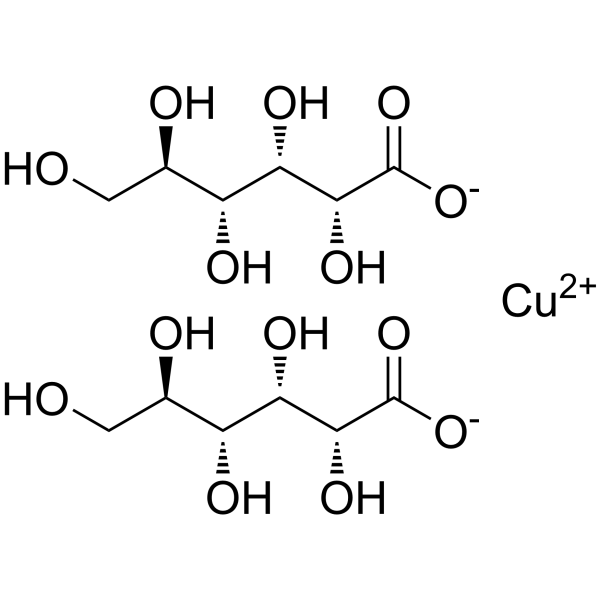
葡萄糖酸铜是一种有机分子实体。
葡萄糖酸铜是D-葡萄糖酸的铜盐,呈浅蓝色至蓝绿色。它是通过葡萄糖酸溶液与氧化铜或碱式碳酸铜反应制备的。根据美国食品药品监督管理局(FDA)的良好生产规范或饲料规范,葡萄糖酸铜可用作营养素或膳食补充剂,通常认为其在不超过0.005%的浓度下使用是安全的。 葡萄糖酸铜是D-葡萄糖酸的口服生物利用度高的铜盐。除了作为细胞色素C氧化酶和超氧化物歧化酶的酶辅因子外,铜还能与硫代氨基甲酸酯二硫仑(DSF)形成复合物,即DSF-铜复合物,从而增强DSF介导的26S蛋白酶体的抑制作用;蛋白酶体抑制可能导致细胞蛋白质降解受阻、细胞周期进程停止、细胞增殖受阻,以及易感肿瘤细胞群凋亡的诱导。 葡萄糖酸铜是D-葡萄糖酸的铜盐。它用于膳食补充剂,并用于治疗寻常痤疮、普通感冒、高血压、早产、利什曼病、内脏术后并发症等疾病。铜是一种化学元素,符号为Cu,原子序数为29。铜是动植物必需的元素,因为它是30多种酶正常运作所必需的。它天然存在于岩石、土壤、水和空气中。(L277, L278, L286) 葡萄糖酸(结构式HOCH2(CHOH)4COOH)的衍生物,包括其盐和酯。 另见:铜(具有活性部分);铜离子(具有活性部分)……查看更多…… |
| 分子式 |
C12H22CUO14
|
|---|---|
| 分子量 |
453.84
|
| 精确质量 |
453.03
|
| CAS号 |
527-09-3
|
| PubChem CID |
10692
|
| 外观&性状 |
Light blue to blue solid powder
|
| 沸点 |
673.6ºC at 760 mmHg
|
| 熔点 |
155-157 °C /D-form/
|
| 闪点 |
375.2ºC
|
| 折射率 |
16.5 ° (C=1, H2O)
|
| tPSA |
254.9
|
| 氢键供体(HBD)数目 |
10
|
| 氢键受体(HBA)数目 |
14
|
| 可旋转键数目(RBC) |
8
|
| 重原子数目 |
27
|
| 分子复杂度/Complexity |
165
|
| 定义原子立体中心数目 |
8
|
| SMILES |
C([C@H]([C@H]([C@@H]([C@H](C(=O)[O-])O)O)O)O)O.C([C@H]([C@H]([C@@H]([C@H](C(=O)[O-])O)O)O)O)O.[Cu+2]
|
| InChi Key |
OCUCCJIRFHNWBP-IYEMJOQQSA-L
|
| InChi Code |
InChI=1S/2C6H12O7.Cu/c2*7-1-2(8)3(9)4(10)5(11)6(12)13;/h2*2-5,7-11H,1H2,(H,12,13);/q;;+2/p-2/t2*2-,3-,4+,5-;/m11./s1
|
| 化学名 |
copper;(2R,3S,4R,5R)-2,3,4,5,6-pentahydroxyhexanoate
|
| HS Tariff Code |
2934.99.9001
|
| 存储方式 |
Powder -20°C 3 years 4°C 2 years In solvent -80°C 6 months -20°C 1 month 注意: (1). 本产品在运输和储存过程中需避光。 (2). 请将本产品存放在密封且受保护的环境中(例如氮气保护),避免吸湿/受潮。 |
| 运输条件 |
Room temperature (This product is stable at ambient temperature for a few days during ordinary shipping and time spent in Customs)
|
| 溶解度 (体外实验) |
DMSO: 25 mg/mL (55.09 mM)
|
|---|---|
| 溶解度 (体内实验) |
注意: 如下所列的是一些常用的体内动物实验溶解配方,主要用于溶解难溶或不溶于水的产品(水溶度<1 mg/mL)。 建议您先取少量样品进行尝试,如该配方可行,再根据实验需求增加样品量。
注射用配方
注射用配方1: DMSO : Tween 80: Saline = 10 : 5 : 85 (如: 100 μL DMSO → 50 μL Tween 80 → 850 μL Saline)(IP/IV/IM/SC等) *生理盐水/Saline的制备:将0.9g氯化钠/NaCl溶解在100 mL ddH ₂ O中,得到澄清溶液。 注射用配方 2: DMSO : PEG300 :Tween 80 : Saline = 10 : 40 : 5 : 45 (如: 100 μL DMSO → 400 μL PEG300 → 50 μL Tween 80 → 450 μL Saline) 注射用配方 3: DMSO : Corn oil = 10 : 90 (如: 100 μL DMSO → 900 μL Corn oil) 示例: 以注射用配方 3 (DMSO : Corn oil = 10 : 90) 为例说明, 如果要配制 1 mL 2.5 mg/mL的工作液, 您可以取 100 μL 25 mg/mL 澄清的 DMSO 储备液,加到 900 μL Corn oil/玉米油中, 混合均匀。 View More
注射用配方 4: DMSO : 20% SBE-β-CD in Saline = 10 : 90 [如:100 μL DMSO → 900 μL (20% SBE-β-CD in Saline)] 口服配方
口服配方 1: 悬浮于0.5% CMC Na (羧甲基纤维素钠) 口服配方 2: 悬浮于0.5% Carboxymethyl cellulose (羧甲基纤维素) 示例: 以口服配方 1 (悬浮于 0.5% CMC Na)为例说明, 如果要配制 100 mL 2.5 mg/mL 的工作液, 您可以先取0.5g CMC Na并将其溶解于100mL ddH2O中,得到0.5%CMC-Na澄清溶液;然后将250 mg待测化合物加到100 mL前述 0.5%CMC Na溶液中,得到悬浮液。 View More
口服配方 3: 溶解于 PEG400 (聚乙二醇400) 请根据您的实验动物和给药方式选择适当的溶解配方/方案: 1、请先配制澄清的储备液(如:用DMSO配置50 或 100 mg/mL母液(储备液)); 2、取适量母液,按从左到右的顺序依次添加助溶剂,澄清后再加入下一助溶剂。以 下列配方为例说明 (注意此配方只用于说明,并不一定代表此产品 的实际溶解配方): 10% DMSO → 40% PEG300 → 5% Tween-80 → 45% ddH2O (或 saline); 假设最终工作液的体积为 1 mL, 浓度为5 mg/mL: 取 100 μL 50 mg/mL 的澄清 DMSO 储备液加到 400 μL PEG300 中,混合均匀/澄清;向上述体系中加入50 μL Tween-80,混合均匀/澄清;然后继续加入450 μL ddH2O (或 saline)定容至 1 mL; 3、溶剂前显示的百分比是指该溶剂在最终溶液/工作液中的体积所占比例; 4、 如产品在配制过程中出现沉淀/析出,可通过加热(≤50℃)或超声的方式助溶; 5、为保证最佳实验结果,工作液请现配现用! 6、如不确定怎么将母液配置成体内动物实验的工作液,请查看说明书或联系我们; 7、 以上所有助溶剂都可在 Invivochem.cn网站购买。 |
| 制备储备液 | 1 mg | 5 mg | 10 mg | |
| 1 mM | 2.2034 mL | 11.0171 mL | 22.0342 mL | |
| 5 mM | 0.4407 mL | 2.2034 mL | 4.4068 mL | |
| 10 mM | 0.2203 mL | 1.1017 mL | 2.2034 mL |
1、根据实验需要选择合适的溶剂配制储备液 (母液):对于大多数产品,InvivoChem推荐用DMSO配置母液 (比如:5、10、20mM或者10、20、50 mg/mL浓度),个别水溶性高的产品可直接溶于水。产品在DMSO 、水或其他溶剂中的具体溶解度详见上”溶解度 (体外)”部分;
2、如果您找不到您想要的溶解度信息,或者很难将产品溶解在溶液中,请联系我们;
3、建议使用下列计算器进行相关计算(摩尔浓度计算器、稀释计算器、分子量计算器、重组计算器等);
4、母液配好之后,将其分装到常规用量,并储存在-20°C或-80°C,尽量减少反复冻融循环。
计算结果:
工作液浓度: mg/mL;
DMSO母液配制方法: mg 药物溶于 μL DMSO溶液(母液浓度 mg/mL)。如该浓度超过该批次药物DMSO溶解度,请首先与我们联系。
体内配方配制方法:取 μL DMSO母液,加入 μL PEG300,混匀澄清后加入μL Tween 80,混匀澄清后加入 μL ddH2O,混匀澄清。
(1) 请确保溶液澄清之后,再加入下一种溶剂 (助溶剂) 。可利用涡旋、超声或水浴加热等方法助溶;
(2) 一定要按顺序加入溶剂 (助溶剂) 。
Link: https://clinicaltrials.gov/ct2/show/NCT05210374
Conditions:Relapsed SarcomasLink: https://clinicaltrials.gov/ct2/show/NCT07471542
Conditions:Cirrhosis|Chronic Liver Disease|Fibrosis|InfectionLink: https://clinicaltrials.gov/ct2/show/NCT02715609
Conditions:Glioblastoma Multiforme
Title:Disulfiram and Copper Gluconate With Temozolomide in Unmethylated Glioblastoma Multiforme
Status:Terminated
updateDate:2024-10-03
Ctid:NCT03363659
Link: https://clinicaltrials.gov/ct2/show/NCT03363659
Conditions:Glioblastoma|Glioblastoma MultiformeLink: https://clinicaltrials.gov/ct2/show/NCT04521335
Conditions:Multiple MyelomaLink: https://clinicaltrials.gov/ct2/show/NCT02963051
Conditions:Prostate CancerLink: https://clinicaltrials.gov/ct2/show/NCT01907165
Conditions:GlioblastomaLink: https://clinicaltrials.gov/ct2/show/NCT01177579
Conditions:Copper DeficiencyLink: https://clinicaltrials.gov/ct2/show/NCT00742911
Conditions:Cancer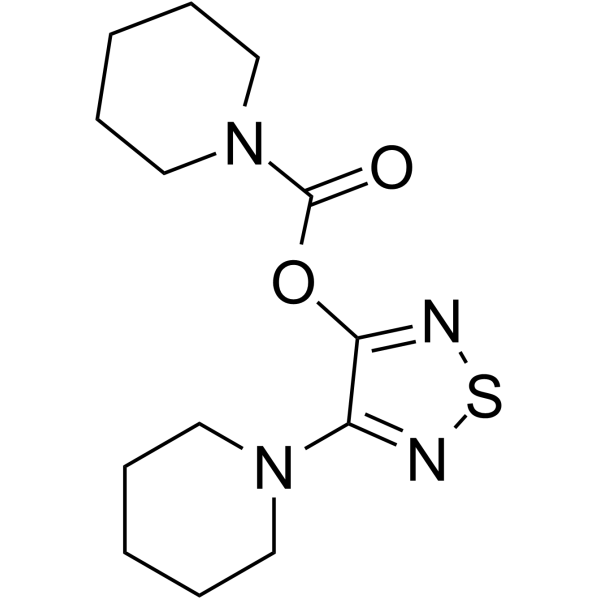 Lalistat 2
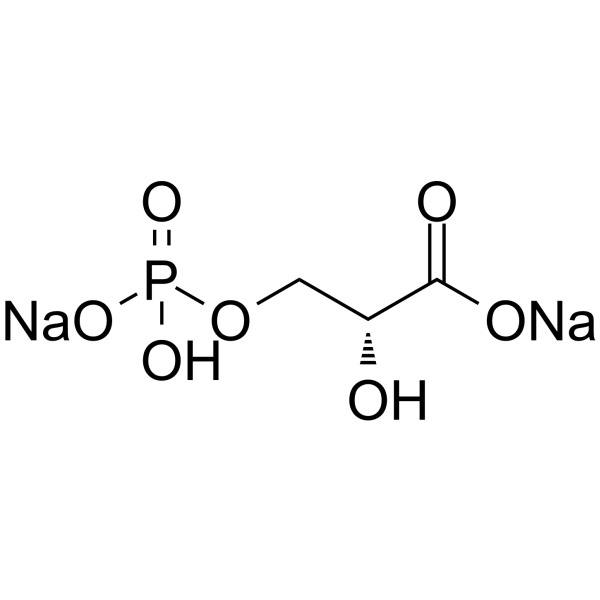 D-(-)-3-Phosphoglyceric acid disodium (3-Phospho-D-glyceric acid disodium)
 STC-15
 TSR-033
InvivoChem的所有产品仅用于作科学研究,不面向患者销售
Copyright 2020 InvivoChem LLC | All Rights Reserved 粤ICP备20063088号-1


 粤公网安备 44011102003439号
 463611831
