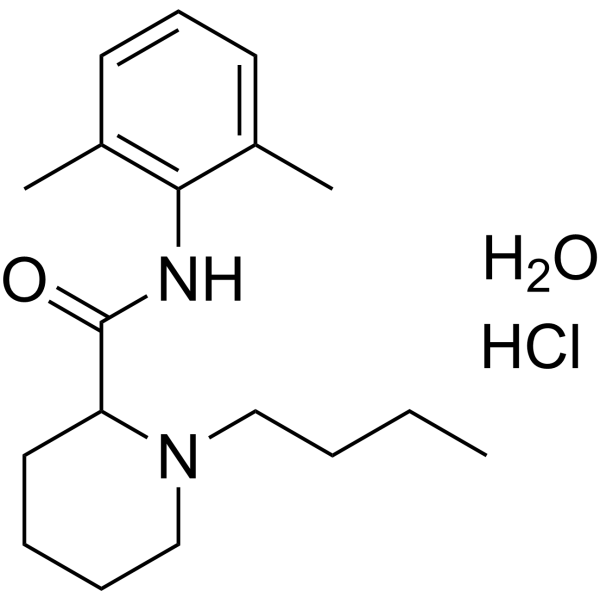
Bupivacaine hydrochloride monohydrate

别名: 盐酸布比卡因;布比卡因 盐酸盐;盐酸布比卡因 USP标准品;盐酸布比卡因 标准品;盐酸布比卡因杂质
目录号: V70442 纯度: ≥98%
布比卡因盐酸盐一水合物是一种 NMDA 受体阻滞剂/抑制剂。
Bupivacaine hydrochloride monohydrate CAS号: 73360-54-0
产品类别: iGluR
产品仅用于科学研究,不针对患者销售
规格 价格 库存 数量
10mg
Other Sizes

Other Forms of Bupivacaine hydrochloride monohydrate:

  • Bupivacaine-d9 (Bupivacaine-d9)
  • Levobupivacaine-d9 hydrochloride
  • Bupivacaine N-oxide hydrochloride
  • 盐酸布比卡因
点击了解更多
InvivoChem产品被CNS等顶刊论文引用
产品描述
布比卡因盐酸盐一水合物是一种 NMDA 受体阻滞剂/抑制剂。布比卡因盐酸盐一水合物可阻断钠、L-钙和钾通道。 Bupivacaine HCl 一水合物可有效阻断 SCN5A 通道,IC50 为 69.5 μM。盐酸布比卡因一水合物可用于慢性疼痛研究。
生物活性&实验参考方法
靶点
NMDA Receptor
体外研究 (In Vitro)
在脊髓背角(与中枢敏化密切相关的区域)中,布西卡因可阻断 NMDA 受体介导的突触传递 [1]。布比卡因将半最大激活/失活膜电位移向更负的膜电位,这改变了通道激活和稳态失活的电压依赖性。 SCN5A 通道处于非活性状态时对布比卡因具有轻微敏感性 (IC50=2.18±0.16 μM) [2]。布比卡因的 IC50 为 16.5 μM,剂量依赖性且可逆地阻断 SK2 通道 [3]。
药代性质 (ADME/PK)
Absorption, Distribution and Excretion
Systemic absorption of local anesthetics depends on the administered dose and concentration, as well as the total amount administered. Other factors affecting the rate of systemic absorption include the route of administration, blood flow at the administration site, and the presence of adrenaline in the anesthetic solution. When bupivacaine reconstituted with meloxicam is administered via infusion, systemic parameters vary after a single dose. In patients undergoing hallux valgus resection, the Cmax of 60 mg bupivacaine was 54 ± 33 ng/mL, the median Tmax was 3 hours, and the AUC∞ was 1718 ± 1211 ngh/mL. In hernia repair using a 300 mg dose, the corresponding values were 271 ± 147 ng/mL, 18 hours, and 15,524 ± 8921 ngh/mL, respectively. Finally, when a 400 mg dose was used in total knee arthroplasty, the corresponding values were 695 ± 411 ng/mL, 21 hours, and 38,173 ± 29,400 ngh/mL, respectively. Only 6% of bupivacaine was excreted unchanged in the urine. After absorption into the bloodstream, bupivacaine hydrochloride exhibits a higher binding rate to plasma proteins than any other local anesthetic; the reported binding rate is 82-96%. Bupivacaine hydrochloride has the lowest placental translocation among all parenteral local anesthetics, and therefore may have the least inhibitory effect on the fetus. Pregnant rats were intravenously infused with bupivacaine at a rate of 0.33 mg·kg⁻¹·min⁻¹ over 15 minutes. The fetus was delivered at the end of the infusion or 2 or 4 hours after administration. Blood and tissue samples were collected from the mother and fetus, and bupivacaine and its metabolites were determined by capillary gas chromatography-mass spectrometry. The elimination half-life of bupivacaine is 37.7 minutes. The major metabolite is 3'-hydroxybupivacaine. At the end of administration, bupivacaine and 3'-hydroxybupivacaine were detected in all samples. The concentration ratio of bupivacaine in fetal plasma to maternal plasma was 0.29, and in the placenta it was 0.63. The highest concentration of bupivacaine was found in the amnion: three times that of maternal plasma and eleven times that of fetal plasma. Four hours after administration, bupivacaine was undetectable in all maternal and fetal samples, while 3'-hydroxybupivacaine remained in all tissues except fetal plasma and the heart. These data indicate that significant amounts of bupivacaine were absorbed by the bilateral placenta, amnion, and myometrium. 3'-hydroxybupivacaine was present in all tissues except fetal plasma and the heart, even though the maternal compound was undetectable. Following tail, epidural, or peripheral nerve block with bupivacaine hydrochloride, peak blood concentrations of bupivacaine are reached within 30 to 45 minutes, subsequently decreasing to negligible levels over the next 3 to 6 hours. Plasma pharmacokinetic studies following direct intravenous injection of bupivacaine hydrochloride have shown that it conforms to a three-compartment open model. The first compartment represents the rapid distribution of the drug within the blood vessels. The second compartment represents the equilibrium of the drug in highly perfused organs such as the brain, myocardium, lungs, kidneys, and liver. The third compartment represents the equilibrium of the drug in low-perfused tissues such as muscle and fat. Clearance from tissue distribution depends primarily on the ability of binding sites in the circulatory system to transport the drug to the liver for metabolism. For more complete data on the absorption, distribution, and excretion of bupivacaine (6 items), please visit the HSDB records page. Metabolites/Metabolites Amide local anesthetics (such as bupivacaine) are primarily metabolized in the liver by binding to glucuronic acid. The major metabolite of bupivacaine is 2,6-piperidinimide, primarily catalyzed by cytochrome P450 3A4. Pregnant rats received intravenous infusion of bupivacaine at a rate of 0.33 mg·kg⁻¹·min⁻¹ over 15 minutes. The fetus was delivered at the end of the infusion or 2 or 4 hours after administration. Blood and tissue samples were collected from both mother and fetus, and bupivacaine and its metabolites were determined by capillary gas chromatography-mass spectrometry. The elimination half-life of bupivacaine was 37.7 minutes. The major metabolite was 3'-hydroxybupivacaine. Bupivacaine and 3'-hydroxybupivacaine were detected in all samples at the end of administration. The fetal-to-maternal concentration ratio of bupivacaine in plasma was 0.29, and in the placenta it was 0.63. The highest concentration of bupivacaine was found in the amnion: 3 times higher than in maternal plasma and 11 times higher than in fetal plasma. Four hours after administration, bupivacaine was undetectable in all maternal and fetal samples, while 3'-hydroxybupivacaine remained in all tissues except fetal plasma and the heart. These data indicate that significant amounts of bupivacaine were absorbed bilaterally by the placenta, as well as in the amnion and myometrium. Even though the maternal compound was undetectable, 3'-hydroxybupivacaine remained in all tissues except fetal plasma and the heart. Bupivacaine hydrochloride is primarily metabolized to piperidinyl dimethylamine (PPX) via N-dealkylation, a process that may occur in the liver. Bupivacaine is primarily excreted in the urine as a small amount of PPX, the unchanged drug (5%), and other unidentified metabolites. Amide-type local anesthetics (such as bupivacaine) are primarily metabolized in the liver via glucuronide conjugation. The major metabolite of bupivacaine is 2,6-piperidinimide, primarily catalyzed by cytochrome P450 3A4. Elimination pathway: Only 6% of bupivacaine is excreted unchanged in the urine. Half-life: 2.7 hours in adults, 8.1 hours in newborns. The median half-life of bupivacaine in combination with meloxicam for postoperative analgesia is 15-17 hours, depending on the dose and administration site. Pregnant rats received intravenous infusion of bupivacaine at a rate of 0.33 mg·kg⁻¹·min⁻¹ over 15 minutes. The fetus was delivered at the end of the infusion or 2 or 4 hours after administration. Blood and tissue samples were collected from the mother and fetus, and bupivacaine and its metabolites were determined by capillary gas chromatography-mass spectrometry. The elimination half-life of bupivacaine is 37.7 minutes. The elimination half-life of bupivacaine hydrochloride in adults is 1.5-5.5 hours, and in newborns it is 8.1 hours.
毒性/毒理 (Toxicokinetics/TK)
Effects During Pregnancy and Lactation
◉ Overview of Lactation Use
Because bupivacaine has very low concentrations in breast milk and is not absorbed orally, the dose ingested by the infant is very small, therefore it has not caused any adverse effects on breastfed infants.
There have been reports that the combined use of bupivacaine with other anesthetics and analgesics during labor may interfere with breastfeeding. However, this assessment is controversial and complex due to the varying drug combinations, dosages, and patient populations involved in studies, as well as the differences in techniques used and flawed designs in many studies. In contrast, epidural bupivacaine initiated after umbilical cord ligation appears to improve breastfeeding success rates due to improved pain control. Overall, with good breastfeeding support, epidural bupivacaine, whether in combination with fentanyl or its derivatives, has little or no adverse effect on breastfeeding success rates. Labor analgesia may delay the onset of lactation.
◉ Effects on Breastfed Infants
No significant adverse reactions were observed in 13 breastfed infants whose mothers received epidural bupivacaine analgesia.
30 patients undergoing cesarean section received bilateral transversus abdominis plane block using a combination of 52 mg 0.25% bupivacaine hydrochloride and 266 mg 1.3% liposomal bupivacaine. Two infants experienced transient tachypnea, but the causal relationship could not be determined. During the 14-day follow-up period, none of the infants required readmission.
◉ Effects on Lactation and Breast Milk
30 women undergoing cesarean section received either spinal anesthesia (unspecified) (n = 15) or spinal anesthesia combined with bupivacaine (n = 15) followed by epidural infusion after umbilical cord ligation. The bupivacaine administration regimen was: an initial bolus dose of 12.5 mg, followed by a continuous infusion at a rate of 17.5 mg/hour for 3 days. Patients treated with bupivacaine experienced better pain relief, as evidenced by lower pain scores and a lower dosage of diclofenac sodium for analgesia. Furthermore, the daily milk production in the bupivacaine treatment group was higher than in the untreated group, and this difference was statistically significant from day 3 to day 11 postpartum (end of the study). The authors concluded that improved pain relief increased the success rate of breastfeeding. Twenty women who underwent cesarean section received either epidural bupivacaine or bupivacaine combined with buprenorphine after umbilical cord ligation. The bupivacaine administration regimen was: an initial bolus dose of 12.5 mg, followed by a continuous infusion of 17.5 mg/hour for 3 days. The buprenorphine administration regimen was: an initial bolus dose of 200 mcg, followed by a continuous infusion of 8.4 mcg/hour for 3 days. Breastfeeding began as soon as patients were able to sit up. Both groups of patients showed increased breast milk intake and infant weight within 10 days postpartum; however, the increase was greater in patients using bupivacaine alone. A prospective cohort study compared women who did not receive analgesia during labor (n = 63) with women who received continuous epidural analgesia with fentanyl combined with 0.05% to 0.1% bupivacaine (n = 39) or ropivacaine (n = 13). The total dose of bupivacaine ranged from 31 to 62 mg, and the mean total infusion time from initiation to delivery was 219 minutes. The study found no differences between the two groups in breastfeeding effectiveness or infant neurobehavioral status 8 to 12 hours postpartum, or in the number of infants exclusively or partially breastfed at 4 weeks postpartum. A randomized prospective study measured breastfeeding behavior in full-term healthy infants of 100 multiparous women who received epidural or intravenous fentanyl during labor. The epidural group initially received 100 mg bupivacaine via epidural injection, followed by a continuous infusion of 25 mg/hour. The intravenous fentanyl group received 15–20 mg bupivacaine via spinal injection. Breastfeeding behavior differed slightly between the two groups, with infants in the intravenous fentanyl group showing slightly less breastfeeding performance than those in the epidural group. However, all mothers were able to breastfeed within 24 hours. No serious breastfeeding problems were reported by any mother; 10 mothers in the epidural group reported mild to moderate breastfeeding problems, compared to 7 mothers in the intravenous fentanyl group. Twenty mothers in the epidural anesthesia group and 14 mothers in the intravenous anesthesia group used supplemental bottle feeding; the difference between the two groups was not statistically significant. A randomized, non-blinded study of women undergoing cesarean section compared the effects of epidural anesthesia with general anesthesia (induced by intravenous thiopental sodium 4 mg/kg and succinylcholine 1.5 mg/kg, followed by nitrous oxide and isoflurane). Results showed that the time to first breastfeeding was significantly shorter in the epidural anesthesia group than in the general anesthesia group (107 minutes vs. 228 minutes). This difference may be due to the effects of anesthesia on the infant, as infants in the general anesthesia group had significantly lower Apgar scores, neurological scores, and adaptation scores than the control group. A randomized, multicenter trial compared the breastfeeding initiation rate and duration in women receiving high-dose epidural bupivacaine monotherapy or a combination of two low-dose bupivacaines with fentanyl. This trial also compared a matched control group that did not receive epidural anesthesia. Results showed no difference in breastfeeding initiation rate and duration between the epidural anesthesia group and the non-epidural anesthesia group that did not receive medication. A non-randomized study of low-risk mothers and infants found no overall difference in neonatal sucking volume regardless of whether the mother received different doses of bupivacaine combined with fentanyl epidural infusion, different doses of fentanyl epidural infusion alone, or no labor analgesia. Subgroup analyses by sex and sucking frequency showed that high doses of bupivacaine and fentanyl had an effect on female infants but no effect on male infants. However, imbalances in many factors between study groups made the results difficult to interpret. In a prospective cohort study, 87 multiparous women received epidural bupivacaine and fentanyl analgesia during labor and vaginal delivery. The loading dose was 0.125% bupivacaine and 50–100 mcg fentanyl. Maintenance epidural analgesia was achieved using 0.0625% bupivacaine and 0.2 mcg/mL fentanyl. The median fentanyl dose received by women was 151 mcg (range 30–570 mcg). Women completed breastfeeding questionnaires at 1 week and 6 weeks postpartum. Most women had prior breastfeeding experience, had family support at home, and had adequate maternity leave. All women initiated breastfeeding at 1 week postpartum, and 95.4% were still breastfeeding at 6 weeks postpartum. A national survey of women from late pregnancy to 12 months postpartum and their infants compared the time to lactroogenesis II in mothers who received and did not receive pain medication during labor. Medication categories included: spinal or epidural anesthesia alone, spinal or epidural anesthesia combined with other medications, and other analgesics alone. Women who received any category of medication were approximately twice as likely to experience a delayed lactroogenesis II (>72 hours) compared to women who did not receive labor analgesia. A randomized study compared the effects of cesarean section under general anesthesia, spinal anesthesia, or epidural anesthesia versus vaginal delivery on serum prolactin and oxytocin levels and the time to lactation initiation. Spinal anesthesia used 10–11 mg of hypertonic 5% bupivacaine solution, while epidural anesthesia used 10 mL (50 mg) of 0.5% bupivacaine solution. After delivery, all patients received an intravenous infusion of 30 IU of oxytocin in 1 L of normal saline; if blood pressure was normal, 0.2 mg of ergonovine was added. Patients in the general anesthesia group (n = 21) had higher postoperative prolactin levels and a longer average time to lactation initiation (25 hours) than other groups (10.8–11.8 hours). Postpartum oxytocin levels were higher in the non-pharmacological vaginal delivery group than in the general anesthesia and spinal anesthesia groups, and serum oxytocin levels were higher in the epidural anesthesia group than in the spinal anesthesia group. A retrospective study in a Spanish public hospital compared infants born to mothers who received epidural anesthesia containing fentanyl and bupivacaine or ropivacaine during delivery. Infants born to mothers who received epidural anesthesia had lower rates of early breastfeeding. A randomized, double-blind study compared three epidural maintenance solutions used for labor analgesia: bupivacaine 1 mg/mL, bupivacaine 0.8 mg/mL plus fentanyl 1 mcg/mL, or bupivacaine 0.625 mg/mL plus fentanyl 2 mcg/mL. At 6 weeks postpartum, breastfeeding rates reached 94% or higher in all groups, with no significant difference between groups. All mothers delivered at term and had a strong desire to breastfeed; almost all mothers delivered vaginally. A prospective cohort study of 1204 Israeli women aimed to investigate the effectiveness of epidural analgesia during labor. This study employed the following protocol: 15 mL of 0.1% bupivacaine and 100 mcg fentanyl were administered in 5 mL increments, followed by continuous epidural infusion of 10 mL of 0.1% bupivacaine and 2 mcg/mL fentanyl in 5 mL increments, using a patient-controlled epidural analgesia (PCA) mode, with each additional 5 mL infusion and a lockout time of 15 minutes. At 6 weeks postpartum, mothers receiving epidural analgesia had lower rates of breastfeeding and exclusive breastfeeding (74% and 52%, respectively) than those not receiving epidural analgesia (83% and 68%, respectively). However, this difference was primarily due to parity, with minimal impact on multiparous women. A retrospective study compared women undergoing elective cesarean sections at a Turkish hospital, finding no difference in breastfeeding rates at 1 hour and 24 hours postpartum between women receiving bupivacaine spinal anesthesia (n = 170) and those receiving general anesthesia (n = 78). General anesthesia was induced with propofol, maintained with sevoflurane, and administered with fentanyl for postpartum anesthesia. However, at 6 months postpartum, 67% of women in the general anesthesia group were still breastfeeding, compared to 81% in the spinal anesthesia group – a statistically significant difference. A study of 169 pregnant women randomly assigned them to three groups, each receiving one of three solutions for epidural anesthesia during labor. One solution was a mixture of 0.1% or 0.125% bupivacaine with 5 micrograms of sufentanil, and another was a mixture of 0.1% bupivacaine with 10 micrograms of sufentanil, each in 15 ml volumes. There was no difference in mean LATCH scores among the three groups of infants. A Swedish observational study compared breastfeeding behavior in infants born to mothers who received intravenous or intramuscular oxytocin (regardless of whether they received concurrent epidural analgesia with sufentanil (median dose 10 micrograms) or bupivacaine (median dose 17.5 mg)). Infants born to mothers receiving only oxytocin infusion had comparable breastfeeding rates to infants born to mothers receiving no intervention. Mothers receiving oxytocin combined with epidural analgesia experienced reduced breastfeeding behavior and greater weight loss on postpartum day 2. Mothers of well-breastfed infants showed greater fluctuations in serum oxytocin levels than mothers of poorly breastfed infants. A non-randomized, non-blinded study conducted in a Serbian hospital included women near term undergoing cesarean section, comparing the effects of general anesthesia (n = 284) with spinal or epidural anesthesia (n = 249). Spinal anesthesia used hyperosmolar bupivacaine 12 mg and fentanyl 0.01 mg; epidural anesthesia used isotonic bupivacaine 0.5% (0.5 mg per 10 cm of height) and fentanyl 0.05 mg. General anesthesia was induced with propofol 2.3 mg/kg and succinylcholine 1.5 mg/kg followed by endotracheal intubation and inhalation of an anesthetic gas mixture and oxygen. Reports indicate that the pre-delivery nitric oxide (likely nitrous oxide) content in the gas was 50%, increasing to 67% post-delivery. Sevoflurane was also used in some cases. After delivery and umbilical cord clamping, the mothers received intravenous fentanyl 3 mcg/kg and rocuronium bromide 0.5 mg/kg to promote placental delivery. Post-operatively, neostigmine and atropine were used to reverse neuromuscular blockade. All patients received diclofenac sodium 1 mg/kg every 8 hours for 24 hours post-delivery. 98% of patients under general anesthesia also received 100 mg tramadol, and 78.5% received 1 g acetaminophen. Patients under regional anesthesia did not receive tramadol or acetaminophen. Lactation occurred earlier in patients receiving regional anesthesia (56% and 29% at 18 and 24 hours post-operation, respectively), while 86% of women under general anesthesia did not begin lactation until 36 to 48 hours post-operation.
Protein binding
Bupivacaine has a protein binding rate of approximately 95%.
参考文献

[1]. Actions of Bupivacaine, a widely used local anesthetic, on NMDA receptor responses. J Neurosci. 2015 Jan 14;35(2):831-42.

[2]. A Comparative Analysis of Bupivacaine and Ropivacaine Effects on Human Cardiac SCN5A Channels. Anesth Analg. 2015 Jun;120(6):1226-34.

[3]. Inhibition of Voltage-Gated Na+ Channels by Bupivacaine Is Enhanced by the Adjuvants Buprenorphine, Ketamine, and Clonidine. Reg Anesth Pain Med.Jul/Aug 2017;42(4):462-468.

其他信息
1-Butyl-N-(2,6-dimethylphenyl)piperidin-2-carboxamide is a piperidine carboxamide formed by the condensation of the carboxyl group of N-butylpiperidinic acid with the amino group of 2,6-dimethylaniline. It is a piperidine carboxamide, aromatic amide, and tertiary amine compound. It is the conjugate base of 1-butyl-2-[(2,6-dimethylphenyl)carbamoyl]piperidinium. Bupivacaine is a widely used local anesthetic. Bupivacaine is an amide-based local anesthetic. The physiological effects of bupivacaine are achieved through local anesthesia. Bupivacaine is a long-acting amide-based local anesthetic. Bupivacaine reversibly binds to specific sodium ion channels on neuronal membranes, leading to a voltage-dependent decrease in membrane permeability to sodium ions, thereby stabilizing membrane structure; inhibiting depolarization and nerve impulse conduction; and causing reversible sensory loss. Liposomed bupivacaine is a liposomally encapsulated bupivacaine formulation. Bupivacaine is a long-acting local anesthetic of the amide class. Upon administration, bupivacaine reversibly binds to specific sodium ion channels on the neuronal membrane, leading to a voltage-dependent decrease in membrane permeability to sodium ions and stabilizing membrane structure. This results in inhibition of depolarization and nerve impulse conduction, leading to reversible sensory loss. Compared to bupivacaine alone, liposomal delivery prolongs the duration of local anesthesia and delays peak plasma concentration due to the slow release of bupivacaine from the liposomes. Bupivacaine is only present in individuals who have used or taken the drug. It is a widely used local anesthetic. Bupivacaine blocks the generation and conduction of nerve impulses by increasing the nerve electrical excitation threshold, slowing nerve impulse propagation, and reducing the rate of action potential rise. Bupivacaine binds to the intracellular portion of sodium channels, blocking sodium ion inflow into nerve cells, thereby preventing depolarization. Typically, the progression of anesthesia is related to the diameter of the affected nerve fiber, the degree of myelination, and the conduction velocity. Clinically, the order of loss of neurological function is as follows: (1) pain sensation, (2) temperature sensation, (3) touch sensation, (4) proprioception, (5) skeletal muscle tone. The analgesic effect of bupivacaine is thought to be related to its binding to the prostaglandin E2 receptor EP1 subtype (PGE2EP1), thereby inhibiting prostaglandin production and thus reducing fever, inflammation, and hyperalgesia.
A widely used local anesthetic.
See also: bupivacaine; meloxicam (ingredients).
Drug Indications
As an implant, bupivacaine is indicated for adults after open inguinal hernia repair surgery, by placing the drug at the surgical site to produce postoperative analgesia for up to 24 hours. Bupivacaine liposome suspension is indicated for patients aged 6 years and older for single infiltration to produce postoperative local analgesia. In adults, it can also be used for brachial plexus interstitial block to produce postoperative regional analgesia. Bupivacaine, when used in combination with meloxicam, is indicated for postoperative analgesia within 72 hours after foot and ankle surgery, minor to medium-sized open abdominal surgery, and total lower extremity joint replacement surgery in adult patients. Bupivacaine, alone or in combination with epinephrine, is indicated for local or regional anesthesia or analgesia in adult patients for surgical, dental and oral surgery, diagnostic and therapeutic procedures, and obstetric procedures. Specific concentrations and formulations are recommended for each type of nerve block used to produce local or regional anesthesia or analgesia. Finally, due to the significant clinical risks associated with its use, bupivacaine is not recommended for all nerve blocks.
FDA Label
Exparel® Liposomes are indicated for: adult patients for brachial plexus or femoral nerve blocks to treat postoperative pain. Also indicated for adults 6 years and older and children as a local anesthetic for postoperative somatic pain from minor to medium-sized surgical wounds.
Postoperative Analgesia
Mechanism of Action
Similar to lidocaine, bupivacaine is an amide-type local anesthetic that exerts its local anesthetic effect by blocking the generation and conduction of nerve impulses. These impulses, also known as action potentials, are primarily dependent on membrane depolarization caused by the influx of sodium ions into neurons through voltage-gated sodium channels. Bupivacaine crosses the neuronal membrane and exerts its anesthetic effect by blocking the intracellular portion of the transmembrane pores of these channels. This blocking effect is use-dependent; repeated or prolonged depolarization enhances the blocking effect of sodium channels. Because sodium ions cannot pass through the channel pores, bupivacaine stabilizes the cell membrane at rest, thereby preventing the transmission of neurotransmitters. Generally, the progression of anesthesia is related to the diameter of the affected nerve fiber, the degree of myelination, and the conduction velocity. Clinically, the order of loss of neurological function is as follows: (1) pain, (2) temperature, (3) touch, (4) proprioception, (5) skeletal muscle tone. Although the primary mechanism of action of bupivacaine, which is the blocking of sodium channels, is well established, its other analgesic effects may be related to its binding to the prostaglandin E2 receptor EP1 subtype (PGE2EP1), which inhibits prostaglandin production, thereby reducing fever, inflammation, and hyperalgesia. Local anesthetics work by blocking the generation and conduction of nerve impulses. The mechanism may be to increase the electrical excitation threshold of the nerve, slow down the propagation speed of nerve impulses, and reduce the rate of rise of action potentials. Generally, the progression of anesthesia is related to the diameter of the affected nerve fibers, the degree of myelination, and the conduction velocity. Clinically, the order of loss of nerve function is as follows: (1) pain sensation, (2) temperature sensation, (3) touch sensation, (4) proprioception, and (5) skeletal muscle tone.
*注: 文献方法仅供参考, InvivoChem并未独立验证这些方法的准确性
化学信息 & 存储运输条件
分子式
C18H31CLN2O2
分子量
342.9039
精确质量
342.207
CAS号
73360-54-0
相关CAS号
Bupivacaine;38396-39-3;Bupivacaine hydrochloride;18010-40-7;Bupivacaine-d9;474668-57-0
PubChem CID
2474
外观&性状
Typically exists as solid at room temperature
熔点
255-259℃
LogP
5.221
tPSA
45.06
氢键供体(HBD)数目
1
氢键受体(HBA)数目
2
可旋转键数目(RBC)
5
重原子数目
21
分子复杂度/Complexity
321
定义原子立体中心数目
0
SMILES
Cl[H].O=C(C1([H])C([H])([H])C([H])([H])C([H])([H])C([H])([H])N1C([H])([H])C([H])([H])C([H])([H])C([H])([H])[H])N([H])C1C(C([H])([H])[H])=C([H])C([H])=C([H])C=1C([H])([H])[H].O([H])[H]
InChi Key
LEBVLXFERQHONN-UHFFFAOYSA-N
InChi Code
InChI=1S/C18H28N2O/c1-4-5-12-20-13-7-6-11-16(20)18(21)19-17-14(2)9-8-10-15(17)3/h8-10,16H,4-7,11-13H2,1-3H3,(H,19,21)
化学名
1-butyl-N-(2,6-dimethylphenyl)piperidine-2-carboxamide
HS Tariff Code
2934.99.9001
存储方式

Powder      -20°C    3 years

                     4°C     2 years

In solvent   -80°C    6 months

                  -20°C    1 month

运输条件
Room temperature (This product is stable at ambient temperature for a few days during ordinary shipping and time spent in Customs)
溶解度数据
溶解度 (体外实验)
May dissolve in DMSO (in most cases), if not, try other solvents such as H2O, Ethanol, or DMF with a minute amount of products to avoid loss of samples
溶解度 (体内实验)
注意: 如下所列的是一些常用的体内动物实验溶解配方,主要用于溶解难溶或不溶于水的产品(水溶度<1 mg/mL)。 建议您先取少量样品进行尝试,如该配方可行,再根据实验需求增加样品量。

注射用配方
(IP/IV/IM/SC等)
注射用配方1: DMSO : Tween 80: Saline = 10 : 5 : 85 (如: 100 μL DMSO 50 μL Tween 80 850 μL Saline)
*生理盐水/Saline的制备:将0.9g氯化钠/NaCl溶解在100 mL ddH ₂ O中,得到澄清溶液。
注射用配方 2: DMSO : PEG300Tween 80 : Saline = 10 : 40 : 5 : 45 (如: 100 μL DMSO 400 μL PEG300 50 μL Tween 80 450 μL Saline)
注射用配方 3: DMSO : Corn oil = 10 : 90 (如: 100 μL DMSO 900 μL Corn oil)
示例: 注射用配方 3 (DMSO : Corn oil = 10 : 90) 为例说明, 如果要配制 1 mL 2.5 mg/mL的工作液, 您可以取 100 μL 25 mg/mL 澄清的 DMSO 储备液,加到 900 μL Corn oil/玉米油中, 混合均匀。
View More

注射用配方 4: DMSO : 20% SBE-β-CD in Saline = 10 : 90 [如:100 μL DMSO 900 μL (20% SBE-β-CD in Saline)]
*20% SBE-β-CD in Saline的制备(4°C,储存1周):将2g SBE-β-CD (磺丁基-β-环糊精) 溶解于10mL生理盐水中,得到澄清溶液。
注射用配方 5: 2-Hydroxypropyl-β-cyclodextrin : Saline = 50 : 50 (如: 500 μL 2-Hydroxypropyl-β-cyclodextrin (羟丙基环胡精) 500 μL Saline)
注射用配方 6: DMSO : PEG300 : Castor oil : Saline = 5 : 10 : 20 : 65 (如: 50 μL DMSO 100 μL PEG300 200 μL Castor oil 650 μL Saline)
注射用配方 7: Ethanol : Cremophor : Saline = 10: 10 : 80 (如: 100 μL Ethanol 100 μL Cremophor 800 μL Saline)
注射用配方 8: 溶解于Cremophor/Ethanol (50 : 50), 然后用生理盐水稀释。
注射用配方 9: EtOH : Corn oil = 10 : 90 (如: 100 μL EtOH 900 μL Corn oil)
注射用配方 10: EtOH : PEG300Tween 80 : Saline = 10 : 40 : 5 : 45 (如: 100 μL EtOH 400 μL PEG300 50 μL Tween 80 450 μL Saline)


口服配方
口服配方 1: 悬浮于0.5% CMC Na (羧甲基纤维素钠)
口服配方 2: 悬浮于0.5% Carboxymethyl cellulose (羧甲基纤维素)
示例: 口服配方 1 (悬浮于 0.5% CMC Na)为例说明, 如果要配制 100 mL 2.5 mg/mL 的工作液, 您可以先取0.5g CMC Na并将其溶解于100mL ddH2O中,得到0.5%CMC-Na澄清溶液;然后将250 mg待测化合物加到100 mL前述 0.5%CMC Na溶液中,得到悬浮液。
View More

口服配方 3: 溶解于 PEG400 (聚乙二醇400)
口服配方 4: 悬浮于0.2% Carboxymethyl cellulose (羧甲基纤维素)
口服配方 5: 溶解于0.25% Tween 80 and 0.5% Carboxymethyl cellulose (羧甲基纤维素)
口服配方 6: 做成粉末与食物混合


注意: 以上为较为常见方法,仅供参考, InvivoChem并未独立验证这些配方的准确性。具体溶剂的选择首先应参照文献已报道溶解方法、配方或剂型,对于某些尚未有文献报道溶解方法的化合物,需通过前期实验来确定(建议先取少量样品进行尝试),包括产品的溶解情况、梯度设置、动物的耐受性等。

请根据您的实验动物和给药方式选择适当的溶解配方/方案:
1、请先配制澄清的储备液(如:用DMSO配置50 或 100 mg/mL母液(储备液));
2、取适量母液,按从左到右的顺序依次添加助溶剂,澄清后再加入下一助溶剂。以 下列配方为例说明 (注意此配方只用于说明,并不一定代表此产品 的实际溶解配方):
10% DMSO → 40% PEG300 → 5% Tween-80 → 45% ddH2O (或 saline);
假设最终工作液的体积为 1 mL, 浓度为5 mg/mL: 取 100 μL 50 mg/mL 的澄清 DMSO 储备液加到 400 μL PEG300 中,混合均匀/澄清;向上述体系中加入50 μL Tween-80,混合均匀/澄清;然后继续加入450 μL ddH2O (或 saline)定容至 1 mL;

3、溶剂前显示的百分比是指该溶剂在最终溶液/工作液中的体积所占比例;
4、 如产品在配制过程中出现沉淀/析出,可通过加热(≤50℃)或超声的方式助溶;
5、为保证最佳实验结果,工作液请现配现用!
6、如不确定怎么将母液配置成体内动物实验的工作液,请查看说明书或联系我们;
7、 以上所有助溶剂都可在 Invivochem.cn网站购买。
制备储备液 1 mg 5 mg 10 mg
1 mM 2.9163 mL 14.5815 mL 29.1630 mL
5 mM 0.5833 mL 2.9163 mL 5.8326 mL
10 mM 0.2916 mL 1.4582 mL 2.9163 mL

1、根据实验需要选择合适的溶剂配制储备液 (母液):对于大多数产品,InvivoChem推荐用DMSO配置母液 (比如:5、10、20mM或者10、20、50 mg/mL浓度),个别水溶性高的产品可直接溶于水。产品在DMSO 、水或其他溶剂中的具体溶解度详见上”溶解度 (体外)”部分;

2、如果您找不到您想要的溶解度信息,或者很难将产品溶解在溶液中,请联系我们;

3、建议使用下列计算器进行相关计算(摩尔浓度计算器、稀释计算器、分子量计算器、重组计算器等);

4、母液配好之后,将其分装到常规用量,并储存在-20°C或-80°C,尽量减少反复冻融循环。

计算器

摩尔浓度计算器可计算特定溶液所需的质量、体积/浓度,具体如下:

  • 计算制备已知体积和浓度的溶液所需的化合物的质量
  • 计算将已知质量的化合物溶解到所需浓度所需的溶液体积
  • 计算特定体积中已知质量的化合物产生的溶液的浓度
使用摩尔浓度计算器计算摩尔浓度的示例如下所示:
假如化合物的分子量为350.26 g/mol,在5mL DMSO中制备10mM储备液所需的化合物的质量是多少?
  • 在分子量(MW)框中输入350.26
  • 在“浓度”框中输入10,然后选择正确的单位(mM)
  • 在“体积”框中输入5,然后选择正确的单位(mL)
  • 单击“计算”按钮
  • 答案17.513 mg出现在“质量”框中。以类似的方式,您可以计算体积和浓度。

稀释计算器可计算如何稀释已知浓度的储备液。例如,可以输入C1、C2和V2来计算V1,具体如下:

制备25毫升25μM溶液需要多少体积的10 mM储备溶液?
使用方程式C1V1=C2V2,其中C1=10mM,C2=25μM,V2=25 ml,V1未知:
  • 在C1框中输入10,然后选择正确的单位(mM)
  • 在C2框中输入25,然后选择正确的单位(μM)
  • 在V2框中输入25,然后选择正确的单位(mL)
  • 单击“计算”按钮
  • 答案62.5μL(0.1 ml)出现在V1框中
g/mol

分子量计算器可计算化合物的分子量 (摩尔质量)和元素组成,具体如下:

注:化学分子式大小写敏感:C12H18N3O4  c12h18n3o4
计算化合物摩尔质量(分子量)的说明:
  • 要计算化合物的分子量 (摩尔质量),请输入化学/分子式,然后单击“计算”按钮。
分子质量、分子量、摩尔质量和摩尔量的定义:
  • 分子质量(或分子量)是一种物质的一个分子的质量,用统一的原子质量单位(u)表示。(1u等于碳-12中一个原子质量的1/12)
  • 摩尔质量(摩尔重量)是一摩尔物质的质量,以g/mol表示。
/

配液计算器可计算将特定质量的产品配成特定浓度所需的溶剂体积 (配液体积)

  • 输入试剂的质量、所需的配液浓度以及正确的单位
  • 单击“计算”按钮
  • 答案显示在体积框中
动物体内实验配方计算器(澄清溶液)
第一步:请输入基本实验信息(考虑到实验过程中的损耗,建议多配一只动物的药量)
第二步:请输入动物体内配方组成(配方适用于不溶/难溶于水的化合物),不同的产品和批次配方组成不同,如对配方有疑问,可先联系我们提供正确的体内实验配方。此外,请注意这只是一个配方计算器,而不是特定产品的确切配方。
+
+
+

计算结果:

工作液浓度 mg/mL;

DMSO母液配制方法 mg 药物溶于 μL DMSO溶液(母液浓度 mg/mL)。如该浓度超过该批次药物DMSO溶解度,请首先与我们联系。

体内配方配制方法μL DMSO母液,加入 μL PEG300,混匀澄清后加入μL Tween 80,混匀澄清后加入 μL ddH2O,混匀澄清。

(1) 请确保溶液澄清之后,再加入下一种溶剂 (助溶剂) 。可利用涡旋、超声或水浴加热等方法助溶;
            (2) 一定要按顺序加入溶剂 (助溶剂) 。

临床试验信息
Postoperative Analgesia Between Paravertebral Block and Epidural Block in Esophageal Surgery
CTID: NCT06704698
Phase: N/A    Status: Recruiting
Date: 2024-11-26
Phase 3 Adductor Canal Block With EXPAREL in Subjects Undergoing Primary Unilateral Total Knee Arthroplasty
CTID: NCT05139030
Phase: Phase 3    Status: Completed
Date: 2024-10-24
Rectus Sheath Block for Analgesia After Gynecological Laparotomy
CTID: NCT06575699
Phase: Phase 4    Status: Recruiting
Date: 2024-10-17
Intra-Articular Dexmedetomidine: A Treatment for Chronic Knee Pain
CTID: NCT06641206
Phase: N/A    Status: Recruiting
Date: 2024-10-15
Pain Palliation in Forearm Fractures in the Emergency Department
CTID: NCT06588907
Phase: N/A    Status: Not yet recruiting
Date: 2024-10-01
View More

Efficacy and Safety of Liposomal Bupivacaine Injection for Paravertebral Nerve Block in the Treatment of Acute and Chronic Pain After Thoracoscopic Pneumonectomy: a Multicenter, Randomized, Double-blind, Controlled Clinical Trial
CTID: NCT06569953
Phase: Phase 4    Status: Recruiting
Date: 2024-09-26


Superior Hypogastric Nerve Plexus Block With Bupivacaine After Robotic Resection of Endometriosis
CTID: NCT06577233
Phase: Phase 4    Status: Recruiting
Date: 2024-08-29
Dexmedetomidine in Obturator Nerve Block as an Analgesic in Transurethral Surgeries
CTID: NCT06229054
PhaseEarly Phase 1    Status: Completed
Date: 2024-08-12
Nebulized Bupivacaine Analgesia for Cleft Palate Repair
CTID: NCT04928352
Phase: Phase 3    Status: Recruiting
Date: 2024-07-31
A Study of Bupivacaine Liposome Injection in the Treatment of Pain After Thoracoscopic Surgery
CTID: NCT06529432
Phase: Phase 2    Status: Not yet recruiting
Date: 2024-07-31
Intrathecal Pethidine Plus Dexamethasone for Distal Lower Orthopedic Surgeries
CTID: NCT05303311
Phase: Phase 4    Status: Completed
Date: 2024-07-30
Impact of Opioid Avoidance Protocol for ACL Reconstruction
CTID: NCT06340932
Phase:    Status: Recruiting
Date: 2024-07-24
A Comparative Study of Intrathecal Dexmedetomidine and Fentanyl as Additives to Bupivacaine in Pott's Fracture
CTID: NCT06502262
Phase: N/A    Status: Not yet recruiting
Date: 2024-07-16
The Hemodynamic Effects of Different Volumes of Bupivacaine 0.25% Caudal Blocks in Pediatrics Undergoing Lower Abdominal Surgeries as Measured by Electrical Cardiometry
CTID: NCT05133687
Phase: Phase 3    Status: Completed
Date: 2024-07-09
Comparison of Clorotekal and Bupivacaine for Short Obstetric Surgery
CTID: NCT03967288
Phase: Phase 4    Status: Suspended
Date: 2024-06-21
Supraclavicular Bupivacaine Vs. Supraclavicular Liposomal Bupivacaine for Distal Radius Fracture Repair
CTID: NCT06179004
Phase: Phase 3    Status: Recruiting
Date: 2024-06-17
Comparison Between Genicular Nerve Block Combined With (IPACK) Block Versus Adductor Canal Block
CTID: NCT06423339
Phase: N/A    Status: Recruiting
Date: 2024-05-21
Liposomal Bupivacaine Single-Injection Interscalene Block vs. Continuous Interscalene Block for Primary Total Shoulder Arthroplasty
CTID: NCT05005260
Phase: Phase 4    Status: Completed
Date: 2024-05-07
Systemic Versus Local Dexmedetomidine as An Adjuvant to Bupivacaine in Ultrasound Guided Erector Spinae Block
CTID: NCT06386770
Phase: Phase 3    Status: Recruiting
Date: 2024-05-03
Liposomal Bupivacaine Versus Lidocaine for Skin Graft Donor Site Pain
CTID: NCT03854344
Phase: Phase 4    Status: Recruiting
Date: 2024-05-01
A Study of Liposomal Bupivacaine Versus 0.25% Bupivacaine Hydrochloride Post Breast Reduction
CTID: NCT05891613
Phase: Phase 4    Status: Recruiting
Date: 2024-04-17
Interscalene Single Shot With Plain Bupivacaine Versus Liposomal Bupivacaine for Arthroscopic Shoulder Surgery
CTID: NCT03638960
Phase: Phase 4    Status: Completed
Date: 2024-04-15
Liposomal Bupivacaine + Bupivacaine vs. Bupivacaine Alone on Opioid Use After Elective c/Section
CTID: NCT04232306
Phase: Phase 4    Status: Withdrawn
Date: 2024-04-10
Study in Subjects Undergoing Complete Abdominoplasty
CTID: NCT03789318
Phase: Phase 2    Status: Completed
Date: 2024-03-19
Bupivacaine Hydrochloride for Pain Control in Cutaneous Surgery
CTID: NCT04260854
Phase: Phase 1    Status: Enrolling by invitation
Date: 2024-03-18
Investigation of Corticosteroid Versus Placebo Injection in Patients With Syndesmotic Ligament Injury or High Ankle Sprain
CTID: NCT02892500
Phase: Phase 2    Status: Terminated
Date: 2024-02-13
Stellate Ganglion Block for Major Depressive Disorder.
CTID: NCT04727229
Phase: Phase 4    Status: Completed
Date: 2024-02-09
Dose and Concentration Relationship for PENG Block in Hip Surgery
CTID: NCT05400148
Phase:    Status: Completed
Date: 2024-02-07
A Phase 3 Study of F14 for Management of Pain Following Total Knee Replacement
CTID: NCT05603832
Phase: Phase 3    Status: Active, not recruiting
Date: 2024-01-31
Study to Evaluate the Pharmacokinetics and Safety of EXPAREL Administered as a Pectoral Plane Block in Women Undergoing Breast Augmentation
CTID: NCT04293809
Phase: Phase 1    Status: Completed
Date: 2024-01-29
Exparel vs. Marcaine ESP Block for Post-cardiac Surgical Pain
CTID: NCT06077422
Phase: Phase 2/Phase 3    Status: Recruiting
Date: 2024-01-26
Opioid Reduction Initiative During Outpatient Pediatric Urologic Procedures Using Exparel
CTID: NCT04826484
Phase: Phase 3    Status: Terminated
Date: 2023-12-26
ED90 of Bupivacaine After Lidocaine Test Dose With DPE and EPL
CTID: NCT06146842
Phase: N/A    Status: Not yet recruiting
Date: 2023-11-27
Femoral Triangle Block With Popliteal Plexus Block Versus Femoral Triangle Block Versus Adductor Canal Block for TKA
CTID: NCT04854395
Phase: Phase 4    Status: Completed
Date: 2023-11-18
A Multi-surgery Assessment of ZYNRELEF (HTX-011), AMAZE.
CTID: NCT06109415
Phase: Phase 4    Status: Completed
Date: 2023-10-31
A Multi-surgery Assessment of ZYNRELEF (HTX-011), AMAZE
CTID: NCT06109428
Phase: Phase 4    Status: Completed
Date: 2023-10-31
Obstetric Liposomal Bupivacaine Via Surgical Transversus Abdominis Plane Block for Post Cesarean Pain Control
CTID: NCT04897841
Phase: Phase 4    Status: Completed
Date: 2023-10-30
A Multi-surgery Assessment of ZYNRELEF (HTX-011), AMAZE. Master Protocol HTX-011-401.
CTID: NCT05109312
Phase: Phase 4    Status: Active, not recruiting
Date: 2023-10-26
'Analgesic Efficacy of Combined Transversus Abdominis Plane Block and Posterior Rectus Sheath Block in Patients Undergoing Laparoscopic Appendectomy'
CTID: NCT06088082
Phase: Phase 3    Status: Active, not recruiting
Date: 2023-10-18
Pharmacokinetic Analysis of Bupivacaine in the Presence and Absence of Perineural Dexamethasone in Axillary Blockade
CTID: NCT05359731
Phase: Phase 4    Status: Completed
Date: 2023-10-17
Topical Bupivacaine Effect On The Response To Awake Extubation During Emergence From General Anesthesia
CTID: NCT04471597
Phase: N/A    Status: Completed
Date: 2023-10-10
Evaluation of the Efficacy and Safety of Locally Administered HTX-011 for Postoperative Analgesia Following Bunionectomy
CTID: NCT02762929
Phase: Phase 2    Status: Completed
Date: 2023-10-04
Erector Spinae Plane Block and Ankle and Foot Surgery
CTID: NCT05708742
Phase: N/A    Status: Completed
Date: 2023-10-04
Inter-semispinal Plane Block and Cervical Spine Surgery
CTID: NCT06003933
Phase: N/A    Status: Completed
Date: 2023-09-13
Bilateral TAP and RS Blocks Using Liposomal Bupivacaine/Bupivacaine vs. Regular Bupivacaine in Laparoscopic Colectomy
CTID: NCT05224089
Phase: Phase 4    Status: Recruiting
Date: 2023-07-18
Comparison Between Bupivacaine and Bupivacaine With Dexmedetomidine in Caudal Block for Post Operative Pain Control
CTID: NCT05919173
Phase: Phase 4    Status: Completed
Date: 2023-07-11
PROUD Study - Preventing Opioid Use Disorders
CTID: NCT04766996
Phase: Phase 4    Status: Terminated
Date: 2023-06-22
Dexmedetomedine and Ketamine in Erector Spinae Block for Postoperative Analgesia Following Mastectomy.
CTID: NCT05727098
Phase: Phase 2/Phase 3    Status: Completed
Date: 2023-06-08
Pediatric Postoperative Analgesia Herniorrhaphy Study
CTID: NCT03922048
Phase: Phase 2    Status: Withdrawn
Date: 2023-06-05
Comparing Liposomal Bupivacaine Versus Standard Bupivacaine in Colorectal Surgery
CTID: NCT03702621
Phase: Phase 3    Status: Completed
Date: 2023-05-17
Effectiveness of Combined Erector Spinae and Pecto-intercostal Fascial Plane Blocks Versus Thoracic Paravertebral Block in Perioperative Pain in Modified Radical Mastectomy
CTID: NCT04778267
Phase: Phase 4    Status: Completed
Date: 2023-03-13
Comparative Study to Evaluate the Efficacy of Ultrasound-Guided Pericapsular Nerve Group (PENG) Block Versus Fascia Iliaca Compartment (FIC) Block on the Postoperative Analgesic Effect in Patients Undergoing Hip Surgeries Under Spinal Anesthesia.
CTID: NCT05751291
Phase: N/A    Status: Not yet recruiting
Date: 2023-03-02
ED90 of Epidural Bupivacaine With Lidocaine for the Initiation of Labor Analgesia
CTID: NCT05543694
Phase: Phase 4    Status: Recruiting
Date: 2023-02-08
Transcutaneous Pulsed Radiofrequency in Migraine
CTID: NCT05499689
Phase: N/A    Status: Active, not recruiting
Date: 2023-02-03
Continuous Erector Spinae Block for Post Analgesia in Pediatric Patients
CTID: NCT04613830
Phase: Phase 3    Status: Completed
Date: 2023-02-03
Comparison of Two Different Norepinephrine Bolus Doses for Management of Spinal Anesthesia-Induced Maternal Hypotension
CTID: NCT05502146
Phase: Phase 4    Status: Completed
Date: 2023-01-18
The Effect of Caudal Block on Optic Nerve Sheath Diameter in Pediatric Patients
CTID: NCT05216211
Phase: N/A    Status: Completed
Date: 2022-12-23
Efficacy and Safety Study of Postsurgical Analgesia With INL-001 in Abdominoplasty
CTID: NCT04785625
Phase: Phase 3    Status: Completed
Date: 2022-11-21
The Efficacy of Transversalis Fascia Plane Block in Pediatric Inguinal Hernia Repair
CTID: NCT04272320
Phase: N/A    Status: Completed
Date: 2022-11-16
Study of Peri-Articular Anaesthetic for Replacement of the Knee
CTID: NCT03326180
Phase: Phase 3    Status: Completed
Date: 2022-11-04
Comparison Between the Quadratus Lumborum Block ,Erector Spinae Plane Block in Lower Abdominal Surgery
CTID: NCT05524038
Phase: N/A    Status: Unknown status
Date: 2022-10-13
Effect of Intrathecal Dexamethasone on Intra-operative Hemodynamic in Elderly Patients Undergoing Urologic Endoscopic Surgery
CTID: NCT05549895
Phase: Phase 4    Status: Unknown status
Date: 2022-09-30
Phase 3, Sciatic Nerve Block With EXPAREL for Subjects Undergoing Bunionectomy
CTID: NCT05157841
Phase: Phase 3    Status: Completed
Date: 2022-09-08
Optimal Bupivacaine Dose for Initiation of Labor Epidural Techniques
CTID: NCT04814537
Phase: Phase 4    Status: Completed
Date: 2022-08-04
Study to Evaluate the Efficacy, Safety, and Pharmacokinetics of EXPAREL, EXPAREL Admixed With Bupivacaine HCl vs. Bupivacaine HCl Administered as Combined Sciatic and Saphenous Nerve Blocks for Postsurgical Analgesia in Subjects Undergoing Lower Extremity Surgeries
CTID: NCT04518462
Phase: Phase 3    Status: Completed
Date: 2022-07-18
Modified Thoracoabdominal Nerve Block Through Perichondrial Approach (M-TAPA) in Major Abdominal Surgeries
CTID: NCT04920994
Phase: N/A    Status: Completed
Date: 2022-07-11
Ultrasound Guided Sacral Erector Spinae Plane Block in Pediatric Anorectal Surgery
CTID: NCT04921007
Phase: N/A    Status: Completed
Date: 2022-07-07
Efficacy of Liposomal Bupivacaine for Prolonged Postoperative Analgesia in Patient Undergoing Breast Reconstruction With Tissue Expander
CTID: NCT04278846
Phase: Phase 4    Status: Completed
Date: 2022-07-01
Dose-Ranging Study for Prolonged Postoperative Analgesia in Subject Undergoing Total Knee Arthroplasty
CTID: NCT00485693
Phase: Phase 2    Status: Completed
Date: 2022-06-28
A Randomized Control Trial Comparing Analgesic Benefits of Ultrasound-guided Single vs Continuous Quadratus Lumborum Blocks (QLB)vs Intrathecal Morphine(ITM) for Post Cesarean Section Pain
CTID: NCT04368364
Phase: Phase 4    Status: Terminated
Date: 2022-05-16
Glossopharyngeal Nerve Block on Post Tonsillectomy Pain Among Egyptian Children
CTID: NCT05109416
Phase: Phase 1/Phase 2    Status: Completed
Date: 2022-04-22
PEMF and PEC Blocks in Mastectomy Reconstruction Patients
CTID: NCT03360214
Phase: Phase 4    Status: Completed
Date: 2022-03-09
Transmuscular Quadratus Lumborum Block Plus Pericapsular Injection vs Pericapsular Injection
CTID: NCT04353414
Phase: Phase 4    Status: Completed
Date: 2022-03-02
Four Quadrants Transverse Abdominus Plane (4Q-TAP) Block With Plain and Liposomal Bupivacaine vs. Thoracic Epidermal Analgesia (TEA) in Patients Undergoing Cytoreductive Surgery With Hyperthermic Intraperitoneal Chemotherapy (CRS-HIPEC) on an Enhanced Recovery Pathway
CTID: NCT03359811
Phase
Does subarachnoid administration of hyperbaric prilocaine produce an improved recovery from anaesthesia when compared with hyperbaric bupivacaine when used to facilitate cervical cerclage in pregnant women at risk of pre-term loss?
CTID: null
Phase: Phase 4    Status: GB - no longer in EU/EEA
Date: 2020-04-02
Randomized, open and controlled clinical trial to evaluate pain after elective open surgery of the liver and pancreas in patients treated with spinal anesthesia with morphine chloride. On-Q incisional catheters.
CTID: null
Phase: Phase 4    Status: Ongoing
Date: 2019-08-26
Hemodynamic safety of isobaric levobupivacaine versus isobaric bupivacaine for spinal anesthesia in patients over 65 years, underwent hip surgery.
CTID: null
Phase: Phase 4    Status: Ongoing
Date: 2018-05-09
Hyperbaric Bupivacaine Versus Hyperbaric Prilocaine 2% for Cesarean Section Under Spinal Anesthesia: a Randomised and Controlled Clinical Trial
CTID: null
Phase: Phase 3    Status: Prematurely Ended
Date: 2018-01-11
Comparison of motor blockade duration in the context of scheduled caesarean section with spinal anaesthesia : hyperbaric Prilocaïne versus hyperbaric Bupivacaïne.
CTID: null
Phase: Phase 2    Status: Ongoing
Date: 2017-12-11
SPAARK: Study of Peri-Articular Anaesthetic for Replacement of the Knee.
CTID: null
Phase: Phase 3    Status: GB - no longer in EU/EEA
Date: 2017-09-18
A Phase 3, Randomized, Double-Blind, Saline Placebo- and Active-Controlled, Multicenter Study of HTX-011 via Local Administration for Postoperative Analgesia and Decreased Opioid Use Following Unilateral Open Inguinal Herniorrhaphy
CTID: null
Phase: Phase 3    Status: Completed
Date: 2017-09-15
The effect of the popliteal plexus block on postoperative pain after reconstruction of the anterior cruciate ligament
CTID: null
Phase: Phase 4    Status: Completed
Date: 2017-06-20
Regional anaesthesia of the cutaneus nerves of the hip -
CTID: null
Phase: Phase 4    Status: Completed
Date: 2016-12-19
The lateral femoral cutaneous nerve – description of the sensory territory and a novel ultrasound guided nerve block technique
CTID: null
Phase: Phase 4    Status: Completed
Date: 2016-10-14
Outcome after total knee arthroplasty under general or spinal anesthesia, a randomized study
CTID: null
Phase: Phase 4    Status: Completed
Date: 2016-05-20
The effect of subsartorial saphenous block on postoperative pain following major ankle and hind foot surgery
CTID: null
Phase: Phase 4    Status: Completed
Date: 2016-04-05
Gluteus medius fascia plane block - Validating a new nerve block technique
CTID: null
Phase: Phase 4    Status: Prematurely Ended
Date: 2015-10-12
Preoperative analgesic affect of combined obturator and femoral nerve block compared to femoral nerve block alone, in patients with hip fracture.
CTID: null
Phase: Phase 4    Status: Prematurely Ended
Date: 2015-07-30
Tendinopathy treatment effects and mechanisms 1 (TEAM 1): A randomised clinical trial of eccentric loading, high volume injection and shock wave therapy for Achilles tendinopathy.
CTID: null
Phase: Phase 4    Status: GB - no longer in EU/EEA
Date: 2015-07-28
'AnAnkle Trial': Peripheral nerve block vs. spinal anaesthesia for ankle fracture surgery – implications on pain profile and quality of recovery
CTID: null
Phase: Phase 4    Status: Completed
Date: 2015-04-30
Analgetisk effekt af proksimal supplerende nervus obturatorius blokade efter insufficient analgetisk effekt af nervus femoralis blokade hos patienter med hoftenær femurfraktur
CTID: null
Phase: Phase 4    Status: Prematurely Ended
Date: 2015-03-17
Comparison of the effect of saphenous block with plain bupivacaine vs. protracted bupivacaine mixture as a supplement to continuos sciatic catheter after major ankle and foot surgery: a randomized study
CTID: null
Phase: Phase 4    Status: Completed
Date: 2015-01-07
Multi-centre randomised control trial comparing the clinical and cost effectiveness of trans-foraminal epidural steroid injection to surgical microdiscectomy for the treatment of chronic radicular pain secondary to prolapsed intervertebral disc herniation: NErve Root Block VErsus Surgery (NERVES)
CTID: null
Phase: Phase 3    Status: Completed
Date: 2014-10-08
Clinical trial with lozenges as local anesthesia for allogeneic bone marrow transplant patients with oral mucositis
CTID: null
Phase: Phase 2    Status: Prematurely Ended
Date: 2013-05-10
Hemodynamic consequences of isobaric levobupivacaine versus hyperbaric bupivacaine for spinal anesthesia in patients over 65 years, underwent hip surgery
CTID: null
Phase: Phase 4    Status: Completed
Date: 2013-04-22
Effect of local anesthesia in patients with marginal periodontitis undergoing subgingival scaling
CTID: null
Phase: Phase 2    Status: Prematurely Ended
Date: 2012-11-15
The Efficacy of Continuous Intra-articular Infusion of Local Anaesthetic Agent following Elective Primary Hip Arthroplasty
CTID: null
Phase: Phase 4    Status: Prematurely Ended
Date: 2012-08-02
Evaluation of the analgesic efficacy of morphine chloride added to a solution of spinal low dose of local anesthetic as compared to standard doses of spinal local anesthetic alone in patients undergoing haemorrhoidectomy: single blind controlled clinical trial with masked evaluation by third parties.
CTID: null
Phase: Phase 4    Status: Ongoing
Date: 2012-05-07
Spinal vs intercostal block for analgesia after open cholecystectomy - differences in postoperative pain?
CTID: null
Phase: Phase 3    Status: Completed
Date: 2012-03-23
Analgésie post-césarienne : intérêt de l'injection sous-aponévrotique d'anesthésique local par cathéter multiperforé, par rapport à la morphine intrathécale.
CTID: null
Phase: Phase 4    Status: Completed
Date: 2012-03-23
Study of the effects of pregabalin in postoperative pain control in general total intravenous anesthesia, general inhalation anesthesia and combined anesthesia
CTID: null
Phase: Phase 3    Status: Ongoing
Date: 2012-03-02
Clinical Trials with bupivacain lozenge as local anaesthesia under upper gastrointestinal endoscopy
CTID: null
Phase: Phase 2    Status: Completed
Date: 2012-02-28
Clinical Trials with lozenge as local anaesthesia as treatment of oral pain in burning mouth syndrome and Sjögrens syndrome
CTID: null
Phase: Phase 2    Status: Prematurely Ended
Date: 2012-02-28
Comparison of periosteal and subcutaneous infusions of articaine and bupivacaine in treatment of acute pain after sternotomy
CTID: null
Phase: Phase 4    Status: Ongoing
Date: 2012-02-09
Posttonsillectomy peritonsillar bupivacaine infiltration for pain relief in children.
CTID: null
Phase: Phase 4    Status: Completed
Date: 2012-01-04
Comparison of 2-chloroprocaïne, bupivacaïne and lidocaïne for spinal anesthesia in knee artroscopy in an outpatient setting: a double blind randomised trial
CTID: null
Phase: Phase 4    Status: Completed
Date: 2011-09-21
Randomized study comparing spinal anealgesia compared with epidural analgesia durinmg and postoperative nephrectomy dua to renal cell carcinoma
CTID: null
Phase: Phase 4    Status: Ongoing
Date: 2011-05-16
Ensayo clínico aleatorizado, doble ciego, de grupos paralelos, de la inyección intra-articular de plasma rico en plaquetas frente a la inyección intra-articular de betametasona y bupivacaína en la artrosis degenerativa de rodilla
CTID: null
Phase: Phase 3    Status: Completed
Date: 2011-03-31
Paracervical block (PCB) during II-trimester abortion – a randomized controlled trial
CTID: null
Phase: Phase 1, Phase 4    Status: Completed
Date: 2011-03-28
Laskimonsisäisesti annetun rasvaemulsion kyky sitoa bupivakaiinia verenkierrossa
CTID: null
Phase: Phase 4    Status: Completed
Date: 2010-12-28
Comparación analgésica de bupivacaína, a diferentes dosis por catéter paravertebral torácico, y su implicación en la función pulmonar en pacientes intervenidos de toracotomía para cirugía de resección pulmonar
CTID: null
Phase: Phase 4    Status: Ongoing
Date: 2010-12-16
Comparison of the Effects of Intermittent Boluses to Simple Continuous Infusion on Patient Global Perceived Effect in Intrathecal Therapy for Pain.
CTID: null
Phase: Phase 4    Status: GB - no longer in EU/EEA
Date: 2010-11-25
Postoperative analgesia with wound catheter och Baxter Infusor after inguinalhernia operation ad modum Lichtenstein with net.
CTID: null
Phase: Phase 4    Status: Ongoing
Date: 2009-11-11
What is the ED95 dose for bupivacaine for supraclavicular brachial plexus block using ultrasound?
CTID: null
Phase: Phase 4    Status: Completed
Date: 2009-11-02
An international, randomised, double blinded, multi-centre, active- and placebo-controlled dose response trial to evaluate the efficacy and safety of SABER-Bupivacaine for postoperative pain control in patients following arthroscopic shoulder surgery
CTID: null
Phase: Phase 2    Status: Completed
Date: 2008-12-17
Does concentration affect the ED50 of bupivacaine for supraclavicular brachial plxus block?
CTID: null
Phase: Phase 4    Status: Completed
Date: 2008-11-28
Transversus Abdominis Plane Block for Analgesia in Renal Transplantation: A Randomised Controlled Trial
CTID: null
Phase: Phase 4    Status: Ongoing
Date: 2008-11-18
A Phase II, Single Dose, Blinded, Prospective Study to Investigate the Efficacy and
CTID: null
Phase: Phase 2    Status: Prematurely Ended
Date: 2008-07-23
A Multicenter, Randomized, Double-Blind, Parallel-Group, Active-Control, Dose-Ranging Study to Evaluate the Safety, Efficacy, and Comparative Systemic Bioavailability of a Single Administration of SKY0402 via Local Infiltration for Prolonged Postoperative Analgesia in Subjects Undergoing Total Knee Arthroplasty
CTID: null
Phase: Phase 2    Status: Prematurely Ended, Completed
Date: 2008-01-21
Comparison of intrathecal low-dose ropivacaine, bupivacaine and lidocaine for knee arthroscopy in ambulatory setting. a randomised, double-blind trial;
CTID: null
Phase: Phase 4    Status: Completed
Date: 2007-12-17
Post-operative analgesia for day-case ankle arthroscopy: Comparison of intra-articular racemic (RS)-bupivicaine with S(-)-bupivicaine.
CTID: null
Phase: Phase 4    Status: Completed
Date: 2007-09-12
Postoperative epidural analgesia with Breivik's mixture (bupivacain, fentanyl, epinephrine) compared to Narop (rupivacain) combined with oral oxycodon after posterior lumbar fusion.
CTID: null
Phase: Phase 4    Status: Completed
Date: 2007-08-10
A randomised, controlled trial to determine the median effective concentration of bupivacaine, levobupivacaine and ropivacaine after intrathecal and extradural injection for pain relief in the first stage of labour
CTID: null
Phase: Phase 4    Status: Prematurely Ended
Date: 2007-05-29
Treatment of postoperative pain after arthroscopic shoulder surgery, a comparison between a fentanyl patch and local anaesthetic
CTID: null
Phase: Phase 4    Status: Completed
Date: 2007-05-16
A Randomised Controlled Trial of Fascia Iliaca Compartment Block vs. Morphine For Pain in Fractured Neck of Femur in the Emergency Department: A Pilot Study
CTID: null
Phase: Phase 3    Status: Completed
Date: 2007-02-23
Effects of the Modification of the Daily Flow Rate with a Constant Daily Dose on Patient's Reported Analgesia in Intathecal Therapy
CTID: null
Phase: Phase 4    Status: Completed
Date: 2006-11-27
Investigation into the effects of steroid and local anaesthetic infiltration into soft tissues in total hip replacement wounds on post-operative pain relief.
CTID: null
Phase: Phase 4    Status: Completed
Date: 2006-10-13
Intrathecal bupivacaine and clonidine for ambulatory knee arthroscopy
CTID: null
Phase: Phase 4    Status: Completed
Date: 2006-08-21
SPINAL ANESTHESIA IN THE CAESAREAN CUT LEVOBUPIVACAINE VERSUS ROPIVACAINE VERSUS HYPERBARIC BUPIVACAINE
CTID: null
Phase: Phase 3    Status: Completed
Date: 2006-05-03
Wirksamkeit periduraler Steroidinjektionen im Rahmen eines multimodelen Behandlungskonzeptes in der Therapie von nicht radikulären chronischen Rückenschmerzen
CTID: null
Phase: Phase 3    Status: Ongoing
Date: 2005-09-27
Effects of Lidocaine patch application of pain s subjective and objective components in patients with Myofascial Pain Syndrome MPS .
CTID: null
Phase: Phase 2    Status: Completed
Date: 2005-07-12
Protocol CLIN004−0009 (February 02, 2005): A Pharmacodynamic/Pharmacokinetic Study of SABER−Bupivacaine and/or Bupivacaine HCl Administered Intra−operatively During Open Inguinal Hernia Repair under Local Anaesthesia
CTID: null
Phase: Phase 2    Status: Completed
Date: 2005-04-21
Efficacy of intrarticular steroid injection in osteoarthritis of the first carpometacarpal joint (CMCJ).
CTID: null
Phase: Phase 4    Status: Completed
Date: 2005-01-31
An international, randomised, double blinded, multi-centre, active- and placebo-controlled dose response trial to evaluate the efficacy and safety of SABER-Bupivacaine for postoperative pain control in patients undergoing primary, elective, open, abdominal hysterectomy.
CTID: null
Phase: Phase 2    Status: Prematurely Ended, Completed
Date:

相关产品
联系我们