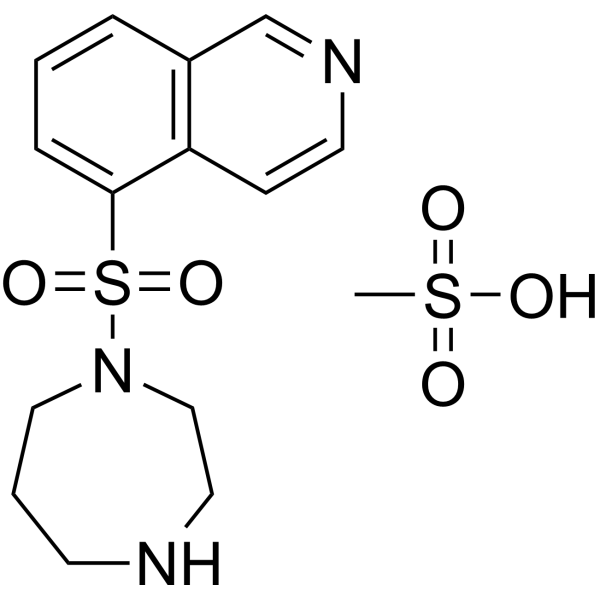
Fasudil mesylate (Fasudil mesylate; HA-1077 mesylate; AT-877 mesylate)

别名: Fasudil mesilate; fasudil mesylate; Fasudil mesilate [WHO-DD]; Fasudil (mesylate); 4S5NTB667B; UNII-4S5NTB667B; 1001206-62-7; Isoquinoline, 5-((hexahydro-1H-1,4-diazepin-1-yl)sulfonyl)-, methanesulfonate (1:1);
目录号: V86053 纯度: ≥98%
法舒地尔 (HA-1077; AT877) 甲磺酸盐是一种非特异性、口服活性的 RhoA/ROCK 抑制剂,可抑制蛋白激酶。
Fasudil mesylate (Fasudil mesylate; HA-1077 mesylate; AT-877 mesylate) CAS号: 1001206-62-7
产品类别: PKC
产品仅用于科学研究,不针对患者销售
规格 价格
500mg
1g
Other Sizes

Other Forms of Fasudil mesylate (Fasudil mesylate; HA-1077 mesylate; AT-877 mesylate):

  • 法舒地尔
  • 盐酸法舒地尔
  • 盐酸法舒地尔
  • 盐酸法舒地尔半水合物
点击了解更多
InvivoChem产品被CNS等顶刊论文引用
产品描述
法舒地尔 (HA-1077; AT877) 甲磺酸盐是一种非特异性、口服活性的 RhoA/ROCK 抑制剂,可抑制蛋白激酶。法舒地尔甲磺酸盐抑制 ROCK1 的 Ki 值为 0.33 μM,抑制 ROCK2、PKA、PKC 和 PKG 的 IC50 分别为 0.158 μM、4.58 μM、12.30 μM 和 1.650 μM。法舒地尔甲磺酸盐也是一种有效的 Ca2+ 通道拮抗剂和血管扩张剂。
生物活性&实验参考方法
靶点
Ki: 0.33 μM (ROCK1)[1] IC50: 0.158 μM (ROCK2), 4.58 μM (PKA), 12.30 μM (PKC), 1.650 μM (PKG)[1]
体外研究 (In Vitro)
Rho激酶(ROCK)在肌动蛋白细胞骨架组织中起着关键作用,并参与多种基本细胞功能,如收缩和基因表达。法舒地尔是一种ROCK抑制剂,自1995年以来在日本临床应用于治疗蛛网膜下腔出血(SAH)。越来越多的证据表明,法舒地尔对阿尔茨海默病等中枢神经系统疾病有明显的治疗作用。 涵盖领域:本文总结了法舒地尔治疗多种中枢神经系统疾病的潜在支持证据的结果。并对其类似物的性质进行了综述。 专家意见:目前针对中枢神经系统疾病的治疗只能减轻症状,不能延缓或预防疾病进展,迫切需要具有疾病修饰活性的新方法。法舒地尔在动物模型和/或中枢神经系统疾病的临床应用中的显著作用使其成为克服人类中枢神经系统疾病的有希望的策略。鉴于中枢神经系统疾病的复杂病理,需要进一步努力开发多功能法舒地尔衍生物或与其他药物的联合策略,以便在中枢神经系统疾病的治疗中发挥更强大的作用,并将不良反应降到最低[1]。
体内研究 (In Vivo)
血脑屏障(BBB)和血脊髓屏障(BSCB)功能障碍是多发性硬化症(MS)的主要特征。我们在豚鼠脊髓诱导的实验性自身免疫性脑脊髓炎(EAE)模型中评估了选择性ROCK抑制剂法舒地尔的保护作用。此外,我们还研究了法舒地尔对BBB和BSCB通透性的影响。我们发现法舒地尔通过降低BBB和BSCB的通透性,部分减轻了EAE依赖性损伤。这些结果为开发Rho激酶选择性抑制剂作为MS的新疗法提供了理论基础。https://pubmed.ncbi.nlm.nih.gov/21978848/
毒性/毒理 (Toxicokinetics/TK)
rat LD50 oral 335 mg/kg SENSE ORGANS AND SPECIAL SENSES: PTOSIS: EYE; BEHAVIORAL: TREMOR; BEHAVIORAL: CONVULSIONS OR EFFECT ON SEIZURE THRESHOLD Yakuri to Chiryo. Pharmacology and Therapeutics., 20(Suppl
rat LD50 subcutaneous 123 mg/kg SENSE ORGANS AND SPECIAL SENSES: PTOSIS: EYE; BEHAVIORAL: TREMOR; BEHAVIORAL: CONVULSIONS OR EFFECT ON SEIZURE THRESHOLD Yakuri to Chiryo. Pharmacology and Therapeutics., 20(Suppl
rat LD50 intravenous 59900 ug/kg SENSE ORGANS AND SPECIAL SENSES: PTOSIS: EYE; BEHAVIORAL: CONVULSIONS OR EFFECT ON SEIZURE THRESHOLD; GASTROINTESTINAL: CHANGES IN STRUCTURE OR FUNCTION OF SALIVARY GLANDS Yakuri to Chiryo. Pharmacology and Therapeutics., 20(Suppl
mouse LD50 oral 274 mg/kg SENSE ORGANS AND SPECIAL SENSES: PTOSIS: EYE; BEHAVIORAL: ALTERED SLEEP TIME (INCLUDING CHANGE IN RIGHTING REFLEX); BEHAVIORAL: CONVULSIONS OR EFFECT ON SEIZURE THRESHOLD Yakuri to Chiryo. Pharmacology and Therapeutics., 20(Suppl
mouse LD50 subcutaneous 124 mg/kg SENSE ORGANS AND SPECIAL SENSES: PTOSIS: EYE; BEHAVIORAL: ALTERED SLEEP TIME (INCLUDING CHANGE IN RIGHTING REFLEX); BEHAVIORAL: CONVULSIONS OR EFFECT ON SEIZURE THRESHOLD Yakuri to Chiryo. Pharmacology and Therapeutics., 20(Suppl
参考文献

[1].Fasudil and its analogs: a new powerful weapon in the long war against central nervous system disorders? Expert Opin Investig Drugs. 2013 Apr;22(4):537-50.

[2].The effects of fasudil on the permeability of the rat blood-brain barrier and blood-spinal cordbarrier following experimental autoimmune encephalomyelitis. J Neuroimmunol. 2011 Oct 28;239(1-2):61-7.

[3].Calcium sensitization of smooth muscle mediated by a Rho-associated protein kinase in hypertension. Nature. 1997 Oct 30;389(6654):990-4.

[4].Fasudil hydrochloride hydrate, a Rho-kinase (ROCK) inhibitor, suppresses collagen production and enhances collagenase activity in hepatic stellate cells. Liver Int. 2005 Aug;25(4):829-38.

[5].Inhibition of the activity of Rho-kinase reduces cardiomyocyte apoptosis in heart ischemia/reperfusion via suppressing JNK-mediated AIF translocation. Clin Chim Acta. 2009 Mar;401(1-2):76-80.

[6].The selective Rho-kinase inhibitor Fasudil is protective and therapeutic in experimental autoimmune encephalomyelitis. J Neuroimmunol. 2006 Nov;180(1-2):126-34. Epub 2006 Sep 22.

其他信息
Fasudil is an isoquinoline substituted by a (1,4-diazepan-1-yl)sulfonyl group at position 5. It is a Rho-kinase inhibitor and its hydrochloride hydrate form is approved for the treatment of cerebral vasospasm and cerebral ischemia. It has a role as a geroprotector, an EC 2.7.11.1 (non-specific serine/threonine protein kinase) inhibitor, a vasodilator agent, a nootropic agent, a neuroprotective agent, an antihypertensive agent and a calcium channel blocker. It is a N-sulfonyldiazepane and a member of isoquinolines. It is a conjugate base of a fasudil(1+).
Fasudil has been investigated in Carotid Stenosis.
Introduction: Rho kinase (ROCK) plays a critical role in actin cytoskeleton organization and is involved in diverse fundamental cellular functions such as contraction and gene expression. Fasudil, a ROCK inhibitor, has been clinically applied since 1995 for the treatment of subarachnoid hemorrhage (SAH) in Japan. Increasing evidences indicate that fasudil could exhibit markedly therapeutic effect on central nervous system (CNS) disorders, such as Alzheimer's disease. Areas covered: This article summarizes results from supporting evidence for the potential therapy for fasudil against a variety of CNS diseases. And the properties of its analogs are also summarized. Expert opinion: Current therapies against CNS disorders are only able to attenuate the symptoms and fail in delaying or preventing disease progression and new approaches with disease-modifying activity are desperately needed. The dramatic effects of fasudil in animal models and/or clinical applications of CNS disorders make it a promising strategy to overcome CNS disorders in human beings. Given the complex pathology of CNS disorders, further efforts are necessary to develop multifunctional fasudil derivatives or combination strategies with other drugs in order to exert more powerful effects with minimized adverse effects in the combat of CNS disorders. https://pubmed.ncbi.nlm.nih.gov/23461757/
Dysfunction of the blood-brain barrier (BBB) and blood-spinal cord barrier (BSCB) is a primary characteristic of multiple sclerosis (MS). We evaluated the protective effects of fasudil, a selective ROCK inhibitor, in a model of experimental autoimmune encephalomyelitis (EAE) that was induced by guinea-pig spinal cord. In addition, we studied the effects of fasudil on BBB and BSCB permeability. We found that fasudil partly alleviated EAE-dependent damage by decreasing BBB and BSCB permeability. These results provide rationale for the development of selective inhibitors of Rho kinase as a novel therapy for MS. https://pubmed.ncbi.nlm.nih.gov/21978848/
Background/aims: The Rho-ROCK signaling pathways play an important role in the activation of hepatic stellate cells (HSCs). We investigated the effects of fasudil hydrochloride hydrate (fasudil), a Rho-kinase (ROCK) inhibitor, on cell growth, collagen production, and collagenase activity in HSCs. Methods: Rat HSCs and human HSC-derived TWNT-4 cells were cultured for studies on stress fiber formation and alpha-smooth muscle actin (alpha-SMA) expression. Proliferation was measured by BrdU incorporation, and apoptosis by TUNEL assay. The phosphorylation states of the MAP kinases (MAPKs), extra cellular signal -regulated kinase 1/2 (ERK1/2), c-jun kinase (JNK), and p38 were evaluated by western blot analysis. Type I collagen, matrix metalloproteinase-1 (MMP-1) and tissue inhibitor of matrix metalloproteinase-1 (TIMP-1) production and gene expression were evaluated by ELISA and real-time PCR, respectively. Collagenase activity (active MMP-1) was also evaluated. Results: Fasudil (100 microM) inhibited cell spreading, the formation of stress fibers, and expression of alpha-SMA with concomitant suppression of cell growth, although it did not induce apoptosis. Fasudil inhibited phosphorylation of ERK1/2, JNK, and p38. Treatment with fasudil suppressed the production and transcription of collagen and TIMP, stimulated the production and transcription of MMP-1, and enhanced collagenase activity. Conclusion: These findings demonstrated that fasudil not only suppresses proliferation and collagen production but also increases collagenase activity. https://pubmed.ncbi.nlm.nih.gov/15998434/
*注: 文献方法仅供参考, InvivoChem并未独立验证这些方法的准确性
化学信息 & 存储运输条件
CAS号
1001206-62-7
相关CAS号
Fasudil;103745-39-7;Fasudil dihydrochloride; 203911-27-7; 105628-07-7 (HCl); 186694-02-0 (hydrochloride hydrate)
PubChem CID
44602745
外观&性状
Typically exists as solid at room temperature
tPSA
133Ų
氢键供体(HBD)数目
2
氢键受体(HBA)数目
8
可旋转键数目(RBC)
2
重原子数目
25
分子复杂度/Complexity
513
定义原子立体中心数目
0
InChi Key
MVCDPGYHRHUECK-UHFFFAOYSA-N
InChi Code
InChI=1S/C14H17N3O2S.CH4O3S/c18-20(19,17-9-2-6-15-8-10-17)14-4-1-3-12-11-16-7-5-13(12)14;1-5(2,3)4/h1,3-5,7,11,15H,2,6,8-10H2;1H3,(H,2,3,4)
化学名
5-(1,4-diazepan-1-ylsulfonyl)isoquinoline;methanesulfonic acid
别名
Fasudil mesilate; fasudil mesylate; Fasudil mesilate [WHO-DD]; Fasudil (mesylate); 4S5NTB667B; UNII-4S5NTB667B; 1001206-62-7; Isoquinoline, 5-((hexahydro-1H-1,4-diazepin-1-yl)sulfonyl)-, methanesulfonate (1:1);
HS Tariff Code
2934.99.9001
存储方式

Powder      -20°C    3 years

                     4°C     2 years

In solvent   -80°C    6 months

                  -20°C    1 month

运输条件
Room temperature (This product is stable at ambient temperature for a few days during ordinary shipping and time spent in Customs)
溶解度数据
溶解度 (体外实验)
Typically soluble in DMSO (e.g. 10 mM)
溶解度 (体内实验)
注意: 如下所列的是一些常用的体内动物实验溶解配方,主要用于溶解难溶或不溶于水的产品(水溶度<1 mg/mL)。 建议您先取少量样品进行尝试,如该配方可行,再根据实验需求增加样品量。

注射用配方
(IP/IV/IM/SC等)
注射用配方1: DMSO : Tween 80: Saline = 10 : 5 : 85 (如: 100 μL DMSO 50 μL Tween 80 850 μL Saline)
*生理盐水/Saline的制备:将0.9g氯化钠/NaCl溶解在100 mL ddH ₂ O中,得到澄清溶液。
注射用配方 2: DMSO : PEG300Tween 80 : Saline = 10 : 40 : 5 : 45 (如: 100 μL DMSO 400 μL PEG300 50 μL Tween 80 450 μL Saline)
注射用配方 3: DMSO : Corn oil = 10 : 90 (如: 100 μL DMSO 900 μL Corn oil)
示例: 注射用配方 3 (DMSO : Corn oil = 10 : 90) 为例说明, 如果要配制 1 mL 2.5 mg/mL的工作液, 您可以取 100 μL 25 mg/mL 澄清的 DMSO 储备液,加到 900 μL Corn oil/玉米油中, 混合均匀。
View More

注射用配方 4: DMSO : 20% SBE-β-CD in Saline = 10 : 90 [如:100 μL DMSO 900 μL (20% SBE-β-CD in Saline)]
*20% SBE-β-CD in Saline的制备(4°C,储存1周):将2g SBE-β-CD (磺丁基-β-环糊精) 溶解于10mL生理盐水中,得到澄清溶液。
注射用配方 5: 2-Hydroxypropyl-β-cyclodextrin : Saline = 50 : 50 (如: 500 μL 2-Hydroxypropyl-β-cyclodextrin (羟丙基环胡精) 500 μL Saline)
注射用配方 6: DMSO : PEG300 : Castor oil : Saline = 5 : 10 : 20 : 65 (如: 50 μL DMSO 100 μL PEG300 200 μL Castor oil 650 μL Saline)
注射用配方 7: Ethanol : Cremophor : Saline = 10: 10 : 80 (如: 100 μL Ethanol 100 μL Cremophor 800 μL Saline)
注射用配方 8: 溶解于Cremophor/Ethanol (50 : 50), 然后用生理盐水稀释。
注射用配方 9: EtOH : Corn oil = 10 : 90 (如: 100 μL EtOH 900 μL Corn oil)
注射用配方 10: EtOH : PEG300Tween 80 : Saline = 10 : 40 : 5 : 45 (如: 100 μL EtOH 400 μL PEG300 50 μL Tween 80 450 μL Saline)


口服配方
口服配方 1: 悬浮于0.5% CMC Na (羧甲基纤维素钠)
口服配方 2: 悬浮于0.5% Carboxymethyl cellulose (羧甲基纤维素)
示例: 口服配方 1 (悬浮于 0.5% CMC Na)为例说明, 如果要配制 100 mL 2.5 mg/mL 的工作液, 您可以先取0.5g CMC Na并将其溶解于100mL ddH2O中,得到0.5%CMC-Na澄清溶液;然后将250 mg待测化合物加到100 mL前述 0.5%CMC Na溶液中,得到悬浮液。
View More

口服配方 3: 溶解于 PEG400 (聚乙二醇400)
口服配方 4: 悬浮于0.2% Carboxymethyl cellulose (羧甲基纤维素)
口服配方 5: 溶解于0.25% Tween 80 and 0.5% Carboxymethyl cellulose (羧甲基纤维素)
口服配方 6: 做成粉末与食物混合


注意: 以上为较为常见方法,仅供参考, InvivoChem并未独立验证这些配方的准确性。具体溶剂的选择首先应参照文献已报道溶解方法、配方或剂型,对于某些尚未有文献报道溶解方法的化合物,需通过前期实验来确定(建议先取少量样品进行尝试),包括产品的溶解情况、梯度设置、动物的耐受性等。

请根据您的实验动物和给药方式选择适当的溶解配方/方案:
1、请先配制澄清的储备液(如:用DMSO配置50 或 100 mg/mL母液(储备液));
2、取适量母液,按从左到右的顺序依次添加助溶剂,澄清后再加入下一助溶剂。以 下列配方为例说明 (注意此配方只用于说明,并不一定代表此产品 的实际溶解配方):
10% DMSO → 40% PEG300 → 5% Tween-80 → 45% ddH2O (或 saline);
假设最终工作液的体积为 1 mL, 浓度为5 mg/mL: 取 100 μL 50 mg/mL 的澄清 DMSO 储备液加到 400 μL PEG300 中,混合均匀/澄清;向上述体系中加入50 μL Tween-80,混合均匀/澄清;然后继续加入450 μL ddH2O (或 saline)定容至 1 mL;

3、溶剂前显示的百分比是指该溶剂在最终溶液/工作液中的体积所占比例;
4、 如产品在配制过程中出现沉淀/析出,可通过加热(≤50℃)或超声的方式助溶;
5、为保证最佳实验结果,工作液请现配现用!
6、如不确定怎么将母液配置成体内动物实验的工作液,请查看说明书或联系我们;
7、 以上所有助溶剂都可在 Invivochem.cn网站购买。
计算器

摩尔浓度计算器可计算特定溶液所需的质量、体积/浓度,具体如下:

  • 计算制备已知体积和浓度的溶液所需的化合物的质量
  • 计算将已知质量的化合物溶解到所需浓度所需的溶液体积
  • 计算特定体积中已知质量的化合物产生的溶液的浓度
使用摩尔浓度计算器计算摩尔浓度的示例如下所示:
假如化合物的分子量为350.26 g/mol,在5mL DMSO中制备10mM储备液所需的化合物的质量是多少?
  • 在分子量(MW)框中输入350.26
  • 在“浓度”框中输入10,然后选择正确的单位(mM)
  • 在“体积”框中输入5,然后选择正确的单位(mL)
  • 单击“计算”按钮
  • 答案17.513 mg出现在“质量”框中。以类似的方式,您可以计算体积和浓度。

稀释计算器可计算如何稀释已知浓度的储备液。例如,可以输入C1、C2和V2来计算V1,具体如下:

制备25毫升25μM溶液需要多少体积的10 mM储备溶液?
使用方程式C1V1=C2V2,其中C1=10mM,C2=25μM,V2=25 ml,V1未知:
  • 在C1框中输入10,然后选择正确的单位(mM)
  • 在C2框中输入25,然后选择正确的单位(μM)
  • 在V2框中输入25,然后选择正确的单位(mL)
  • 单击“计算”按钮
  • 答案62.5μL(0.1 ml)出现在V1框中
g/mol

分子量计算器可计算化合物的分子量 (摩尔质量)和元素组成,具体如下:

注:化学分子式大小写敏感:C12H18N3O4  c12h18n3o4
计算化合物摩尔质量(分子量)的说明:
  • 要计算化合物的分子量 (摩尔质量),请输入化学/分子式,然后单击“计算”按钮。
分子质量、分子量、摩尔质量和摩尔量的定义:
  • 分子质量(或分子量)是一种物质的一个分子的质量,用统一的原子质量单位(u)表示。(1u等于碳-12中一个原子质量的1/12)
  • 摩尔质量(摩尔重量)是一摩尔物质的质量,以g/mol表示。
/

配液计算器可计算将特定质量的产品配成特定浓度所需的溶剂体积 (配液体积)

  • 输入试剂的质量、所需的配液浓度以及正确的单位
  • 单击“计算”按钮
  • 答案显示在体积框中
动物体内实验配方计算器(澄清溶液)
第一步:请输入基本实验信息(考虑到实验过程中的损耗,建议多配一只动物的药量)
第二步:请输入动物体内配方组成(配方适用于不溶/难溶于水的化合物),不同的产品和批次配方组成不同,如对配方有疑问,可先联系我们提供正确的体内实验配方。此外,请注意这只是一个配方计算器,而不是特定产品的确切配方。
+
+
+

计算结果:

工作液浓度 mg/mL;

DMSO母液配制方法 mg 药物溶于 μL DMSO溶液(母液浓度 mg/mL)。如该浓度超过该批次药物DMSO溶解度,请首先与我们联系。

体内配方配制方法μL DMSO母液,加入 μL PEG300,混匀澄清后加入μL Tween 80,混匀澄清后加入 μL ddH2O,混匀澄清。

(1) 请确保溶液澄清之后,再加入下一种溶剂 (助溶剂) 。可利用涡旋、超声或水浴加热等方法助溶;
            (2) 一定要按顺序加入溶剂 (助溶剂) 。

临床试验信息
Rho Kinase Inhibitor in Amyotrophic Lateral Sclerosis (REAL)
CTID: NCT05218668
Phase: Phase 2
Status: Recruiting
Date: 2024-07-18
Fasudil Trial for Treatment of Early Alzheimer's Disease (FEAD)
CTID: NCT06362707
Phase: Phase 2
Status: Not yet recruiting
Date: 2024-04-15
Inhibition of Rho Kinase (ROCK) With Fasudil as Disease-modifying Treatment for ALS
CTID: NCT03792490
Phase: Phase 2
Status: Completed
Date: 2023-11-30
Fasudil fOr redUcing elopemeNt and Spatial Disorientation
CTID: NCT04793659
Phase: Phase 2
Status: Completed
Date: 2022-07-11
Rho Kinase (ROCK) Inhibitor in Tauopathies - 1
CTID: NCT04734379
Phase: Phase 2
Status: Unknown status
Date: 2022-06-03
相关产品
联系我们