| 规格 | 价格 | 库存 | 数量 |
|---|---|---|---|
| 5mg |
|
||
| 10mg |
|
||
| 25mg |
|
||
| 50mg |
|
||
| 100mg |
|
||
| 250mg |
|
||
| 500mg |
|
||
| Other Sizes |
|
| 靶点 |
Induces human/rat Heat Shock Protein 70 (HSP70) expression (no direct binding target; exerts effects via inducing HSP70 transcription/translation) [1]
|
|---|---|
| 体外研究 (In Vitro) |
TRC051384 在 HeLa 和大鼠原代混合神经元中,剂量依赖性地使 HSP70B mRNA 增加数百倍。 TRC051384 治疗导致荧光素酶活性恢复,HSF1 转录活性以剂量依赖性方式显着增加。在分化的 THP-1 细胞系中,TRC051384 在 6.25 μM 时可抑制 LPS 引起的 TNF-α 表达 60%,在 12.5 μM 时可抑制 90%[1]。
诱导HSP70表达:10、25、50 μM TRC051384处理原代大鼠皮质神经元24小时,HSP70蛋白表达量分别增加约2.0倍、3.5倍、5.0倍(western blot检测)[1] - 保护缺氧缺糖(OGD)诱导的神经元损伤:25 μM TRC051384预处理神经元24小时,经4小时OGD处理后复氧24小时,神经元存活率从对照组的35%提升至68%(LDH释放法检测)[1] - 减少神经元凋亡:50 μM TRC051384处理后,OGD诱导的神经元凋亡率降低约55%,caspase-3活性降低约40%(比色法检测)[1] - 细胞毒性低:浓度高达100 μM时,正常原代皮质神经元存活率>90%(MTT法)[1] |
| 体内研究 (In Vivo) |
TRC051384 治疗可显着降低中风相关的神经元损伤(梗塞募集的半暗带面积减少 87%,脑水肿减少 25%)和短暂性缺血性中风大鼠模型的损伤,即使在缺血开始后 8 小时给药也是如此。当缺血发作四小时后开始使用 TRC051384 药物时,生存率显着提高(第二天为 50%,第七天为 67.3%)。 TRC051384 对 HSP70 的诱导包括 HSF1 激活,并导致伴侣和抗炎活性增强 [1]。
减轻大鼠大脑中动脉阻塞(MCAO)诱导的脑损伤:MCAO梗死后6小时腹腔注射TRC051384(10、30 mg/kg),24小时后脑梗死体积分别减少约30%和55%(TTC染色法)[1] - 改善神经功能缺损:30 mg/kg剂量使MCAO大鼠神经功能评分(0-5分制,0分为正常,5分为重度偏瘫)从3.8分降至1.6分,运动协调能力和平衡能力显著改善(旋转棒实验、胶带去除实验)[1] - 诱导脑组织HSP70表达:30 mg/kg给药后24小时,大鼠缺血侧大脑皮质HSP70蛋白表达增加约4.2倍(免疫组织化学和western blot检测)[1] - 延迟干预仍有效:MCAO梗死后12小时给药(30 mg/kg),脑梗死体积仍减少约40%,显示出较宽的治疗时间窗口[1] |
| 细胞实验 |
原代皮质神经元培养与OGD模型建立:分离大鼠胚胎皮质神经元,接种于96孔板或6孔板,培养7天。OGD处理前24小时,加入系列浓度TRC051384(1-100 μM)预处理。OGD处理时,更换为无糖Earle's液,置于低氧培养箱(1% O2、5% CO2、94% N2)孵育4小时,随后换用正常培养基复氧24小时[1]
- HSP70表达检测:复氧后收集细胞,提取总蛋白,western blot法检测HSP70蛋白水平,以β-actin为内参,量化相对表达量[1] - 神经元存活率检测:96孔板培养的神经元复氧后加入LDH检测试剂,测定培养基中LDH活性计算存活率;或采用MTT法检测细胞内甲臜结晶吸光度值[1] - 凋亡指标检测:收集6孔板培养的细胞,提取蛋白后用caspase-3活性检测试剂盒(比色法)测定酶活性,或通过Annexin V-FITC/PI双染色流式细胞术检测凋亡率[1] |
| 动物实验 |
大鼠MCAO实验性脑卒中模型:采用腔内丝线法对雄性Sprague-Dawley大鼠(250-300 g)进行大脑中动脉闭塞,建立缺血性脑卒中模型。术后通过神经功能缺损评分(0-5分制)确认造模成功[1]
- 给药方案:造模后6或12小时,将大鼠随机分为溶剂组和TRC051384治疗组(10、30 mg/kg)。药物溶于5% DMSO + 95%生理盐水,单次腹腔注射给药[1] - 检测指标:给药后24小时,麻醉大鼠并断头取脑组织。将脑组织切成2 mm厚的冠状切片进行TTC染色,并使用ImageJ软件分析梗死体积。评估了神经功能(转棒试验:记录大鼠在旋转杆上停留的时间;粘性去除试验:记录大鼠从前肢去除粘性物质所需的时间)。部分脑组织用于蛋白质提取或石蜡切片,并通过蛋白质印迹法和免疫组织化学法检测HSP70的表达[1] |
| 毒性/毒理 (Toxicokinetics/TK) |
急性毒性:单次腹腔注射剂量高达 100 mg/kg 的 TRC051384 后 24 小时内,大鼠未观察到死亡或明显的行为异常(例如共济失调、嗜睡、厌食)[1]
- 无显著器官毒性:30 mg/kg 给药 24 小时后,大鼠肝肾功能指标(ALT、AST、肌酐、尿素氮)与对照组相比无显著差异,肝、肾、脾脏的组织病理学检查未见炎症或损伤[1] - 体外细胞毒性低:浓度 ≤100 μM 时,正常原代皮层神经元存活率 >90%,未见明显的细胞损伤[1] |
| 参考文献 | |
| 其他信息 |
TRC051384是一种小分子HSP70诱导剂,专为实验性缺血性卒中的延迟干预而开发[1]
- 核心作用机制:诱导神经元中HSP70的表达,增强细胞对缺血缺氧损伤的耐受性,减少神经元凋亡和坏死,从而减轻脑梗死损伤并改善神经功能[1] - 主要优势:具有较宽的治疗时间窗,即使在卒中后6-12小时给药也能有效减少梗死体积,为临床卒中患者的延迟治疗提供了可能[1] - 潜在治疗应用:治疗缺血性卒中,尤其适用于无法及时接受溶栓治疗的患者[1] - 研究局限性:其疗效和安全性仅在大鼠MCAO模型中得到验证,需要在更高级的动物模型或临床试验中进行进一步评估[1] |
| 分子式 |
C25H31N5O4
|
|---|---|
| 分子量 |
465.54474568367
|
| 精确质量 |
501.214
|
| 元素分析 |
C, 64.50; H, 6.71; N, 15.04; O, 13.75
|
| CAS号 |
1333327-56-2
|
| 相关CAS号 |
TRC051384;867164-40-7
|
| PubChem CID |
132350867
|
| 外观&性状 |
Light yellow to yellow solid powder
|
| tPSA |
96
|
| 氢键供体(HBD)数目 |
3
|
| 氢键受体(HBA)数目 |
7
|
| 可旋转键数目(RBC) |
8
|
| 重原子数目 |
35
|
| 分子复杂度/Complexity |
670
|
| 定义原子立体中心数目 |
0
|
| SMILES |
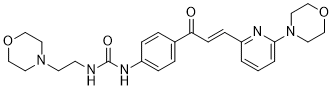
O1CCN(CCNC(NC2C=CC(C(/C=C/C3=CC=CC(=N3)N3CCOCC3)=O)=CC=2)=O)CC1
|
| InChi Key |
BCOFJDCZCSLJAM-HRNDJLQDSA-N
|
| InChi Code |
InChI=1S/C25H31N5O4.ClH/c31-23(9-8-21-2-1-3-24(27-21)30-14-18-34-19-15-30)20-4-6-22(7-5-20)28-25(32)26-10-11-29-12-16-33-17-13-29;/h1-9H,10-19H2,(H2,26,28,32);1H/b9-8+;
|
| 化学名 |
1-(2-morpholin-4-ylethyl)-3-[4-[(E)-3-(6-morpholin-4-ylpyridin-2-yl)prop-2-enoyl]phenyl]urea;hydrochloride
|
| 别名 |
TRC051384; TRC 051384; TRC-051384.
|
| HS Tariff Code |
2934.99.9001
|
| 存储方式 |
Powder -20°C 3 years 4°C 2 years In solvent -80°C 6 months -20°C 1 month |
| 运输条件 |
Room temperature (This product is stable at ambient temperature for a few days during ordinary shipping and time spent in Customs)
|
| 溶解度 (体外实验) |
May dissolve in DMSO (in most cases), if not, try other solvents such as H2O, Ethanol, or DMF with a minute amount of products to avoid loss of samples
|
|---|---|
| 溶解度 (体内实验) |
注意: 如下所列的是一些常用的体内动物实验溶解配方,主要用于溶解难溶或不溶于水的产品(水溶度<1 mg/mL)。 建议您先取少量样品进行尝试,如该配方可行,再根据实验需求增加样品量。
注射用配方
注射用配方1: DMSO : Tween 80: Saline = 10 : 5 : 85 (如: 100 μL DMSO → 50 μL Tween 80 → 850 μL Saline)(IP/IV/IM/SC等) *生理盐水/Saline的制备:将0.9g氯化钠/NaCl溶解在100 mL ddH ₂ O中,得到澄清溶液。 注射用配方 2: DMSO : PEG300 :Tween 80 : Saline = 10 : 40 : 5 : 45 (如: 100 μL DMSO → 400 μL PEG300 → 50 μL Tween 80 → 450 μL Saline) 注射用配方 3: DMSO : Corn oil = 10 : 90 (如: 100 μL DMSO → 900 μL Corn oil) 示例: 以注射用配方 3 (DMSO : Corn oil = 10 : 90) 为例说明, 如果要配制 1 mL 2.5 mg/mL的工作液, 您可以取 100 μL 25 mg/mL 澄清的 DMSO 储备液,加到 900 μL Corn oil/玉米油中, 混合均匀。 View More
注射用配方 4: DMSO : 20% SBE-β-CD in Saline = 10 : 90 [如:100 μL DMSO → 900 μL (20% SBE-β-CD in Saline)] 口服配方
口服配方 1: 悬浮于0.5% CMC Na (羧甲基纤维素钠) 口服配方 2: 悬浮于0.5% Carboxymethyl cellulose (羧甲基纤维素) 示例: 以口服配方 1 (悬浮于 0.5% CMC Na)为例说明, 如果要配制 100 mL 2.5 mg/mL 的工作液, 您可以先取0.5g CMC Na并将其溶解于100mL ddH2O中,得到0.5%CMC-Na澄清溶液;然后将250 mg待测化合物加到100 mL前述 0.5%CMC Na溶液中,得到悬浮液。 View More
口服配方 3: 溶解于 PEG400 (聚乙二醇400) 请根据您的实验动物和给药方式选择适当的溶解配方/方案: 1、请先配制澄清的储备液(如:用DMSO配置50 或 100 mg/mL母液(储备液)); 2、取适量母液,按从左到右的顺序依次添加助溶剂,澄清后再加入下一助溶剂。以 下列配方为例说明 (注意此配方只用于说明,并不一定代表此产品 的实际溶解配方): 10% DMSO → 40% PEG300 → 5% Tween-80 → 45% ddH2O (或 saline); 假设最终工作液的体积为 1 mL, 浓度为5 mg/mL: 取 100 μL 50 mg/mL 的澄清 DMSO 储备液加到 400 μL PEG300 中,混合均匀/澄清;向上述体系中加入50 μL Tween-80,混合均匀/澄清;然后继续加入450 μL ddH2O (或 saline)定容至 1 mL; 3、溶剂前显示的百分比是指该溶剂在最终溶液/工作液中的体积所占比例; 4、 如产品在配制过程中出现沉淀/析出,可通过加热(≤50℃)或超声的方式助溶; 5、为保证最佳实验结果,工作液请现配现用! 6、如不确定怎么将母液配置成体内动物实验的工作液,请查看说明书或联系我们; 7、 以上所有助溶剂都可在 Invivochem.cn网站购买。 |
| 制备储备液 | 1 mg | 5 mg | 10 mg | |
| 1 mM | 2.1480 mL | 10.7402 mL | 21.4804 mL | |
| 5 mM | 0.4296 mL | 2.1480 mL | 4.2961 mL | |
| 10 mM | 0.2148 mL | 1.0740 mL | 2.1480 mL |
1、根据实验需要选择合适的溶剂配制储备液 (母液):对于大多数产品,InvivoChem推荐用DMSO配置母液 (比如:5、10、20mM或者10、20、50 mg/mL浓度),个别水溶性高的产品可直接溶于水。产品在DMSO 、水或其他溶剂中的具体溶解度详见上”溶解度 (体外)”部分;
2、如果您找不到您想要的溶解度信息,或者很难将产品溶解在溶液中,请联系我们;
3、建议使用下列计算器进行相关计算(摩尔浓度计算器、稀释计算器、分子量计算器、重组计算器等);
4、母液配好之后,将其分装到常规用量,并储存在-20°C或-80°C,尽量减少反复冻融循环。
计算结果:
工作液浓度: mg/mL;
DMSO母液配制方法: mg 药物溶于 μL DMSO溶液(母液浓度 mg/mL)。如该浓度超过该批次药物DMSO溶解度,请首先与我们联系。
体内配方配制方法:取 μL DMSO母液,加入 μL PEG300,混匀澄清后加入μL Tween 80,混匀澄清后加入 μL ddH2O,混匀澄清。
(1) 请确保溶液澄清之后,再加入下一种溶剂 (助溶剂) 。可利用涡旋、超声或水浴加热等方法助溶;
(2) 一定要按顺序加入溶剂 (助溶剂) 。
InvivoChem的所有产品仅用于作科学研究,不面向患者销售
Copyright 2020 InvivoChem LLC | All Rights Reserved 粤ICP备20063088号-1


 COA
COA
 粤公网安备 44011102003439号
 463611831
