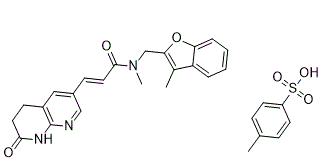
| 规格 | 价格 | |
|---|---|---|
| 500mg | ||
| 1g | ||
| Other Sizes |

| 靶点 |
FabI/enoyl-acyl carrier protein reductase
|
|---|---|
| 体外研究 (In Vitro) |
AFN-1252是烯酰基载体蛋白还原酶(FabI)的强效抑制剂,在浓度<=0.12微克/毫升时,抑制了所有测试的金黄色葡萄球菌(n=502)和表皮葡萄球菌(t=51)的临床分离株,包括耐甲氧西林(甲氧西林)的分离株。相比之下,AFN-1251对肺炎链球菌、β-溶血性链球菌、肠球菌属、肠杆菌科、非发酵革兰氏阴性杆菌和卡他莫拉菌的临床分离物没有活性(MIC(90)>4微克/毫升)。这些数据支持AFN-1252继续开发用于治疗耐药葡萄球菌感染患者[1]。
|
| 体内研究 (In Vivo) |
类鼻疽是一种热带细菌感染,由革兰阴性菌假鼻疽伯克氏菌(B.pseudomallei;Bpm)引起。目前的治疗选择主要限于甲氧苄啶-磺胺甲恶唑和β-内酰胺类药物,治疗时间约为4个月。此外,有报道称对这些药物有耐药性。因此,迫切需要开发新的类鼻疽抗生素。抑制脂肪酸生物合成途径中的关键酶烯酰基ACP还原酶(FabI)在抗菌药物开发方面显示出巨大的前景。FabI已被确定为假鼻疽杆菌中存在的主要烯酰基ACP还原酶。在这项研究中,我们评估了目前正在临床开发的金黄色葡萄球菌FabI抑制剂AFN-1252与BpmFabI酶结合并抑制拟鼻疽杆菌生长的潜力。AFN-1252稳定了BpmFabI并抑制了酶活性,IC50为9.6 nM。它对从类鼻疽患者中分离出的拟鼻疽杆菌R15菌株显示出良好的抗菌活性(MIC为2.35mg/L)。以2.3Å的分辨率确定了含有AFN-1252的BpmFabI的X射线结构。BpmFabI与AFN-1252的复合物形成了一个对称的四聚体结构,每个单体亚基上都结合有一个AFN-125二分子。动力学和热熔融研究支持了AFN-1252可以独立于辅因子与BpmFabI结合的发现。这些研究的结构和机理见解可能有助于新FabI抑制剂的合理设计和开发[2]。
|
| 酶活实验 |
AFN-1252的BpmFabI酶抑制试验[2]
AFN-1252是使用已发表的合成方案在内部合成的。38通过监测辅因子NADH.33的氧化,在分光光度测定中评估了AFN-1252中抑制BpmFabI的效力。用于测定的缓冲液为30 mM PIPES,pH 6.8,含有150 mM NaCl和1 mM EDTA。试验中使用了175 nM BpmFabI酶。米氏常数(Km)和Kcat是根据巴豆酰辅酶A浓度增加时的酶活性确定的。Km(257µM)和Kcat(307分钟-1)的值略高于报告的值(分别为188µM和215分钟-1)。为了测定IC50,将AFN-1252与BpmFabI预孵育30分钟,并通过加入含有巴豆酰辅酶A(300µM)和NADH(375µM)的底物混合物开始反应。通过跟踪340nm处吸光度的降低来监测NADH的氧化。IC50值是通过使用Graphpad Prism软件V4将剂量反应数据拟合到S形剂量反应(可变斜率)曲线来确定的。为了确定结合机制,在不同浓度的抑制剂下进行了动力学研究,并在固定浓度的巴豆酰辅酶a(300µM)下改变NADH的浓度,同时通过改变巴豆酰CoA的浓度将NADH浓度固定在375µM。随后生成Lineweaver–Burk图,以确定AFN-1252与BpmFabI结合的机制。
|
| 细胞实验 |
使用Wiegand等人描述的微量稀释技术进行最低抑菌浓度(MIC)测定,并进行了一些修改。39在脑心输注肉汤(BHIB)中制备化合物的两倍连续稀释液,并将其分配到96孔板中。将1×10⁸cfu/mL的BpR15接种物加入每个孔中,在37°C下孵育24小时。同时制备生长对照(仅细菌接种物)、无菌对照(仅肉汤)和阳性对照(含三氯生的细菌接种)孔并孵育。记录了MIC,定义为抑制BpR15可见生长的AFN-1252的最低浓度。MIC结果为n=2[2]的平均值。
|
| 动物实验 |
伯克霍尔德氏菌R15株(以下简称BpR15)分离自马来西亚吉隆坡医院一名死于类鼻疽的患者。40 BpR15常规在37℃的Ashdown琼脂培养基上培养,并在BHIB培养基中制备过夜细菌培养物。AFN-1252溶解于二甲基亚砜(DMSO)中,并储存于-20℃直至使用。[2]
|
| 参考文献 |
[5]. Yao J,\nEricson ME, Frank MW, Rock CO. Enoyl-Acyl Carrier Protein Reductase I\n(FabI) is Essential for the Intracellular Growth of Listeria\nmonocytogenes. Infect Immun. 2016 Oct 10. pii: IAI.00647-16. PubMed\nPMID: 27736774. |
| 其他信息 |
AFN-1252 是一种强效抗金黄色葡萄球菌抗生素,其靶点为烯酰-酰基载体蛋白还原酶 (FabI)。为了鉴定获得性耐药机制,我们对 AFN-1252 耐药菌株进行了全面筛选。我们分离到 49 个预测编码 FabI(M99T) 的 fabI 错义突变株,并分离到一个预测编码 FabI(Y147H) 的菌株。AFN-1252 仅与 FabI 的 NADPH 形式结合,该药物与 Met-99 和 Tyr-147 之间的紧密相互作用解释了这些突变如何导致耐药酶的产生。表达 FabI(Y147H) 的克隆株表现出明显的生长缺陷,但可通过外源补充脂肪酸来挽救,且纯化的 FabI(Y147H) 蛋白的酶活性低于 FabI 的 5%。 FabI(Y147F) 也存在催化缺陷,但仍对 AFN-1252 敏感,这表明保守的 Tyr-147 羟基在 FabI 功能中至关重要。表达 FabI(M99T) 的菌株生长正常,且纯化蛋白的生化特性与 FabI 无异。AFN-1252 的 Ki(app) 值从 FabI 的 4 nM 增加到 FabI(M99T) 的 69 nM,这解释了相应突变株抗性的增强。FabI(Y147H) 的活性较低,无法准确测定 Ki 值。表达 FabI(Y147H) 的菌株也对三氯生具有抗性;然而,表达 FabI(M99T) 的菌株则更易感。未获得具有更高 AFN-1252 抗性的菌株。 AFN-1252耐药菌株仍对亚微摩尔浓度的AFN-1252敏感,AFN-1252通过抑制FabI步骤的脂肪酸生物合成来阻断其生长。[3]
本研究探讨了用II型脂肪酸合成抑制剂AFN-1252处理后金黄色葡萄球菌基因表达的变化。Affymetrix芯片分析显示,在指数生长期细胞中,AFN-1252迅速增加脂肪酸合成基因的表达,并抑制由SaeRS双组分调控因子控制的毒力基因的表达。在saeR缺失菌株或表达组成型活性SaeS激酶的Newman菌株中,AFN-1252不改变毒力mRNA水平。AFN-1252导致进入稳定期细胞中fabH mRNA水平显著升高,而对毒力因子转录的抑制作用减弱。本研究采用小鼠皮下肉芽肿感染模型,测定了AFN-1252对体内基因表达的影响。结果表明,AFN-1252具有治疗效果,且在袋液中的暴露量(0~48 h浓度-时间曲线下面积[AUC(0-48)])与口服给药动物的血浆浓度相当。AFN-1252抑制感染袋内脂肪酸的生物合成,表现为袋内相关细菌fabH mRNA水平显著且持续升高;而AFN-1252处理后袋内细菌毒力因子mRNA水平的降低并不像体外指数生长期细胞那样明显。动物体内fabH和毒力因子基因表达的趋势与体外生长较慢的细菌相似。这些数据表明,AFN-1252 对毒力因子基因表达的影响取决于细菌的生理状态。[4]烯酰-酰基载体蛋白还原酶催化 II 型细菌脂肪酸合成每个延伸循环的最后一步,是细菌脂肪酸合成的关键调控蛋白。兼性胞内病原体单核细胞增生李斯特菌的基因编码两种功能性烯酰-酰基载体蛋白亚型,这两种亚型能够互补大肠杆菌 JP1111 株的温度敏感生长表型 [fabI(Ts)]。FabI 亚型被 FabI 选择性抑制剂 AFN-1252 灭活,但正如预期的那样,FabK 亚型不受该药物的影响。AFN-1252 对 FabI 的抑制使内源性脂肪酸合成减少了 80%,并降低了单核细胞增生李斯特菌在实验室培养基中的生长速率。除非用 AFN-1252 处理部分抑制该途径,否则在单增李斯特菌中未检测到有效的外源脂肪酸掺入。然而,补充外源脂肪酸并不能在 AFN-1252 存在的情况下恢复其正常生长。FabI 失活阻止了单增李斯特菌的胞内生长,表明 FabK 或宿主细胞脂肪酸的掺入均不足以支持单增李斯特菌的胞内生长。我们的结果表明,FabI 是 II 型细菌脂肪酸合成的主要烯酰-酰基载体蛋白还原酶,对单增李斯特菌的胞内生长至关重要。[5] |
| 分子式 |
CC29H29N3O6S
|
|---|---|
| 分子量 |
547.622066259384
|
| 精确质量 |
547.178
|
| 元素分析 |
C, 63.61; H, 5.34; N, 7.67; O, 17.53; S, 5.85
|
| CAS号 |
1047981-31-6
|
| 相关CAS号 |
1047981-31-6;620175-39-5;1047981-30-5 (tosylate hydrate);
|
| PubChem CID |
24880177
|
| 外观&性状 |
Typically exists as solid at room temperature
|
| LogP |
6.1
|
| tPSA |
141.68
|
| 氢键供体(HBD)数目 |
2
|
| 氢键受体(HBA)数目 |
7
|
| 可旋转键数目(RBC) |
5
|
| 重原子数目 |
39
|
| 分子复杂度/Complexity |
829
|
| 定义原子立体中心数目 |
0
|
| SMILES |
S(C1C=CC(C)=CC=1)(=O)(=O)O.O1C2C=CC=CC=2C(C)=C1CN(C)C(/C=C/C1C=NC2=C(C=1)CCC(N2)=O)=O
|
| InChi Key |
NHTYVWVPSCBFQW-HCUGZAAXSA-N
|
| InChi Code |
InChI=1S/C22H21N3O3.C7H8O3S/c1-14-17-5-3-4-6-18(17)28-19(14)13-25(2)21(27)10-7-15-11-16-8-9-20(26)24-22(16)23-12-151-6-2-4-7(5-3-6)11(8,9)10/h3-7,10-12H,8-9,13H2,1-2H3,(H,23,24,26)2-5H,1H3,(H,8,9,10)/b10-7+
|
| 化学名 |
2-Propenamide,
N-methyl-N-((3-methyl-2-benzofuranyl)methyl)-3-(5,6,7,8-tetrahydro-7-oxo-1,8-naphthyridin-3-yl)-,
(2E)-, 4-methylbenzenesulfonate (1
|
| 别名 |
AFN-1252 tosylate; API-1252 tosylate; AFN-1252; Debio 1452; AFN 1252; AFN1252; AFN-12520000; API-1252; Debio-1452; AFN12520000; API1252; Debio1452; AFN-1252 tosylate; 1047981-31-6; API-1252 tosylate; UNII-VDH5PP94F0; VDH5PP94F0; 2-Propenamide, N-methyl-N-((3-methyl-2-benzofuranyl)methyl)-3-(5,6,7,8-tetrahydro-7-oxo-1,8-naphthyridin-3-yl)-, (2E)-, 4-methylbenzenesulfonate (1:1); 4-methylbenzenesulfonic acid;(E)-N-methyl-N-[(3-methyl-1-benzofuran-2-yl)methyl]-3-(7-oxo-6,8-dihydro-5H-1,8-naphthyridin-3-yl)prop-2-enamide; SCHEMBL725467;
|
| HS Tariff Code |
2934.99.9001
|
| 存储方式 |
Powder -20°C 3 years 4°C 2 years In solvent -80°C 6 months -20°C 1 month |
| 运输条件 |
Room temperature (This product is stable at ambient temperature for a few days during ordinary shipping and time spent in Customs)
|
| 溶解度 (体外实验) |
May dissolve in DMSO (in most cases), if not, try other solvents such as H2O, Ethanol, or DMF with a minute amount of products to avoid loss of samples
|
|---|---|
| 溶解度 (体内实验) |
注意: 如下所列的是一些常用的体内动物实验溶解配方,主要用于溶解难溶或不溶于水的产品(水溶度<1 mg/mL)。 建议您先取少量样品进行尝试,如该配方可行,再根据实验需求增加样品量。
注射用配方
注射用配方1: DMSO : Tween 80: Saline = 10 : 5 : 85 (如: 100 μL DMSO → 50 μL Tween 80 → 850 μL Saline)(IP/IV/IM/SC等) *生理盐水/Saline的制备:将0.9g氯化钠/NaCl溶解在100 mL ddH ₂ O中,得到澄清溶液。 注射用配方 2: DMSO : PEG300 :Tween 80 : Saline = 10 : 40 : 5 : 45 (如: 100 μL DMSO → 400 μL PEG300 → 50 μL Tween 80 → 450 μL Saline) 注射用配方 3: DMSO : Corn oil = 10 : 90 (如: 100 μL DMSO → 900 μL Corn oil) 示例: 以注射用配方 3 (DMSO : Corn oil = 10 : 90) 为例说明, 如果要配制 1 mL 2.5 mg/mL的工作液, 您可以取 100 μL 25 mg/mL 澄清的 DMSO 储备液,加到 900 μL Corn oil/玉米油中, 混合均匀。 View More
注射用配方 4: DMSO : 20% SBE-β-CD in Saline = 10 : 90 [如:100 μL DMSO → 900 μL (20% SBE-β-CD in Saline)] 口服配方
口服配方 1: 悬浮于0.5% CMC Na (羧甲基纤维素钠) 口服配方 2: 悬浮于0.5% Carboxymethyl cellulose (羧甲基纤维素) 示例: 以口服配方 1 (悬浮于 0.5% CMC Na)为例说明, 如果要配制 100 mL 2.5 mg/mL 的工作液, 您可以先取0.5g CMC Na并将其溶解于100mL ddH2O中,得到0.5%CMC-Na澄清溶液;然后将250 mg待测化合物加到100 mL前述 0.5%CMC Na溶液中,得到悬浮液。 View More
口服配方 3: 溶解于 PEG400 (聚乙二醇400) 请根据您的实验动物和给药方式选择适当的溶解配方/方案: 1、请先配制澄清的储备液(如:用DMSO配置50 或 100 mg/mL母液(储备液)); 2、取适量母液,按从左到右的顺序依次添加助溶剂,澄清后再加入下一助溶剂。以 下列配方为例说明 (注意此配方只用于说明,并不一定代表此产品 的实际溶解配方): 10% DMSO → 40% PEG300 → 5% Tween-80 → 45% ddH2O (或 saline); 假设最终工作液的体积为 1 mL, 浓度为5 mg/mL: 取 100 μL 50 mg/mL 的澄清 DMSO 储备液加到 400 μL PEG300 中,混合均匀/澄清;向上述体系中加入50 μL Tween-80,混合均匀/澄清;然后继续加入450 μL ddH2O (或 saline)定容至 1 mL; 3、溶剂前显示的百分比是指该溶剂在最终溶液/工作液中的体积所占比例; 4、 如产品在配制过程中出现沉淀/析出,可通过加热(≤50℃)或超声的方式助溶; 5、为保证最佳实验结果,工作液请现配现用! 6、如不确定怎么将母液配置成体内动物实验的工作液,请查看说明书或联系我们; 7、 以上所有助溶剂都可在 Invivochem.cn网站购买。 |
| 制备储备液 | 1 mg | 5 mg | 10 mg | |
| 1 mM | 1.8261 mL | 9.1304 mL | 18.2608 mL | |
| 5 mM | 0.3652 mL | 1.8261 mL | 3.6522 mL | |
| 10 mM | 0.1826 mL | 0.9130 mL | 1.8261 mL |
1、根据实验需要选择合适的溶剂配制储备液 (母液):对于大多数产品,InvivoChem推荐用DMSO配置母液 (比如:5、10、20mM或者10、20、50 mg/mL浓度),个别水溶性高的产品可直接溶于水。产品在DMSO 、水或其他溶剂中的具体溶解度详见上”溶解度 (体外)”部分;
2、如果您找不到您想要的溶解度信息,或者很难将产品溶解在溶液中,请联系我们;
3、建议使用下列计算器进行相关计算(摩尔浓度计算器、稀释计算器、分子量计算器、重组计算器等);
4、母液配好之后,将其分装到常规用量,并储存在-20°C或-80°C,尽量减少反复冻融循环。
计算结果:
工作液浓度: mg/mL;
DMSO母液配制方法: mg 药物溶于 μL DMSO溶液(母液浓度 mg/mL)。如该浓度超过该批次药物DMSO溶解度,请首先与我们联系。
体内配方配制方法:取 μL DMSO母液,加入 μL PEG300,混匀澄清后加入μL Tween 80,混匀澄清后加入 μL ddH2O,混匀澄清。
(1) 请确保溶液澄清之后,再加入下一种溶剂 (助溶剂) 。可利用涡旋、超声或水浴加热等方法助溶;
(2) 一定要按顺序加入溶剂 (助溶剂) 。
InvivoChem的所有产品仅用于作科学研究,不面向患者销售
Copyright 2020 InvivoChem LLC | All Rights Reserved 粤ICP备20063088号-1


 COA
COA
 粤公网安备 44011102003439号
 463611831
