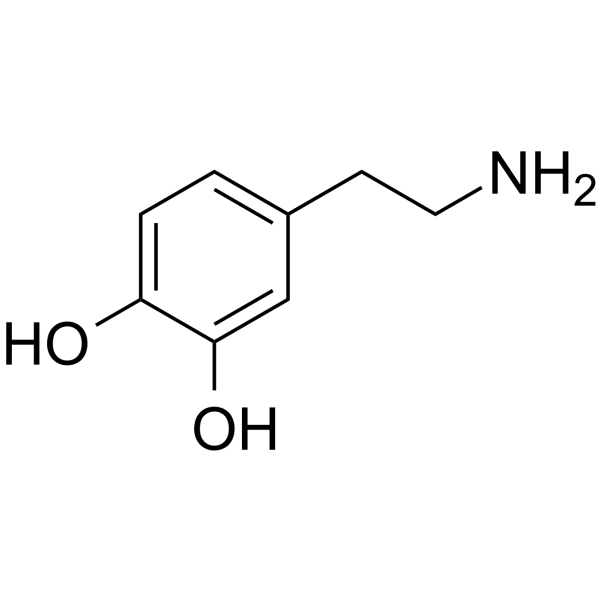
| 规格 | 价格 | 库存 | 数量 |
|---|---|---|---|
| 10mg |
|
||
| 50mg |
|
||
| 1g |
|
||
| Other Sizes |
|
| 靶点 |
The primary targets of Dopamine are dopamine receptors (D1-D5), a family of G protein-coupled receptors. It acts as an agonist at these receptors, activating downstream signaling pathways. D1-like receptors (D1, D5) are coupled to Gs proteins and stimulate adenylyl cyclase, increasing cAMP levels. D2-like receptors (D2, D3, D4) are coupled to Gi/o proteins and inhibit adenylyl cyclase, decreasing cAMP levels. Dopamine also induces endocytosis of VEGFR2 through D2 dopamine receptors, promoting angiogenesis.
|
|---|---|
| 体外研究 (In Vitro) |
人脐静脉内皮细胞 (HUVEC) 在血管通透性因子/血管内皮生长因子 (VPF/VEGF) 的刺激下增殖显著增强。一小时后,多巴胺 (1 µM) 可消除 VPF/VEGF 的刺激作用 [2]。
多巴胺是一种内源性神经递质,其“体外活性”与药物不同。然而,在基于细胞的实验中,它作为多巴胺受体的激动剂,激活下游信号通路。它通过 D2 多巴胺受体诱导 VEGFR2 的内吞作用,这对于促进血管生成至关重要。多巴胺还能调节多种离子通道和神经递质系统的活性。 |
| 体内研究 (In Vivo) |
多巴胺(50 mg/kg;腹腔注射;第1-7天)可强效且选择性地抑制血管通透性和血管内皮生长因子/血管内皮生长因子(VPF/VEGF)的血管生成活性[2]。
临床上,多巴胺用于纠正血流动力学失衡。静脉注射多巴胺可增加休克、心力衰竭及其他疾病患者的心输出量和血压。低剂量时,多巴胺作用于肾脏和肠系膜的D1受体,引起血管舒张,增加肾血流量。中高剂量时,多巴胺作用于β1肾上腺素能受体,增强心肌收缩力。高剂量时,多巴胺作用于α肾上腺素能受体,引起血管收缩。 |
| 酶活实验 |
多巴胺是一种内源性化合物,通常不作为药物在无细胞实验中进行评估。其与多巴胺受体的相互作用可通过放射性配体结合实验进行研究。将表达多巴胺受体的细胞膜制备物与放射性标记的多巴胺受体配体(例如,D2样受体使用[³H]螺哌隆)在不同浓度的多巴胺存在下孵育。通过测量放射性标记配体的置换情况来确定结合亲和力。对于功能性实验,可通过测量cAMP积累或使用[³⁵S]GTPγS结合实验来评估多巴胺受体的激活情况。
|
| 细胞实验 |
细胞增殖实验[2]
细胞类型: HUVEC 测试浓度: 1 µM 孵育时间: 24 小时 实验结果: 通过其 D2 受体特异性抑制 VPF/VEGF 诱导的 HUVEC 增殖。 细胞实验中,使用表达多巴胺受体的细胞(例如,转染 D1 或 D2 受体的 HEK293 细胞)。将细胞用不同浓度的多巴胺(通常为 0.1 nM 至 100 µM)处理一定时间。通过 ELISA 或使用 cAMP 敏感的报告基因来测量 cAMP 水平。钙动员可使用荧光染料(例如,Fluo-4)进行测量。下游靶点(例如 CREB、ERK)的磷酸化水平通过蛋白质印迹法,使用磷酸化特异性抗体进行分析。在血管生成研究中,内皮细胞(HUVECs)经多巴胺处理后,通过免疫荧光或流式细胞术评估 VEGFR2 的内吞作用。 |
| 动物实验 |
动物/疾病模型: 同基因C3Heb/FeJ小鼠,携带MOT腹水瘤[2]
剂量: 50 mg/kg 给药途径: 腹腔注射;7天 实验结果: 相当于小鼠半数致死量(LD50)的约5%,从肿瘤细胞注射后24小时开始,每日给药,持续7天。 在体内,多巴胺通过静脉注射给药于患者或动物模型。在动物研究中,多巴胺以不同剂量(通常为1-20 µg/kg/min)输注,并监测血流动力学参数(血压、心率、心输出量)。在休克或心力衰竭模型中,给予该化合物,并评估生存或恢复情况。在神经学研究中,会给患者注射多巴胺或多巴胺受体激动剂,并评估行为或神经化学参数。 |
| 药代性质 (ADME/PK) |
吸收、分布和排泄
多巴胺在小肠内迅速吸收。 据报道,约80%的药物在24小时内经尿液排出,主要以高香草酸(HVA)及其硫酸盐和葡萄糖醛酸苷结合物以及3,4-二羟基苯乙酸的形式排出。极少量以原形排出。 多巴胺常用于治疗危重新生儿的休克和心力衰竭,但其药代动力学尚未采用特定的分析方法进行评估。本研究测量了11例疑似或确诊脓毒症和低血压性休克的危重婴儿在接受多巴胺输注(5-20 μg/kg⁻¹·min⁻¹)治疗后的稳态动脉血浆多巴胺浓度。稳态多巴胺浓度范围为0.013至0.3 μg/mL。平均系统清除率为 115 mL/kg⁻¹·min⁻¹。表观分布容积和消除半衰期分别为 1.8 L/kg⁻¹ 和 6.9 min。多巴胺药代动力学与胎龄、出生后日龄或出生体重均无相关性。危重婴儿的多巴胺药代动力学存在显著的个体差异,且无法根据输注速率准确预测血浆浓度。清除率的显著差异部分解释了危重新生儿达到临床疗效所需多巴胺剂量范围较广的原因。不到 10% 的剂量以原形经尿液排出。采用高效液相色谱法 (HPLC) 测定了心脏手术或休克后恢复期儿童(3 个月至 13 岁)稳态或输注结束时的血浆多巴胺浓度。多巴胺的分布半衰期和消除半衰期分别为 1.8 ± 1.1 分钟和 26 ± 14 (SD) 分钟。表观分布容积为 2952 ± 2332 mL/kg。清除率为 454 ± 900 mL/kg·min。在同时接受多巴酚丁胺治疗的患者中,多巴胺清除率与剂量呈线性相关 (r² = 0.76,p < 0.05)。肝肾功能不影响多巴胺的药代动力学。多巴胺和多巴酚丁胺之间可能存在相互作用,影响两种药物在体内的分布。即使在血流动力学稳定的儿童中,多巴胺的药代动力学也存在个体差异。肝肾功能不影响多巴胺的药代动力学。大脑包含一个独立的神经系统,该系统利用三种不同的儿茶酚胺——多巴胺、去甲肾上腺素和肾上腺素……中枢神经系统中超过一半的儿茶酚胺是多巴胺,在特定区域浓度极高,例如基底神经节(尤其是尾状核)、伏隔核、嗅结节、中央杏仁核、正中隆起和额叶皮层。多巴胺广泛分布于全身,但难以穿过血脑屏障。新生儿体内该药物的表观分布容积为0.6–4 L/kg。目前尚不清楚多巴胺是否能通过胎盘。 代谢/代谢物 多巴胺经历快速的生物转化,主要排泄产物为3,4-二羟基苯乙酸(DOPAC)和3-甲氧基-4-羟基苯乙酸(高香草酸,HVA)。 多巴胺在肝脏中广泛代谢。……肝脏代谢产生无活性代谢物(占剂量的75%)和去甲肾上腺素(活性代谢物,占剂量的25%),后者到达肾上腺素能神经末梢。主要的清除途径似乎是儿茶酚-O-甲基转移酶催化的O-甲基化,生成3-甲氧基酪胺,后者随后通过磺化(由苄基磺酰酶催化)或脱氨(由单胺氧化酶(MAO)催化)转化为高香草酸。大约 80% 的药物在 24 小时内以高香草酸、高香草酸代谢物和去甲肾上腺素代谢物的形式经尿液排出。 N-乙酰-3,4-二羟基苯乙胺在人和大鼠体内均有产生;Hauson A, Studnitz W Von; Clinica Chim Acta 11: 384 (1965); Goldstein M, Musacchio Jm; Biochim Biophys Acta 58: 607 (1962)。3,4-二羟基-N-甲基苯乙胺在大鼠体内有产生;Laduron P; Nature New Biology 238: 212 (1972)。/摘自表格/ 大鼠体内 3,4-二羟基苯乙胺-O-β-D-葡糖醛酸苷的产生;Young Ja, Edwards Kdg; J Pharmac Exp Ther 145: 102 (1964). 人和大鼠体内3,4-二羟基苯乙醛的生成;Nagatsu T 等;Enzymologia 39: 15 (1970);Goldstein M 等;Biochim Biophys Acta 33: 572 (1959)。/表格摘录/ 大鼠体内4-羟基苯乙胺-3-基硫酸酯的生成;Jenner Wn,Rose Fa;Biochem J 135: 109 (1973)。人体体内3-甲氧基酪胺的生成;Goodall MCC,Alton A;Biochem Pharmac 17: 905 (1968)。在人体内,它产生d-去甲肾上腺素;Sjoerdsma AJ 等;J Clin Invest 38: 31 (1959)。 /表格摘录/ 有关多巴胺代谢/代谢物(共8种代谢物)的更完整数据,请访问HSDB记录页面。 已知的多巴胺人体代谢物包括多巴胺3-O-硫酸盐和多巴胺4-D-葡萄糖醛酸苷。 多巴胺是酪胺的已知人体代谢物。 多巴胺可快速生物转化,主要排泄产物为3,4-二羟基苯乙酸(DOPAC)和3-甲氧基-4-羟基苯乙酸(香草酸,HVA)。 排泄途径:据报道,约80%的药物在24小时内经尿液排出,主要以HVA及其硫酸盐和葡萄糖醛酸苷结合物以及3,4-二羟基苯乙酸的形式排出。 极少量的药物通过其他途径排出。给药途径:不变。 半衰期:2 分钟 生物半衰期2 分钟 采用高效液相色谱法 (HPLC) 测定心脏手术或休克后恢复期儿童(3 个月至 13 岁)血浆多巴胺浓度,分别在稳态或输注结束时进行测定。分布半衰期和消除半衰期分别为 1.8 ± 1.1 分钟和 26 ± 14 (SD) 分钟。 多巴胺的血浆半衰期约为 2 分钟。据报道,新生儿多巴胺的消除半衰期为 5-11 分钟。 由于单胺氧化酶 (MAO) 和儿茶酚-O-甲基转移酶 (COMT) 的快速代谢,多巴胺在循环中的半衰期非常短(约 1-2 分钟)。它以持续静脉输注的方式给药。该化合物全身给药时难以有效穿过血脑屏障,因此仅用于发挥外周作用。若要发挥中枢神经系统作用,则需使用能够穿过血脑屏障的多巴胺前体(左旋多巴)或多巴胺受体激动剂。 |
| 毒性/毒理 (Toxicokinetics/TK) |
毒性概述
多巴胺是去甲肾上腺素能神经元中去甲肾上腺素的前体,也是中枢神经系统某些区域的神经递质。多巴胺对心肌具有正性变时性和正性变力性作用,导致心率加快和心肌收缩力增强。这是通过直接刺激β-肾上腺素能受体和间接刺激交感神经末梢释放去甲肾上腺素来实现的。在大脑中,多巴胺作为五种多巴胺受体亚型(D1、D2、D3、D4 和 D5)的激动剂发挥作用。 妊娠和哺乳期影响 ◉ 哺乳期用药概述 目前尚无关于哺乳期使用多巴胺的信息。由于其口服生物利用度低且半衰期短,母乳中的多巴胺不太可能对婴儿产生影响。静脉输注多巴胺可能会减少乳汁分泌。已知多巴胺可降低非哺乳期妇女的血清催乳素水平,但尚无关于其对哺乳期妇女乳汁分泌影响的信息。 ◉ 对母乳喂养婴儿的影响 截至修订日期,未找到相关的已发表信息。 ◉ 对泌乳和母乳的影响 以 2 至 5 mcg/kg/min 的剂量静脉输注多巴胺可降低非哺乳期受试者和高催乳素血症妇女的血清催乳素浓度。然而,截至修订日期,未找到关于静脉输注多巴胺对哺乳期妇女乳汁分泌影响的相关已发表信息。对于已建立泌乳的母亲,催乳素水平可能不会影响其母乳喂养能力。 蛋白质结合 目前尚无关于蛋白质结合的信息。 毒性数据 小鼠口服LD50 = 1460 mg/kg,大鼠口服LD50 = 1780 mg/kg相互作用 呋喃唑酮抑制单胺氧化酶……如果与其他胺释放剂/多巴胺同时服用,患者可能存在发生高血压危象的风险。 ……目前正在服用或近期服用过胍乙啶的患者,对苯肾上腺素和其他主要直接作用的α-肾上腺素能拟交感神经胺(例如多巴胺……)的药理反应可能会增强。 对脑多巴胺的影响:在大鼠代谢研究中,氯丙嗪、硫利达嗪和噻虫嗪呈剂量依赖性地增加脑内3,4-二羟基苯乙酸的浓度,并且该浓度与抗精神病疗效相关。地普拉尼酮的给药可抑制大脑中多巴胺的代谢降解。有关多巴胺相互作用的更完整数据(共12种),请访问HSDB记录页面。 非人类毒性值 大鼠腹腔注射LD50:163 mg/kg 小鼠腹腔注射LD50:950 mg/kg 小鼠静脉注射LD50:59 mg/kg 小鼠腹腔注射LD50:74 mg/kg 犬静脉注射LD50:79 mg/kg 多巴胺是一种强效血管活性药物,可引起显著的心血管效应。常见副作用包括心动过速、心律失常、高血压或低血压,以及高剂量下的外周缺血。外渗可导致局部组织坏死。对于患有心律失常、嗜铬细胞瘤或未纠正的低血容量的患者,应谨慎使用该化合物。对该化合物过敏的患者或患有快速性心律失常或室颤的患者禁用多巴胺。 |
| 参考文献 | |
| 其他信息 |
治疗用途
正性肌力药物 在心肺复苏 (CPR) 期间,多巴胺也用于高级心血管生命支持 (ACLS) 中,以增加心输出量和血压。对于阿托品无效的症状性心动过缓,可考虑使用多巴胺作为临时措施,例如在等待起搏器可用或起搏无效时。在复苏过程中,多巴胺治疗常用于控制低血压,尤其是在出现症状性心动过缓或自主循环恢复后。多巴胺与其他药物(例如多巴酚丁胺)联合使用也可能是复苏后低血压的有效治疗选择。如果在充盈压(即血管内容量)优化后低血压仍然存在,则可以使用具有正性肌力作用和血管加压作用的药物(例如肾上腺素、去甲肾上腺素)。一些动物研究证据表明,在心肺复苏期间,肾上腺素在改善血流动力学方面可能比多巴胺更有效。此外,对于严重心动过缓和低血压的患者,肾上腺素通常是首选药物,因为此时可能即将发生无脉性电活动甚至心脏骤停。/美国产品标签内容/ 多巴胺的净血流动力学效应使其在治疗心源性休克(包括急性心肌梗死相关的休克)或对其他血管加压药无反应的少尿性休克方面尤为有效。一些专家指出,多巴胺可用于治疗药物引起的低血容量性休克,并且当患者对液体复苏无反应且需要正性肌力药物和/或血管加压药物支持时,多巴胺通常是推荐的初始治疗方案。对于急性心肌梗死后出现左心室衰竭的患者,如果在降低后负荷期间动脉血压急剧下降,可联合使用多巴胺作为辅助药物(以进一步增加心输出量并维持血压),并可与血管扩张剂(如硝普钠)联用;对于较小的血压下降,首选多巴酚丁胺,但对于严重低血压患者,不应单独使用。对于急性心肌梗死后出现低血压性心源性休克的患者,一旦全身动脉压升至至少 80 mmHg,多巴胺可替代去甲肾上腺素使用。一旦动脉血压稳定在至少 90 mmHg,可联合使用多巴酚丁胺和多巴胺,以减少这些患者所需的多巴胺剂量。多巴胺也曾用于在主动脉内球囊反搏(IACP)治疗期间支持心输出量和维持动脉血压(例如,用于急性心肌梗死后低血压性心源性休克患者)。研究表明,在心脏直视手术后低心输出量综合征中使用多巴胺可以改善长期生存率。然而,由于多巴酚丁胺在较宽的剂量范围内均可降低外周阻力,其作用不依赖于内源性儿茶酚胺的释放,且具有心脏选择性,因此在体外循环手术后立即使用可能更为理想。/美国产品标签内容/ 多巴胺用于增加心输出量、血压和尿量,作为辅助治疗,用于治疗尽管进行了充分的液体复苏但仍持续存在的休克以及全身血管阻力降低的情况。/美国产品标签内容/ 有关多巴胺(12种类型)治疗用途的更完整数据,请访问HSDB记录页面。 药物警告 缺血性心脏病患者应谨慎使用多巴胺。嗜铬细胞瘤、未纠正的心动过速或室颤患者禁用此药。 市售盐酸多巴胺制剂可能含有亚硫酸盐,某些易感人群可能会发生过敏反应,包括过敏性休克和危及生命或轻微的哮喘发作。亚硫酸盐过敏在普通人群中的总体患病率尚不清楚,但可能较低;这种过敏在哮喘患者中似乎比非哮喘患者更常见。 应避免药物外渗。多巴胺应通过长静脉导管注入较大的静脉,最好是肘窝静脉,而不是手部或踝部静脉。有生产商指出,不建议通过脐动脉导管给药。如果无法选择较大的静脉,且患者病情需要经手部或踝部静脉给药,则应尽快更换注射部位至较大的静脉。注射部位应密切监测。 有闭塞性血管疾病史(例如动脉粥样硬化、动脉栓塞、雷诺氏病、冻伤、糖尿病性动脉内膜炎或血栓闭塞性脉管炎)的患者在多巴胺治疗期间应密切监测肢体循环下降情况,表现为皮肤颜色或温度变化或肢体疼痛。如果出现这些情况,可通过降低输注速度或停用多巴胺来纠正。然而,这些变化有时会在停用多巴胺后持续存在并加重。应权衡继续使用多巴胺的潜在获益与坏死的潜在风险。 有关多巴胺的更完整数据(共13项),请访问HSDB记录页面。 药效学 多巴胺是一种天然儿茶酚胺,由3,4-二羟基苯丙氨酸(DOPA)脱羧形成。它是去甲肾上腺素能神经中去甲肾上腺素的前体,也是中枢神经系统某些区域(尤其是黑质纹状体)和少数外周交感神经中的神经递质。多巴胺对心肌具有正性变时性和正性变力性作用,从而增加心率和心肌收缩力。这直接通过其对β-肾上腺素能受体的激动作用实现,也间接通过交感神经末梢释放去甲肾上腺素实现。 多巴胺是一种临床批准的药物,用于治疗血流动力学失衡,包括休克、心力衰竭和急性肾损伤。它以注射液的形式提供,用于静脉给药。多巴胺是大脑中一种重要的神经递质,在调节运动、动机、奖赏和认知方面发挥着关键作用。多巴胺能系统的功能障碍与多种神经和精神疾病有关,包括帕金森病、精神分裂症和成瘾。多巴胺及其受体是这些疾病药物研发的主要靶点。 |
| 分子式 |
C8H11NO2
|
|---|---|
| 分子量 |
153.17844
|
| 精确质量 |
153.078
|
| CAS号 |
51-61-6
|
| 相关CAS号 |
Dopamine hydrochloride;62-31-7
|
| PubChem CID |
681
|
| 外观&性状 |
Light yellow to light brown solid powder
|
| 密度 |
1.2±0.1 g/cm3
|
| 沸点 |
337.7±27.0 °C at 760 mmHg
|
| 熔点 |
128 °C
|
| 闪点 |
158.0±23.7 °C
|
| 蒸汽压 |
0.0±0.8 mmHg at 25°C
|
| 折射率 |
1.619
|
| LogP |
0.12
|
| tPSA |
66.48
|
| 氢键供体(HBD)数目 |
3
|
| 氢键受体(HBA)数目 |
3
|
| 可旋转键数目(RBC) |
2
|
| 重原子数目 |
11
|
| 分子复杂度/Complexity |
119
|
| 定义原子立体中心数目 |
0
|
| SMILES |
C1=CC(=C(C=C1CCN)O)O
|
| InChi Key |
VYFYYTLLBUKUHU-UHFFFAOYSA-N
|
| InChi Code |
InChI=1S/C8H11NO2/c9-4-3-6-1-2-7(10)8(11)5-6/h1-2,5,10-11H,3-4,9H2
|
| 化学名 |
4-(2-aminoethyl)benzene-1,2-diol
|
| HS Tariff Code |
2934.99.9001
|
| 存储方式 |
Powder -20°C 3 years 4°C 2 years In solvent -80°C 6 months -20°C 1 month |
| 运输条件 |
Room temperature (This product is stable at ambient temperature for a few days during ordinary shipping and time spent in Customs)
|
| 溶解度 (体外实验) |
May dissolve in DMSO (in most cases), if not, try other solvents such as H2O, Ethanol, or DMF with a minute amount of products to avoid loss of samples
|
|---|---|
| 溶解度 (体内实验) |
注意: 如下所列的是一些常用的体内动物实验溶解配方,主要用于溶解难溶或不溶于水的产品(水溶度<1 mg/mL)。 建议您先取少量样品进行尝试,如该配方可行,再根据实验需求增加样品量。
注射用配方
注射用配方1: DMSO : Tween 80: Saline = 10 : 5 : 85 (如: 100 μL DMSO → 50 μL Tween 80 → 850 μL Saline)(IP/IV/IM/SC等) *生理盐水/Saline的制备:将0.9g氯化钠/NaCl溶解在100 mL ddH ₂ O中,得到澄清溶液。 注射用配方 2: DMSO : PEG300 :Tween 80 : Saline = 10 : 40 : 5 : 45 (如: 100 μL DMSO → 400 μL PEG300 → 50 μL Tween 80 → 450 μL Saline) 注射用配方 3: DMSO : Corn oil = 10 : 90 (如: 100 μL DMSO → 900 μL Corn oil) 示例: 以注射用配方 3 (DMSO : Corn oil = 10 : 90) 为例说明, 如果要配制 1 mL 2.5 mg/mL的工作液, 您可以取 100 μL 25 mg/mL 澄清的 DMSO 储备液,加到 900 μL Corn oil/玉米油中, 混合均匀。 View More
注射用配方 4: DMSO : 20% SBE-β-CD in Saline = 10 : 90 [如:100 μL DMSO → 900 μL (20% SBE-β-CD in Saline)] 口服配方
口服配方 1: 悬浮于0.5% CMC Na (羧甲基纤维素钠) 口服配方 2: 悬浮于0.5% Carboxymethyl cellulose (羧甲基纤维素) 示例: 以口服配方 1 (悬浮于 0.5% CMC Na)为例说明, 如果要配制 100 mL 2.5 mg/mL 的工作液, 您可以先取0.5g CMC Na并将其溶解于100mL ddH2O中,得到0.5%CMC-Na澄清溶液;然后将250 mg待测化合物加到100 mL前述 0.5%CMC Na溶液中,得到悬浮液。 View More
口服配方 3: 溶解于 PEG400 (聚乙二醇400) 请根据您的实验动物和给药方式选择适当的溶解配方/方案: 1、请先配制澄清的储备液(如:用DMSO配置50 或 100 mg/mL母液(储备液)); 2、取适量母液,按从左到右的顺序依次添加助溶剂,澄清后再加入下一助溶剂。以 下列配方为例说明 (注意此配方只用于说明,并不一定代表此产品 的实际溶解配方): 10% DMSO → 40% PEG300 → 5% Tween-80 → 45% ddH2O (或 saline); 假设最终工作液的体积为 1 mL, 浓度为5 mg/mL: 取 100 μL 50 mg/mL 的澄清 DMSO 储备液加到 400 μL PEG300 中,混合均匀/澄清;向上述体系中加入50 μL Tween-80,混合均匀/澄清;然后继续加入450 μL ddH2O (或 saline)定容至 1 mL; 3、溶剂前显示的百分比是指该溶剂在最终溶液/工作液中的体积所占比例; 4、 如产品在配制过程中出现沉淀/析出,可通过加热(≤50℃)或超声的方式助溶; 5、为保证最佳实验结果,工作液请现配现用! 6、如不确定怎么将母液配置成体内动物实验的工作液,请查看说明书或联系我们; 7、 以上所有助溶剂都可在 Invivochem.cn网站购买。 |
| 制备储备液 | 1 mg | 5 mg | 10 mg | |
| 1 mM | 6.5283 mL | 32.6413 mL | 65.2827 mL | |
| 5 mM | 1.3057 mL | 6.5283 mL | 13.0565 mL | |
| 10 mM | 0.6528 mL | 3.2641 mL | 6.5283 mL |
1、根据实验需要选择合适的溶剂配制储备液 (母液):对于大多数产品,InvivoChem推荐用DMSO配置母液 (比如:5、10、20mM或者10、20、50 mg/mL浓度),个别水溶性高的产品可直接溶于水。产品在DMSO 、水或其他溶剂中的具体溶解度详见上”溶解度 (体外)”部分;
2、如果您找不到您想要的溶解度信息,或者很难将产品溶解在溶液中,请联系我们;
3、建议使用下列计算器进行相关计算(摩尔浓度计算器、稀释计算器、分子量计算器、重组计算器等);
4、母液配好之后,将其分装到常规用量,并储存在-20°C或-80°C,尽量减少反复冻融循环。
计算结果:
工作液浓度: mg/mL;
DMSO母液配制方法: mg 药物溶于 μL DMSO溶液(母液浓度 mg/mL)。如该浓度超过该批次药物DMSO溶解度,请首先与我们联系。
体内配方配制方法:取 μL DMSO母液,加入 μL PEG300,混匀澄清后加入μL Tween 80,混匀澄清后加入 μL ddH2O,混匀澄清。
(1) 请确保溶液澄清之后,再加入下一种溶剂 (助溶剂) 。可利用涡旋、超声或水浴加热等方法助溶;
(2) 一定要按顺序加入溶剂 (助溶剂) 。
Link: https://clinicaltrials.gov/ct2/show/NCT07322133
Conditions:Hypotension and Shock|Pulmonary Hypertension of the Newborn (PPHN)|Hypoxemic Respiratory FailureLink: https://clinicaltrials.gov/ct2/show/NCT07273526
Conditions:Fluid Refractory Septic Shock|Septic ShockLink: https://clinicaltrials.gov/ct2/show/NCT07214285
Conditions:Parkinson Disease
Title:AZD3427 Effects on Renal Perfusion in Heart Failure Patients With Reduced Ejection Fraction and Renal Impairment
Status:Terminated
updateDate:2025-09-24
Ctid:NCT06611423
Link: https://clinicaltrials.gov/ct2/show/NCT06611423
Conditions:Heart Failure With Reduced Ejection Fraction (HFrEF)|Renal ImpairmentLink: https://clinicaltrials.gov/ct2/show/NCT07111442
Conditions:Renal Artery Stenosis Atherosclerotic|Secondary Hypertension Renal ArterialLink: https://clinicaltrials.gov/ct2/show/NCT02965963
Conditions:HealthLink: https://clinicaltrials.gov/ct2/show/NCT05347238
Conditions:Late-Onset Neonatal Sepsis|Extreme Prematurity|Neonatal HypotensionLink: https://clinicaltrials.gov/ct2/show/NCT04332276
Conditions:Parkinson DiseaseLink: https://clinicaltrials.gov/ct2/show/NCT06447740
Conditions:Renal Artery Stenosis Atherosclerotic|Secondary Hypertension Renal ArterialLink: https://clinicaltrials.gov/ct2/show/NCT05732077
Conditions:Renal Artery Stenosis Atherosclerotic|Secondary Hypertension Renal ArterialLink: https://clinicaltrials.gov/ct2/show/NCT00604019
Conditions:Septic ShockLink: https://clinicaltrials.gov/ct2/show/NCT04536194
Conditions:Anesthesia|Infant|Congenital Heart Disease|Hemodynamic InstabilityLink: https://clinicaltrials.gov/ct2/show/NCT04753008
Conditions:Dopamine|Bronchodilation|Heart|Surgery|Functional DisturbanceLink: https://clinicaltrials.gov/ct2/show/NCT04525495
Conditions:Neonates and Preterm InfantsLink: https://clinicaltrials.gov/ct2/show/NCT02726620
Conditions:HypotensionLink: https://clinicaltrials.gov/ct2/show/NCT03892447
Conditions:Children AKI PatientsLink: https://clinicaltrials.gov/ct2/show/NCT01318278
Conditions:HypotensionLink: https://clinicaltrials.gov/ct2/show/NCT01901809
Conditions:Heart Failure, DiastolicLink: https://clinicaltrials.gov/ct2/show/NCT03170739
Conditions:Renal FunctionLink: https://clinicaltrials.gov/ct2/show/NCT02428062
Conditions:Post-operative Cognitive DysfunctionLink: https://clinicaltrials.gov/ct2/show/NCT03107858
Conditions:Renal TransplantLink: https://clinicaltrials.gov/ct2/show/NCT00874393
Conditions:Infant, Newborn|Infant, Low Birth Weight|Infant, Small for Gestational Age|Infant, Premature|Hypotension|Blood PressureLink: https://clinicaltrials.gov/ct2/show/NCT02053935
Conditions:Hyperglycemia|SepsisLink: https://clinicaltrials.gov/ct2/show/NCT01427686
Conditions:Arterial HypotensionLink: https://clinicaltrials.gov/ct2/show/NCT02241083
Conditions:Head and Neck CancerLink: https://clinicaltrials.gov/ct2/show/NCT01132846
Conditions:Acute Heart FailureLink: https://clinicaltrials.gov/ct2/show/NCT02009007
Conditions:Hypoxia|HypotensionLink: https://clinicaltrials.gov/ct2/show/NCT00126087
Conditions:StrokeLink: https://clinicaltrials.gov/ct2/show/NCT01722630
Conditions:Intra Operative Fluid ManagementLink: https://clinicaltrials.gov/ct2/show/NCT00937092
Conditions:Acute Heart FailureLink: https://clinicaltrials.gov/ct2/show/NCT00484133
Conditions:Severe Sepsis|MicrocirculationInvivoChem的所有产品仅用于作科学研究,不面向患者销售
Copyright 2020 InvivoChem LLC | All Rights Reserved 粤ICP备20063088号-1


 COA
COA
 粤公网安备 44011102003439号
 463611831
