| 规格 | 价格 | 库存 | 数量 |
|---|---|---|---|
| 100mg |
|
||
| 500mg |
|
| 靶点 |
JAK1 (IC50 = 10 nM); JAK2 (IC50= 28 nM); Tyk2 (IC50= 116 nM); JAK3 (IC50= 810 nM)
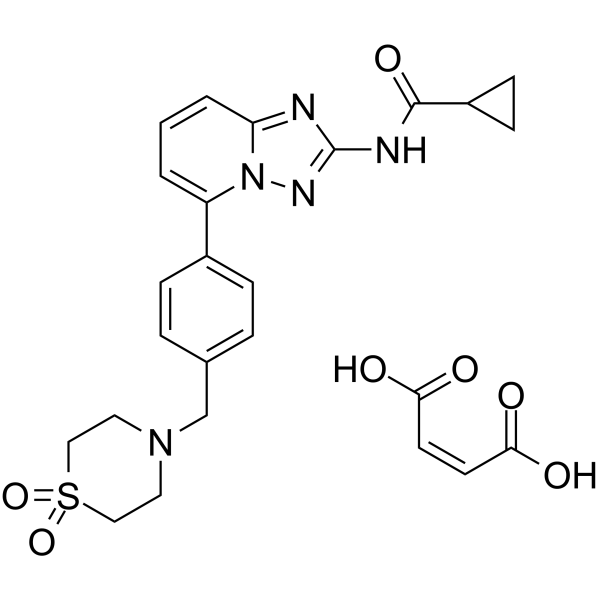
Filgotinib maleate targets Janus kinase 1 (JAK1), a member of the JAK family of cytoplasmic tyrosine kinases that mediate signaling from multiple cytokines involved in inflammation and immune responses. JAK1 pairs with JAK2, JAK3, or TYK2 to transduce signals from cytokine receptors. By selectively inhibiting JAK1, filgotinib blocks the signaling of pro-inflammatory cytokines such as IL-6, IL-2, IL-12, and IFN-γ, which are implicated in the pathogenesis of inflammatory and autoimmune diseases. The compound's selectivity for JAK1 over JAK2 reduces the risk of JAK2-mediated toxicities such as anemia and thrombocytopenia. Filgotinib maleate is used for researching rheumatoid arthritis and other inflammatory diseases. |
|---|---|
| 体外研究 (In Vitro) |
filgotinib(马来酸盐)(1–10 μM)以剂量依赖的方式抑制Th1和Th2细胞分化[1]。IL-4是一种通过JAK1和JAK3信号通路发挥作用的细胞因子,其介导的Th2细胞分化可被filgotinib(GLPG0634)以剂量依赖的方式抑制。此外,filgotinib在1 μM或更低浓度下也能有效抑制Th1细胞分化[1]。由PRL或EPO产生的JAK2同源二聚体介导的信号通路(IC50 > 10 μM)不受filgotinib(GLPG0634)的抑制[2]。体外实验表明,filgotinib对JAK1具有强效且选择性的抑制作用,IC50值在低纳摩尔范围内。生化激酶活性测定显示,该化合物对JAK1的选择性高于JAK2、JAK3和TYK2。在基于细胞的实验中,filgotinib 可抑制 JAK1 依赖性细胞因子信号通路,包括 IL-6 诱导的 STAT 磷酸化,而对 JAK2 依赖性信号通路(例如促红细胞生成素诱导的 STAT 磷酸化)的影响较弱。与游离碱相比,马来酸盐形式具有更高的溶解度和稳定性。这些体外活性支持该化合物作为选择性 JAK1 抑制剂用于炎症性疾病研究。
|
| 体内研究 (In Vivo) |
菲戈替尼(马来酸盐)(1–10 mg/mL;口服和静脉注射;胶原诱导性关节炎大鼠)具有良好的药代动力学特征,可减少炎症细胞、骨骼和软骨退化以及爪肿胀。效应量[1]。体内研究表明,菲戈替尼马来酸盐在包括胶原诱导性关节炎 (CIA) 和炎症性肠病模型在内的炎症性疾病动物模型中均显示出疗效。口服菲戈替尼可降低关节炎模型的疾病严重程度、炎症细胞因子水平和关节破坏。该化合物对 JAK1 的选择性优于 JAK2,这意味着与泛 JAK 抑制剂相比,其对体内血液学参数的影响较小。菲戈替尼已在临床试验中进行评估,并在部分地区获得监管部门批准用于治疗类风湿性关节炎。
|
| 酶活实验 |
生化分析[1]
IC50 测定[1] 使用重组 JAK1、TYK2、JAK2 和 JAK3 在 50 mM HEPES (pH 7.5)、1 mM EGTA、10 mM MgCl2、2 mM DTT 和 0.01% Tween 20 的缓冲液中建立活性测定。测定每个等分试样中的 JAK 蛋白量,以保持初始反应速率和反应的线性关系。ATP 浓度相当于实验测定的 Km 值的 4 倍,底物浓度(ULight 标记的 JAK-1(Tyr1023) 肽)与实验测定的 Km 值相对应。室温 (RT) 孵育 90 分钟后,加入 2 nM 铕标记的抗磷酸酪氨酸抗体 (PerkinElmer) 和 10 mM EDTA 于 Lance 检测缓冲液中,测定磷酸化底物的量。化合物IC50值的测定方法为:在加入ATP之前,将酶与化合物在室温下预孵育60分钟。 Kd测定。[1] 解离常数由一家CRO公司测定。将具有快速解离速率的专有荧光标记ATP类似物(JAK1、JAK2和JAK3分别使用PRO13、PRO14和PRO13)与纯化的JAK的JH1结构域在20 mM MOPS(pH 7.5)、1 mM DTT、0.01% Tween 20和500 mM羟基依克托因(仅限JAK3)中孵育30分钟。将化合物(浓度范围为520 pM至1.1 μM)溶于100% DMSO中,并测量报告分子置换的时间依赖性。获得对应于50%探针置换的IC50值,并根据Cheng-Prusoff方程计算Kd值。 体外激酶活性测定用于表征filgotinib对JAK家族激酶的抑制活性。将该化合物与纯化的JAK1、JAK2、JAK3或TYK2以及ATP底物孵育,并通过肽底物的磷酸化或监测ATP消耗来测定激酶活性。IC50值由剂量反应曲线确定。通过比较JAK家族各成员的IC50值来评估选择性。基于细胞的测定用于测量相关细胞系中细胞因子诱导的STAT磷酸化的抑制情况。这些测定证实了该化合物对JAK1的效力和选择性。 |
| 细胞实验 |
细胞分析[1]
IL-4诱导的STAT6磷酸化。[1] THP-1细胞(ATCC TIB-202)在室温下与化合物预孵育1小时,然后在室温下与IL-4(10 ng/ml)孵育60分钟,并进行流式细胞术分析。细胞用Cytofix/Cytoperm缓冲液固定,并在冰上用Phosflow perm缓冲液III透化30分钟。阻断(Fc阻断试剂)后,使用鼠抗人PE标记的抗pSTAT6抗体检测pSTAT6。 IL-2、IL-3和促红细胞生成素诱导STAT5磷酸化。[1] NK-92细胞(ATCC CRL-2407)经IL-2饥饿过夜,在37℃下与化合物预孵育1小时,室温下用IL-2(1 ng/ml)刺激20分钟,然后进行AlphaScreen分析。TF1细胞在含0.1% FBS的RPMI 1640培养基中饥饿过夜,室温下与化合物预孵育1小时,室温下用IL-3(30 ng/ml)刺激20分钟,然后进行AlphaScreen分析。将 UT-7-促红细胞生成素 (EPO) 细胞(UT-7 的 EPO 依赖性衍生物;Centocor)在室温下与化合物预孵育 1 小时,用 EPO (1 U/ml) 刺激 20 分钟,然后进行 AlphaScreen 分析。使用 AlphaScreen 技术,基本按照制造商的方案测量 pSTAT5。 IFN-α 和 IFN-γ 诱导的 STAT1 磷酸化。[1] 将 STAT1 U2OS 细胞(Invitrogen,货号 K1469)在 37°C 下与化合物预孵育 1 小时,然后在 37°C 下用 30,000 U/ml IFN-αB2(PBL IFN 来源,货号 11115-1)或 20 ng/ml IFN-γ 处理 1 小时,按照制造商的方案裂解(裂解缓冲液中含有 2 nM Tb-Ab),并在室温下孵育 60 分钟。通过时间分辨荧光共振能量转移检测pSTAT1。催乳素诱导STAT5磷酸化。[1] 22Rv1细胞(ATCC CW22Rv)饥饿过夜后,用化合物预孵育,然后用催乳素(PRL;500 ng/ml人PRL,孵育20分钟)触发,在含有磷酸酶/蛋白酶抑制剂混合物的10 mM Tris-HCl(pH 7.5)、5 mM EDTA、150 mM NaCl、0.5% Triton X-100、50 mM NaF、30 mM焦磷酸钠、10%甘油缓冲液中裂解,并离心。取180 μg细胞裂解液进行STAT5免疫沉淀(抗STAT5多克隆抗体,C-17;蛋白A-琼脂糖珠)。通过蛋白质印迹法进行密度分析,测定总STAT5和磷酸化STAT5的表达水平。 IL-3/JAK2诱导Ba/F3细胞增殖。[1] Ba/F3细胞(由法国巴黎V. Lacronique提供)依赖于IL-3和JAK2信号通路,将其与化合物在37°C下孵育40小时,然后通过测定ATP含量分析细胞增殖情况。 抑癌素M诱导HeLa细胞中STAT1报告基因的检测[1] HeLa细胞(ATCC CCL-2)用pSTAT1报告基因构建体(Panomics,货号LR0127)转染。转染24小时后,将细胞与化合物孵育1小时,并用抑癌素M(OSM;33 ng/ml)触发。孵育 20 小时后,裂解细胞,并根据供应商的建议使用 SteadyLite 荧光素酶试剂盒测定荧光素酶活性。同时,在 4 mg/ml 2-硝基苯基-β-D-吡喃半乳糖苷存在下测定 β-半乳糖苷酶活性。 基因敲低实验。[1] 从美国典型培养物保藏中心 (ATCC) 获得的 HeLa 和 HCT116 细胞,使用 Invitrogen 公司的 Lipofectamine RNAiMAX 转染试剂,分别转染 50 nM 针对人 JAK1、JAK2、JAK3 或 TYK2 的 ON-TARGETplus SMARTpool 小干扰 RNA (siRNA),或非靶向 siRNA 或 GAPDH 阴性对照 siRNA。转染四天后,细胞饥饿过夜,然后用IL-6/sIL-6R(均为250 ng/ml)刺激20分钟,并根据制造商的方案使用AlphaScreen技术测定pSTAT1水平。 T细胞分化研究。[1] 使用Lymphoprep密度梯度离心法从健康供体的白细胞层中分离PBMC。使用初始CD4+ T细胞分离试剂盒II去除非辅助性T细胞和记忆性CD4+ T细胞,进一步分离初始CD4+ T细胞。将分离的初始CD4+ T细胞在诱导分化为Th1、Th2或Th17亚群的细胞因子存在下,用包被于培养板上的抗CD3(3 μg/ml)和抗CD28(5 μg/ml)抗体进行刺激。为了诱导Th1细胞极化,将细胞在含有10 μg/ml抗IL-4抗体、10 ng/ml IL-2和10 ng/ml IL-12的培养基中培养。为了诱导Th2细胞极化,将细胞在含有10 μg/ml抗IFN-γ抗体(Becton Dickinson公司)、25 ng/ml IL-4和10 ng/ml IL-2的培养基中培养。为了诱导Th17细胞极化,使用以下细胞因子的混合物:10 ng/ml IL-6、10 ng/ml IL-1β、1 ng/ml TGF-β和100 ng/ml IL-23。为了监测化合物对T细胞分化的影响,在T细胞分化开始时加入指定浓度的化合物。 5天后,使用RNeasy Mini试剂盒提取RNA,进行逆转录,并通过在ViiA7实时荧光定量PCR仪上使用预先设计的TaqMan Assay-on-Demand基因表达引物/探针组,检测IFN-γ(Th1标志物)、IL-13(Th2标志物)或IL-17F(Th17标志物)的表达来监测Th亚群的分化程度。基因表达以18S rRNA为内参进行标准化,并以ΔCt值表示,其中ΔCt = Ct基因 − Ct18S;或者以2-ΔCt法计算的特定基因表达的相对mRNA水平表示。 filgotinib maleate的细胞活性检测在对JAK依赖性细胞因子有反应的细胞系或原代细胞中进行。将细胞用不同浓度的filgotinib处理,并用细胞因子(如IL-6(JAK1/JAK2依赖性)、IL-2(JAK1/JAK3依赖性)或IFN-γ(JAK1/JAK2依赖性))刺激。使用磷酸化特异性抗体,通过Western blot或流式细胞术检测STAT磷酸化水平。通过qPCR检测细胞因子诱导的基因表达。这些实验表明该化合物能够抑制JAK1依赖性信号通路。 |
| 动物实验 |
大鼠每日30 mg/kg;小鼠每日两次50 mg/kg | 在胶原诱导性关节炎 (CIA) 大鼠模型中,口服GLPG0634在3 mg/kg剂量下显示出对骨损伤的显著保护作用。从1 mg/kg开始,它能显著减少炎症细胞的浸润药代动力学[1]
| 药代性质 (ADME/PK) |
吸收
口服后,弗拉戈替尼吸收迅速。弗拉戈替尼的血浆峰浓度中位数在给药后2-3小时出现,而GS-829845的血浆峰浓度中位数在给药后5小时出现。弗拉戈替尼的稳态血浆浓度在2-3天内达到,而GS-829845的稳态血浆浓度则需要4天。食物似乎对弗拉戈替尼的吸收没有显著影响;因此,进食不影响该药的给药。重复口服200 mg弗拉戈替尼后,Cmax和AUCτ值分别为2.15 μg/mL和6.77 μg·h/mL。对于主要代谢物 GS-829845,报道的 Cmax 为 4.43 μg/mL,报道的 AUCτ 为 83.2 μg·h/mL。 排泄 给药总量中,约 87% 经肾脏排泄,15% 经粪便排泄。 代谢/代谢物 羧酸酯酶参与 filgotinib 的代谢。羧酸酯酶 2 (CES2) 同工酶主要负责将 filgotinib 代谢为其主要代谢物 GS-829845。虽然羧酸酯酶 1 (CES1) 在 filgotinib 的生物转化中作用较小,但体外研究表明,当 CES2 饱和时,CES1 可以部分补偿。GS-829845 是迄今为止唯一鉴定的主要循环代谢物。 生物半衰期 filgotinib 的半衰期估计为 7 小时,而其活性代谢物 GS-829845 的半衰期估计为 19 小时。 filgotinib 马来酸盐的药代动力学特性包括良好的口服生物利用度,马来酸盐形式可提高溶解度。口服后 filgotinib 可迅速吸收,达峰时间 (Tmax) 为 2-4 小时。该化合物的半衰期约为 5-6 小时,支持每日两次给药。Filgotinib 主要通过羧酸酯酶代谢为其活性代谢物,该代谢物具有相似的 JAK1 抑制活性。filgotinib 及其代谢物均经尿液和粪便排泄。该化合物的药代动力学特征支持其作为治疗慢性炎症性疾病的口服药物。 |
| 毒性/毒理 (Toxicokinetics/TK) |
妊娠期和哺乳期用药
◉ 哺乳期用药概述 菲戈替尼尚未获得美国食品药品监督管理局 (FDA) 的批准。目前尚无关于菲戈替尼在哺乳期临床应用的信息。欧洲生产商建议在菲戈替尼治疗期间停止母乳喂养。 ◉ 对母乳喂养婴儿的影响 截至修订日期,未找到相关的已发表信息。 ◉ 对泌乳和母乳的影响 截至修订日期,未找到相关的已发表信息。 蛋白结合率 菲戈替尼的蛋白结合率约为 55-59%,其活性代谢物 GS-829845 的蛋白结合率为 39-44%。 马来酸菲戈替尼的安全性和毒理学数据已在临床前和临床研究中进行了评估。在临床前毒理学研究中,filgotinib 对血液学参数表现出剂量依赖性效应,与高剂量下 JAK1/JAK2 抑制作用一致,但其对 JAK1 的选择性降低了发生严重血液毒性的风险。在临床试验中,filgotinib 显示出可接受的安全性,常见不良反应包括恶心、上呼吸道感染和头痛。与其他 JAK 抑制剂一样,也有严重感染和血栓栓塞事件的报道。此外,还观察到肝酶升高。该化合物已在某些地区获准用于治疗类风湿性关节炎。 |
| 参考文献 | |
| 其他信息 |
药物适应症
类风湿性关节炎:Jyseleca适用于治疗对一种或多种改善病情抗风湿药(DMARDs)无反应或不耐受的中重度活动性类风湿性关节炎成人患者。Jyseleca可作为单药治疗,也可与甲氨蝶呤(MTX)联合使用。溃疡性结肠炎:Jyseleca适用于治疗对传统疗法或生物制剂无反应、疗效丧失或不耐受的中重度活动性溃疡性结肠炎成人患者。 马来酸菲戈替尼的CAS号为1802998-75-9,是菲戈替尼(一种选择性JAK1抑制剂)的马来酸盐形式。该化合物已在类风湿性关节炎、克罗恩病、溃疡性结肠炎和其他炎症性疾病的治疗中进行过研究。菲戈替尼已在部分地区(例如欧洲、日本)获得监管部门批准,用于治疗类风湿性关节炎。该化合物对JAK1的选择性高于JAK2、JAK3和TYK2,因此与泛JAK抑制剂相比,其安全性可能更高。菲戈替尼通常每日口服一次,剂量为100-200毫克。该化合物仅供研究和临床应用,不得作为非处方药出售。 |
| 分子式 |
C25H27N5O7S
|
|---|---|
| 分子量 |
541.5762
|
| 精确质量 |
541.163
|
| 元素分析 |
C, 55.44; H, 5.03; N, 12.93; O, 20.68; S, 5.92
|
| CAS号 |
1802998-75-9
|
| 相关CAS号 |
Filgotinib;1206161-97-8
|
| PubChem CID |
131801100
|
| 外观&性状 |
White to off-white solid powder
|
| tPSA |
180
|
| 氢键供体(HBD)数目 |
3
|
| 氢键受体(HBA)数目 |
10
|
| 可旋转键数目(RBC) |
7
|
| 重原子数目 |
38
|
| 分子复杂度/Complexity |
834
|
| 定义原子立体中心数目 |
0
|
| SMILES |
C1CC1C(=O)NC2=NN3C(=N2)C=CC=C3C4=CC=C(C=C4)CN5CCS(=O)(=O)CC5.C(=C\C(=O)O)\C(=O)O
|
| InChi Key |
BFENHEAPFWQJFL-BTJKTKAUSA-N
|
| InChi Code |
InChI=1S/C21H23N5O3S.C4H4O4/c27-20(17-8-9-17)23-21-22-19-3-1-2-18(26(19)24-21)16-6-4-15(5-7-16)14-25-10-12-30(28,29)13-11-25;5-3(6)1-2-4(7)8/h1-7,17H,8-14H2,(H,23,24,27);1-2H,(H,5,6)(H,7,8)/b;2-1-
|
| 化学名 |
(Z)-but-2-enedioic acid;N-[5-[4-[(1,1-dioxo-1,4-thiazinan-4-yl)methyl]phenyl]-[1,2,4]triazolo[1,5-a]pyridin-2-yl]cyclopropanecarboxamide
|
| 别名 |
Filgotinib maleate; 1802998-75-9; Filgotinib (maleate); JG8OB4UL9Y; Filgotinib maleate [USAN]; GS-6034; (Z)-but-2-enedioic acid;N-[5-[4-[(1,1-dioxo-1,4-thiazinan-4-yl)methyl]phenyl]-[1,2,4]triazolo[1,5-a]pyridin-2-yl]cyclopropanecarboxamide; Cyclopropanecarboxamide, N-(5-(4-((1,1-dioxido-4-thiomorpholinyl)methyl)phenyl)(1,2,4)triazolo(1,5-a)pyridin-2-yl)-, (2Z)-2-butenedioate (1:1);
|
| HS Tariff Code |
2934.99.9001
|
| 存储方式 |
Powder -20°C 3 years 4°C 2 years In solvent -80°C 6 months -20°C 1 month |
| 运输条件 |
Room temperature (This product is stable at ambient temperature for a few days during ordinary shipping and time spent in Customs)
|
| 溶解度 (体外实验) |
May dissolve in DMSO (in most cases), if not, try other solvents such as H2O, Ethanol, or DMF with a minute amount of products to avoid loss of samples
|
|---|---|
| 溶解度 (体内实验) |
注意: 如下所列的是一些常用的体内动物实验溶解配方,主要用于溶解难溶或不溶于水的产品(水溶度<1 mg/mL)。 建议您先取少量样品进行尝试,如该配方可行,再根据实验需求增加样品量。
注射用配方
注射用配方1: DMSO : Tween 80: Saline = 10 : 5 : 85 (如: 100 μL DMSO → 50 μL Tween 80 → 850 μL Saline)(IP/IV/IM/SC等) *生理盐水/Saline的制备:将0.9g氯化钠/NaCl溶解在100 mL ddH ₂ O中,得到澄清溶液。 注射用配方 2: DMSO : PEG300 :Tween 80 : Saline = 10 : 40 : 5 : 45 (如: 100 μL DMSO → 400 μL PEG300 → 50 μL Tween 80 → 450 μL Saline) 注射用配方 3: DMSO : Corn oil = 10 : 90 (如: 100 μL DMSO → 900 μL Corn oil) 示例: 以注射用配方 3 (DMSO : Corn oil = 10 : 90) 为例说明, 如果要配制 1 mL 2.5 mg/mL的工作液, 您可以取 100 μL 25 mg/mL 澄清的 DMSO 储备液,加到 900 μL Corn oil/玉米油中, 混合均匀。 View More
注射用配方 4: DMSO : 20% SBE-β-CD in Saline = 10 : 90 [如:100 μL DMSO → 900 μL (20% SBE-β-CD in Saline)] 口服配方
口服配方 1: 悬浮于0.5% CMC Na (羧甲基纤维素钠) 口服配方 2: 悬浮于0.5% Carboxymethyl cellulose (羧甲基纤维素) 示例: 以口服配方 1 (悬浮于 0.5% CMC Na)为例说明, 如果要配制 100 mL 2.5 mg/mL 的工作液, 您可以先取0.5g CMC Na并将其溶解于100mL ddH2O中,得到0.5%CMC-Na澄清溶液;然后将250 mg待测化合物加到100 mL前述 0.5%CMC Na溶液中,得到悬浮液。 View More
口服配方 3: 溶解于 PEG400 (聚乙二醇400) 请根据您的实验动物和给药方式选择适当的溶解配方/方案: 1、请先配制澄清的储备液(如:用DMSO配置50 或 100 mg/mL母液(储备液)); 2、取适量母液,按从左到右的顺序依次添加助溶剂,澄清后再加入下一助溶剂。以 下列配方为例说明 (注意此配方只用于说明,并不一定代表此产品 的实际溶解配方): 10% DMSO → 40% PEG300 → 5% Tween-80 → 45% ddH2O (或 saline); 假设最终工作液的体积为 1 mL, 浓度为5 mg/mL: 取 100 μL 50 mg/mL 的澄清 DMSO 储备液加到 400 μL PEG300 中,混合均匀/澄清;向上述体系中加入50 μL Tween-80,混合均匀/澄清;然后继续加入450 μL ddH2O (或 saline)定容至 1 mL; 3、溶剂前显示的百分比是指该溶剂在最终溶液/工作液中的体积所占比例; 4、 如产品在配制过程中出现沉淀/析出,可通过加热(≤50℃)或超声的方式助溶; 5、为保证最佳实验结果,工作液请现配现用! 6、如不确定怎么将母液配置成体内动物实验的工作液,请查看说明书或联系我们; 7、 以上所有助溶剂都可在 Invivochem.cn网站购买。 |
| 制备储备液 | 1 mg | 5 mg | 10 mg | |
| 1 mM | 1.8464 mL | 9.2322 mL | 18.4645 mL | |
| 5 mM | 0.3693 mL | 1.8464 mL | 3.6929 mL | |
| 10 mM | 0.1846 mL | 0.9232 mL | 1.8464 mL |
1、根据实验需要选择合适的溶剂配制储备液 (母液):对于大多数产品,InvivoChem推荐用DMSO配置母液 (比如:5、10、20mM或者10、20、50 mg/mL浓度),个别水溶性高的产品可直接溶于水。产品在DMSO 、水或其他溶剂中的具体溶解度详见上”溶解度 (体外)”部分;
2、如果您找不到您想要的溶解度信息,或者很难将产品溶解在溶液中,请联系我们;
3、建议使用下列计算器进行相关计算(摩尔浓度计算器、稀释计算器、分子量计算器、重组计算器等);
4、母液配好之后,将其分装到常规用量,并储存在-20°C或-80°C,尽量减少反复冻融循环。
计算结果:
工作液浓度: mg/mL;
DMSO母液配制方法: mg 药物溶于 μL DMSO溶液(母液浓度 mg/mL)。如该浓度超过该批次药物DMSO溶解度,请首先与我们联系。
体内配方配制方法:取 μL DMSO母液,加入 μL PEG300,混匀澄清后加入μL Tween 80,混匀澄清后加入 μL ddH2O,混匀澄清。
(1) 请确保溶液澄清之后,再加入下一种溶剂 (助溶剂) 。可利用涡旋、超声或水浴加热等方法助溶;
(2) 一定要按顺序加入溶剂 (助溶剂) 。
| NCT Number | Recruitment | interventions | Conditions | Sponsor/Collaborators | Start Date | Phases |
| NCT05817942 | Recruiting | Drug: Filgotinib | Ulcerative Colitis | Galapagos NV | June 12, 2023 | |
| NCT05323591 | Recruiting | Drug: Filgotinib | Rheumatoid Arthritis | Galapagos NV | May 3, 2022 | |
| NCT04871919 | Recruiting | Drug: Filgotinib | Rheumatoid Arthritis | Galapagos NV | May 11, 2021 | |
| NCT05785611 | Recruiting | Drug: Filgotinib Drug: Placebo |
Axial Spondyloarthritis | Galapagos NV | April 5, 2023 | Phase 3 |
InvivoChem的所有产品仅用于作科学研究,不面向患者销售
Copyright 2020 InvivoChem LLC | All Rights Reserved 粤ICP备20063088号-1


 粤公网安备 44011102003439号
 463611831
