| 规格 | 价格 | 库存 | 数量 |
|---|---|---|---|
| 5mg |
|
||
| 10mg |
|
||
| 50mg |
|
||
| 100mg |
|
||
| Other Sizes |
|
| 靶点 |
The primary targets of Naloxone are the opioid receptors in the central nervous system (CNS). It binds to mu-opioid receptors with high affinity, and to a lesser degree to kappa- and gamma-opioid receptors. It is a competitive antagonist at mu, delta, and kappa opioid receptors. By binding to these receptors, it blocks the effects of opioid analgesics and reverses their actions, including respiratory depression.
|
|---|---|
| 体外研究 (In Vitro) |
体外实验表明,纳洛酮是一种阿片受体拮抗剂。其活性特征在于能够与阿片受体结合并阻断阿片激动剂的作用。这通常通过使用放射性标记配体的受体结合试验进行评估。纳洛酮对μ-阿片受体具有高亲和力。其体外活性证实了其作为竞争性拮抗剂的作用机制。
|
| 体内研究 (In Vivo) |
纳洛酮(2.0 mg/kg,以 1.7 mg/kg/h 的速度持续输注)显著改善了大鼠的神经行为结果,这种效果可持续长达 4 周。纳洛酮治疗可导致平均动脉压 (MAP) 轻微升高,但无统计学意义 [1]。纳洛酮(0.4 mg/kg)可改善大鼠的记忆力,并抑制 ACTH 和肾上腺素的遗忘作用 [2]。纳洛酮给药可剂量依赖性地降低猫的首次破伤风发作强度。纳洛酮(5 或 10 mg/kg,静脉注射)可降低后续吗啡剂量对 PTP 的抑制作用,但对最大肌肉抽搐抑制无影响 [3]。在体内,纳洛酮用于逆转阿片类药物过量的作用。它能迅速对抗阿片类药物引起的危及生命的中枢神经系统和呼吸抑制。它可通过静脉注射、肌肉注射或鼻内给药。其起效迅速的原因在于它能快速将阿片类药物从受体结合位点上置换下来。它对阿片受体的阻断作用可能会诱发阿片类药物依赖者出现戒断症状。
|
| 酶活实验 |
纳洛酮的体外受体结合研究旨在测定其与阿片受体的亲和力。放射性配体结合试验采用表达μ、δ和κ阿片受体的细胞膜制备物进行。该化合物与标记的激动剂或拮抗剂竞争结合位点,IC₅₀或Ki值由竞争曲线确定。这些试验是表征阿片受体配体的标准方法,仅供研究之用。
|
| 细胞实验 |
体外细胞实验用于评估纳洛酮的功能性拮抗作用。将表达阿片受体的细胞在有或无纳洛酮存在的情况下,用阿片激动剂(例如吗啡)处理。通过下游信号通路(例如 cAMP 积累的抑制或 G 蛋白偶联内向整流钾 (GIRK) 通道的激活)来测量受体激活。测定纳洛酮阻断激动剂诱导反应的能力。采用标准的细胞培养和信号通路检测方法。
|
| 动物实验 |
纳洛酮的体内动物研究常用于评估其逆转阿片类药物诱导效应的疗效。例如,先用吗啡等阿片类药物处理啮齿动物以诱导镇痛或呼吸抑制,随后给予纳洛酮。通过甩尾试验(用于评估镇痛效果)或测量呼吸频率等方法来评估这些效应的逆转情况。这些研究是验证阿片类拮抗剂的标准方法。所有操作均须遵守机构动物护理指南。
|
| 药代性质 (ADME/PK) |
吸收、分布和排泄
鼻内给药纳洛酮的生物利用度为 42-47%。鼻内给予 8 mg 纳洛酮后,血浆峰浓度 (Cmax) 为 12.3-12.8 ng/mL,达峰时间 (Tmax) 为 0.25 h,曲线下面积 (AUC) 为 16.7-19.0 hng/mL。肌内注射 0.4 mg 纳洛酮后,血浆峰浓度 (Cmax) 为 0.876-0.910 ng/mL,达峰时间 (Tmax) 为 0.25 h,AUC 为 1.94-1.95 hng/mL。静脉注射2 mg纳洛酮后,血浆峰浓度(Cmax)为26.2 ng/mL,AUC为12.8 hng/mL。口服或静脉给药后,25-40%的纳洛酮在6小时内经尿液排出,50%在24小时内排出,60-70%在72小时内排出。代谢产物纳洛酮-3-葡萄糖醛酸苷、去甲羟吗啡酮和纳洛醇均可在尿液中检测到。纳洛酮的分布容积为200升。纳洛酮迅速分布于组织,并能穿过胎盘和血脑屏障。纳洛酮的清除率为2500升/天。纳洛酮迅速分布于全身,在脑、肾、脾、骨骼肌、肺和心脏中的浓度较高。该药物也很容易通过胎盘。纳洛酮口服吸收极少,因为它在胃肠道内迅速被破坏。采用这种给药途径,需要更高的剂量才能达到任何药理作用。静脉注射纳洛酮起效非常迅速(通常1-2分钟)。肌注纳洛酮通常在给药后5分钟内起效。作用持续时间通常为45-90分钟,但最长可达3小时。口服纳洛酮后会迅速失活。虽然口服有效,但与肠外给药相比,完全拮抗海洛因的作用需要更大的剂量。在一项研究中,单次口服3克盐酸纳洛酮可有效拮抗50毫克海洛因的作用,且作用持续24小时。纳洛酮静脉注射后1-2分钟内起效,皮下或肌肉注射后2-5分钟内起效。作用持续时间取决于剂量和给药途径,肌肉注射的作用持续时间比静脉注射更长。一项研究显示,新生儿经脐静脉注射35或70微克盐酸纳洛酮后,40分钟内血浆纳洛酮峰值浓度分别达到4-5.4 ng/mL和9.2-20.2 ng/mL。同一项研究还显示,新生儿肌肉注射0.2毫克纳洛酮后,0.5-2小时内血浆纳洛酮峰值浓度达到11.3-34.7 ng/mL。有关纳洛酮吸收、分布和排泄的更完整数据(共14项),请访问HSDB记录页面。 代谢/代谢物 纳洛酮主要通过葡萄糖醛酸化代谢为纳洛酮-3-葡萄糖醛酸苷。纳洛酮也可发生N-脱烷基化生成去甲羟基吗啡,或发生6-酮还原生成纳洛醇。纳洛酮在肝脏中迅速代谢,主要通过与葡萄糖醛酸结合。主要代谢物是纳洛酮-3-葡萄糖醛酸苷。纳洛酮还会发生N-脱烷基化和6-酮还原,随后发生结合反应。在人体内,会生成N-烯丙基-7,8-二氢-14-羟基去甲吗啡和7,8-二氢-14-羟基去甲吗啡; Weinstein, SH, Pfeffer, M, Schor, JM, Indindoli, L, & Mintz, M, J Pharm Sci, 60, 1567 (1971). 人体内会产生纳洛酮-3-β-D-葡萄糖醛酸苷;Fujimoto, JM, J Pharmac Exp Ther, 168, 180 (1969). /摘自表格/ ……氧化脱烯丙基化、6-酮还原和葡萄糖醛酸化反应在人体内发生。 ……已鉴定的纳洛酮代谢产物包括:纳洛酮-3-葡萄糖醛酸苷(主要)、3-硫酸酯(次要)、纳洛醇及其结合物(次要)以及7,8-二氢-14-羟基去甲吗啡及其结合物。此外,初步证据表明存在两种极性羟基化代谢物(羟基化位点可能位于17-侧链或芳香环的2位)。在脑组织中也观察到了7,8-二氢-14-羟基去甲吗啡酮和两种极性代谢物。…… 生物半衰期 盐酸纳洛酮的平均半衰期为鼻内给药后1.8-2.7小时,肌内给药后1.4小时,静脉给药后1.2小时。新生儿纳洛酮的平均半衰期为3.1±0.5小时。 使用自动注射器肌内或皮下注射盐酸纳洛酮后,纳洛酮的平均血浆半衰期为1.28小时;而使用标准注射器肌内或皮下注射后,血浆半衰期为1.36小时。据报道,纳洛酮在成人体内的半衰期为 30-81 分钟,在新生儿体内的半衰期约为 3 小时。采用放射免疫分析法 (RIA) 测定了三组新生儿在出生后 6-36 小时内的血浆纳洛酮水平:(1) 出生后 1 分钟内静脉注射 35 μg 盐酸纳洛酮 (n = 6);(2) 静脉注射 70 μg 盐酸纳洛酮 (n = 6);(3) 出生后 1 分钟内肌注 200 μg 盐酸纳洛酮 (n = 17)。静脉注射35 μg和70 μg纳洛酮后,分别在5-40分钟内达到4-15 ng/mL和9-20 ng/mL的血药浓度峰值,两种剂量的平均血浆半衰期均为3.1 ± 0.5小时。纳洛酮的药代动力学特性包括肠外给药后迅速起效。它在肝脏代谢,半衰期相对较短(约1-2小时)。它不能口服,只能通过注射或鼻内给药。其快速的代谢和清除导致其作用持续时间短,因此对于长效阿片类药物而言,可能需要重复给药。 |
| 毒性/毒理 (Toxicokinetics/TK) |
毒性概述
识别和用途:纳洛酮是一种结晶物质。盐酸纳洛酮用于完全或部分逆转天然和合成阿片类药物引起的阿片类药物抑制,包括呼吸抑制(用于人类和兽医)。它还可用作脓毒性休克治疗的辅助药物以升高血压。更高浓度的制剂(曲唑尼)用于逆转野生动物的镇静作用。人体暴露和症状:与纳洛酮使用相关的不良反应包括癫痫发作、严重高血压、低血压和/或心动过缓。在非成瘾者中,分别在11、22和33分钟时静脉注射0.2、0.4和0.6毫克,总剂量为1.2毫克,导致瞳孔缩小、核心体温下降和收缩压下降。纳洛酮诱发的急性肺水肿是一种极其罕见但致命的并发症。内源性阿片类物质似乎能调节某些高血压患者的血压,因此,在这些患者中使用纳洛酮等阿片拮抗剂必须谨慎。服用纳洛酮的儿童可能会出现呼吸频率、心率和血压中度升高,但更严重的并发症很少见。纳洛酮在体外人淋巴细胞染色体畸变试验中呈弱阳性。纳洛酮可能影响人体免疫系统的某些功能,但其影响是短暂的。动物研究:向大鼠内侧隔核注射纳洛酮可显著增加海马乙酰胆碱的释放,且呈剂量依赖性。研究还发现,注射纳洛酮的大鼠表现出运动活性增强,偶尔出现行为性癫痫发作。大鼠皮下注射100 mg/kg/天,持续3周,仅引起注射后短暂的流涎和部分眼睑下垂。从妊娠第17天开始给大鼠注射纳洛酮,显著增加了新生大鼠的死亡率。纳洛酮给药轻微抑制了体重增长。纳洛酮在Ames诱变性试验中呈弱阳性,在体外中国仓鼠V79细胞HGPRT诱变性试验和体内大鼠骨髓染色体畸变研究中呈阴性。 相互作用 由于丁丙诺啡与阿片受体的结合和解离缓慢,其作用持续时间较长,需要高剂量的纳洛酮才能拮抗。丁丙诺啡拮抗作用的特点是作用逐渐逆转,并且通常持续时间较长的呼吸抑制作用持续时间缩短。巴比妥类药物甲氧氯普胺似乎可以阻断纳洛酮引起的阿片类药物成瘾者的急性戒断症状。 对志愿者同时给予氟硝西泮和纳洛酮可增加呼吸频率和分钟通气量,但与单独使用纳洛酮相比,并未改变呼气末二氧化碳分压、吸入量或肺泡通气量。 非人类毒性值 小鼠静脉注射LD50:90 mg/kg / 盐酸纳洛酮/ 大鼠静脉注射LD50:107 mg/kg / 盐酸纳洛酮/ 大鼠腹腔注射LD50:239 mg/kg / 盐酸纳洛酮/ 大鼠皮下注射LD50:500 mg/kg / 盐酸纳洛酮/ 小鼠皮下注射LD50:286 mg/kg / 盐酸纳洛酮/ 纳洛酮的毒性特征总体良好。它没有明显的激动剂活性,被认为是安全的。然而,它可能导致阿片类药物依赖者出现急性戒断症状。在极少数情况下,它可能导致肺水肿或心律失常。它是处方药,应在医生的指导下使用。 |
| 参考文献 | |
| 其他信息 |
治疗用途
麻醉拮抗剂临床试验/ClinicalTrials.gov 是一个注册和结果数据库,列出了全球公共和私人机构资助的人体临床研究。该网站由美国国家医学图书馆 (NLM) 和美国国立卫生研究院 (NIH) 维护。ClinicalTrials.gov 上的每条记录都包含研究方案的摘要信息,包括:疾病或病症;干预措施(例如,正在研究的医疗产品、行为或程序);研究的标题、描述和设计;参与要求(资格标准);研究地点;研究地点的联系方式;以及指向其他健康网站相关信息的链接,例如 NLM 的 MedlinePlus(用于提供患者健康信息)和 PubMed(用于提供医学领域学术文章的引文和摘要)。纳洛酮已列入该数据库。盐酸纳洛酮注射液(USP)适用于完全或部分逆转由天然和合成阿片类药物(包括丙氧芬、美沙酮以及某些混合激动剂-拮抗剂镇痛药,如纳布啡、喷他佐辛、布托啡诺和环唑辛)引起的阿片类药物抑制作用,包括呼吸抑制。盐酸纳洛酮注射液(USP)也适用于诊断疑似或确诊的急性阿片类药物过量。/美国产品标签上注明/ 盐酸纳洛酮注射液(USP)可作为辅助疗法用于治疗感染性休克,以升高血压。/美国产品标签上注明/ 有关纳洛酮治疗用途(共14种)的更多完整数据,请访问HSDB记录页面。 药物警告 有报道称,术后患者接受高于常规推荐剂量的纳洛酮盐酸盐肠外给药后,出现罕见的恶心和呕吐症状;然而,尚未证实其与纳洛酮盐酸盐存在因果关系。一些因阿片类药物过量而接受纳洛酮治疗的患者出现震颤和过度换气,并伴有意识突然恢复。虽然尚未证实其与纳洛酮盐酸盐存在因果关系,但已有报道称,术后接受纳洛酮盐酸盐治疗的患者出现严重的心肺不良反应(例如,低血压、高血压、室性心动过速和室颤、呼吸困难、肺水肿、心脏骤停),导致死亡、昏迷和脑病。心肺不良反应最常发生于既往存在心血管疾病或正在服用其他可能引起类似心血管不良反应药物的术后患者。服用盐酸纳洛酮后发生癫痫发作的情况很少见;然而,尚未证实癫痫发作与该药物之间存在因果关系。当使用高剂量口服纳洛酮治疗阿片类药物成瘾时,部分患者会出现抑郁、冷漠、注意力不集中、嗜睡、易怒、厌食、恶心和呕吐等不良反应。这些不良反应通常在治疗的最初几天出现,并随着继续治疗或减少剂量而迅速消退。曾有一例多形性红斑患者在停用纳洛酮后迅速痊愈。有关纳洛酮的更多完整数据(共23例),请访问HSDB记录页面。药效学:纳洛酮是一种阿片受体拮抗剂,用于逆转阿片类药物过量。纳洛酮的作用持续时间比阿片类药物短,可能需要多次给药。纳洛酮的治疗窗较宽,如果患者未服用阿片类药物,则无效。接受纳洛酮治疗的患者可能会出现阿片类药物戒断症状;管理者应注意,如果患者同时服用其他药物,逆转阿片类药物过量可能无法消除所有症状。 补充信息:纳洛酮的CAS号为465-65-6。它是一种μ-阿片受体竞争性拮抗剂,用作阿片类药物过量的解毒剂。纳洛酮是阿片类药物研究中的标准工具,也是临床实践中的救命药物。它以多种商品名销售用于临床,但用于研究的纳洛酮则以高纯度化合物的形式提供。 |
| 分子式 |
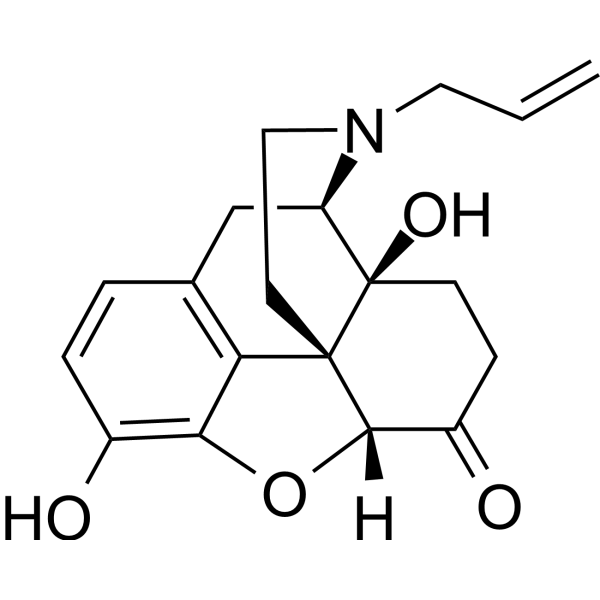
C19H21NO4
|
|---|---|
| 分子量 |
327.37
|
| 精确质量 |
327.147
|
| CAS号 |
465-65-6
|
| 相关CAS号 |
Naloxone hydrochloride;357-08-4;Naloxone-d5;1261079-38-2
|
| PubChem CID |
5284596
|
| 外观&性状 |
Crystals from ethyl acetate
|
| 密度 |
1.43 g/cm3
|
| 沸点 |
532.8ºC at 760 mmHg
|
| 熔点 |
184ºC
|
| 闪点 |
276.1ºC
|
| LogP |
1.239
|
| tPSA |
70
|
| 氢键供体(HBD)数目 |
2
|
| 氢键受体(HBA)数目 |
5
|
| 可旋转键数目(RBC) |
2
|
| 重原子数目 |
24
|
| 分子复杂度/Complexity |
594
|
| 定义原子立体中心数目 |
4
|
| SMILES |
C=CCN1CC[C@@]23C4=C5C=CC(=C4O[C@H]3C(=O)CC[C@]2([C@H]1C5)O)O
|
| InChi Key |
UZHSEJADLWPNLE-GRGSLBFTSA-N
|
| InChi Code |
InChI=1S/C19H21NO4/c1-2-8-20-9-7-18-15-11-3-4-12(21)16(15)24-17(18)13(22)5-6-19(18,23)14(20)10-11/h2-4,14,17,21,23H,1,5-10H2/t14-,17+,18+,19-/m1/s1
|
| 化学名 |
(4R,4aS,7aR,12bS)-4a,9-dihydroxy-3-prop-2-enyl-2,4,5,6,7a,13-hexahydro-1H-4,12-methanobenzofuro[3,2-e]isoquinolin-7-one
|
| HS Tariff Code |
2934.99.9001
|
| 存储方式 |
Powder -20°C 3 years 4°C 2 years In solvent -80°C 6 months -20°C 1 month |
| 运输条件 |
Room temperature (This product is stable at ambient temperature for a few days during ordinary shipping and time spent in Customs)
|
| 溶解度 (体外实验) |
May dissolve in DMSO (in most cases), if not, try other solvents such as H2O, Ethanol, or DMF with a minute amount of products to avoid loss of samples
|
|---|---|
| 溶解度 (体内实验) |
注意: 如下所列的是一些常用的体内动物实验溶解配方,主要用于溶解难溶或不溶于水的产品(水溶度<1 mg/mL)。 建议您先取少量样品进行尝试,如该配方可行,再根据实验需求增加样品量。
注射用配方
注射用配方1: DMSO : Tween 80: Saline = 10 : 5 : 85 (如: 100 μL DMSO → 50 μL Tween 80 → 850 μL Saline)(IP/IV/IM/SC等) *生理盐水/Saline的制备:将0.9g氯化钠/NaCl溶解在100 mL ddH ₂ O中,得到澄清溶液。 注射用配方 2: DMSO : PEG300 :Tween 80 : Saline = 10 : 40 : 5 : 45 (如: 100 μL DMSO → 400 μL PEG300 → 50 μL Tween 80 → 450 μL Saline) 注射用配方 3: DMSO : Corn oil = 10 : 90 (如: 100 μL DMSO → 900 μL Corn oil) 示例: 以注射用配方 3 (DMSO : Corn oil = 10 : 90) 为例说明, 如果要配制 1 mL 2.5 mg/mL的工作液, 您可以取 100 μL 25 mg/mL 澄清的 DMSO 储备液,加到 900 μL Corn oil/玉米油中, 混合均匀。 View More
注射用配方 4: DMSO : 20% SBE-β-CD in Saline = 10 : 90 [如:100 μL DMSO → 900 μL (20% SBE-β-CD in Saline)] 口服配方
口服配方 1: 悬浮于0.5% CMC Na (羧甲基纤维素钠) 口服配方 2: 悬浮于0.5% Carboxymethyl cellulose (羧甲基纤维素) 示例: 以口服配方 1 (悬浮于 0.5% CMC Na)为例说明, 如果要配制 100 mL 2.5 mg/mL 的工作液, 您可以先取0.5g CMC Na并将其溶解于100mL ddH2O中,得到0.5%CMC-Na澄清溶液;然后将250 mg待测化合物加到100 mL前述 0.5%CMC Na溶液中,得到悬浮液。 View More
口服配方 3: 溶解于 PEG400 (聚乙二醇400) 请根据您的实验动物和给药方式选择适当的溶解配方/方案: 1、请先配制澄清的储备液(如:用DMSO配置50 或 100 mg/mL母液(储备液)); 2、取适量母液,按从左到右的顺序依次添加助溶剂,澄清后再加入下一助溶剂。以 下列配方为例说明 (注意此配方只用于说明,并不一定代表此产品 的实际溶解配方): 10% DMSO → 40% PEG300 → 5% Tween-80 → 45% ddH2O (或 saline); 假设最终工作液的体积为 1 mL, 浓度为5 mg/mL: 取 100 μL 50 mg/mL 的澄清 DMSO 储备液加到 400 μL PEG300 中,混合均匀/澄清;向上述体系中加入50 μL Tween-80,混合均匀/澄清;然后继续加入450 μL ddH2O (或 saline)定容至 1 mL; 3、溶剂前显示的百分比是指该溶剂在最终溶液/工作液中的体积所占比例; 4、 如产品在配制过程中出现沉淀/析出,可通过加热(≤50℃)或超声的方式助溶; 5、为保证最佳实验结果,工作液请现配现用! 6、如不确定怎么将母液配置成体内动物实验的工作液,请查看说明书或联系我们; 7、 以上所有助溶剂都可在 Invivochem.cn网站购买。 |
| 制备储备液 | 1 mg | 5 mg | 10 mg | |
| 1 mM | 3.0546 mL | 15.2732 mL | 30.5465 mL | |
| 5 mM | 0.6109 mL | 3.0546 mL | 6.1093 mL | |
| 10 mM | 0.3055 mL | 1.5273 mL | 3.0546 mL |
1、根据实验需要选择合适的溶剂配制储备液 (母液):对于大多数产品,InvivoChem推荐用DMSO配置母液 (比如:5、10、20mM或者10、20、50 mg/mL浓度),个别水溶性高的产品可直接溶于水。产品在DMSO 、水或其他溶剂中的具体溶解度详见上”溶解度 (体外)”部分;
2、如果您找不到您想要的溶解度信息,或者很难将产品溶解在溶液中,请联系我们;
3、建议使用下列计算器进行相关计算(摩尔浓度计算器、稀释计算器、分子量计算器、重组计算器等);
4、母液配好之后,将其分装到常规用量,并储存在-20°C或-80°C,尽量减少反复冻融循环。
计算结果:
工作液浓度: mg/mL;
DMSO母液配制方法: mg 药物溶于 μL DMSO溶液(母液浓度 mg/mL)。如该浓度超过该批次药物DMSO溶解度,请首先与我们联系。
体内配方配制方法:取 μL DMSO母液,加入 μL PEG300,混匀澄清后加入μL Tween 80,混匀澄清后加入 μL ddH2O,混匀澄清。
(1) 请确保溶液澄清之后,再加入下一种溶剂 (助溶剂) 。可利用涡旋、超声或水浴加热等方法助溶;
(2) 一定要按顺序加入溶剂 (助溶剂) 。
Efficacy of Spinal Manipulation Therapy or Mindfulness-based Reduction Therapy on Patients With Chronic Low Back Pain
CTID: NCT04744883
PhaseEarly Phase 1 Status: Active, not recruiting
Date: 2024-10-08
InvivoChem的所有产品仅用于作科学研究,不面向患者销售
Copyright 2020 InvivoChem LLC | All Rights Reserved 粤ICP备20063088号-1


 粤公网安备 44011102003439号
 463611831
