| 规格 | 价格 | 库存 | 数量 |
|---|---|---|---|
| 5mg |
|
||
| Other Sizes |
|
| 靶点 |
α-adrenergic receptor
|
|---|---|
| 体外研究 (In Vitro) |
体外活性:甲磺酸酚妥拉明在海绵体膜中以相对较高的亲和力取代选择性 α 1 受体拮抗剂 [125I]HEAT 和 [3H]prazosin 以及 α2 受体拮抗剂 [3H]rauwolscine 和 [3H]RX 821002 的结合。甲磺酸酚妥拉明会导致预先用肾上腺素激动剂去氧肾上腺素、去甲肾上腺素、羟甲唑啉和 UK 14,304 以及非肾上腺素收缩剂内皮素和 KCl 收缩的勃起组织条产生浓度依赖性松弛。 Phentolamine mesylate 通过直接拮抗 α1 和 2 肾上腺素能受体,以及通过非肾上腺素能、内皮介导的机制(提示一氧化氮合酶激活)间接功能拮抗,诱导海绵体勃起组织松弛。酚妥拉明是一种α-肾上腺素能拮抗剂,可阻断与牙科麻醉制剂中使用的肾上腺素相关的血管收缩,从而增强局部麻醉剂从注射部位的全身吸收。
|
| 体内研究 (In Vivo) |
在小鼠中,酚妥拉明(5–20 mg/kg;腹腔注射)可减轻 DOPS(4 mg/kg,腹腔注射)引起的癫痫发作,并成功预防士的宁(2 mg/kg,腹腔注射)引起的癫痫发作[2]。腹腔注射酚妥拉明 (1 mg/kg) 通过阻断小鼠 B 细胞中的 a2A 肾上腺素受体来增强胰岛素的产生 [3]。
1.研究了一些去甲肾上腺素能药物对马钱子碱诱导的小鼠癫痫发作的影响。2.士的宁(0.5-4mg/kg,i.p.)剂量依赖性地产生强直性癫痫发作。3.DOPS(4-8mg/kg,i.p.)显著缩短了士的宁(2mg/kg,i.p。同样,DOPS(4 mg/kg,i.p.)有效地增加了士的宁(1 mg/kg,i.p..)诱导的癫痫发作的发生率,并显著缩短了癫痫发作的潜伏期。4.丙咪嗪(20-40mg/kg,腹腔注射)和帕吉林(200mg/kg,腹腔注射”)显著缩短了士的宁(2mg/kg,腹腔注射“)诱导的癫痫发作的潜伏期。5.酚妥拉明(5-20mg/kg,i.p.)有效拮抗士的宁(2mg/kg,i.p.m.)引起的癫痫发作。此外,酚妥拉明(10mg/kg,i.p.)减弱了DOPS(4mg/kg,i.p。6.普萘洛尔(0.5-2mg/kg,i.p.)和哌唑嗪(1-2mg/kg,i.p..)降低了士的宁(2mg/kg,i.p.m.)引起的癫痫发作的发生率,并显著延迟了癫痫发作的潜伏期。7.利血平(5-10mg/kg,i.p.)显著延长了士的宁(2mg/kg,i.p..)诱导的癫痫发作的潜伏期。8.可乐定(0.25-1mg/kg,腹腔注射)剂量依赖性地显著拮抗士的宁(2mg/kg,腹腔注射。)诱导的癫痫发作。9.依他唑嗪(1-4mg/kg,i.p.)以剂量相关的方式显著缩短了士的宁(2mg/kg,i.p.m.)诱导的癫痫发作的潜伏期。同样,伊达唑嗪(2 mg/kg,腹腔注射)显著增强了士的宁(1 mg/kg,腹腔内注射)引起的癫痫发作。Idazoxan(4 mg/kg,i.p.)显著拮抗可乐定(1 mg/kg,i.p..)对士的宁(2 mg/kg,i.i.p.)诱导的癫痫发作的保护作用。10.二硫仑(3 x 25-3 x 100 mg/kg,腹腔注射)显著减轻了士的宁(2 mg/kg,腹腔内注射)诱导的癫痫发作。DOPS(4 mg/kg,i.p.)显著增强了双硫仑(3 x 100 mg/kg,i.p..)预处理动物的士的宁癫痫发作。11.这些结果表明,去甲肾上腺素能神经传递的增强会增强小鼠士的宁的发作[2]。 |
| 酶活实验 |
在无细胞系统中,通过将特异性和选择性放射性标记的配体置换到α1和2肾上腺素能受体上来研究酚妥拉明的结合活性。在器官浴室中研究了酚妥拉明介导的人和兔海绵体肾上腺素能和非肾上腺素能预收缩勃起组织条的松弛的生理活性。Int J Impot Res . 1998 Dec;10(4):215-23.
|
| 细胞实验 |
在体外研究了NO-cGMP依赖途径对甲磺酸酚妥拉明诱发的兔海绵体非肾上腺素能、非胆碱能舒张的贡献。刺激兔海绵体的非肾上腺素能、非胆碱能神经元可引发频率相关的弛豫,L-NAME(NO合酶抑制剂)或ODQ(鸟苷酸环化酶抑制剂)可显著减弱这种弛豫。此外,钠通道阻断剂河豚毒素消除了电场刺激诱导的兔海绵体松弛,表明神经元释放NO介导了电场刺激的松弛。甲磺酸酚妥拉明(30和100 nM)剂量依赖性地增强电场刺激诱导的兔海绵体松弛。哌唑嗪(30μM)和育亨宾(30μm)未能影响甲磺酸酚妥拉明介导的非肾上腺素能、非胆碱能兔阴茎平滑肌放松,表明酚妥拉明放松兔海绵体,与α肾上腺素能受体阻断无关。相比之下,用L-NAME预处理兔海绵体条可显著减弱电场刺激,对甲磺酸酚妥拉明产生舒张作用,表明甲磺酸酚托拉明通过激活NO合酶来放松兔海绵体。数据表明,甲磺酸酚妥拉明通过激活NO合酶来放松兔海绵体的非肾上腺素能非胆碱能神经元,并且与α肾上腺素能受体阻断无关. Fundam Clin Pharmacol . 2001 Feb;15(1):1-7.
|
| 动物实验 |
动物/疾病模型:野生型小鼠[3]
剂量:1 mg/kg 给药途径:腹腔注射 实验结果:血糖降低,胰岛素水平升高。 比较了(+/-)-依法罗沙(5 mg kg(-1))和酚妥拉明(1 mg kg(-1))对血糖和胰岛素水平的影响,以及非咪唑啉类α2-肾上腺素能受体拮抗剂[8aR,12aS,13aS]-5,8,8a,9,10,11,12,12a,13,13a-十氢-3-甲氧基-12-(乙基磺酰基)-6H-异喹啉并[2,1-g][1,6]萘啶(RS79948-197,1 mg)对血糖和胰岛素水平的影响。在α2A基因敲除(α2A-KO)小鼠和对照(野生型(WT))小鼠中,分别使用(+/-)-依法罗沙、酚妥拉明和RS79948-197(5 mg/kg)和磺酰脲类药物格列本脲进行研究。主要结果:在喂食的WT小鼠中,(+/-)-依法罗沙、酚妥拉明和RS79948-197可降低血糖并升高胰岛素水平。禁食可消除这些作用。在喂食的α2A-KO小鼠中,(+/-)-依法罗沙、酚妥拉明和RS79948-197均不影响血糖或胰岛素水平;而在禁食的α2A-KO小鼠中,血糖水平升高。格列本脲在WT小鼠中仅具有中等疗效的剂量(5 mg/kg)即可引起α2A-KO小鼠出现严重的胰岛素血症和低血糖症。在WT小鼠中,RS79948-197与格列本脲联合给药可模拟这种现象。结论和意义:这些结果表明,(+/-)-依法罗沙和酚妥拉明通过抑制β细胞α2A-肾上腺素受体来增加胰岛素分泌,并证明α2A-肾上腺素受体在限制磺脲类药物引起的胰岛素增多症和低血糖症中起着关键作用。[3] |
| 药代性质 (ADME/PK) |
吸收、分布和排泄
酚妥拉明黏膜下给药后10至20分钟内达到血药峰浓度。体重较大的儿童血药峰浓度(Cmax)更高。局部滴眼0.75%酚妥拉明滴眼液后,血药峰浓度在给药后15分钟至1小时内达到,中位数为0.45 ng/mL。 单次静脉注射剂量约有13%以原形药物的形式经尿液排出。 虽然关于酚妥拉明分布的信息有限,但据报道该药物可穿过血脑屏障。 达峰时间(Tmax)为30至60分钟。蛋白结合率低于72%。它主要经肝脏代谢,80%经肾脏排泄(其中10%至13%以原药形式排出),20%经粪便排泄。 口服酚妥拉明的活性仅为肠外给药的约20%。肠外给药剂量中约10%可从尿液中以活性药物形式回收;其余药物的去向尚不清楚。目前尚不清楚该药物是否能通过胎盘或出现在乳汁中。 代谢/代谢物 酚妥拉明已知的代谢物包括[3-[N-(4,5-二氢-1H-咪唑-2-基甲基)-4-甲基苯胺基]苯基]硫酸氢盐。 生物半衰期 静脉注射酚妥拉明的半衰期为19分钟。酚妥拉明黏膜下给药后的末端消除半衰期约为2至3小时。 酚妥拉明静脉给药后的消除半衰期为19分钟,口服给药后的消除半衰期为5至7小时。 |
| 毒性/毒理 (Toxicokinetics/TK) |
大鼠皮下注射LDLo 275 mg/kg,《日本药物》,6(667),1982
大鼠静脉注射LDLo 75 mg/kg,《日本药物》,6(667),1982 小鼠静脉注射LD50 75 mg/kg,《药理学杂志》,5(101),1974 兔皮下注射LDLo 200 mg/kg,《日本药物》,6(667),1982 兔静脉注射LDLo 35 mg/kg,《日本药物》,6(667),1982 相互作用 匹莫齐特是(+)苯丙胺、二乙丙酮、马吲哚和芬特明在小鼠厌食症中的强效拮抗剂。酚妥拉明和普萘洛尔未产生此类拮抗作用,但对药物引起的厌食症要么增强作用,要么无作用。 非人类毒性值 大鼠口服LD50:1250 mg/kg 小鼠口服LD50:1000 mg/kg |
| 参考文献 |
|
| 其他信息 |
治疗用途
肾上腺素能α受体阻滞剂;抗高血压药;交感神经阻滞剂 酚妥拉明主要用于嗜铬细胞瘤的诊断,以及在嗜铬细胞瘤切除术前或术中控制或预防阵发性高血压。/用途详见美国产品标签/ OraVerse适用于逆转软组织麻醉,即唇舌麻醉,以及因口腔黏膜下注射含血管收缩剂的局部麻醉剂而导致的相应功能障碍。/用途详见美国产品标签/ 虽然没有单一的化学或药理学检测方法完全可靠,但测定血液中儿茶酚胺的浓度和/或尿液中儿茶酚胺或其代谢物的排泄量是诊断嗜铬细胞瘤最安全、最可靠的方法。当需要进一步确诊嗜铬细胞瘤且该试验的潜在获益大于可能的风险时,可使用酚妥拉明试验。酚妥拉明试验在持续性高血压患者中检测嗜铬细胞瘤的可靠性高于阵发性高血压患者,而对于试验时血压正常的患者则无诊断价值。对高血压患者进行酚妥拉明肠外给药后,若血压突然显著下降,则提示可能存在嗜铬细胞瘤。然而,酚妥拉明试验的假阴性和假阳性结果较为常见。 /用途详见美国产品标签/ 有关酚妥拉明(共10种)的更多治疗用途(完整)数据,请访问HSDB记录页面。 药物警告 酚妥拉明可能引起急性或持续性低血压、心动过速、心律失常和心绞痛,尤其是在肠外给药后。肠外给药酚妥拉明后偶有发生心肌梗死和脑血管痉挛或闭塞的报道,通常伴有显著的低血压和休克样状态。曾有因诊断嗜铬细胞瘤而静脉注射酚妥拉明后死亡的病例报道。 接受酚妥拉明治疗的患者曾报告出现乏力、头晕、潮红、体位性低血压和鼻塞等症状。胃肠道不良反应常见,包括腹痛、恶心、呕吐、腹泻和消化性溃疡加重;这些不良反应通常会限制酚妥拉明的长期使用。 酚妥拉明和罂粟碱联合用药(美国未批准)用于治疗阳痿时,偶尔会引起阴茎异常勃起。阴茎异常勃起是一种医疗急症,如不及时治疗,可能导致阴茎组织损伤和永久性性功能丧失。因此,如果勃起持续超过4小时或伴有剧烈疼痛,应告知患者立即就医;如无法就医,则应寻求其他紧急医疗救助。……酚妥拉明和罂粟碱联合用药的其他并发症包括短暂性疼痛(包括龟头牵涉痛)、灼烧感和感觉异常。许多患者出现阴茎瘀斑,也曾出现阴茎浅表血肿和挫伤。已有报道称,患者会出现纤维化改变(例如,阴茎硬结、肿块,但不一定位于注射部位),包括双侧阴茎海绵体纤维化。龟头栓塞的报道罕见,一名患者曾出现阴茎异常勃起、深静脉血栓形成和致命性肺栓塞。此外,还曾出现药物的全身不良反应(例如,面部潮红、头晕、血压下降、口中出现金属味)。目前尚不清楚甲磺酸酚妥拉明是否会分泌到乳汁中。由于酚妥拉明甲磺酸盐可能对哺乳婴儿造成严重不良反应,应权衡药物对产妇的重要性,决定是停止哺乳还是停止用药。 有关酚妥拉明(共7条)的更多药物警告(完整)数据,请访问HSDB记录页面。 药效学 酚妥拉明可产生持续时间相对较短的α-肾上腺素能阻滞。酚妥拉明可引起血管平滑肌和瞳孔扩张。当用于眼用溶液时,瞳孔扩张通常在30分钟内开始出现,并在60至90分钟内达到最大效应。瞳孔扩张至少持续24小时。酚妥拉明还对心肌具有直接但不太明显的正性肌力作用和正性变时作用,并对血管平滑肌具有血管扩张作用;然而,酚妥拉明被认为不影响收缩功能或腺苷酸环化酶功能。大剂量可导致轻微的交感神经阻断作用。一些证据表明,酚妥拉明还能刺激β-肾上腺素能受体,从而引起外周血管舒张。酚妥拉明已被证实能刺激胰岛素分泌,这可能与其阻断ATP敏感性钾离子通道的作用有关。 |
| 分子式 |
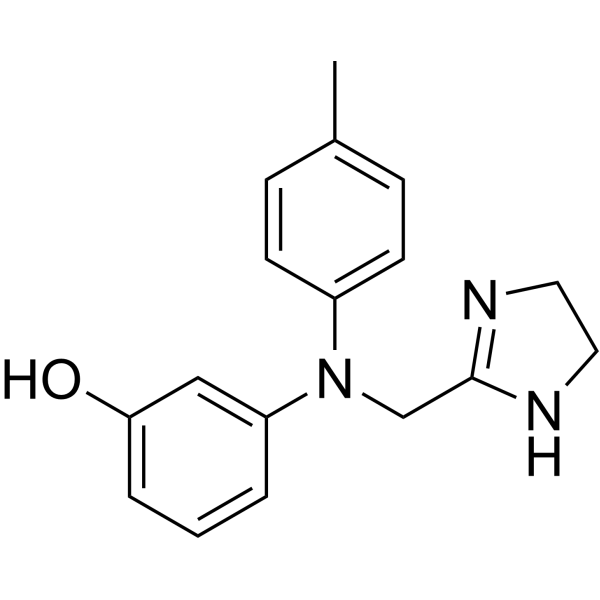
C17H19N3O
|
|---|---|
| 分子量 |
281.359
|
| 精确质量 |
281.152
|
| 元素分析 |
C, 72.57; H, 6.81; N, 14.94; O, 5.69
|
| CAS号 |
50-60-2
|
| 相关CAS号 |
Phentolamine hydrochloride;73-05-2;Phentolamine mesylate;65-28-1
|
| PubChem CID |
5775
|
| 外观&性状 |
White to off-white solid powder
|
| 密度 |
1.2±0.1 g/cm3
|
| 沸点 |
551.0±45.0 °C at 760 mmHg
|
| 熔点 |
175 °C
; Bitter crystals; MP: 239-240 °C. One gram dissolves in 50 mL water, in 70 mL alcohol. Very slightly soluble in chloroform. Practically insoluble in acetone, ethyl acetate. pH of 1% aqueous solution 4.5 to 5.5. Aqueous solutions cannot be stored. /Phentolamin hydrochloride/
; 174.5 °C
|
| 闪点 |
287.0±28.7 °C
|
| 蒸汽压 |
0.0±1.5 mmHg at 25°C
|
| 折射率 |
1.626
|
| LogP |
3.6
|
| tPSA |
47.86
|
| 氢键供体(HBD)数目 |
2
|
| 氢键受体(HBA)数目 |
3
|
| 可旋转键数目(RBC) |
4
|
| 重原子数目 |
21
|
| 分子复杂度/Complexity |
363
|
| 定义原子立体中心数目 |
0
|
| SMILES |
CC1=CC=C(C=C1)N(CC2=NCCN2)C3=CC(=CC=C3)O
|
| InChi Key |
MRBDMNSDAVCSSF-UHFFFAOYSA-N
|
| InChi Code |
InChI=1S/C17H19N3O/c1-13-5-7-14(8-6-13)20(12-17-18-9-10-19-17)15-3-2-4-16(21)11-15/h2-8,11,21H,9-10,12H2,1H3,(H,18,19)
|
| 化学名 |
3-[N-(4,5-dihydro-1H-imidazol-2-ylmethyl)-4-methylanilino]phenol
|
| 别名 |
C-7337; C-7337 Ciba; HSDB-3382; C7337; 50-60-2; Regitine; Fentolamin; Regitin; Dibasin; Fentolamina; Phentolaminum; C7337 Ciba; HSDB3382;; Phentolamine
|
| HS Tariff Code |
2934.99.9001
|
| 存储方式 |
Powder -20°C 3 years 4°C 2 years In solvent -80°C 6 months -20°C 1 month |
| 运输条件 |
Room temperature (This product is stable at ambient temperature for a few days during ordinary shipping and time spent in Customs)
|
| 溶解度 (体外实验) |
May dissolve in DMSO (in most cases), if not, try other solvents such as H2O, Ethanol, or DMF with a minute amount of products to avoid loss of samples
|
|---|---|
| 溶解度 (体内实验) |
注意: 如下所列的是一些常用的体内动物实验溶解配方,主要用于溶解难溶或不溶于水的产品(水溶度<1 mg/mL)。 建议您先取少量样品进行尝试,如该配方可行,再根据实验需求增加样品量。
注射用配方
注射用配方1: DMSO : Tween 80: Saline = 10 : 5 : 85 (如: 100 μL DMSO → 50 μL Tween 80 → 850 μL Saline)(IP/IV/IM/SC等) *生理盐水/Saline的制备:将0.9g氯化钠/NaCl溶解在100 mL ddH ₂ O中,得到澄清溶液。 注射用配方 2: DMSO : PEG300 :Tween 80 : Saline = 10 : 40 : 5 : 45 (如: 100 μL DMSO → 400 μL PEG300 → 50 μL Tween 80 → 450 μL Saline) 注射用配方 3: DMSO : Corn oil = 10 : 90 (如: 100 μL DMSO → 900 μL Corn oil) 示例: 以注射用配方 3 (DMSO : Corn oil = 10 : 90) 为例说明, 如果要配制 1 mL 2.5 mg/mL的工作液, 您可以取 100 μL 25 mg/mL 澄清的 DMSO 储备液,加到 900 μL Corn oil/玉米油中, 混合均匀。 View More
注射用配方 4: DMSO : 20% SBE-β-CD in Saline = 10 : 90 [如:100 μL DMSO → 900 μL (20% SBE-β-CD in Saline)] 口服配方
口服配方 1: 悬浮于0.5% CMC Na (羧甲基纤维素钠) 口服配方 2: 悬浮于0.5% Carboxymethyl cellulose (羧甲基纤维素) 示例: 以口服配方 1 (悬浮于 0.5% CMC Na)为例说明, 如果要配制 100 mL 2.5 mg/mL 的工作液, 您可以先取0.5g CMC Na并将其溶解于100mL ddH2O中,得到0.5%CMC-Na澄清溶液;然后将250 mg待测化合物加到100 mL前述 0.5%CMC Na溶液中,得到悬浮液。 View More
口服配方 3: 溶解于 PEG400 (聚乙二醇400) 请根据您的实验动物和给药方式选择适当的溶解配方/方案: 1、请先配制澄清的储备液(如:用DMSO配置50 或 100 mg/mL母液(储备液)); 2、取适量母液,按从左到右的顺序依次添加助溶剂,澄清后再加入下一助溶剂。以 下列配方为例说明 (注意此配方只用于说明,并不一定代表此产品 的实际溶解配方): 10% DMSO → 40% PEG300 → 5% Tween-80 → 45% ddH2O (或 saline); 假设最终工作液的体积为 1 mL, 浓度为5 mg/mL: 取 100 μL 50 mg/mL 的澄清 DMSO 储备液加到 400 μL PEG300 中,混合均匀/澄清;向上述体系中加入50 μL Tween-80,混合均匀/澄清;然后继续加入450 μL ddH2O (或 saline)定容至 1 mL; 3、溶剂前显示的百分比是指该溶剂在最终溶液/工作液中的体积所占比例; 4、 如产品在配制过程中出现沉淀/析出,可通过加热(≤50℃)或超声的方式助溶; 5、为保证最佳实验结果,工作液请现配现用! 6、如不确定怎么将母液配置成体内动物实验的工作液,请查看说明书或联系我们; 7、 以上所有助溶剂都可在 Invivochem.cn网站购买。 |
| 制备储备液 | 1 mg | 5 mg | 10 mg | |
| 1 mM | 3.5542 mL | 17.7708 mL | 35.5417 mL | |
| 5 mM | 0.7108 mL | 3.5542 mL | 7.1083 mL | |
| 10 mM | 0.3554 mL | 1.7771 mL | 3.5542 mL |
1、根据实验需要选择合适的溶剂配制储备液 (母液):对于大多数产品,InvivoChem推荐用DMSO配置母液 (比如:5、10、20mM或者10、20、50 mg/mL浓度),个别水溶性高的产品可直接溶于水。产品在DMSO 、水或其他溶剂中的具体溶解度详见上”溶解度 (体外)”部分;
2、如果您找不到您想要的溶解度信息,或者很难将产品溶解在溶液中,请联系我们;
3、建议使用下列计算器进行相关计算(摩尔浓度计算器、稀释计算器、分子量计算器、重组计算器等);
4、母液配好之后,将其分装到常规用量,并储存在-20°C或-80°C,尽量减少反复冻融循环。
计算结果:
工作液浓度: mg/mL;
DMSO母液配制方法: mg 药物溶于 μL DMSO溶液(母液浓度 mg/mL)。如该浓度超过该批次药物DMSO溶解度,请首先与我们联系。
体内配方配制方法:取 μL DMSO母液,加入 μL PEG300,混匀澄清后加入μL Tween 80,混匀澄清后加入 μL ddH2O,混匀澄清。
(1) 请确保溶液澄清之后,再加入下一种溶剂 (助溶剂) 。可利用涡旋、超声或水浴加热等方法助溶;
(2) 一定要按顺序加入溶剂 (助溶剂) 。
Link: https://clinicaltrials.gov/ct2/show/NCT03079921
Conditions:Type1diabetes|Hypoglycemia|Hypoglycemia Unawareness|Islet Cell TransplantationLink: https://clinicaltrials.gov/ct2/show/NCT03318094
Conditions:Insulin Resistance|Healthy|ObesityLink: https://clinicaltrials.gov/ct2/show/NCT06787066
Conditions:Menopause
Title:The Role of the Adrenergic System in Hypoglycaemia Induced Inflammatory Response in People With Type 1 Diabetes and People Without Type 1 Diabetes-RAID-II
Status:Active, not recruiting
updateDate:2025-07-24
Ctid:NCT06422494
Link: https://clinicaltrials.gov/ct2/show/NCT06422494
Conditions:Diabetes Mellitus, Type 1|InflammationLink: https://clinicaltrials.gov/ct2/show/NCT04436731
Conditions:Obesity|Healthy|Vasoconstriction|VasodilationLink: https://clinicaltrials.gov/ct2/show/NCT06620991
Conditions:Preoperative|Phentolamine|Intraoperative|Esmolol|Hypotensive Anesthesia|Functional Endoscopic Sinus SurgeryLink: https://clinicaltrials.gov/ct2/show/NCT06385600
Conditions:Severe Pre-eclampsiaLink: https://clinicaltrials.gov/ct2/show/NCT06286059
Conditions:CA-AKI - Contrast-Associated Acute Kidney Injury|Coronary Artery Disease|Acute Coronary Syndrome|Adrenergic Receptor Antagonist Adverse ReactionLink: https://clinicaltrials.gov/ct2/show/NCT06172998
Conditions:Obstructive Sleep ApneaLink: https://clinicaltrials.gov/ct2/show/NCT00132106
Conditions:Heart Failure, CongestiveInvivoChem的所有产品仅用于作科学研究,不面向患者销售
Copyright 2020 InvivoChem LLC | All Rights Reserved 粤ICP备20063088号-1


 粤公网安备 44011102003439号
 463611831
