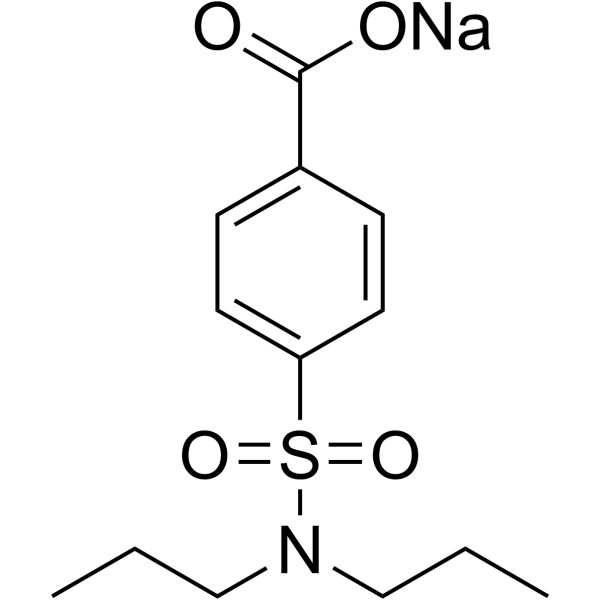
Probenecid sodium

别名: Probenesulfonate; Probenecid sodium; 23795-03-1; Sodium probenecid; Benemid, sodium salt; Probenecid sodium salt; 丙磺舒钠
目录号: V107115 纯度: ≥98%
丙磺舒钠是丙磺舒的钠盐。
Probenecid sodium CAS号: 23795-03-1
产品类别: TRP Channel
产品仅用于科学研究,不针对患者销售
规格 价格 库存 数量
1g
5g
10g
25g
50g
Other Sizes

Other Forms of Probenecid sodium:

  • Probenecid-d14 (丙磺舒 d14)
  • Probenecid-d7
  • Probenecid acyl β-D-glucuronide
  • 丙磺舒
点击了解更多
InvivoChem产品被CNS等顶刊论文引用
产品描述
丙磺舒钠是丙磺舒的钠盐。丙磺舒是一种强效且选择性的瞬时受体电位香草酸受体通道 2 (TRPV2) 激动剂。丙磺舒还能抑制 pannexin 1 通道。
生物活性&实验参考方法
靶点
OAT1/OAT3; Pannexin-1 (Panx1) ; MRP1; transient receptor potential vanilloid 2 (TRPV2)
体外研究 (In Vitro)
Probenecid 有效抑制 MRP1 和 MRP2 对 ATP 依赖性活性囊泡 N-乙基马来酰亚胺谷胱甘肽 (NEM-GS) 的吸收。随着有机阴离子浓度的增加,MRP1-ATP酶受到显着抑制。 MRP2的ATPase活性受丙磺舒(约KACT=250μM)、磺吡酮(KACT=300μM)和吲哚美辛(KACT=150μM)的影响,且ATPase激活甚至比NEM-GS更强。有机阴离子对 MRP2-ATP 酶的激活遵循钟形曲线,丙磺舒的最大值为 2 mM,磺吡酮的最大值为 800 μM,吲哚美辛的最大值为 400 μM [2]。 Probenecid 是 hTAS2R16、hTAS2R38 和 hTAS2R43 苦味受体的抑制剂。丙磺舒作用于 TAS2R 的一个子集,并通过新的变构作用机制进行抑制。丙磺舒也经常用于改善 GPCR 钙动员实验中的细胞信号传导。丙磺舒特异性抑制苦味受体 hTAS2R16 介导的细胞反应,并为使用非竞争性(变构)机制与该 GPCR 直接接触提供分子和药理学证据。
体内研究 (In Vivo)
与饲喂盐水的对照小鼠相比,丙磺舒增加了 WT 小鼠的收缩力,如射血分数 (EF) 所示。在 75 mg/kg 及更高剂量的所有剂量下,在推注后 5 分钟内观察到收缩力增加(75 mg/kg、100 mg/kg 和 200 mg/kg 时的峰值变化分别为 5.26±3.35、8.40±2.80 和分别为7.32±2.52)。估计 EC50 为 49.33 mg/kg,在总共 30 分钟内以 5 分钟为间隔评估的收缩性变化显示出收缩性的剂量依赖性增加。在较长时间内接受检查的患者中,EF 保持升高至少一个小时(n=5,200 mg/kg IV)(EF 相对于基线的平均升高为 8.9±2.57)
动物实验
In order to obtain a dose response curve, male C57 WT (n=39) mice 12-16 weeks of age are anesthetized with isoflurane while intravenous jugular access (IV) is obtained under a microscope. Subsequently, an echocardiographic study with both M-mode and B-mode is obtained in parasternal long axis (PSLAX) as described below. Either saline or different doses of Probenecid (increasing from 2 to 200mg/kg) are injected (bolus IV) for the initial contractility studies in WT mice.
药代性质 (ADME/PK)
Absorption, Distribution and Excretion
Excreted principally in the urine as monoacyl glucuronide and unchanged drug. Alkalinization of urine increases renal probenecid excretion.
PROBENECID IS COMPLETELY ABSORBED AFTER ORAL ADMIN. PEAK PLASMA CONCN ARE REACHED IN 2-4 HR. THE HALF-LIFE OF THE DRUG IN PLASMA IS DOSE DEPENDENT AND VARIES FROM LESS THAN 5 HR TO MORE THAN 8 HR.
BETWEEN 85 & 95% OF DRUG IS BOUND TO PLASMA ALBUMIN, LARGELY TO ALBUMIN. SMALL UNBOUND PORTION GAINS ACCESS TO GLOMERULAR FILTRATE; A MUCH LARGER PORTION IS ACTIVELY SECRETED BY PROXIMAL TUBULE.
IN SPITE OF ITS LOW PKA (3.4), HIGH LIPID SOLUBILITY OF UNDISSOCIATED FORM RESULTS IN VIRTUALLY COMPLETE ABSORPTION BY BACK DIFFUSION UNLESS URINE IS MARKEDLY ALKALINE. SMALL AMOUNT OF PROBENECID GLUCURONIDE APPEARS IN URINE.
... /ORG ACID CMPD SUCH AS PROBENECID /ARE/ NOT TAKEN UP SO AVIDLY BY /PARENCHYMATOUS OR RETICULO-ENDOTHELIAL TISSUES/ & EXHIBIT HIGHER PLASMA CONCN ... .
For more Absorption, Distribution and Excretion (Complete) data for PROBENECID (8 total), please visit the HSDB record page.
Metabolism / Metabolites
YIELDS P-DIPROPYLSULFAMOYLBENZOYL-BETA-D-GLUCURONIC ACID; P-(2-HYDROXYPROPYL N-PROPYLSULFAMOYL) BENZOIC ACID; P-(3-HYDROXYPROPYL N-PROPYLSULFAMOYL) BENZOIC ACID; & P-PROPYLSULFAMOYLBENZOIC ACID IN MAN. /FROM TABLE/
STRUCTURES OF ALL OF METAB OF PROBENECID IN RAT BILE & HUMAN URINE HAVE BEEN ELUCIDATED. PROPIONIC ACID HAS NOW BEEN IDENTIFIED AS ANOTHER PROBENECID METAB. MAJOR METABOLIC PATHWAYS INVOLVE SIDE-CHAIN OXIDATION & GLUCURONIDE CONJUGATION ... .
... BETA-GLUCURONIDES OF 2- & 3-HYDROXYLATED METAB & ACYL GLUCURONIDE OF PROBENECID PER SE HAVE NOW BEEN IDENTIFIED. ... THERE IS CONSIDERABLE SPECIES DIFFERENCE IN METABOLISM. IN RATS & MONKEYS OXIDATION IS FAVORED. ... IN DOGS CONJUGATION ... /IS/ MAJOR PATHWAY, WHEREAS IN MAN, OXIDATIVE ... PATHWAY ... IS AS IMPORTANT AS GLUCURONIDATION.
CHRONIC ADMIN OF DRUGS NOT ONLY STIMULATES METAB OF OTHER CMPD, BUT IN SOME INSTANCES PHARMACOLOGICAL OR TOXIC EFFECT OF A DRUG WHEN GIVEN CHRONICALLY, DIMINISHES, BECAUSE IT STIMULATES ITS OWN METABOLISM EXAMPLE OF DRUG THAT EXERT THIS EFFECT IN DOGS ... /IS/ ... PROBENECID ... .
For more Metabolism/Metabolites (Complete) data for PROBENECID (6 total), please visit the HSDB record page.
Biological Half-Life
6-12 hours
THE HALF-LIFE OF /PROBENECID/ IN PLASMA IS DOSE DEPENDENT AND VARIES FROM LESS THAN 5 HR TO MORE THAN 8 HR ... .
Following oral administration of 2 g of probenecid, plasma half-life of the drug ranges from 4-17 hr; the half-life decreases as the dose decreases from 2 g to 500 mg.
毒性/毒理 (Toxicokinetics/TK)
23662399 man TDLo oral 630 mg/kg/6W KIDNEY, URETER, AND BLADDER: PROTEINURIS; KIDNEY, URETER, AND BLADDER: CHANGES PRIMARILY IN GLOMERULI Archives of Pathology., 94(241), 1972 [PMID:5051645]
23662399 mouse LD50 oral 1666 mg/kg BEHAVIORAL: CONVULSIONS OR EFFECT ON SEIZURE THRESHOLD; BEHAVIORAL: TETANY; LUNGS, THORAX, OR RESPIRATION: OTHER CHANGES Journal of Pharmacology and Experimental Therapeutics., 102(208), 1951 [PMID:14851208]
23662399 rat LD50 intraperitoneal 394 mg/kg BEHAVIORAL: CONVULSIONS OR EFFECT ON SEIZURE THRESHOLD; BEHAVIORAL: TETANY; LUNGS, THORAX, OR RESPIRATION: OTHER CHANGES Journal of Pharmacology and Experimental Therapeutics., 102(208), 1951 [PMID:14851208]
23662399 rabbit LD50 intravenous 304 mg/kg BEHAVIORAL: CONVULSIONS OR EFFECT ON SEIZURE THRESHOLD; BEHAVIORAL: TETANY; LUNGS, THORAX, OR RESPIRATION: OTHER CHANGES Journal of Pharmacology and Experimental Therapeutics., 102(208), 1951 [PMID:14851208]
23662399 mouse LD50 subcutaneous 1156 mg/kg BEHAVIORAL: CONVULSIONS OR EFFECT ON SEIZURE THRESHOLD; BEHAVIORAL: TETANY; LUNGS, THORAX, OR RESPIRATION: OTHER CHANGES Journal of Pharmacology and Experimental Therapeutics., 102(208), 1951 [PMID:14851208]
Hepatotoxicity
There are no reports on the frequency of liver test abnormalities during probenecid therapy, but they are probably rare as the drug is largely secreted unchanged in the urine. A single case report of a severe hypersensitivity reaction from probenecid and rechallenge with a rapid and severe recurrence of jaundice was reported over 50 years ago. As is typical for hypersensitivity reactions, the onset was within days of starting probenecid and was accompanied by fever and rash.
Likelihood score: D (possible rare cause of clinically apparent liver injury).
Effects During Pregnancy and Lactation
◉ Summary of Use during Lactation
Limited information indicates that maternal doses of probenecid up to 2 grams daily produce low levels in milk and would not be expected to cause any adverse effects in breastfed infants, especially if the infant is older than 2 months. In animal studies, probenecid increased the breastmilk excretion of cimetidine, possible via an interaction with an active transport mechanism in the breast. The implications of enhanced excretion of drugs given with probenecid for nursing mothers and their infants has not been studied; however, only a few drugs are known to undergo active transport into breastmilk.
◉ Effects in Breastfed Infants
A woman with mastitis received 3 days of intravenous cephalothin, followed by 16 days of probenecid 500 mg and cephalexin 500 mg 4 times daily for 16 days. Her infant developed green liquid stools, severe diarrhea, discomfort and crying. The authors judged the effects to be probably related to the cephalothin and cephalexin in milk rather than the probenecid.
◉ Effects on Lactation and Breastmilk
Relevant published information was not found as of the revision date.
Protein Binding
75-95%
参考文献

[1]. Probenecid: novel use as a non-injurious positive inotrope acting via cardiac TRPV2 stimulation. J Mol Cell Cardiol. 2012 Jul;53(1):134-44.

[2]. Interactions of the human multidrug resistance proteins MRP1 and MRP2 with organic anions. Mol Pharmacol. 2000 Apr;57(4):760-8.

[3]. Probenecid inhibits the human bitter taste receptor TAS2R16 and suppresses bitter perception of salicin. PLoS One. 2011;6(5):e20123.

[4]. Probenecid, a gout remedy, inhibits pannexin 1 channels. Am J Physiol Cell Physiol. 2008 Sep;295(3):C761-7.

其他信息
Probenecid appears as odorless white or almost white crystalline powder. Slightly bitter taste; pleasant aftertaste. (NTP, 1992)
Probenecid is a sulfonamide in which the nitrogen of 4-sulfamoylbenzoic acid is substituted with two propyl groups. It has a role as a uricosuric drug. It is a sulfonamide and a member of benzoic acids.
The prototypical uricosuric agent. It inhibits the renal excretion of organic anions and reduces tubular reabsorption of urate. Probenecid has also been used to treat patients with renal impairment, and, because it reduces the renal tubular excretion of other drugs, has been used as an adjunct to antibacterial therapy.
Probenecid is a uricosuric agent used for the treatment of gout usually in combination with other agents. Probenecid has been associated with minor serum aminotransferase elevations and very rarely with hypersensitivity reactions which, even more rarely, can be accompanied by acute liver injury.
Probenecid is a benzoic acid derivative with antihyperuricemic property. Probenecid competitively inhibits the active reabsorption of urate at the proximal tubule in the kidney thereby increasing urinary excretion of uric acid and lowering serum urate concentrations. This prevents urate deposition and promotes resolution of existing urate deposits. In addition, probenecid modulates the transport of organic acids and acidic drugs at the proximal and distal renal tubule, thereby increasing the drug serum concentration.
The prototypical uricosuric agent. It inhibits the renal excretion of organic anions and reduces tubular reabsorption of urate. Probenecid has also been used to treat patients with renal impairment, and, because it reduces the renal tubular excretion of other drugs, has been used as an adjunct to antibacterial therapy.
See also: Colchicine; probenecid (component of); Ampicillin/ampicillin trihydrate; probenecid (component of).
Drug Indication
For the reduction of serum uric acid concentrations in chronic gouty arthritis and tophaceous gout in patients with frequent disabling gout attacks. Has also been effectively used to promote uric acid excretion in hyperuricemia secondary to the administration of thiazide and related diuretics.
Mechanism of Action
Probenecid inhibits the tubular reabsorption of urate, thus increasing the urinary excretion of uric acid and decreasing serum urate levels. Probenecid may also reduce plasma binding of urate and inhibit renal secretion of uric acid at subtherapeutic concentrations. The mechanism by which probenecid inhibits renal tubular transport is not known, but the drug may inhibit transport enzymes that require a source of high energy phosphate bonds and/or nonspecifically interfere with substrate access to protein receptor sites on the kidney tubules.
IN HIGHER DOSES THAN ARE REQUIRED FOR URICOSURIC EFFECT, PROBENECID ALSO INHIBITS TRANSPORT OF ORG ACIDS AT OTHER SITES, IE, TRANSPORT SYSTEM THAT REMOVES ORG ACIDS FROM CEREBROSPINAL FLUID.
IT INHIBITS TUBULAR REABSORPTION OF URATE, THUS INCR URINARY EXCRETION OF URIC ACID & DECR SERUM URIC ACID LEVELS.
Probenecid is a renal tubular blocking agent. The drug competitively inhibits active reabsorption of uric acid at the proximal convoluted tubule, thus promoting urinary excretion of uric acid and reducing serum urate concentrations. Probenecid may reduce plasma protein binding of urate and, in subtherapeutic doses, may inhibit renal secretion of uric acid. In healthy individuals, probenecid has no effect on the glomerular filtration rate or on the tubular reabsorption of normal urinary constituents such as glucose, arginine, urea, sodium, potassium, chloride, or phosphate.
At the proximal and distal tubules, probenecid competitively inhibits the secretion of many weak organic acids including penicillins, most cephalosporins, and some other beta-lactam antibiotics. In general, the net effect of probenecid on the plasma concentration of weak acids depends on the ratio of the amount of organic acid secreted by the kidneys to that amount filtered at the glomeruli. Thus, probenecid substantially increases plasma concentrations of acidic drugs eliminated principally by renal secretion, but increases plasma concentrations only slightly if the drug is eliminated mainly by filtration. Plasma concentrations of penicillins are often more than doubled by probenecid; the concentration of penicillin in the CSF is also increased. Probenecid also substantially increases plasma concentrations of most cephalosporins and some other beta-lactam antibiotics. In addition, half-lives of the penicillins and cephalosporins are prolonged and their volumes of distribution may be reduced by probenecid. ... The cellular mechanism(s) responsible for the inhibition of renal tubular transport by probenecid is not known. The drug may inhibit transport enzymes that require a source of high energy phosphate bonds and/or nonspecifically interfere with substrate access to protein receptor sites on the kidney tubules.
CSF concentrations of 5-hydroxyindoleacetic acid, homovanillic acid, cyclic adenosine monophosphate, and 4-hydroxy-3-methoxyphenylglycol are elevated following administration of probenecid. It has been proposed that probenecid blocks the active transport of these organic acids from the CSF into blood. Probenecid-induced elevations of homovanillic acid (a dopamine metabolite) in the CSF of patients with parkinsonian syndrome and of 5-hydroxyindoleacetic acid(a metabolite of serotonin) in the CSF of mentally depressed patients are substantially lower than those in healthy patients.
*注: 文献方法仅供参考, InvivoChem并未独立验证这些方法的准确性
化学信息 & 存储运输条件
分子式
C13H18NNAO4S
分子量
307.34
精确质量
307.08542
CAS号
23795-03-1
相关CAS号
Probenecid-d14;1189657-87-1;Probenecid;57-66-9;Probenecid-d7;2012598-90-0
PubChem CID
23662399
外观&性状
White to off-white solids at room temperature
沸点
438ºC at 760mmHg
闪点
218.7ºC
蒸汽压
1.91E-08mmHg at 25°C
LogP
1.942
tPSA
85.89
氢键受体(HBA)数目
5
可旋转键数目(RBC)
7
重原子数目
20
分子复杂度/Complexity
380
定义原子立体中心数目
0
SMILES
[Na+].CCCN(S(C1C=CC(C([O-])=O)=CC=1)(=O)=O)CCC
InChi Key
QCCCFHDTBTUDEA-UHFFFAOYSA-M
InChi Code
InChI=1S/C13H19NO4S.Na/c1-3-9-14(10-4-2)19(17,18)12-7-5-11(6-8-12)13(15)16;/h5-8H,3-4,9-10H2,1-2H3,(H,15,16);/q;+1/p-1
化学名
sodium 4-(dipropylsulfamoyl)benzoate
别名
Probenesulfonate; Probenecid sodium; 23795-03-1; Sodium probenecid; Benemid, sodium salt; Probenecid sodium salt;
HS Tariff Code
2934.99.9001
存储方式

Powder      -20°C    3 years

                     4°C     2 years

In solvent   -80°C    6 months

                  -20°C    1 month

运输条件
Room temperature (This product is stable at ambient temperature for a few days during ordinary shipping and time spent in Customs)
溶解度数据
溶解度 (体外实验)
May dissolve in DMSO (in most cases), if not, try other solvents such as H2O, Ethanol, or DMF with a minute amount of products to avoid loss of samples
溶解度 (体内实验)
注意: 如下所列的是一些常用的体内动物实验溶解配方,主要用于溶解难溶或不溶于水的产品(水溶度<1 mg/mL)。 建议您先取少量样品进行尝试,如该配方可行,再根据实验需求增加样品量。

注射用配方
(IP/IV/IM/SC等)
注射用配方1: DMSO : Tween 80: Saline = 10 : 5 : 85 (如: 100 μL DMSO 50 μL Tween 80 850 μL Saline)
*生理盐水/Saline的制备:将0.9g氯化钠/NaCl溶解在100 mL ddH ₂ O中,得到澄清溶液。
注射用配方 2: DMSO : PEG300Tween 80 : Saline = 10 : 40 : 5 : 45 (如: 100 μL DMSO 400 μL PEG300 50 μL Tween 80 450 μL Saline)
注射用配方 3: DMSO : Corn oil = 10 : 90 (如: 100 μL DMSO 900 μL Corn oil)
示例: 注射用配方 3 (DMSO : Corn oil = 10 : 90) 为例说明, 如果要配制 1 mL 2.5 mg/mL的工作液, 您可以取 100 μL 25 mg/mL 澄清的 DMSO 储备液,加到 900 μL Corn oil/玉米油中, 混合均匀。
View More

注射用配方 4: DMSO : 20% SBE-β-CD in Saline = 10 : 90 [如:100 μL DMSO 900 μL (20% SBE-β-CD in Saline)]
*20% SBE-β-CD in Saline的制备(4°C,储存1周):将2g SBE-β-CD (磺丁基-β-环糊精) 溶解于10mL生理盐水中,得到澄清溶液。
注射用配方 5: 2-Hydroxypropyl-β-cyclodextrin : Saline = 50 : 50 (如: 500 μL 2-Hydroxypropyl-β-cyclodextrin (羟丙基环胡精) 500 μL Saline)
注射用配方 6: DMSO : PEG300 : Castor oil : Saline = 5 : 10 : 20 : 65 (如: 50 μL DMSO 100 μL PEG300 200 μL Castor oil 650 μL Saline)
注射用配方 7: Ethanol : Cremophor : Saline = 10: 10 : 80 (如: 100 μL Ethanol 100 μL Cremophor 800 μL Saline)
注射用配方 8: 溶解于Cremophor/Ethanol (50 : 50), 然后用生理盐水稀释。
注射用配方 9: EtOH : Corn oil = 10 : 90 (如: 100 μL EtOH 900 μL Corn oil)
注射用配方 10: EtOH : PEG300Tween 80 : Saline = 10 : 40 : 5 : 45 (如: 100 μL EtOH 400 μL PEG300 50 μL Tween 80 450 μL Saline)


口服配方
口服配方 1: 悬浮于0.5% CMC Na (羧甲基纤维素钠)
口服配方 2: 悬浮于0.5% Carboxymethyl cellulose (羧甲基纤维素)
示例: 口服配方 1 (悬浮于 0.5% CMC Na)为例说明, 如果要配制 100 mL 2.5 mg/mL 的工作液, 您可以先取0.5g CMC Na并将其溶解于100mL ddH2O中,得到0.5%CMC-Na澄清溶液;然后将250 mg待测化合物加到100 mL前述 0.5%CMC Na溶液中,得到悬浮液。
View More

口服配方 3: 溶解于 PEG400 (聚乙二醇400)
口服配方 4: 悬浮于0.2% Carboxymethyl cellulose (羧甲基纤维素)
口服配方 5: 溶解于0.25% Tween 80 and 0.5% Carboxymethyl cellulose (羧甲基纤维素)
口服配方 6: 做成粉末与食物混合


注意: 以上为较为常见方法,仅供参考, InvivoChem并未独立验证这些配方的准确性。具体溶剂的选择首先应参照文献已报道溶解方法、配方或剂型,对于某些尚未有文献报道溶解方法的化合物,需通过前期实验来确定(建议先取少量样品进行尝试),包括产品的溶解情况、梯度设置、动物的耐受性等。

请根据您的实验动物和给药方式选择适当的溶解配方/方案:
1、请先配制澄清的储备液(如:用DMSO配置50 或 100 mg/mL母液(储备液));
2、取适量母液,按从左到右的顺序依次添加助溶剂,澄清后再加入下一助溶剂。以 下列配方为例说明 (注意此配方只用于说明,并不一定代表此产品 的实际溶解配方):
10% DMSO → 40% PEG300 → 5% Tween-80 → 45% ddH2O (或 saline);
假设最终工作液的体积为 1 mL, 浓度为5 mg/mL: 取 100 μL 50 mg/mL 的澄清 DMSO 储备液加到 400 μL PEG300 中,混合均匀/澄清;向上述体系中加入50 μL Tween-80,混合均匀/澄清;然后继续加入450 μL ddH2O (或 saline)定容至 1 mL;

3、溶剂前显示的百分比是指该溶剂在最终溶液/工作液中的体积所占比例;
4、 如产品在配制过程中出现沉淀/析出,可通过加热(≤50℃)或超声的方式助溶;
5、为保证最佳实验结果,工作液请现配现用!
6、如不确定怎么将母液配置成体内动物实验的工作液,请查看说明书或联系我们;
7、 以上所有助溶剂都可在 Invivochem.cn网站购买。
制备储备液 1 mg 5 mg 10 mg
1 mM 3.2537 mL 16.2686 mL 32.5373 mL
5 mM 0.6507 mL 3.2537 mL 6.5075 mL
10 mM 0.3254 mL 1.6269 mL 3.2537 mL

1、根据实验需要选择合适的溶剂配制储备液 (母液):对于大多数产品,InvivoChem推荐用DMSO配置母液 (比如:5、10、20mM或者10、20、50 mg/mL浓度),个别水溶性高的产品可直接溶于水。产品在DMSO 、水或其他溶剂中的具体溶解度详见上”溶解度 (体外)”部分;

2、如果您找不到您想要的溶解度信息,或者很难将产品溶解在溶液中,请联系我们;

3、建议使用下列计算器进行相关计算(摩尔浓度计算器、稀释计算器、分子量计算器、重组计算器等);

4、母液配好之后,将其分装到常规用量,并储存在-20°C或-80°C,尽量减少反复冻融循环。

计算器

摩尔浓度计算器可计算特定溶液所需的质量、体积/浓度,具体如下:

  • 计算制备已知体积和浓度的溶液所需的化合物的质量
  • 计算将已知质量的化合物溶解到所需浓度所需的溶液体积
  • 计算特定体积中已知质量的化合物产生的溶液的浓度
使用摩尔浓度计算器计算摩尔浓度的示例如下所示:
假如化合物的分子量为350.26 g/mol,在5mL DMSO中制备10mM储备液所需的化合物的质量是多少?
  • 在分子量(MW)框中输入350.26
  • 在“浓度”框中输入10,然后选择正确的单位(mM)
  • 在“体积”框中输入5,然后选择正确的单位(mL)
  • 单击“计算”按钮
  • 答案17.513 mg出现在“质量”框中。以类似的方式,您可以计算体积和浓度。

稀释计算器可计算如何稀释已知浓度的储备液。例如,可以输入C1、C2和V2来计算V1,具体如下:

制备25毫升25μM溶液需要多少体积的10 mM储备溶液?
使用方程式C1V1=C2V2,其中C1=10mM,C2=25μM,V2=25 ml,V1未知:
  • 在C1框中输入10,然后选择正确的单位(mM)
  • 在C2框中输入25,然后选择正确的单位(μM)
  • 在V2框中输入25,然后选择正确的单位(mL)
  • 单击“计算”按钮
  • 答案62.5μL(0.1 ml)出现在V1框中
g/mol

分子量计算器可计算化合物的分子量 (摩尔质量)和元素组成,具体如下:

注:化学分子式大小写敏感:C12H18N3O4  c12h18n3o4
计算化合物摩尔质量(分子量)的说明:
  • 要计算化合物的分子量 (摩尔质量),请输入化学/分子式,然后单击“计算”按钮。
分子质量、分子量、摩尔质量和摩尔量的定义:
  • 分子质量(或分子量)是一种物质的一个分子的质量,用统一的原子质量单位(u)表示。(1u等于碳-12中一个原子质量的1/12)
  • 摩尔质量(摩尔重量)是一摩尔物质的质量,以g/mol表示。
/

配液计算器可计算将特定质量的产品配成特定浓度所需的溶剂体积 (配液体积)

  • 输入试剂的质量、所需的配液浓度以及正确的单位
  • 单击“计算”按钮
  • 答案显示在体积框中
动物体内实验配方计算器(澄清溶液)
第一步:请输入基本实验信息(考虑到实验过程中的损耗,建议多配一只动物的药量)
第二步:请输入动物体内配方组成(配方适用于不溶/难溶于水的化合物),不同的产品和批次配方组成不同,如对配方有疑问,可先联系我们提供正确的体内实验配方。此外,请注意这只是一个配方计算器,而不是特定产品的确切配方。
+
+
+

计算结果:

工作液浓度 mg/mL;

DMSO母液配制方法 mg 药物溶于 μL DMSO溶液(母液浓度 mg/mL)。如该浓度超过该批次药物DMSO溶解度,请首先与我们联系。

体内配方配制方法μL DMSO母液,加入 μL PEG300,混匀澄清后加入μL Tween 80,混匀澄清后加入 μL ddH2O,混匀澄清。

(1) 请确保溶液澄清之后,再加入下一种溶剂 (助溶剂) 。可利用涡旋、超声或水浴加热等方法助溶;
            (2) 一定要按顺序加入溶剂 (助溶剂) 。

临床试验信息
A Study of Baricitinib and Probenecid in Healthy Participants
CTID: NCT01937026
Phase: Phase 1
Status: Completed
Date: 2017-06-06
Intravesical Cidofovir for Hemorrhagic Cystitis
CTID: NCT01816646
Phase: Phase 1
Status: Completed
Date: 2016-12-06
Pharmacologic Study of Oseltamivir in Healthy Volunteers
CTID: NCT00439530
Phase: Phase 1
Status: Completed
Date: 2009-07-28
Biodistribution and Pathophysiology Study of 11C-para-aminobenzoic Acid
CTID: NCT05611905
Status: Completed
Date: 2025-12-12
Pharmacokinetic Drug-Drug Interaction Study to Identify Biomarkers of Kidney Transporters
CTID: NCT05365451
Phase: Early Phase 1
Status: Completed
Date: 2025-08-08
Does Cholestyramine/Colesevelam and Probenecid increase the elimination of Perfluoroalkyl substances? An experimental study of highly exposed individuals in Ronneby, Sweden.
EudraCT: 2021-005865-42
Phase: Phase 2
Status: Completed
Date: 2022-05-11
Observational study of the effects of probenecid on the pharmacokinetics and pharmacodynamics of sorafenib (PROSORA-study)
EudraCT: 2017-002470-40
Phase: Phase 4
Status: Ongoing
Date: 2017-11-16
The influence of UGT inhibition on endoxifen exposure in cancer patients treated with tamoxifen: A proof of concept study. “The PROTAM study”
EudraCT: 2019-004854-27
Phase: Phase 4
Status: Completed
Date: 2020-02-27
Pharmacokinetic interactions between probenecid and the combination mycophenolate mofetil - cyclosporine/tacrolimus in stable renal allograft recipients
EudraCT: 2005-000012-27
Phase: Phase 4
Status: Completed
Date: 2005-09-06
multicenter non-randomized non-blind exploratory clinical trial of safety and efficacy of cidofovir for adenovirus infection after hematopoietic stem cell transplantation
CTID: UMIN000011158
Status: Complete: follow-up complete
Date: 2013-07-10
14C-acetaminophen microdose clinical trial using AMS
CTID: UMIN000002084
Phase: Not applicable
Status: Complete: follow-up complete
Date: 2009-06-21
Amoxicillin study for early syphilis
CTID: jRCT1031210615
Status: Recruiting
Date: 2022-02-18
Efficacy of amoxicillin therapy versus benzathine penicillin G for early syphilis, a multicenter, open-Label,randomized, controlled clinical trial
CTID: UMIN000046856
Phase: Not applicable
Status: Recruiting
Date: 2022-02-10
Safety and efficacy of cidofovir for adenovirus infection
CTID: UMIN000004336
Status: Complete: follow-up complete
Date: 2010-10-06
相关产品
联系我们