| 规格 | 价格 | 库存 | 数量 |
|---|---|---|---|
| 50mg |
|
||
| Other Sizes |
|
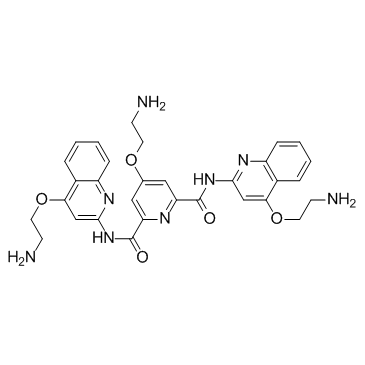
描述:吡啶斯他汀 (RR82) 是一种 G-四链体 (G4) 稳定剂,在无细胞测定中 Kd 为 490 nM,靶向一系列原癌基因,包括 c-kit、K-ras 和 Bcl-2。吡啶斯他汀可降低 MRC-5–SV40 细胞和多种癌细胞系的增殖,并通过激活 DNA 损伤检查点诱导细胞周期阻滞。吡啶斯他汀还可通过与 SRC 中的 G-四链体基序相互作用,降低 MDA-MB-231 细胞中 SRC 依赖的细胞运动能力。
| 靶点 |
G-quadruplexe ( Kd = 490 nM )
Pyridostatin is a small molecule that binds to G-quadruplex DNA structures. [1] |
|---|---|
| 体外研究 (In Vitro) |
吡啶格洛汀 (RR82) (10 μM;48 小时) 可诱导细胞周期阻滞 [1]。吡啶格洛汀是一种微小的化学物质,它能选择性地与 DNA 中的 G-四链体结构结合,并与其形成复合物以稳定该结构。吡啶格洛汀可引起剂量依赖性的神经元死亡、神经突回缩和突触丢失。在培养的原代神经元中,吡啶格洛汀会导致 DNA 双链断裂。值得注意的是,吡啶格洛汀 (1–5 μM,过夜) 可下调 BRCA1 蛋白(该蛋白负责保护和修复神经元基因组)的转录 [3]。在 FRET 熔解实验中,吡啶格洛汀及其炔烃类似物(吡啶格洛汀-a)对一组已知的 G-四链体 DNA 基序表现出相似的熔解曲线。 [1]
- SRC基因G-四链体序列的圆二色谱光谱显示在265 nm(平行构象)和/或298 nm(反平行构象)处有特征性的摩尔椭圆率峰值,表明存在折叠的G-四链体结构。[1] - SRC基因G-四链体序列的核磁共振波谱显示,在10.5至12.5 ppm之间存在亚氨基质子信号,这是堆叠G-四联体中Hoogsteen氢键的特征信号。加入1.1摩尔当量吡啶斯他汀后,观察到整体谱线展宽和亚氨基质子信号向高场位移,这与吡啶斯他汀通过堆叠相互作用与顶部G-四联体结合相一致。 [1] - 通过铜催化的点击化学反应对吡啶斯他汀-a(炔烃类似物)进行细胞内化学标记,生成荧光标记的吡啶斯他汀(3),该标记物在细胞核内形成聚集灶,并呈现出与核仁染色一致的较大图案。[1] |
| 体内研究 (In Vivo) |
吡啶斯他汀对 BRCA2 缺陷型异种移植瘤具有抗肿瘤活性[4]
已证实,能够结合并稳定 G4 结构域的化合物对小鼠体内建立的 BRCA1/2 缺陷型异种移植瘤(RHPS4 和 CX-5461)具有活性。然而,这些化合物尚未被证实能够使 BRCA 突变患者获益。此外,BRCA 突变型肿瘤难以治疗,因为它们会迅速对靶向治疗(例如 PARP 抑制剂;PARPi)产生耐药性。因此,亟需寻找新的 G4 配体,不仅能够清除 BRCA 缺陷型肿瘤,还能对抗耐药性疾病。我们之前发表的研究结果(Zimmer 等,2016)表明,G4 配体吡啶斯他汀在体外对 BRCA2 缺陷型细胞具有特异性毒性。本研究评估了吡啶斯他汀在体内清除BRCA2缺陷型异种移植瘤的潜力。为此,研究人员使用同源的BRCA2+/+(BRCA2功能正常)和BRCA2-/-(BRCA2缺陷)人结直肠腺癌DLD1细胞,在CB17-SCID小鼠中构建了异种移植瘤(图1A和B)。研究人员对吡啶斯他汀的体内应用条件进行了广泛优化,结果表明,连续5天静脉注射7.5 mg/kg/天,停药2天后再进行5天治疗,该给药方案耐受性良好,表现为无明显体重下降且无不良临床症状(附录表S1)。在这些条件下,研究人员发现吡啶斯他汀能有效且特异性地抑制由BRCA2缺陷型DLD1细胞建立的异种移植瘤的生长(图1B)。作为对照,研究人员使用了PARP抑制剂他拉唑帕尼,该药物因其能够根除小鼠体内BRCA1/2缺陷型肿瘤而为人所知(Shen等,2013),并且最近已获准用于治疗携带BRCA1/2种系突变的转移性乳腺癌患者(Litton等,2018)。吡啶斯他汀对 BRCA2 缺陷型肿瘤的抗肿瘤作用与他拉唑帕尼相似,两种药物均不抑制 BRCA2 功能正常型肿瘤的生长。 此外,研究人员使用由同源 BRCA2 +/+ 和 BRCA2 −/− 结直肠癌 HCT116 细胞建立的第二个肿瘤模型研究了吡啶斯他汀的体内反应(Xu 等,2014)。吡啶斯他汀对 BRCA2 缺陷型 HCT116 细胞来源的肿瘤表现出选择性毒性(附录图 S1A 和 B;附录表 S2),与它在 DLD1 细胞来源的异种移植瘤中的作用类似。[4] 研究人员之前的研究表明,吡啶斯他汀治疗会导致 HR 修复受损的细胞(包括 BRCA2 缺陷型细胞)中 DNA 损伤的积累(Zimmer 等,2016)。与此一致的是,免疫组织化学 (IHC) 分析显示,BRCA2 缺陷型肿瘤(而非 BRCA2 功能正常的肿瘤)在暴露于吡啶斯他汀或他拉唑帕尼后,DNA 损伤标志物 γH2AX 的水平升高(附录图 S1C-F)。这些结果表明,吡啶斯他汀不仅能特异性地抑制细胞生长(Zimmer等人,2016),还能抑制缺乏BRCA2的肿瘤,并且其在体内的作用机制是通过造成DNA损伤。[4] |
| 细胞实验 |
细胞活力检测 [1]
细胞类型: 超过 60 种不同的癌细胞系 测试浓度: 10 μM 孵育时间: 48 小时 实验结果: 主要积累在超过 60 种不同癌细胞系的细胞周期 G2 期。 用吡啶斯他汀(2 μM,24-72 小时)处理的 MRC5-SV40 成纤维细胞和各种癌细胞系均表现出增殖减少和细胞周期 G2 期积累。 [1] - 对吡啶斯他汀(2 μM,24–72 h)处理的细胞进行蛋白质印迹分析显示,组蛋白 H2AX(Ser-139,γH2AX)、KAP1(Ser-824)、Chk1(Ser-345)、RPA(Ser-4/8)和 DNA-PKcs(Ser-2056)发生磷酸化,表明 DNA 损伤反应被激活。处理 72 h 后观察到 PARP-1 裂解,表明部分细胞发生凋亡。[1] - 免疫荧光分析显示,吡啶斯他汀(20 μM,4 h)处理的细胞在 G1、S 和 G2 期均形成 γH2AX 聚集灶。用 DRB(转录抑制剂)预处理可阻止 G1 和 G2 期细胞中 γH2AX 聚集灶的形成;用蚜虫霉素(复制抑制剂)进一步预处理可减少聚集灶。 [1] - 中性彗星试验证实,吡啶斯他汀(2 μM,24 h)处理的细胞中存在DNA双链断裂;与DNA-PKcs抑制剂NU7441联合处理可增强彗星尾矩。[1] - 在MRC5-SV40细胞中,吡啶斯他汀(2 μM)处理8 h后,SRC mRNA水平降低>95%,24 h后SRC蛋白水平降低约60%。[1] - 在MDA-MB-231乳腺癌细胞中,吡啶斯他汀(2 μM)处理48 h后,划痕试验中伤口愈合能力显著降低,而阿霉素(100 nM)虽然生长抑制作用相似,但对细胞迁移没有影响。 [1] - 对γH2AX进行染色质免疫沉淀(ChIP),随后进行高通量测序(ChIP-Seq),鉴定出吡啶斯他汀诱导的DNA损伤位点富集于含有具有G-四链体形成潜能序列簇的基因体中。[1] - 在稳定表达GFP-hPif1α的U2OS细胞中,荧光显微镜显示,在药物添加前固定的细胞中,GFP-hPif1α与荧光标记的吡啶斯他汀共定位,表明二者靶向基因组结构存在重叠。[1] |
| 动物实验 |
CB17-SCID小鼠
7.5 mg/kg 静脉注射 体内异种移植实验[4] CB17-SCID小鼠(CB17/Icr-Prkdcscid/IcrIcoCrl,雄性或雌性)和FVB雌性小鼠购自Charles River Laboratories。小鼠饲养于高效空气微粒过滤器(HEPA)过滤的笼架中,并喂以高压灭菌的实验室啮齿动物饲料。[4] 为了构建源自DLD1和HCT116 BRCA2功能正常或缺陷细胞的异种移植模型,将5 × 10⁶个细胞/只注射到6周龄CB17-SCID雄性小鼠的后腿肌肉中。当肿瘤体积达到约 250 mm³ 时,将小鼠随机分组开始治疗。[4] 为了构建 PARP 抑制剂耐药小鼠肿瘤模型,将 4 × 10⁶ 个 KP3.33 (Brca1 +/+) 细胞或 KB1PM5 (Brca1 −/− Tp53bp1 −/−) 小鼠乳腺肿瘤细胞肌内注射到 6 周龄 FVB 雌性小鼠的后肢肌肉中。每个实验组包含 5 只小鼠。当肿瘤体积达到约 250 mm³ 时,将小鼠随机分组并开始治疗。[4] 为了构建 MDA-MB-436 细胞异种移植瘤,将 4 × 10⁶ 个细胞肌内注射到 6 周龄 CB17-SCID 雌性小鼠的后肢肌肉中。当肿瘤体积达到约 220 mm³ 时(细胞注射后 6 天),开始治疗。每个实验组包含五只小鼠。[4] Talazoparib(BMN 673,Selleckchem)溶于10%二甲基乙酰胺、6% HS溶液和84% PBS中,以0.33 mg/kg/天的剂量口服给药,连续给药五天,然后停药两天,再给药五天(Wang et al, 2016)。pyridostatin溶于生理盐水中,以7.5 mg/kg/天的剂量静脉注射给药,连续给药五天,然后停药两天,再给药五天。 NU-7441(Selleckchem)溶于5% DMSO、40% PEG300和5% Tween-80的混合溶液中,以10 mg/kg/天的剂量腹腔注射,连续给药5天,之后停药2天,再继续给药5天(Zhao等,2006)。紫杉醇溶于生理盐水中,于治疗的第1天和第8天以20 mg/kg/天的剂量静脉注射(Bizzaro等,2018)。与其他化合物联合用药时,紫杉醇于治疗的第5天和第12天静脉注射,吡啶斯他汀和NU-7441分别静脉注射和腹腔注射,连续给药4天,之后停药3天,再继续给药4天。 NU-7441 在给予吡啶斯他汀前 2 小时给药。在指定时间点,使用游标卡尺测量肿瘤的二维体积,并根据肿瘤体积估算肿瘤重量(1 mg = 1 mm³)。采用学生 t 检验(非配对,双尾)进行单组两两比较。当 P < 0.05 时,差异被认为具有统计学意义。小鼠的生存曲线采用 Kaplan-Meier 法绘制,并使用对数秩检验评估统计学意义。数据采用 GraphPad Prism 8.3 软件绘制。[4] PDTX 模型构建[4] 根据机构伦理审查委员会 (IRB) 批准的方案和相关知情同意书,或由剑桥郡国家研究伦理服务中心 (REC) 批准(REC 参考编号:08/H0308/178)(Bruna 等,2016),前瞻性地收集携带 gBRCA 基因突变的乳腺癌患者的新鲜肿瘤样本,用于小鼠移植。VHI0179 患者来源肿瘤异种移植模型 (PDTX) 由携带 BRCA1 种系截断且因 REV7 突变而对奥拉帕尼耐药的患者乳腺肿瘤构建而成。所有患者均签署了书面知情同意书,实验符合世界医学协会《赫尔辛基宣言》和美国卫生与公众服务部《贝尔蒙特报告》中规定的原则。将冷冻肿瘤组织块(15–20 mm³)包被Matrigel基质胶,并通过在小鼠下背部一侧皮下切口植入一只6周龄CB17-SCID雌性小鼠体内。当肿瘤体积达到约400 mm³时,将肿瘤从处死的小鼠体内取出,切成约15–20 mm³的组织块,再次皮下植入14只CB17-SCID雌性小鼠体内。当肿瘤体积达到约200 mm³时,将小鼠随机分为载体组和治疗组,开始治疗。每个实验组包含7只小鼠。 |
| 毒性/毒理 (Toxicokinetics/TK) |
吡啶斯他汀可诱导人癌细胞DNA损伤和细胞周期阻滞。[1]
- 长期治疗(72小时或更长时间)可导致部分细胞凋亡,PARP-1裂解即为佐证。[1] - DNA-PKcs缺陷型MO59J细胞对吡啶斯他汀的敏感性高于DNA-PKcs功能正常的MO59K细胞。[1] |
| 参考文献 |
|
| 其他信息 |
吡啶斯他汀是一种高选择性的G-四链体结合小分子,旨在靶向多态性G-四链体结构,不受序列变异的影响。[1]
- 该化合物可诱导复制和转录依赖性的DNA损伤,导致细胞周期阻滞和含有G-四链体形成序列的基因转录下调。[1] - ChIP-Seq分析表明,吡啶斯他汀靶向含有潜在G-四链体序列簇的基因体,包括原癌基因SRC。[1] - 吡啶斯他汀降低了乳腺癌细胞中SRC蛋白水平和SRC依赖性细胞运动能力,验证了SRC作为靶点的有效性。[1] - 该研究基于标记的吡啶斯他汀与固定细胞中G-四链体解旋酶hPif1的共定位,提供了未受干扰的人类细胞中存在预折叠G-四链体结构的证据。 [1] - 利用铜催化的炔烃-叠氮环加成反应(点击化学)对细胞中的吡啶斯他汀进行荧光标记,从而实现对其定位的可视化。[1] |
| 分子式 |
C35H34N10O7
|
|---|---|
| 分子量 |
706.70726
|
| 精确质量 |
596.249
|
| CAS号 |
1085412-37-8
|
| 相关CAS号 |
Pyridostatin hydrochloride;1781882-65-2; 1472611-44-1 (TFA salt)
|
| PubChem CID |
25227847
|
| 外观&性状 |
Typically exists as solid at room temperature
|
| 密度 |
1.4±0.1 g/cm3
|
| 沸点 |
753.8±60.0 °C at 760 mmHg
|
| 闪点 |
409.7±32.9 °C
|
| 蒸汽压 |
0.0±2.5 mmHg at 25°C
|
| 折射率 |
1.726
|
| LogP |
0.59
|
| tPSA |
202.62
|
| 氢键供体(HBD)数目 |
5
|
| 氢键受体(HBA)数目 |
11
|
| 可旋转键数目(RBC) |
13
|
| 重原子数目 |
44
|
| 分子复杂度/Complexity |
850
|
| 定义原子立体中心数目 |
0
|
| SMILES |
C1=CC=C2C(=C1)C(=CC(=N2)NC(=O)C3=CC(=CC(=N3)C(=O)NC4=NC5=CC=CC=C5C(=C4)OCCN)OCCN)OCCN
|
| InChi Key |
VGHSATQVJCTKEF-UHFFFAOYSA-N
|
| InChi Code |
InChI=1S/C31H32N8O5/c32-9-12-42-19-15-24(30(40)38-28-17-26(43-13-10-33)20-5-1-3-7-22(20)36-28)35-25(16-19)31(41)39-29-18-27(44-14-11-34)21-6-2-4-8-23(21)37-29/h1-8,15-18H,9-14,32-34H2,(H,36,38,40)(H,37,39,41)
|
| 化学名 |
4-(2-aminoethoxy)-2-N,6-N-bis[4-(2-aminoethoxy)quinolin-2-yl]pyridine-2,6-dicarboxamide
|
| 别名 |
Pyridostatin; 1085412-37-8; Pyridostain; 4-(2-Aminoethoxy)-N2,N6-bis(4-(2-aminoethoxy)quinolin-2-yl)pyridine-2,6-dicarboxamide; RR-82; RR 82; 4-(2-aminoethoxy)-2-N,6-N-bis[4-(2-aminoethoxy)quinolin-2-yl]pyridine-2,6-dicarboxamide; RR82 hydrochloride;
|
| HS Tariff Code |
2934.99.9001
|
| 存储方式 |
Powder -20°C 3 years 4°C 2 years In solvent -80°C 6 months -20°C 1 month |
| 运输条件 |
Room temperature (This product is stable at ambient temperature for a few days during ordinary shipping and time spent in Customs)
|
| 溶解度 (体外实验) |
May dissolve in DMSO (in most cases), if not, try other solvents such as H2O, Ethanol, or DMF with a minute amount of products to avoid loss of samples
|
|---|---|
| 溶解度 (体内实验) |
注意: 如下所列的是一些常用的体内动物实验溶解配方,主要用于溶解难溶或不溶于水的产品(水溶度<1 mg/mL)。 建议您先取少量样品进行尝试,如该配方可行,再根据实验需求增加样品量。
注射用配方
注射用配方1: DMSO : Tween 80: Saline = 10 : 5 : 85 (如: 100 μL DMSO → 50 μL Tween 80 → 850 μL Saline)(IP/IV/IM/SC等) *生理盐水/Saline的制备:将0.9g氯化钠/NaCl溶解在100 mL ddH ₂ O中,得到澄清溶液。 注射用配方 2: DMSO : PEG300 :Tween 80 : Saline = 10 : 40 : 5 : 45 (如: 100 μL DMSO → 400 μL PEG300 → 50 μL Tween 80 → 450 μL Saline) 注射用配方 3: DMSO : Corn oil = 10 : 90 (如: 100 μL DMSO → 900 μL Corn oil) 示例: 以注射用配方 3 (DMSO : Corn oil = 10 : 90) 为例说明, 如果要配制 1 mL 2.5 mg/mL的工作液, 您可以取 100 μL 25 mg/mL 澄清的 DMSO 储备液,加到 900 μL Corn oil/玉米油中, 混合均匀。 View More
注射用配方 4: DMSO : 20% SBE-β-CD in Saline = 10 : 90 [如:100 μL DMSO → 900 μL (20% SBE-β-CD in Saline)] 口服配方
口服配方 1: 悬浮于0.5% CMC Na (羧甲基纤维素钠) 口服配方 2: 悬浮于0.5% Carboxymethyl cellulose (羧甲基纤维素) 示例: 以口服配方 1 (悬浮于 0.5% CMC Na)为例说明, 如果要配制 100 mL 2.5 mg/mL 的工作液, 您可以先取0.5g CMC Na并将其溶解于100mL ddH2O中,得到0.5%CMC-Na澄清溶液;然后将250 mg待测化合物加到100 mL前述 0.5%CMC Na溶液中,得到悬浮液。 View More
口服配方 3: 溶解于 PEG400 (聚乙二醇400) 请根据您的实验动物和给药方式选择适当的溶解配方/方案: 1、请先配制澄清的储备液(如:用DMSO配置50 或 100 mg/mL母液(储备液)); 2、取适量母液,按从左到右的顺序依次添加助溶剂,澄清后再加入下一助溶剂。以 下列配方为例说明 (注意此配方只用于说明,并不一定代表此产品 的实际溶解配方): 10% DMSO → 40% PEG300 → 5% Tween-80 → 45% ddH2O (或 saline); 假设最终工作液的体积为 1 mL, 浓度为5 mg/mL: 取 100 μL 50 mg/mL 的澄清 DMSO 储备液加到 400 μL PEG300 中,混合均匀/澄清;向上述体系中加入50 μL Tween-80,混合均匀/澄清;然后继续加入450 μL ddH2O (或 saline)定容至 1 mL; 3、溶剂前显示的百分比是指该溶剂在最终溶液/工作液中的体积所占比例; 4、 如产品在配制过程中出现沉淀/析出,可通过加热(≤50℃)或超声的方式助溶; 5、为保证最佳实验结果,工作液请现配现用! 6、如不确定怎么将母液配置成体内动物实验的工作液,请查看说明书或联系我们; 7、 以上所有助溶剂都可在 Invivochem.cn网站购买。 |
| 制备储备液 | 1 mg | 5 mg | 10 mg | |
| 1 mM | 1.4150 mL | 7.0750 mL | 14.1501 mL | |
| 5 mM | 0.2830 mL | 1.4150 mL | 2.8300 mL | |
| 10 mM | 0.1415 mL | 0.7075 mL | 1.4150 mL |
1、根据实验需要选择合适的溶剂配制储备液 (母液):对于大多数产品,InvivoChem推荐用DMSO配置母液 (比如:5、10、20mM或者10、20、50 mg/mL浓度),个别水溶性高的产品可直接溶于水。产品在DMSO 、水或其他溶剂中的具体溶解度详见上”溶解度 (体外)”部分;
2、如果您找不到您想要的溶解度信息,或者很难将产品溶解在溶液中,请联系我们;
3、建议使用下列计算器进行相关计算(摩尔浓度计算器、稀释计算器、分子量计算器、重组计算器等);
4、母液配好之后,将其分装到常规用量,并储存在-20°C或-80°C,尽量减少反复冻融循环。
计算结果:
工作液浓度: mg/mL;
DMSO母液配制方法: mg 药物溶于 μL DMSO溶液(母液浓度 mg/mL)。如该浓度超过该批次药物DMSO溶解度,请首先与我们联系。
体内配方配制方法:取 μL DMSO母液,加入 μL PEG300,混匀澄清后加入μL Tween 80,混匀澄清后加入 μL ddH2O,混匀澄清。
(1) 请确保溶液澄清之后,再加入下一种溶剂 (助溶剂) 。可利用涡旋、超声或水浴加热等方法助溶;
(2) 一定要按顺序加入溶剂 (助溶剂) 。
InvivoChem的所有产品仅用于作科学研究,不面向患者销售
Copyright 2020 InvivoChem LLC | All Rights Reserved 粤ICP备20063088号-1


 COA
COA
 粤公网安备 44011102003439号
 463611831
