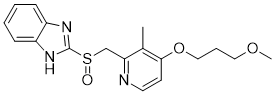
Rabeprazole (LY307640)

别名: 雷贝拉唑; 2-[[4-(3-甲氧基丙氧基)-3-甲基吡啶-2-基]甲基亚硫酰基]-1H-苯并咪唑; Rabeprazole,certified 标准品;雷贝拉唑 ;雷贝拉唑-D4;雷贝拉唑杂质;2-{[4-(3-甲氧基丙氧基)-3-甲基吡啶-2-基]-亚硫氧基}1H-苯并咪唑;雷贝拉唑及中间体
目录号: V9732 纯度: ≥98%
雷贝拉唑 (LY-307640) 是一种新型、有效的第二代质子泵抑制剂 (PPI),用作抗溃疡药物。
Rabeprazole (LY307640) CAS号: 117976-89-3
产品类别: New1
产品仅用于科学研究,不针对患者销售
规格 价格 库存 数量
5mg
10mg
50mg
100mg
250mg
Other Sizes

Other Forms of Rabeprazole (LY307640):

  • 雷贝拉唑钠
  • Rabeprazole-d4 sodium (LY307640-d4 sodium)
  • Rabeprazole-d4 potassium
  • Rabeprazole-d4 (LY307640-d4)
  • 雷贝拉唑硫化物 (标准品)
  • 雷贝拉唑硫醚
点击了解更多
InvivoChem产品被CNS等顶刊论文引用
产品描述
雷贝拉唑 (LY-307640) 是一种新型、有效的第二代质子泵抑制剂 (PPI),用作抗溃疡药物。它不可逆地灭活胃 H+/K+-ATP 酶并诱导细胞凋亡。雷贝拉唑是一种尿苷核苷核糖水解酶 (UNH) 抑制剂,IC50 为 0.3 μM。雷贝拉唑可用于胃溃疡和胃食管反流的研究。它是一种部分可逆的胃质子泵抑制剂,也是ATP4的抑制剂。
生物活性&实验参考方法
体外研究 (In Vitro)
暴露于 0.2 mM 雷贝拉唑 16 小时后,人胃癌细胞表现出活力降低 [2]。在 MKN-28 细胞中,雷贝拉唑完全抑制 ERK1/2 磷酸化。胃癌细胞系 MKN-28 在酸性培养基(pH 5.4)中生长两个小时。在 MKN-28 细胞中,雷贝拉唑预处理(0.2 mM,2 小时)显着降低 ERK1/2 磷酸化 [2]。
体内研究 (In Vivo)
在雌性小鼠中,雷贝拉唑疗程(10 mg/kg;口服;每 48 小时一次,持续 18 周)导致血清钙水平、继发性甲状旁腺疾病和骨矿物质密度 (BMD) 显着降低。甲状腺功能亢进症[3]。
细胞实验
细胞活力测定[2]
细胞类型: 三种胃癌细胞系 KATO III、MKN-28 和 MKN-45
测试浓度: 0.2 mM
孵育持续时间:16 小时
实验结果:使用 KATO III 进行治疗后,所有测试的癌细胞系的活力均下降,并进行比较与 MKN-45 细胞相比,MKN-28 细胞的细胞活力显着降低。

细胞活力测定[2]
细胞类型: 三种胃癌细胞系(KATO III、MKN-28 和 MKN-45)[2]
测试浓度: 0.2 mM
孵育持续时间:2 小时预处理
实验结果: 导致强烈抑制ERK 1/2 在 MKN-28 细胞中磷酸化,但在 KATO III 和 MKN-45 细胞中未观察到类似的作用。
动物实验
动物/疾病模型:雌性瑞士白化小鼠(体重 18-26 克)[3]
剂量:10 mg/kg
给药途径:口服;每 48 小时一次,持续 18 周
实验结果:与载体处理组相比,血清钙水平显著降低(5.5±2.07 vs. 9.68±2.77)。
药代性质 (ADME/PK)
吸收、分布和排泄
绝对生物利用度约为52%。
单次口服20 mg 14C标记的雷贝拉唑后,约90%的药物经尿液排出,主要以硫醚羧酸、其葡萄糖醛酸苷和巯基尿酸代谢物的形式排出。
排泄:肾功能正常:约1至2小时。肝功能受损:2至6小时。
蛋白结合率:非常高;约96%与人血浆蛋白结合。
由于雷贝拉唑对酸不稳定,因此以缓释片形式给药,以便其能够相对完整地通过胃。雷贝拉唑离开胃后,在给药后1小时内即可被吸收。生物利用度约为52%。
尚不清楚雷贝拉唑是否会分布到人乳中。然而,在哺乳期大鼠中,乳汁中雷贝拉唑的浓度比血液中高2至7倍。
有关雷贝拉唑(共10项)的更多吸收、分布和排泄(完整)数据,请访问HSDB记录页面。
代谢/代谢物
肝脏代谢
约90%的雷贝拉唑剂量以代谢物的形式经尿液排出。这些代谢物主要包括硫醚羧酸(TCA)、TCA的葡萄糖醛酸苷和巯基尿酸。
雷贝拉唑代谢广泛。在人血浆中检测到的主要代谢物是硫醚和砜。未观察到这些代谢物具有显著的抗分泌活性。体外研究表明,雷贝拉唑主要在肝脏中经细胞色素P450 3A (CYP3A)代谢为砜类代谢物,并经细胞色素P450 2C19 (CYP2C19)代谢为去甲基雷贝拉唑。硫醚类代谢物是由雷贝拉唑还原而非酶促生成的。CYP2C19存在已知的遗传多态性,这是由于某些亚人群(例如3%至5%的白种人和17%至20%的亚洲人)存在CYP2C19缺陷所致。在这些亚人群中,雷贝拉唑代谢缓慢,因此他们被称为该药物的弱代谢者。
雷贝拉唑是雷贝拉唑(雷贝拉唑硫醚)的已知人体代谢产物。
生物半衰期
1-2 小时(血浆中)
血浆半衰期为 1 至 2 小时。
本研究旨在确定 20 mg 雷贝拉唑片剂在正常健康受试者中的绝对生物利用度,并与静脉注射 20 mg 雷贝拉唑进行比较。……每位受试者在研究开始时被随机分配,在第一阶段接受单次 20 mg 雷贝拉唑静脉注射或口服。……静脉注射剂量以 5 分钟的持续输注方式给药。口服雷贝拉唑钠后的消除半衰期(1.47±0.82 小时)明显长于静脉注射后的消除半衰期(1.02±0.63 小时),这可能是由于吸收速度比消除速度慢所致。
毒性/毒理 (Toxicokinetics/TK)
肝毒性
尽管雷贝拉唑应用广泛,但其引起肝损伤的病例却很少见。在大规模的雷贝拉唑长期试验中,血清ALT升高发生率低于1%,且与安慰剂或对照药物组的发生率相似。在大型药物性肝损伤病例系列研究中,雷贝拉唑仅导致少数有症状的急性肝损伤。目前仅有少数雷贝拉唑引起的临床明显肝病病例报道,且该损伤的特征尚未明确,但似乎与其他质子泵抑制剂相关的肝损伤特征相似。质子泵抑制剂引起的临床明显肝损伤通常在治疗的前4周内出现,症状包括黄疸、恶心和疲乏,以及肝细胞性或混合型血清酶升高。停药后通常可迅速恢复。皮疹、发热和嗜酸性粒细胞增多症很少见,自身抗体形成也很少见。已有报告显示再次用药后出现复发病例。
可能性评分:D(可能是临床上明显的肝损伤的罕见原因)。
妊娠和哺乳期影响
◉ 哺乳期用药概述
由于目前尚无关于哺乳期使用雷贝拉唑的信息,因此建议选择其他药物,尤其是在哺乳新生儿或早产儿时。
◉ 对母乳喂养婴儿的影响
截至修订日期,未找到相关的已发表信息。
◉ 对哺乳和母乳的影响
美国一项回顾性索赔数据库研究发现,质子泵抑制剂使用者发生男性乳房发育症的风险增加。
西班牙药物警戒系统发现,1982年至1983年间报告了一例90岁男性服用雷贝拉唑后出现男性乳房发育症的病例。 2006年。该反应发生在治疗32天后,停药后消退。
一篇综述文章报道,欧洲药物警戒中心数据库检索发现,雷贝拉唑相关不良反应包括11例男性乳房发育症、3例溢乳、2例乳房疼痛和1例乳房增大。世界卫生组织全球药物警戒数据库检索发现,雷贝拉唑相关不良反应包括38例男性乳房发育症、29例溢乳、28例乳房疼痛和5例乳房增大。
一名女性因腹泻和消化不良被处方甲硝唑400毫克,每日三次,以及含有雷贝拉唑20毫克和多潘立酮30毫克的复方制剂,每日一次。治疗3天后,
她出现双侧溢乳。雷贝拉唑和多潘立酮的联合用药被认为是导致不良反应的原因。
蛋白结合率
96.3%(与人血浆蛋白结合)
药物相互作用
华法林:潜在的药代动力学相互作用。质子泵抑制剂可能抑制华法林的代谢。单剂量研究中未发现具有临床意义的相互作用,但有报道称,同时服用这些药物的患者会出现国际标准化比值 (INR) 和凝血酶原时间 (PT) 升高;在与雷贝拉唑联合用药期间可能需要监测 INR 和 PT。
雷贝拉唑可能升高胃肠道 pH 值;正常受试者同时服用地高辛和雷贝拉唑会导致血清峰浓度升高 29%。
雷贝拉唑可能升高胃肠道 pH 值;酮康唑与雷贝拉唑合用导致雷贝拉唑生物利用度降低30%。
体外人肝微粒体孵育实验表明,雷贝拉唑抑制环孢素代谢的IC50值为62微摩尔,该浓度比健康志愿者连续14天服用20毫克雷贝拉唑后达到的Cmax高50倍以上。这种抑制程度与等浓度奥美拉唑的抑制程度相似。
雷贝拉唑、阿莫西林和克拉霉素联合用药导致雷贝拉唑和14-羟基克拉霉素的血浆浓度升高。
参考文献

[1]. Identification of Proton-Pump Inhibitor Drugs That Inhibit Trichomonas Vaginalis Uridine Nucleoside Ribohydrolase. Bioorg Med Chem Lett. 2014 Feb 15;24(4):1080-4.

[2]. Rabeprazole Exhibits Antiproliferative Effects on Human Gastric Cancer Cell Lines. Oncol Lett. 2014 Oct;8(4):1739-1744.

[3]. Supplement With Calcium or Alendronate Suppresses Osteopenia Due to Long Term Rabeprazole Treatment in Female Mice: Influence on Bone TRAP and Osteopontin Levels. Front Pharmacol. 2020 May 13;11:583.

其他信息
治疗用途
抗溃疡药
雷贝拉唑适用于短期治疗(4-8周),以缓解糜烂性或溃疡性胃食管反流病的症状并促进其愈合。对于未愈合的患者,雷贝拉唑可额外治疗8周。雷贝拉唑也适用于维持糜烂性或溃疡性胃食管反流病的愈合。/美国产品标签包含/
雷贝拉唑适用于长期治疗病理性高分泌状态,包括卓-艾综合征。/美国产品标签包含/
雷贝拉唑适用于短期治疗(最长4周),以促进活动性十二指肠溃疡患者的愈合并缓解其症状。 /包含于美国产品标签/
药物警告
对于严重肝功能损害的患者,应谨慎用药,尤其因为缺乏该患者群体的临床数据。然而,每日20毫克的常用剂量不太可能导致雷贝拉唑蓄积,轻度至中度肝功能损害患者无需调整剂量。
雷贝拉唑治疗的症状缓解并不能排除胃肿瘤隐匿存在的可能性。约4%的患者在随访期间(长达40个月)未出现肠化生,且未观察到持续性变化。
使用质子泵抑制剂与某些感染(例如社区获得性肺炎)风险增加相关。
FDA妊娠风险类别:B /无证据表明对人类存在风险。尽管动物实验中发现了不良反应,但对孕妇进行的充分、控制良好的研究并未显示胎儿畸形风险增加;或者,在缺乏充分的人体研究的情况下,动物研究显示无胎儿风险。胎儿受损的可能性很小,但仍然存在。/
有关雷贝拉唑(共12条)的更多药物警告(完整)数据,请访问HSDB记录页面。
药效学
雷贝拉唑可抑制胃酸分泌。它能减轻胃食管反流病(GERD)或溃疡患者的症状,并预防食管或胃损伤。雷贝拉唑也适用于胃酸分泌过多的疾病,例如卓-艾综合征。雷贝拉唑也可与抗生素联合使用,以清除与某些溃疡相关的细菌。雷贝拉唑是一种选择性且不可逆的质子泵抑制剂,它通过特异性抑制壁细胞分泌表面的H+,K+-ATP酶来抑制胃酸分泌。这样一来,它就抑制了氢离子(通过与钾离子交换)最终转运到胃腔的过程。
*注: 文献方法仅供参考, InvivoChem并未独立验证这些方法的准确性
化学信息 & 存储运输条件
分子式
C18H21N3O3S
分子量
359.4426
精确质量
359.13
CAS号
117976-89-3
相关CAS号
Rabeprazole sodium;117976-90-6;Rabeprazole-d4;934295-48-4;Rabeprazole Sulfide;117977-21-6
PubChem CID
5029
外观&性状
Light green to green solid powder
密度
1.3±0.1 g/cm3
沸点
603.9±65.0 °C at 760 mmHg
熔点
202-204°C
闪点
319.1±34.3 °C
蒸汽压
0.0±1.7 mmHg at 25°C
折射率
1.655
LogP
1.83
tPSA
96.31
氢键供体(HBD)数目
1
氢键受体(HBA)数目
6
可旋转键数目(RBC)
8
重原子数目
25
分子复杂度/Complexity
440
定义原子立体中心数目
0
InChi Key
YREYEVIYCVEVJK-UHFFFAOYSA-N
InChi Code
InChI=1S/C18H21N3O3S/c1-13-16(19-9-8-17(13)24-11-5-10-23-2)12-25(22)18-20-14-6-3-4-7-15(14)21-18/h3-4,6-9H,5,10-12H2,1-2H3,(H,20,21)
化学名
2-[[4-(3-methoxypropoxy)-3-methylpyridin-2-yl]methylsulfinyl]-1H-benzimidazole
HS Tariff Code
2934.99.9001
存储方式

Powder      -20°C    3 years

                     4°C     2 years

In solvent   -80°C    6 months

                  -20°C    1 month

运输条件
Room temperature (This product is stable at ambient temperature for a few days during ordinary shipping and time spent in Customs)
溶解度数据
溶解度 (体外实验)
May dissolve in DMSO (in most cases), if not, try other solvents such as H2O, Ethanol, or DMF with a minute amount of products to avoid loss of samples
溶解度 (体内实验)
注意: 如下所列的是一些常用的体内动物实验溶解配方,主要用于溶解难溶或不溶于水的产品(水溶度<1 mg/mL)。 建议您先取少量样品进行尝试,如该配方可行,再根据实验需求增加样品量。

注射用配方
(IP/IV/IM/SC等)
注射用配方1: DMSO : Tween 80: Saline = 10 : 5 : 85 (如: 100 μL DMSO 50 μL Tween 80 850 μL Saline)
*生理盐水/Saline的制备:将0.9g氯化钠/NaCl溶解在100 mL ddH ₂ O中,得到澄清溶液。
注射用配方 2: DMSO : PEG300Tween 80 : Saline = 10 : 40 : 5 : 45 (如: 100 μL DMSO 400 μL PEG300 50 μL Tween 80 450 μL Saline)
注射用配方 3: DMSO : Corn oil = 10 : 90 (如: 100 μL DMSO 900 μL Corn oil)
示例: 注射用配方 3 (DMSO : Corn oil = 10 : 90) 为例说明, 如果要配制 1 mL 2.5 mg/mL的工作液, 您可以取 100 μL 25 mg/mL 澄清的 DMSO 储备液,加到 900 μL Corn oil/玉米油中, 混合均匀。
View More

注射用配方 4: DMSO : 20% SBE-β-CD in Saline = 10 : 90 [如:100 μL DMSO 900 μL (20% SBE-β-CD in Saline)]
*20% SBE-β-CD in Saline的制备(4°C,储存1周):将2g SBE-β-CD (磺丁基-β-环糊精) 溶解于10mL生理盐水中,得到澄清溶液。
注射用配方 5: 2-Hydroxypropyl-β-cyclodextrin : Saline = 50 : 50 (如: 500 μL 2-Hydroxypropyl-β-cyclodextrin (羟丙基环胡精) 500 μL Saline)
注射用配方 6: DMSO : PEG300 : Castor oil : Saline = 5 : 10 : 20 : 65 (如: 50 μL DMSO 100 μL PEG300 200 μL Castor oil 650 μL Saline)
注射用配方 7: Ethanol : Cremophor : Saline = 10: 10 : 80 (如: 100 μL Ethanol 100 μL Cremophor 800 μL Saline)
注射用配方 8: 溶解于Cremophor/Ethanol (50 : 50), 然后用生理盐水稀释。
注射用配方 9: EtOH : Corn oil = 10 : 90 (如: 100 μL EtOH 900 μL Corn oil)
注射用配方 10: EtOH : PEG300Tween 80 : Saline = 10 : 40 : 5 : 45 (如: 100 μL EtOH 400 μL PEG300 50 μL Tween 80 450 μL Saline)


口服配方
口服配方 1: 悬浮于0.5% CMC Na (羧甲基纤维素钠)
口服配方 2: 悬浮于0.5% Carboxymethyl cellulose (羧甲基纤维素)
示例: 口服配方 1 (悬浮于 0.5% CMC Na)为例说明, 如果要配制 100 mL 2.5 mg/mL 的工作液, 您可以先取0.5g CMC Na并将其溶解于100mL ddH2O中,得到0.5%CMC-Na澄清溶液;然后将250 mg待测化合物加到100 mL前述 0.5%CMC Na溶液中,得到悬浮液。
View More

口服配方 3: 溶解于 PEG400 (聚乙二醇400)
口服配方 4: 悬浮于0.2% Carboxymethyl cellulose (羧甲基纤维素)
口服配方 5: 溶解于0.25% Tween 80 and 0.5% Carboxymethyl cellulose (羧甲基纤维素)
口服配方 6: 做成粉末与食物混合


注意: 以上为较为常见方法,仅供参考, InvivoChem并未独立验证这些配方的准确性。具体溶剂的选择首先应参照文献已报道溶解方法、配方或剂型,对于某些尚未有文献报道溶解方法的化合物,需通过前期实验来确定(建议先取少量样品进行尝试),包括产品的溶解情况、梯度设置、动物的耐受性等。

请根据您的实验动物和给药方式选择适当的溶解配方/方案:
1、请先配制澄清的储备液(如:用DMSO配置50 或 100 mg/mL母液(储备液));
2、取适量母液,按从左到右的顺序依次添加助溶剂,澄清后再加入下一助溶剂。以 下列配方为例说明 (注意此配方只用于说明,并不一定代表此产品 的实际溶解配方):
10% DMSO → 40% PEG300 → 5% Tween-80 → 45% ddH2O (或 saline);
假设最终工作液的体积为 1 mL, 浓度为5 mg/mL: 取 100 μL 50 mg/mL 的澄清 DMSO 储备液加到 400 μL PEG300 中,混合均匀/澄清;向上述体系中加入50 μL Tween-80,混合均匀/澄清;然后继续加入450 μL ddH2O (或 saline)定容至 1 mL;

3、溶剂前显示的百分比是指该溶剂在最终溶液/工作液中的体积所占比例;
4、 如产品在配制过程中出现沉淀/析出,可通过加热(≤50℃)或超声的方式助溶;
5、为保证最佳实验结果,工作液请现配现用!
6、如不确定怎么将母液配置成体内动物实验的工作液,请查看说明书或联系我们;
7、 以上所有助溶剂都可在 Invivochem.cn网站购买。
制备储备液 1 mg 5 mg 10 mg
1 mM 2.7821 mL 13.9105 mL 27.8211 mL
5 mM 0.5564 mL 2.7821 mL 5.5642 mL
10 mM 0.2782 mL 1.3911 mL 2.7821 mL

1、根据实验需要选择合适的溶剂配制储备液 (母液):对于大多数产品,InvivoChem推荐用DMSO配置母液 (比如:5、10、20mM或者10、20、50 mg/mL浓度),个别水溶性高的产品可直接溶于水。产品在DMSO 、水或其他溶剂中的具体溶解度详见上”溶解度 (体外)”部分;

2、如果您找不到您想要的溶解度信息,或者很难将产品溶解在溶液中,请联系我们;

3、建议使用下列计算器进行相关计算(摩尔浓度计算器、稀释计算器、分子量计算器、重组计算器等);

4、母液配好之后,将其分装到常规用量,并储存在-20°C或-80°C,尽量减少反复冻融循环。

计算器

摩尔浓度计算器可计算特定溶液所需的质量、体积/浓度,具体如下:

  • 计算制备已知体积和浓度的溶液所需的化合物的质量
  • 计算将已知质量的化合物溶解到所需浓度所需的溶液体积
  • 计算特定体积中已知质量的化合物产生的溶液的浓度
使用摩尔浓度计算器计算摩尔浓度的示例如下所示:
假如化合物的分子量为350.26 g/mol,在5mL DMSO中制备10mM储备液所需的化合物的质量是多少?
  • 在分子量(MW)框中输入350.26
  • 在“浓度”框中输入10,然后选择正确的单位(mM)
  • 在“体积”框中输入5,然后选择正确的单位(mL)
  • 单击“计算”按钮
  • 答案17.513 mg出现在“质量”框中。以类似的方式,您可以计算体积和浓度。

稀释计算器可计算如何稀释已知浓度的储备液。例如,可以输入C1、C2和V2来计算V1,具体如下:

制备25毫升25μM溶液需要多少体积的10 mM储备溶液?
使用方程式C1V1=C2V2,其中C1=10mM,C2=25μM,V2=25 ml,V1未知:
  • 在C1框中输入10,然后选择正确的单位(mM)
  • 在C2框中输入25,然后选择正确的单位(μM)
  • 在V2框中输入25,然后选择正确的单位(mL)
  • 单击“计算”按钮
  • 答案62.5μL(0.1 ml)出现在V1框中
g/mol

分子量计算器可计算化合物的分子量 (摩尔质量)和元素组成,具体如下:

注:化学分子式大小写敏感:C12H18N3O4  c12h18n3o4
计算化合物摩尔质量(分子量)的说明:
  • 要计算化合物的分子量 (摩尔质量),请输入化学/分子式,然后单击“计算”按钮。
分子质量、分子量、摩尔质量和摩尔量的定义:
  • 分子质量(或分子量)是一种物质的一个分子的质量,用统一的原子质量单位(u)表示。(1u等于碳-12中一个原子质量的1/12)
  • 摩尔质量(摩尔重量)是一摩尔物质的质量,以g/mol表示。
/

配液计算器可计算将特定质量的产品配成特定浓度所需的溶剂体积 (配液体积)

  • 输入试剂的质量、所需的配液浓度以及正确的单位
  • 单击“计算”按钮
  • 答案显示在体积框中
动物体内实验配方计算器(澄清溶液)
第一步:请输入基本实验信息(考虑到实验过程中的损耗,建议多配一只动物的药量)
第二步:请输入动物体内配方组成(配方适用于不溶/难溶于水的化合物),不同的产品和批次配方组成不同,如对配方有疑问,可先联系我们提供正确的体内实验配方。此外,请注意这只是一个配方计算器,而不是特定产品的确切配方。
+
+
+

计算结果:

工作液浓度 mg/mL;

DMSO母液配制方法 mg 药物溶于 μL DMSO溶液(母液浓度 mg/mL)。如该浓度超过该批次药物DMSO溶解度,请首先与我们联系。

体内配方配制方法μL DMSO母液,加入 μL PEG300,混匀澄清后加入μL Tween 80,混匀澄清后加入 μL ddH2O,混匀澄清。

(1) 请确保溶液澄清之后,再加入下一种溶剂 (助溶剂) 。可利用涡旋、超声或水浴加热等方法助溶;
            (2) 一定要按顺序加入溶剂 (助溶剂) 。

临床试验信息
A Study to Investigate the Effects of Acid Reducing Agents on Pharmacokinetics of PC14586 in Healthy Participants
CTID: NCT06054464
Phase: Phase 1    Status: Completed
Date: 2024-11-13
Study to Evaluate Safety, Drug Levels, Food and Relative Bioavailability of BMS-986365 in Healthy Adult Male Participants
CTID: NCT06417229
Phase: Phase 1    Status: Recruiting
Date: 2024-11-04
A Study of Maribavir Pediatric Formulation in Healthy Adult Participants
CTID:
A Randomized Double-Blind Parallel Study of Rabeprazole Extended-Release 50 mg Versus Esomeprazole 40 mg for Healing and Symptomatic Relief of Moderate to Severe Erosive gastroesophageal Reflux Disease (GERD)
CTID: null
Phase: Phase 3    Status: Completed
Date: 2008-08-01
EFECTO DEL ÁCIDO ACETILSALICÍLICO EN LA PROLIFERACIÓN Y APOPTOSIS CELULAR DEL EPITELIO METAPLÁSICO DEL ESÓFAGO DE BARRETT
CTID: null
Phase: Phase 4    Status: Ongoing
Date: 2005-11-24
Prospective multicenter non-randomized parallel-group comparative study to evaluate the efficacy of P-CAB/AMPC/MNZ 7 day triple therapy as first line eradication of CAM-resistant Helicobacter pylori: superiority study compared to P-CAB/AMPC/CAM, non-inferiority study compared to PPI/AMPC/MNZ, superiority study compared to PPI/AMPC/CAM
CTID: UMIN000022920
Phase:    Status: Complete: follow-up complete
Date: 2016-06-28
Acid-inhibitory effects of vonoprazan compared with rabeprazole in healthy adult subjects - a randomised open-label cross-over study
CTID: UMIN000022198
Phase:    Status: Complete: follow-up complete
Date: 2016-06-01
View More

Study of the improvement effect of potassium competitive acid blocker and proton pump inhibitors on symptoms in patients with gastro-esophageal reflux disease (GERD): a randomized comparative study of vonoprazan 20mg vs. rabeprazole 10mg using the time (number of days) to improvement in symptoms as an index
CTID: UMIN000021621
Phase:    Status: Pending
Date: 2016-04-01


Prospective multicenter cohort study to evaluate the efficacy and safety of Helicobacter pylori eradication therapy
CTID: UMIN000021604
Phase:    Status: Complete: follow-up complete
Date: 2016-03-25
The exploratory study for the efficacy and the safety of Hangeshashinto on symptoms of heartburn /belch in the patients with gastroesophageal reflux disease (GERD)
CTID: UMIN000021251
Phase:    Status: Complete: follow-up complete
Date: 2016-03-01
A randomized controlled trial comparing the first-line eradication rate using vonoprazan or PPI for Helicobacter pylori infectious gastritis.
CTID: UMIN000021148
Phase:    Status: Complete: follow-up complete
Date: 2016-02-23
A trial to study of treatment with a new PPI for infection of H. pylori with Clarithromycin resistance
CTID: UMIN000018595
Phase:    Status: Complete: follow-up continuing
Date: 2015-08-07
A prospective randomized trial of potassium competitive acid blocker vs proton pump inhibitors on effect of ulcer healing after endoscopic submucosal dissection of gastric neoplasia
CTID: UMIN000017386
Phase:    Status: Complete: follow-up complete
Date: 2015-05-02
Study of the improvement effect of potassium competitive acid blocker and proton pump inhibitors on symptoms in patients with reflux esophagitis (RE): a randomized comparative study of vonoprazan 20mg vs. rabeprazole 10mg using the time (number of days) to improvement in symptoms as an index
CTID: UMIN000016637
Phase:    Status: Pending
Date: 2015-02-26
Comparison of the night acid suppresion between Proton pump inhibitors in Helicobacter pylori negative healthy volunteers
CTID: UMIN000013484
PhaseNot applicable    Status: Complete: follow-up complete
Date: 2014-12-30
Irsogladine maleate and rabeprazole in non-erosive reflux disease - a double-blind, placebo- controlled study
CTID: UMIN000015731
PhaseNot applicable    Status: Complete: follow-up complete
Date: 2014-11-21
Comparison of efficacy and safety of levofloxacin-containing versus standard sequential therapy in eradication of Helicobacter pylori infection in Korea
CTID: UMIN000015375
Phase:    Status: Complete: follow-up complete
Date: 2014-10-08
Evaluation of the efficasy of H. pylori eradication therapies using different PPI.
CTID: UMIN000014366
PhaseNot applicable    Status: Complete: follow-up complete
Date: 2014-07-01
Evaluation of symptom relief in functional dyspepsia patients with PPI-resistant Gastroesophageal reflux disease -Acotiamide + standard-dose PPI vs double-dose PPI ; Prospective multi-center randomized study-
CTID: UMIN000014082
Phase:    Status: Complete: follow-up complete
Date: 2014-06-05
A multicenter randomized trial comparing rabeprazole and itopride with functional dyspepsia in Japan: the NAGOYA study
CTID: UMIN000013961
PhaseNot applicable    Status: Complete: follow-up complete
Date: 2014-05-20
A study on the effect of proton pump inhibitors on intra-gastric pH in healthy adults: comparison of rabeprazole and esomeprazole
CTID: UMIN000013165
PhaseNot applicable    Status: Complete: follow-up complete
Date: 2014-02-19
The study on the preventive effect of irsogladine for gastric bleeding risk of antithrombotic drugs after ESD -multicenter randomized controlled study of irsogladine + PPI versus PPI alone-
CTID: UMIN000012434
Phase: Phase IV    Status: Complete: follow-up complete
Date: 2013-11-28
The study on the preventive effect of irsogladine for gastric bleeding risk of antithrombotic drugs after ESD -multicenter randomized controlled study of irsogladine + PPI versus PPI alone-
CTID: UMIN000012434
Phase: Phase IV    Status: Complete: follow-up complete
Date: 2013-11-28
LinkagE between GAstrointestinal Symptom and CoronarY stenting study
CTID: UMIN000011996
Phase:    Status: Recruiting
Date: 2013-10-10
LinkagE between GAstrointestinal Symptom and CoronarY stenting study
CTID: UMIN000011996
Phase:    Status: Recruiting
Date: 2013-10-10
Effects and cost-effectiveness of proton pump inhibitor by oral versus injection after endoscopic submucosal dissection
CTID: UMIN000011138
Phase:    Status: Complete: follow-up complete
Date: 2013-07-07
Histamine-2 Receptor Antagonist Versus Proton-Pump Inhibitor for the Prevention of Ulcer Bleeding Associated With Low-dose Aspirin in Patients With Very High Ulcer Risk (ASP (PPI_H2RA) Study)
CTID: UMIN000011072
Phase:    Status: Complete: follow-up complete
Date: 2013-06-29
Study of the improvement effect of proton pump inhibitors on symptoms in patients with reflux esophagitis (RE): a randomized double-blind comparative study of esomeprazole 20mg vs. rabeprazole 10mg
CTID: UMIN000010450
Phase:    Status: Complete: follow-up complete
Date: 2013-04-10
Randomized trial of PPI-amoxicillin-clarithromycin and PPI-amoxicillin-metronidazole as first-line Helicobacter pylori eradication therapy
CTID: UMIN000010229
PhaseNot applicable    Status: Complete: follow-up complete
Date: 2013-03-13
Influence of proton pump inhibitor on NSAID-induced small-intestinal mucosal injuries; prospective, double-blind, placebo controlled study
CTID: UMIN000008883
Phase:    Status: Complete: follow-up complete
Date: 2012-10-01
The study for the efficacy of the combine therapy with proton pump inhibitor and irsogladine for the post-endoscopic submucosal dissection (ESD) gastric ulcer
CTID: UMIN000008161
Phase:    Status: Recruiting
Date: 2012-06-13
A randomized study comparing Esomeprazole based versus rabeprazole based triple therapy for the eradication of Helicobacter pylori.
CTID: UMIN000007550
Phase:    Status: Complete: follow-up complete
Date: 2012-03-31
The study for the efficacy of the combine therapy with proton pump inhibitor and rebamipide for the post-endoscopic submucosal dissection (ESD) gastric ulcer
CTID: UMIN000007435
PhaseNot applicable    Status: Recruiting
Date: 2012-03-05
Effect of meal on pharmacokinetics of omeprazole and rabeprazole.
CTID: UMIN000004761
Phase:    Status: Complete: follow-up continuing
Date: 2011-12-21
Evaluation of abdominal symptoms and gastrointestinal mucosal injuries in patients receiving oral anticoagulant dabigatran
CTID: UMIN000006344
Phase: Phase IV    Status: Pending
Date: 2011-09-14
Prospective, randomized controlled trial for effect of rikkunshito on symptoms in PPI-refractory gastroesophageal reflux disease (GERD) patients
CTID: UMIN000005880
PhaseNot applicable    Status: Complete: follow-up complete
Date: 2011-07-28
Efficacy of sitafloxacin as third-line eradication treatment of Helicobacter pylori
CTID: UMIN000004778
Phase: Phase II    Status: Complete: follow-up complete
Date: 2011-04-01
Compariosn with the effect of PPI in the use on demand using BRAVO system
CTID: UMIN000004858
PhaseNot applicable    Status: Complete: follow-up complete
Date: 2011-01-11
A trial on the effects of gastric-acid inhibiting drug on treatment of sleep bruxism
CTID: UMIN000004577
Phase: Phase I,II    Status: Complete: follow-up complete
Date: 2010-11-18
A randomized study of the influence of proton pump inhibitors on antiplatelet effect by Clopidogrel based on CYP2C19 genotypes
CTID: UMIN000003898
Phase:    Status: Pending
Date: 2010-07-20
Medicinal treatment on symptoms in patients with gastroesophageal reflux disease (GERD) refractory to PPIs. Multicenter, randomized, paralleled controlled study
CTID: UMIN000003716
PhaseNot applicable    Status: Complete: follow-up complete
Date: 2010-06-07
The influence of coadministration of PPIs on pharmacodynamics of clopidogrel
CTID: UMIN000003668
Phase:    Status: Complete: follow-up complete
Date: 2010-06-01
A study on the effect of proton pump inhibitors on the intragastric pH for the patients of functional dysplasia
CTID: UMIN000003127
PhaseNot applicable    Status: Pending
Date: 2010-02-15
Study of the improvement effect of proton pump inhibitors on symptoms in patients with reflux esophagitis (RE): a randomized comparative study of omeprazole 20mg vs. rabeprazole 10mg using the time (number of days) to improvement in symptoms as an index
CTID: UMIN000003078
Phase:    Status: Complete: follow-up complete
Date: 2010-01-25
Randomized control trial of secondary eradication therapies of Helicobacter pylori
CTID: UMIN000003074
Phase:    Status: Complete: follow-up complete
Date: 2010-01-21
The evaluation of healing effect of Rebamipide for patients with artificial ulcer after ESD
CTID: UMIN000003001
Phase:    Status: Complete: follow-up complete
Date: 2010-01-09
Study of the improvement effect of proton pump inhibitors on symptoms in patients with reflux esophagitis (RE): a randomized comparative study of omeprazole 20mg vs. rabeprazole 10mg using the time (number of days) to improvement in symptoms as an index
CTID: UMIN000002955
Phase:    Status: Complete: follow-up complete
Date: 2010-01-01
Investigation of relationships among upper abdominal symptoms, findings of esophagogastroduodenoscopy (EGD) and quality of life (QOL) and comparing study of therapeutic effects of various gastrointestinal drugs on upper abdominal symptoms of patients with functional dyspepsia (FD) or non-errosive reflux disease (NERD) by using questionnaires to evaluate upper abdominal symptoms (GOS) and QOL (SF-8).
CTID: UMIN000002432
Phase:    Status: Complete: follow-up complete
Date: 2009-09-15
The Influence of Proton Pump Inhibitors on the Antiplatelet Effect of Clopidogrel
CTID: UMIN000002060
Phase:    Status: Complete: follow-up complete
Date: 2009-06-10
Effects of rabeprazole on acute exacerbation in chronic obstructive pulmonary disease (COPD) patients with acid reflux symptoms
CTID: UMIN000002056
PhaseNot applicable    Status: Recruiting
Date: 2009-06-10
Preventive effect of proton-pump inhibitor for upper gastrointestinal injury induced by low-dose aspirin in patients with ischemic stroke
CTID: UMIN000002051
Phase:    Status: Complete: follow-up complete
Date: 2009-06-05
Effect of rabeprazole and sucralfate on low-dose aspirin-related gastroduodenal mucosal injury
CTID: UMIN000001679
Phase:    Status: Complete: follow-up complete
Date: 2009-02-02
The prevention effect in renal disease patients taking a oral steroid with the rebamipide or the rabeprazole- a randomized control study-
CTID: UMIN000001611
Phase: Phase IV    Status: Complete: follow-up complete
Date: 2009-01-05
Randomized control trial of primary eradication therapies of Helicobacter pylori
CTID: UMIN000001197
Phase:    Status:
Date: 2008-07-01
Clinical Assessment to Establish the Symptomatic Advantage of Rabeprazole: double-blind, randomized, placebo-controlled study in functional dyspepsia
CTID: UMIN000001124
PhaseNot applicable    Status: Complete: follow-up complete
Date: 2008-04-29

生物数据图片
  • Decline in cancer cell viability induced by rabeprazole and expression level analysis of α - and β-subunits of hydrogen/potassium adenosine triphosphatase (H+/K+-ATPase) in gastric cancer cells. (A) Rabeprazole attenuated the cell viability of the human gastric cancer cells. Following treatment with 0.2 mM of the proton pump inhibitor rabeprazole for 16 h, the cell viability of the MKN-28 cells significantly decreased compared with the KATO III and MKN-45 cells, respectively. *P<0.05 vs. the viability of the KATO III cells. #P<0.05 vs. the viability of the MKN-45 cells. (B) Expression level analysis of α - and β-subunits of H+/K+-ATPase in the gastric cancer cells. The α-subunit of H+/K+-ATPase was strongly expressed in the KATO III and MKN-28 cells, while being weakly expressed in the MKN-45 cells. The β-subunit of H+/K+-ATPase was equally expressed in the tested cancer cells. Glyceraldehyde 3-phosphate dehydrogenase (GAPDH) was used as an internal control to verify equal amounts of total cDNA in each sample. RT-PCR, reverse transcription polymerase chain reaction.[2]. Mengli Gu, et al. Rabeprazole Exhibits Antiproliferative Effects on Human Gastric Cancer Cell Lines. Oncol Lett. 2014 Oct;8(4):1739-1744.
  • Rabeprazole treatment induces apoptotic cell death in gastric cancer AGS cells. (A) Kinetics of apoptotic cell death (%) induced by rabeprazole. Exposure to 0.2 mM rabeprazole resulted in significant apoptosis in the AGS cells after 72 h. (B) Annexin V-FITC)/PI double staining fluorescence-activated cell sorting analysis. Cells were harvested, stained with annexin V-FITC/PI, and analyzed by flow cytometry following treatment with rabeprazole. Administration of rabeprazole to the AGS cells markedly increased the apoptosis rate, reaching 72.21±3.24% compared with 3.20±0.26% in the control group (P<0.01). FITC, fluorescein isothiocyanate; PI, propidium iodide.[2]. Mengli Gu, et al. Rabeprazole Exhibits Antiproliferative Effects on Human Gastric Cancer Cell Lines. Oncol Lett. 2014 Oct;8(4):1739-1744.
  • Effect of suppression of ERK 1/2 on cell viability. Following treatment with proton pump inhibitor rabeprazole or PD98059 (a potent ERK 1/2 inhibitor) for 2 h, the AGS cells were further cultured at various pH levels (pH 7.4, 6.4 or 5.4) for 16 h. (A) Administration of rabeprazole to the AGS cells at a dosage of 0.2 mM resulted in a marked attenuation in cancer cell viability at pH 5.4. *P<0.05 vs. 0 mM rabeprazole treatment at pH 5.4. #P<0.05 vs. 0.1 mM rabeprazole treatment at pH 5.4. ΔP<0.05 vs. 0.2 mM rabeprazole treatment at pH 7.4 or 6.4. (B) Pretreatment with 100 μM PD98059 significantly reduced the cell viability at pH 5.4. *P<0.05 vs. 0 μM PD98059 treatment at pH 5.4. #P<0.05 vs. 50 μM PD98059 treatment at pH 5.4. ΔP<0.05 vs. 100 μM PD98059 treatment at pH 7.4 or 6.4. (C) PD98059 and rabeprazole were each able to efficaciously inhibit the phosphorylation of ERK 1/2 in the AGS cells. P-ERK, phosphorylated extracellular signal-regulated protein kinase 1/2; Rabe, rabeprazole.[2]. Mengli Gu, et al. Rabeprazole Exhibits Antiproliferative Effects on Human Gastric Cancer Cell Lines. Oncol Lett. 2014 Oct;8(4):1739-1744.
相关产品
联系我们