| 规格 | 价格 | |
|---|---|---|
| 500mg | ||
| 1g | ||
| Other Sizes |
| 靶点 |
Acetylcholinesterase/AChE
|
|---|---|
| 体外研究 (In Vitro) |
乙酰胆碱酯酶抑制剂,包括新斯的明,已被用于拮抗神经肌肉阻滞多年。Sugammadex使用其γ-环糊精环逆转这种阻断,这种机制不同于胆碱酯酶,因此可以避免新斯的明的副作用。尽管在几项临床研究中已经概述了Sugammadex相对于新斯的明的优越性,但据我们所知,还没有任何关于细胞培养的研究来比较这两种药物的细胞毒性、遗传毒性和凋亡作用。因此,这是第一项比较不同剂量两种药物对人胚胎肾(HEK-293)细胞的细胞毒性、遗传毒性和凋亡作用的研究。在这项研究中,分别使用MTT、彗星试验和流式细胞术膜联蛋白-V方法分析了Sugammadex和新斯的明对HEK-293细胞的细胞毒性、遗传毒性和凋亡作用。结果表明,50、100、250和500µg/mL的新斯的明比同等剂量的Sugammadex具有更强的细胞毒性。发现500和1000µg/mL的新斯的明具有更高的遗传毒性,500µg/mL的新斯的明引起细胞凋亡和坏死的风险在统计学上高于Sugammadex(p<0.05)。与Sugammadex相同剂量的新斯的明体外给药对HEK-293细胞具有更大的细胞毒性、遗传毒性和凋亡作用[1]。
|
| 体内研究 (In Vivo) |
在慢性炎症性疾病(如哮喘)期间,白细胞可以侵入中枢神经系统(CNS),并与CNS驻留细胞一起产生过量的活性氧(ROS)产生以及抗氧化系统失衡,导致氧化应激,这在很大程度上导致了神经炎症。从这个意义上讲,本研究的目的是研究以控制肺部炎症能力而闻名的新斯的明治疗对哮喘小鼠大脑皮层氧化应激的影响。将雌性BALB/cJ小鼠置于卵清蛋白(OVA)诱导的哮喘模型中。对照组仅接受杜尔贝科磷酸缓冲盐水(DPBS)。为了评估新斯的明的效果,小鼠在每次OVA攻击后30分钟腹腔注射80μg/kg的新斯的明。我们的研究结果首次表明,新斯的明(一种不穿过血脑屏障的乙酰胆碱酯酶抑制剂)治疗能够恢复哮喘小鼠大脑皮层中ROS的产生并改变抗氧化酶过氧化氢酶。这些结果支持外周免疫系统和中枢神经系统之间的沟通,并表明乙酰胆碱酯酶抑制剂,如新斯的明,应作为哮喘神经保护的可能治疗策略进行进一步研究[2]。
|
| 动物实验 |
致敏、气道激发和新斯的明治疗[2] 在第0天和第7天,通过皮下注射20 μg卵清蛋白(OVA,用Dulbecco磷酸盐缓冲液(DPBS)稀释200 μL)对动物进行致敏。随后,在第14、15和16天,通过鼻内途径给予100 μg OVA(用DPBS稀释50 μL)进行三次激发。对照组在致敏和鼻内激发阶段仅接受DPBS。为了评估新斯的明对大脑皮层氧化应激的影响,在OVA激发后30分钟,连续三天(第14、15和16天)每天一次腹腔注射80 μg/kg新斯的明(Hofer等人,2008)。在实验方案的第17天,动物经腹腔注射氯胺酮(0.4 mg/g)和赛拉嗪(0.2 mg/g)混合溶液麻醉后,通过心脏穿刺放血处死。收集支气管肺泡灌洗液(BAL)、肺组织和大脑皮层进行分析。研究方案如图1所示。
|
| 参考文献 |
[1].Comparison of the cytotoxic, genotoxic and apoptotic effects of Sugammadex and Neostigmine on human embryonic renal cell (HEK-293). Cell Mol Biol (Noisy-le-grand). 2018 Oct 30;64(13):74-78.
[2].Neostigmine treatment induces neuroprotection against oxidative stress in cerebral cortex of asthmatic mice. Metab Brain Dis. 2020 Jun;35(5):765-774. [3]. Neostigmine: safe and effective treatment for acute colonic pseudo-obstruction. Dis Colon Rectum, 2000. 43(5): 599-603. |
| 其他信息 |
背景:奥格尔维综合征(Ogilvie's syndrome),又称急性结肠假性梗阻,是一种常见且相对危险的疾病。如不及时治疗,可导致缺血性坏死和结肠穿孔,死亡率高达50%。新斯的明通过与乙酰胆碱竞争胆碱能传递位点的乙酰胆碱酯酶结合,增强兴奋性副交感神经活性,从而增强胆碱能作用。我们假设新斯的明可以恢复急性结肠假性梗阻患者的肠蠕动。[3]
方法:在弗莱彻艾伦医疗中心和克利夫兰诊所基金会,28例急性结肠假性梗阻患者接受了新斯的明治疗,静脉注射2.5 mg,3分钟内完成,同时进行遥测监测。所有患者均已排除机械性梗阻。[3] 结果:28例患者中有26例大肠扩张症状完全缓解。服用新斯的明后,排气时间为30秒至10分钟不等。未观察到不良反应或并发症。两例未缓解的患者中,一例患有乙状结肠癌,需行手术切除;另一例死于多器官功能衰竭。[3] 结论:本研究支持急性结肠假性梗阻是由副交感神经过度抑制而非交感神经过度活跃所致的理论。我们已证实,新斯的明是治疗急性结肠假性梗阻的一种安全有效的药物。 |
| 分子式 |
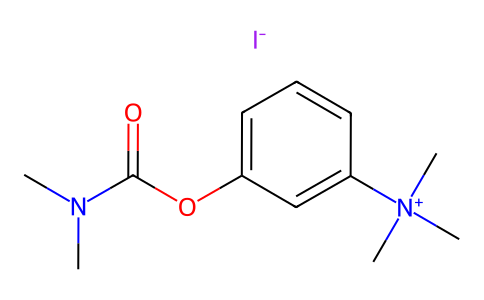
C12H19N2O2+.I-
|
|---|---|
| 分子量 |
350.19546
|
| 精确质量 |
350.049
|
| 元素分析 |
C, 41.16; H, 5.47; I, 36.24; N, 8.00; O, 9.14
|
| CAS号 |
1212-37-9
|
| 相关CAS号 |
59-99-4 (cation);114-80-7 (bromide);51-60-5 (methylsulfate);1212-37-9 (iodide); 588-17-0 (hydroxide);
|
| PubChem CID |
14596
|
| 外观&性状 |
Typically exists as solid at room temperature
|
| tPSA |
29.54
|
| 氢键供体(HBD)数目 |
0
|
| 氢键受体(HBA)数目 |
3
|
| 可旋转键数目(RBC) |
3
|
| 重原子数目 |
17
|
| 分子复杂度/Complexity |
246
|
| 定义原子立体中心数目 |
0
|
| SMILES |
[I-].CN(C(OC1=CC=CC([N+](C)(C)C)=C1)=O)C
|
| InChi Key |
IRBBYXNXNPIQLI-UHFFFAOYSA-M
|
| InChi Code |
InChI=1S/C12H19N2O2.HI/c1-13(2)12(15)16-11-8-6-7-10(9-11)14(3,4)5;/h6-9H,1-5H3;1H/q+1;/p-1
|
| 化学名 |
[3-(dimethylcarbamoyloxy)phenyl]-trimethylazanium;iodide
|
| 别名 |
Ammonium, (3-(dimethylcarbamoyloxy)phenyl)trimethyl-, iodide; 1212-37-9 (iodide); [3-(dimethylcarbamoyloxy)phenyl]-trimethylazanium;iodide; 3-((dimethylcarbamoyl)oxy)-N,N,N-trimethylbenzenaminium iodide; Benzenaminium, 3-[[(dimethylamino)carbonyl]oxy]-N,N,N-trimethyl-, iodide (1:1); SB-24;
|
| HS Tariff Code |
2934.99.9001
|
| 存储方式 |
Powder -20°C 3 years 4°C 2 years In solvent -80°C 6 months -20°C 1 month |
| 运输条件 |
Room temperature (This product is stable at ambient temperature for a few days during ordinary shipping and time spent in Customs)
|
| 溶解度 (体外实验) |
May dissolve in DMSO (in most cases), if not, try other solvents such as H2O, Ethanol, or DMF with a minute amount of products to avoid loss of samples
|
|---|---|
| 溶解度 (体内实验) |
注意: 如下所列的是一些常用的体内动物实验溶解配方,主要用于溶解难溶或不溶于水的产品(水溶度<1 mg/mL)。 建议您先取少量样品进行尝试,如该配方可行,再根据实验需求增加样品量。
注射用配方
注射用配方1: DMSO : Tween 80: Saline = 10 : 5 : 85 (如: 100 μL DMSO → 50 μL Tween 80 → 850 μL Saline)(IP/IV/IM/SC等) *生理盐水/Saline的制备:将0.9g氯化钠/NaCl溶解在100 mL ddH ₂ O中,得到澄清溶液。 注射用配方 2: DMSO : PEG300 :Tween 80 : Saline = 10 : 40 : 5 : 45 (如: 100 μL DMSO → 400 μL PEG300 → 50 μL Tween 80 → 450 μL Saline) 注射用配方 3: DMSO : Corn oil = 10 : 90 (如: 100 μL DMSO → 900 μL Corn oil) 示例: 以注射用配方 3 (DMSO : Corn oil = 10 : 90) 为例说明, 如果要配制 1 mL 2.5 mg/mL的工作液, 您可以取 100 μL 25 mg/mL 澄清的 DMSO 储备液,加到 900 μL Corn oil/玉米油中, 混合均匀。 View More
注射用配方 4: DMSO : 20% SBE-β-CD in Saline = 10 : 90 [如:100 μL DMSO → 900 μL (20% SBE-β-CD in Saline)] 口服配方
口服配方 1: 悬浮于0.5% CMC Na (羧甲基纤维素钠) 口服配方 2: 悬浮于0.5% Carboxymethyl cellulose (羧甲基纤维素) 示例: 以口服配方 1 (悬浮于 0.5% CMC Na)为例说明, 如果要配制 100 mL 2.5 mg/mL 的工作液, 您可以先取0.5g CMC Na并将其溶解于100mL ddH2O中,得到0.5%CMC-Na澄清溶液;然后将250 mg待测化合物加到100 mL前述 0.5%CMC Na溶液中,得到悬浮液。 View More
口服配方 3: 溶解于 PEG400 (聚乙二醇400) 请根据您的实验动物和给药方式选择适当的溶解配方/方案: 1、请先配制澄清的储备液(如:用DMSO配置50 或 100 mg/mL母液(储备液)); 2、取适量母液,按从左到右的顺序依次添加助溶剂,澄清后再加入下一助溶剂。以 下列配方为例说明 (注意此配方只用于说明,并不一定代表此产品 的实际溶解配方): 10% DMSO → 40% PEG300 → 5% Tween-80 → 45% ddH2O (或 saline); 假设最终工作液的体积为 1 mL, 浓度为5 mg/mL: 取 100 μL 50 mg/mL 的澄清 DMSO 储备液加到 400 μL PEG300 中,混合均匀/澄清;向上述体系中加入50 μL Tween-80,混合均匀/澄清;然后继续加入450 μL ddH2O (或 saline)定容至 1 mL; 3、溶剂前显示的百分比是指该溶剂在最终溶液/工作液中的体积所占比例; 4、 如产品在配制过程中出现沉淀/析出,可通过加热(≤50℃)或超声的方式助溶; 5、为保证最佳实验结果,工作液请现配现用! 6、如不确定怎么将母液配置成体内动物实验的工作液,请查看说明书或联系我们; 7、 以上所有助溶剂都可在 Invivochem.cn网站购买。 |
| 制备储备液 | 1 mg | 5 mg | 10 mg | |
| 1 mM | 2.8555 mL | 14.2776 mL | 28.5551 mL | |
| 5 mM | 0.5711 mL | 2.8555 mL | 5.7110 mL | |
| 10 mM | 0.2856 mL | 1.4278 mL | 2.8555 mL |
1、根据实验需要选择合适的溶剂配制储备液 (母液):对于大多数产品,InvivoChem推荐用DMSO配置母液 (比如:5、10、20mM或者10、20、50 mg/mL浓度),个别水溶性高的产品可直接溶于水。产品在DMSO 、水或其他溶剂中的具体溶解度详见上”溶解度 (体外)”部分;
2、如果您找不到您想要的溶解度信息,或者很难将产品溶解在溶液中,请联系我们;
3、建议使用下列计算器进行相关计算(摩尔浓度计算器、稀释计算器、分子量计算器、重组计算器等);
4、母液配好之后,将其分装到常规用量,并储存在-20°C或-80°C,尽量减少反复冻融循环。
计算结果:
工作液浓度: mg/mL;
DMSO母液配制方法: mg 药物溶于 μL DMSO溶液(母液浓度 mg/mL)。如该浓度超过该批次药物DMSO溶解度,请首先与我们联系。
体内配方配制方法:取 μL DMSO母液,加入 μL PEG300,混匀澄清后加入μL Tween 80,混匀澄清后加入 μL ddH2O,混匀澄清。
(1) 请确保溶液澄清之后,再加入下一种溶剂 (助溶剂) 。可利用涡旋、超声或水浴加热等方法助溶;
(2) 一定要按顺序加入溶剂 (助溶剂) 。
InvivoChem的所有产品仅用于作科学研究,不面向患者销售
Copyright 2020 InvivoChem LLC | All Rights Reserved 粤ICP备20063088号-1


 粤公网安备 44011102003439号
 463611831
