Pasireotide

目录号: V43851 纯度: ≥98%
Pasireotide (SOM230) diaspartate 是一种长效环己烷生长抑素类似物,可增加生长抑素受体的激动剂活性,sst1/2/3/4/5 的 pKi 分别为 8.2/9.0。
Pasireotide CAS号: 1421446-02-7
产品类别: New3
产品仅用于科学研究,不针对患者销售
规格 价格
500mg
1g
Other Sizes

Other Forms of Pasireotide:

  • 帕瑞肽醋酸盐
  • 帕西瑞肽L-天冬氨酸盐
  • 帕瑞肽双羟萘酸盐
  • Pasireotide ditrifluoroacetate (Pasireotide ditrifluoroacetate; SOM230 ditrifluoroacetate; Pasireotide TFA salt)
  • Pasireotide-d7 TFA
  • Pasireotide (aspartate) TFA
  • Pasireotide diaspartate (SOM-230)
  • 帕瑞肽
点击了解更多
InvivoChem产品被CNS等顶刊论文引用
产品描述
Pasireotide (SOM230) diaspartate 是一种长效环己烷生长抑素类似物,可增加生长抑素受体的激动剂活性,sst1/2/3/4/5 的 pKi 分别为 8.2/9.0。 /9.1/<7.0/9.9。 Pasireotide diaspartate 具有抗分泌、抗增殖和促凋亡活性。
生物活性&实验参考方法
靶点
sst1 ( pKi = 8.2 ); sst2 ( pKi = 9.0 ); sst3 ( pKi = 9.1 ); sst4 ( pKi < 7.0 ); sst5 ( pKi = 9.9 )
体外研究 (In Vitro)
当与人生长抑素受体(亚型 sst1/2/3/4/5,pKi 分别为 8.2/9.0/9.1/<7.0/9.9)结合时,帕瑞肽二天冬氨酸表现出独特的高亲和力结合特性 [1]。在大鼠垂体细胞的原代培养物中,帕瑞肽二天冬氨酸有效抑制生长激素释放激素 (GHRH) 诱导的生长激素 (GH) 释放,IC50 为 0.4 nM [1]。
本研究中采用的策略得到了回报,与2相比,帕西瑞肽/25具有明显的优势。体外药理学研究清楚地表明,Pasireotide/25有效地抑制了大鼠垂体细胞原代培养中生长激素释放激素(GHRH)诱导的生长激素(GH)释放,IC50为0.4±0.1 nmol/L(n=5)[1]。
Pasireotide是一种生长抑素类似物,与生长抑素受体亚型sst1,2,3和sst5具有高结合亲和力,如使用表达人重组生长抑素受体的CHO-K1细胞的竞争性结合研究所示(表2)(Bruns等人,2002,Schmid和Schoeffter,2004)。在表达人重组sst受体的CCL39细胞中,帕瑞肽和生长抑素(SRIF-14)以大致相同的功效和效力抑制毛喉素刺激的cAMP积累。与奥曲肽相比,帕瑞肽对sst1、sst3和sst5的功能活性(基于EC50值)分别高出30倍、11倍和158倍,但对sst2的功能活性低7倍(Schmid和Schoeffter,2004)。
基于帕瑞肽和奥曲肽的结合亲和力和功能活性的差异,可以推测,在表达sst2受体亚型以外的sst受体的细胞和组织中,帕瑞肽对激素分泌的抑制作用将比奥曲肽更强[3]。
体内研究 (In Vivo)
在 Pdx1-Cre 中,帕列托肽(160 mg/kg/口服;皮下注射 4 个月)天冬氨酸显着降低血清胰岛素、升高血糖、缩小肿瘤大小并加速细胞凋亡 [2]。在免疫介导的关节炎小鼠模型中,帕瑞肽(2-50 μg/kg;每天皮下注射两次,持续 42 天)通过 SSTR2 受体分解天门冬氨酸,产生镇痛和抗炎作用[3]。
在体内,Pasireotide/25也能有效抑制大鼠的GH分泌。注射25后1小时和6小时测定的ED50值表明其在体内的作用持续时间很长。在大鼠中,25显著降低了IGF-1血浆水平,与治疗7天后2引起的效果相比,疗效显著增强。此外,在大鼠、狗和恒河猴中,25在SMS 201-995中观察到的情况下,长时间有效且剂量依赖性地降低IGF-1水平,而没有脱敏(2)。1.
背景:Pasireotide(SOM230)是一种长效生长抑素类似物(LAR),可提高生长抑素受体的激动剂活性。我们使用MEN1转基因小鼠模型测试了SOM230对胰岛素分泌、血糖浓度、肿瘤生长和存活的影响。
方法:对8只12个月龄患有胰岛素瘤的条件性Men1基因敲除小鼠进行评估。治疗组(n=4)和对照组(n=4)每月接受SOM230或PBS的皮下注射。分别通过酶联免疫吸附试验和酶比色法测定血清胰岛素和葡萄糖水平。通过microPET/CT扫描和组织学分析确定肿瘤活性、生长和凋亡。
结果:在第7天,治疗组的血清胰岛素水平从1.06±0.28μg/L降至0.37±0.17μg/L(P=0.0128),血糖从4.2±0.45 mmol/L显著升高至7.12±1.06 mmol/L(P=0.0075),但对照组没有变化。治疗组肿瘤大小(2098±388μm2)小于对照组(7067±955μm2);P=.0024)。此外,与对照组(0.29±0.103%;P=0.002)相比,治疗组的细胞凋亡增加(6.9±1.23%)。
结论:Pasireotide/SOM230在我们的MEN1胰岛素瘤模型中显示出抗分泌、抗增殖和促凋亡活性。有必要进一步研究SOM230对患有MEN1突变的PNET患者的影响。[2]
目的:临床和临床前证据表明,生长抑素具有强效的抗炎和镇痛作用。然而,尚不清楚5种生长抑素受体亚型(SSTRs 1-5)中的哪一种参与了这些作用。本研究旨在评估稳定的生长抑素类似物奥曲肽和Pasireotide(SOM230)在抗原诱导性关节炎(AIA)小鼠模型中的作用。
方法:在SSTR2缺陷小鼠(SSTR2(-/-))及其野生型同窝小鼠(SSTR2+/-)中进行研究。通过免疫组织化学检测背根神经节中SSTR1、SSTR2A、SSTR3和SSTR5的表达。
结果:未经治疗的SSTR2(-/-)AIA小鼠表现出与SSTR2(+/-+)小鼠相似的关节肿胀和机械性痛觉过敏。在野生型小鼠中,奥曲肽和帕瑞肽均显著减轻了膝关节肿胀和关节炎的组织病理学表现,其程度与地塞米松相当。在SSTR2(-/-)小鼠中,奥曲肽和帕瑞肽的抗炎作用被完全消除。长期服用帕西瑞肽也能抑制关节肿胀,并在AIA发作反应中保护关节免受破坏。此外,奥曲肽和帕瑞肽均能减轻炎症性痛觉过敏。奥曲肽在SSTR2(-/-)小鼠中的镇痛作用被消除,但帕瑞肽的镇痛作用得以保留。在幼稚野生型小鼠的背根神经节中,在中小直径神经元的一个子集中只检测到SSTR1和SSTR2A,而没有检测到SSTR3或SSTR5。
结论:我们的研究结果表明,奥曲肽和Pasireotide的镇痛和抗炎作用在很大程度上是通过SSTR2受体介导的。此外,我们发现SSTR1受体是生长抑素介导的炎症性疼痛外周镇痛的新药理学靶点[4]。
酶活实验
药理学特征。放射性配体结合分析。[1]
如前所述进行放射性配体结合分析。简而言之,在存在或不存在不同浓度的SRIF受体配体的情况下,将表达相应人SRIF受体亚型的CHO和COS细胞的膜与SRIF受体配位体Tyr11[125I]-SRIF一起孵育。1小时后,通过Whatman GF/C过滤器快速过滤停止孵育。分析抑制曲线,并计算IC50值。
细胞实验
细胞凋亡分析[2]
通过末端脱氧核苷酸转移酶dUTP缺口末端标记(TUNEL)法测量对照组和治疗组小鼠内分泌肿瘤组织中的凋亡状态。为了定量凋亡,根据制造商的要求,使用原位细胞死亡检测试剂盒对石蜡包埋切片进行TUNEL检测。将组织切片脱蜡,用蛋白酶K(10μg/ml)处理20分钟。然后用PBS洗涤切片两次,在37°C下用TUNEL反应混合物(标记物加酶溶液)标记和染色60分钟,并在黑暗中用PBS洗涤两次。将载玻片安装在含有DAPI的Vectashield安装介质中。在荧光显微镜下计数凋亡的荧光细胞,并将数量表示为总细胞的百分比±标准差(SD)。还进行了未经酶处理的阴性对照和经DNase I处理的阳性对照。
SSTR检测[2]
在我们的小鼠模型中测量了胰腺内分泌肿瘤组织中sstr1-5的检测。使用兔或山羊抗sstr1、sstr2、sstr3、sstr4和sstr5抗体(Abs)对切片上的sstr1-5进行免疫荧光(IF)染色,并分别在4°C下以1:50的稀释度孵育过夜。猪抗胰岛素抗体也用于鉴定β细胞。然后用PBS洗涤切片,并分别在黑暗中用1:200稀释的抗兔或抗山羊Alexa Fluor 488和抗猪Alexa Fluor 647二抗孵育45分钟。还进行了不含一抗的阴性对照。
动物实验
动物/疾病模型: 12月龄条件性Men1基因敲除胰岛素瘤小鼠[2]
剂量: 160 mg/kg/口服
给药途径: 每月皮下注射一次,持续4个月
实验结果: 血清胰岛素水平从1.060 μg/L降至0.3653 μg/L,血糖水平从4.246 mM升至7.122 mM。肿瘤体积显著缩小,细胞凋亡增加。
SOM230/帕瑞肽和PBS给药[2]
小鼠用氟烷麻醉后,剃除侧腹毛发,皮下注射磷酸盐缓冲液(PBS)或帕瑞肽/SOM230,浓度为160mg/kg/月(64mg/ml),每月一次,持续4个月。
治疗方案和药物。[4]
小鼠随机分为以下几组(每组8-10只):0.9%生理盐水组;奥曲肽组(2、20或50 μg/kg);帕瑞肽组(2、20或50 μg/kg)。这些剂量已被证明对啮齿动物和人类的垂体激素分泌具有持久的治疗作用。奥曲肽和帕瑞肽由诺华公司慷慨提供,以0.1 ml/kg体重的剂量皮下注射。治疗在诱导AIA前12小时开始,持续3天、21天或42天,每12小时给药一次。在AIA的第21天和第35天,通过向右膝关节腔内注射100 μg溶于20 μl PBS的mBSA来诱发炎症反应。另一组腹腔注射0.6 mg/kg棕榈酸地塞米松。地塞米松治疗持续5天,然后在诱导AIA前12小时开始停药2天。
药代性质 (ADME/PK)
吸收、分布和排泄
帕瑞肽的血浆峰浓度在0.25-0.5小时内达到。单次和多次给药后,Cmax和AUC均呈剂量比例增加。
帕瑞肽主要通过肝脏清除(胆汁排泄)(约48%),少量经肾脏清除(约7.63%)。
帕瑞肽分布广泛,分布容积>100L。
健康受试者的清除率约为7.6 L/h,库欣病患者的清除率约为3.8 L/h。
代谢/代谢物
代谢极少。
生物半衰期
半衰期为12小时。
毒性/毒理 (Toxicokinetics/TK)
肝毒性
接受帕瑞肽长效制剂治疗的患者中,高达 29% 会出现轻度、短暂、无症状的血清转氨酶水平升高,但升高超过正常值上限 5 倍的情况很少见。
帕瑞肽可抑制胆囊收缩并减少胆汁分泌,长期治疗与高胆固醇胆结石发生率相关。前瞻性研究显示,接受帕瑞肽维持治疗 1 至 2 年的肢端肥大症患者中,20% 至 30% 的患者出现胆结石,经超声检查发现,其中一部分患者出现症状性胆结石,需要住院治疗和胆囊切除术。即使在胆囊切除术后,在生长抑素类似物治疗期间,胆固醇结石仍可能在胆总管和肝内胆管内形成,从而引起症状和肝功能异常。熊去氧胆酸治疗似乎并不能预防胆结石的形成。尽管生长抑素类似物疗法可能有效,但帕瑞肽对母乳分泌的影响不大。
可能性评分:E(未经证实,但怀疑是临床上明显的肝胆损伤的罕见病因)。
妊娠和哺乳期影响
◉ 哺乳期用药概述
尚未研究帕瑞肽在母乳中的排泄情况。然而,由于其分子量高达 1047 道尔顿,因此可能很少排泄到母乳中,而且它是一种肽,很可能在婴儿的胃肠道中被消化。它不太可能在婴儿血清中达到具有临床意义的浓度。但是,生产商声明哺乳期妇女不应使用帕瑞肽。建议使用其他替代药物。
◉ 对母乳喂养婴儿的影响
截至修订日期,未找到相关的已发表信息。
◉ 对哺乳的影响母乳
截至修订日期,未找到相关的已发表信息。
蛋白质结合
血浆蛋白结合率为 88%。
参考文献

[1]. A novel somatostatin mimic with broad somatotropin release inhibitory factor receptor binding and superior therapeutic potential. J Med Chem. 2003 Jun 5;46(12):2334-44.

[2]. Pasireotide (SOM230) is effective for the treatment of pancreatic neuroendocrine tumors (PNETs) in a multiple endocrine neoplasia type 1 (MEN1) conditional knockout mouse model. Surgery. 2012 Dec;152(6):1068-77.

[3]. Pasireotide (SOM230): development, mechanism of action and potential applications. Mol Cell Endocrinol. 2008 May 14;286(1-2):69-74.

[4]. Differential antiinflammatory and antinociceptive effects of the somatostatin analogs octreotide and pasireotide in a mouse model of immune-mediated arthritis. Arthritis Rheum. 2011 Aug;63(8):2352-62.

其他信息
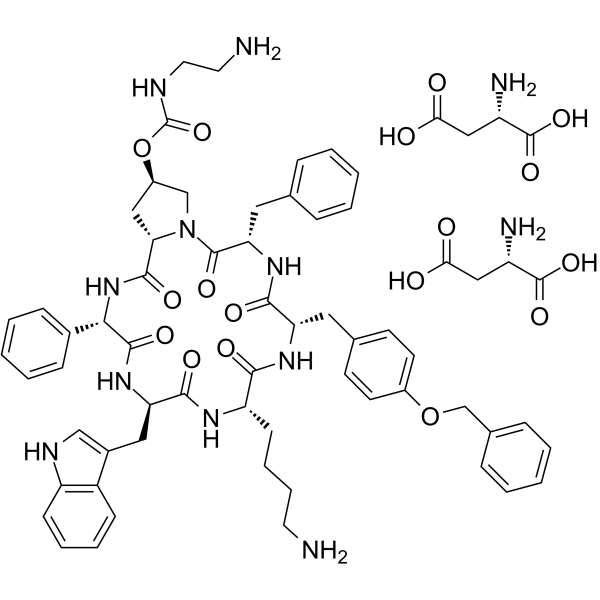
帕瑞肽是一种六元同型环肽,由L-苯基甘氨酰、D-色氨酰、L-赖氨酰、O-苄基-L-酪氨酰、L-苯丙氨酰和修饰的L-羟脯氨酸残基按顺序连接而成。它是一种生长抑素类似物,具有与天然激素生长抑素相似的药理特性;(以其二天冬氨酸盐的形式)用于治疗库欣病。它还具有抗肿瘤作用。它是一种同型环肽,也是一种肽类激素。它是帕瑞肽(2+)的共轭碱。
帕瑞肽是一种合成的长效环状六肽,具有类似生长抑素的活性。它以二天冬氨酸盐Signifor的形式上市,用于治疗库欣病。
帕瑞肽是一种生长抑素类似物。帕瑞肽的作用机制是作为生长抑素受体激动剂。
帕瑞肽是一种合成的生长抑素多肽类似物,其抑制生长激素、胰岛素、胰高血糖素和许多其他胃肠道肽的水平和活性的能力与天然激素相似。由于其半衰期比生长抑素长,帕瑞肽可用于临床治疗分泌过量生长激素(导致肢端肥大症)或促肾上腺皮质激素(ACTH,导致库欣病)的垂体神经内分泌肿瘤。帕瑞肽有许多副作用,包括抑制胆囊收缩和胆汁分泌,维持治疗可能导致胆结石以及血清酶和胆红素水平升高。
帕瑞肽是一种具有生长抑素样活性的合成长效环状肽。帕瑞肽可激活多种生长抑素受体,体外实验表明,其对生长抑素受体1、3和5的结合亲和力远高于奥曲肽,而对生长抑素受体2的结合亲和力则与之相当。该药物抑制人生长激素(HGH)、胰高血糖素和胰岛素释放的效力强于生长抑素。
另见:帕瑞肽二天冬氨酸盐(其活性成分);帕瑞肽帕莫酸盐(其活性成分)。
药物适应症
用于治疗库欣病,尤其适用于垂体手术无效或不适合手术的患者。
FDA标签
Signifor适用于治疗不适合手术或手术失败的成年库欣病患者。 Signifor适用于治疗不适合手术或手术无效,且使用其他生长抑素类似物治疗控制不佳的成人肢端肥大症患者。
肢端肥大症和垂体性巨人症的治疗
垂体ACTH分泌过多、垂体依赖性库欣病、垂体依赖性高肾上腺皮质功能亢进症
作用机制
帕瑞肽可激活多种生长抑素受体,体外实验表明,其对生长抑素受体1、3和5的结合亲和力远高于奥曲肽,对生长抑素受体2的结合亲和力与之相当。生长抑素受体的结合和激活可抑制ACTH分泌,从而降低库欣病患者的皮质醇分泌。此外,该药物在抑制人类生长激素 (HGH)、胰高血糖素和胰岛素释放方面比生长抑素更有效。
药效学
Signifor® 是生长抑素类似物,可降低库欣病患者的皮质醇分泌水平。
基于结构-活性关系,将生长激素释放抑制因子 (SRIF) 的功能基团转移到更小尺寸的环六肽模板中,通过合理的药物设计方法,发现了 SOM230 (25)。SOM230 是一种新型稳定的环六肽生长抑素类似物,对人类生长抑素受体(亚型 sst1-sst5)具有独特的高亲和力结合。SOM230 对生长激素和胰岛素样生长因子-1 的释放具有强效且持久的抑制作用,是一种很有前途的候选药物,目前正在进行 I 期临床试验。 [1]帕瑞肽(SOM230)是一种多受体配体生长抑素类似物,对生长抑素受体亚型sst(1,2,3)和sst(5)具有高亲和力。帕瑞肽能有效抑制生长激素(GH)、胰岛素样生长因子-I(IGF-I)和促肾上腺皮质激素(ACTH)的分泌,提示其在肢端肥大症和库欣病中具有潜在疗效。动物模型中帕瑞肽对激素分泌的长期抑制作用以及类癌肿瘤中多种sst受体的表达表明,帕瑞肽在类癌肿瘤患者中可能比奥曲肽具有临床优势。体外实验观察到帕瑞肽具有直接和间接的抗肿瘤活性,包括sst受体介导的细胞凋亡和抗血管生成,提示帕瑞肽可能在抗肿瘤治疗中发挥作用。总之,临床前证据以及临床研究的初步结果表明,帕瑞肽有望成为治疗对奥曲肽耐药或难治性转移性类癌肿瘤症状、新发或持续性肢端肥大症患者的新疗法,并且帕瑞肽有可能成为首个针对库欣病的靶向药物。[3]
总之,本研究首次在胰岛素瘤小鼠模型中证实了新型长效释放生长抑素类似物SOM230的抗分泌、抗增殖和促凋亡作用,并观察到其可提高小鼠的总体生存率。SOM230活性谱的增强是由于其对5种生长抑素受体亚型中的4种(sstr5、sstr2、sstr3和sstr1)的活性增强。对于无法切除或转移性胰岛素瘤,尤其是那些对奥曲肽和/或二氮嗪等传统疗法反应较差的病例,SOM230 治疗具有重要的临床意义。SOM230 治疗可能有助于缓解症状并导致肿瘤消退。我们相信,这种新型的 SOM230 靶向治疗策略将使胰腺神经内分泌肿瘤 (PNET) 患者受益。虽然这些数据有力地支持了帕瑞肽在该模型中的疗效,但我们也承认,需要开展更大样本量的研究,以推进这一新方法进入临床试验阶段。[2] 我们还研究了长期使用帕瑞肽后慢性炎症组织病理学变化的进展。这些变化在反复向关节内注射抗原后尤为明显。目前的数据清楚地表明,在该免疫介导的关节炎模型中,生长抑素受体 (SSTR) 激动剂不仅可以抑制急性炎症反应,还可以抑制慢性炎症/破坏过程。由于其抗炎作用(与地塞米松相当)和镇痛作用,生长抑素受体激动剂在临床治疗中备受关注。事实上,在一项针对类风湿关节炎(RA)患者的初步研究中,奥曲肽治疗后观察到了显著的临床改善。目前的观察结果表明,帕瑞肽和奥曲肽可能具有相似的抗炎作用;然而,预计帕瑞肽在RA疼痛控制方面优于奥曲肽。此外,生长抑素类似物治疗被认为相对安全且耐受性良好。而且,奥曲肽和帕瑞肽均有长效制剂,可用于长期治疗;这些制剂只需每月给药一次,无需每日皮下注射。总之,我们提供了生长抑素受体激动剂奥曲肽和帕瑞肽具有强效抗炎和镇痛作用的证据。我们发现 SSTR2 是生长抑素抗炎作用的重要靶点。SSTR2 和 SSTR1 均能介导镇痛作用。关于 SSTR 激动剂的临床应用,应考虑泛 SSTR 激动剂可能优于选择性 SSTR2 激动剂。[4]
*注: 文献方法仅供参考, InvivoChem并未独立验证这些方法的准确性
化学信息 & 存储运输条件
分子式
C62H73N11O13
分子量
1180.30893492699
CAS号
1421446-02-7
相关CAS号
Pasireotide acetate;396091-76-2;Pasireotide L-aspartate salt;396091-77-3;Pasireotide pamoate;396091-79-5;Pasireotide;396091-73-9
外观&性状
Typically exists as solid at room temperature
HS Tariff Code
2934.99.9001
存储方式

Powder      -20°C    3 years

                     4°C     2 years

In solvent   -80°C    6 months

                  -20°C    1 month

运输条件
Room temperature (This product is stable at ambient temperature for a few days during ordinary shipping and time spent in Customs)
溶解度数据
溶解度 (体外实验)
May dissolve in DMSO (in most cases), if not, try other solvents such as H2O, Ethanol, or DMF with a minute amount of products to avoid loss of samples
溶解度 (体内实验)
注意: 如下所列的是一些常用的体内动物实验溶解配方,主要用于溶解难溶或不溶于水的产品(水溶度<1 mg/mL)。 建议您先取少量样品进行尝试,如该配方可行,再根据实验需求增加样品量。

注射用配方
(IP/IV/IM/SC等)
注射用配方1: DMSO : Tween 80: Saline = 10 : 5 : 85 (如: 100 μL DMSO 50 μL Tween 80 850 μL Saline)
*生理盐水/Saline的制备:将0.9g氯化钠/NaCl溶解在100 mL ddH ₂ O中,得到澄清溶液。
注射用配方 2: DMSO : PEG300Tween 80 : Saline = 10 : 40 : 5 : 45 (如: 100 μL DMSO 400 μL PEG300 50 μL Tween 80 450 μL Saline)
注射用配方 3: DMSO : Corn oil = 10 : 90 (如: 100 μL DMSO 900 μL Corn oil)
示例: 注射用配方 3 (DMSO : Corn oil = 10 : 90) 为例说明, 如果要配制 1 mL 2.5 mg/mL的工作液, 您可以取 100 μL 25 mg/mL 澄清的 DMSO 储备液,加到 900 μL Corn oil/玉米油中, 混合均匀。
View More

注射用配方 4: DMSO : 20% SBE-β-CD in Saline = 10 : 90 [如:100 μL DMSO 900 μL (20% SBE-β-CD in Saline)]
*20% SBE-β-CD in Saline的制备(4°C,储存1周):将2g SBE-β-CD (磺丁基-β-环糊精) 溶解于10mL生理盐水中,得到澄清溶液。
注射用配方 5: 2-Hydroxypropyl-β-cyclodextrin : Saline = 50 : 50 (如: 500 μL 2-Hydroxypropyl-β-cyclodextrin (羟丙基环胡精) 500 μL Saline)
注射用配方 6: DMSO : PEG300 : Castor oil : Saline = 5 : 10 : 20 : 65 (如: 50 μL DMSO 100 μL PEG300 200 μL Castor oil 650 μL Saline)
注射用配方 7: Ethanol : Cremophor : Saline = 10: 10 : 80 (如: 100 μL Ethanol 100 μL Cremophor 800 μL Saline)
注射用配方 8: 溶解于Cremophor/Ethanol (50 : 50), 然后用生理盐水稀释。
注射用配方 9: EtOH : Corn oil = 10 : 90 (如: 100 μL EtOH 900 μL Corn oil)
注射用配方 10: EtOH : PEG300Tween 80 : Saline = 10 : 40 : 5 : 45 (如: 100 μL EtOH 400 μL PEG300 50 μL Tween 80 450 μL Saline)


口服配方
口服配方 1: 悬浮于0.5% CMC Na (羧甲基纤维素钠)
口服配方 2: 悬浮于0.5% Carboxymethyl cellulose (羧甲基纤维素)
示例: 口服配方 1 (悬浮于 0.5% CMC Na)为例说明, 如果要配制 100 mL 2.5 mg/mL 的工作液, 您可以先取0.5g CMC Na并将其溶解于100mL ddH2O中,得到0.5%CMC-Na澄清溶液;然后将250 mg待测化合物加到100 mL前述 0.5%CMC Na溶液中,得到悬浮液。
View More

口服配方 3: 溶解于 PEG400 (聚乙二醇400)
口服配方 4: 悬浮于0.2% Carboxymethyl cellulose (羧甲基纤维素)
口服配方 5: 溶解于0.25% Tween 80 and 0.5% Carboxymethyl cellulose (羧甲基纤维素)
口服配方 6: 做成粉末与食物混合


注意: 以上为较为常见方法,仅供参考, InvivoChem并未独立验证这些配方的准确性。具体溶剂的选择首先应参照文献已报道溶解方法、配方或剂型,对于某些尚未有文献报道溶解方法的化合物,需通过前期实验来确定(建议先取少量样品进行尝试),包括产品的溶解情况、梯度设置、动物的耐受性等。

请根据您的实验动物和给药方式选择适当的溶解配方/方案:
1、请先配制澄清的储备液(如:用DMSO配置50 或 100 mg/mL母液(储备液));
2、取适量母液,按从左到右的顺序依次添加助溶剂,澄清后再加入下一助溶剂。以 下列配方为例说明 (注意此配方只用于说明,并不一定代表此产品 的实际溶解配方):
10% DMSO → 40% PEG300 → 5% Tween-80 → 45% ddH2O (或 saline);
假设最终工作液的体积为 1 mL, 浓度为5 mg/mL: 取 100 μL 50 mg/mL 的澄清 DMSO 储备液加到 400 μL PEG300 中,混合均匀/澄清;向上述体系中加入50 μL Tween-80,混合均匀/澄清;然后继续加入450 μL ddH2O (或 saline)定容至 1 mL;

3、溶剂前显示的百分比是指该溶剂在最终溶液/工作液中的体积所占比例;
4、 如产品在配制过程中出现沉淀/析出,可通过加热(≤50℃)或超声的方式助溶;
5、为保证最佳实验结果,工作液请现配现用!
6、如不确定怎么将母液配置成体内动物实验的工作液,请查看说明书或联系我们;
7、 以上所有助溶剂都可在 Invivochem.cn网站购买。
制备储备液 1 mg 5 mg 10 mg
1 mM 0.8472 mL 4.2362 mL 8.4724 mL
5 mM 0.1694 mL 0.8472 mL 1.6945 mL
10 mM 0.0847 mL 0.4236 mL 0.8472 mL

1、根据实验需要选择合适的溶剂配制储备液 (母液):对于大多数产品,InvivoChem推荐用DMSO配置母液 (比如:5、10、20mM或者10、20、50 mg/mL浓度),个别水溶性高的产品可直接溶于水。产品在DMSO 、水或其他溶剂中的具体溶解度详见上”溶解度 (体外)”部分;

2、如果您找不到您想要的溶解度信息,或者很难将产品溶解在溶液中,请联系我们;

3、建议使用下列计算器进行相关计算(摩尔浓度计算器、稀释计算器、分子量计算器、重组计算器等);

4、母液配好之后,将其分装到常规用量,并储存在-20°C或-80°C,尽量减少反复冻融循环。

计算器

摩尔浓度计算器可计算特定溶液所需的质量、体积/浓度,具体如下:

  • 计算制备已知体积和浓度的溶液所需的化合物的质量
  • 计算将已知质量的化合物溶解到所需浓度所需的溶液体积
  • 计算特定体积中已知质量的化合物产生的溶液的浓度
使用摩尔浓度计算器计算摩尔浓度的示例如下所示:
假如化合物的分子量为350.26 g/mol,在5mL DMSO中制备10mM储备液所需的化合物的质量是多少?
  • 在分子量(MW)框中输入350.26
  • 在“浓度”框中输入10,然后选择正确的单位(mM)
  • 在“体积”框中输入5,然后选择正确的单位(mL)
  • 单击“计算”按钮
  • 答案17.513 mg出现在“质量”框中。以类似的方式,您可以计算体积和浓度。

稀释计算器可计算如何稀释已知浓度的储备液。例如,可以输入C1、C2和V2来计算V1,具体如下:

制备25毫升25μM溶液需要多少体积的10 mM储备溶液?
使用方程式C1V1=C2V2,其中C1=10mM,C2=25μM,V2=25 ml,V1未知:
  • 在C1框中输入10,然后选择正确的单位(mM)
  • 在C2框中输入25,然后选择正确的单位(μM)
  • 在V2框中输入25,然后选择正确的单位(mL)
  • 单击“计算”按钮
  • 答案62.5μL(0.1 ml)出现在V1框中
g/mol

分子量计算器可计算化合物的分子量 (摩尔质量)和元素组成,具体如下:

注:化学分子式大小写敏感:C12H18N3O4  c12h18n3o4
计算化合物摩尔质量(分子量)的说明:
  • 要计算化合物的分子量 (摩尔质量),请输入化学/分子式,然后单击“计算”按钮。
分子质量、分子量、摩尔质量和摩尔量的定义:
  • 分子质量(或分子量)是一种物质的一个分子的质量,用统一的原子质量单位(u)表示。(1u等于碳-12中一个原子质量的1/12)
  • 摩尔质量(摩尔重量)是一摩尔物质的质量,以g/mol表示。
/

配液计算器可计算将特定质量的产品配成特定浓度所需的溶剂体积 (配液体积)

  • 输入试剂的质量、所需的配液浓度以及正确的单位
  • 单击“计算”按钮
  • 答案显示在体积框中
动物体内实验配方计算器(澄清溶液)
第一步:请输入基本实验信息(考虑到实验过程中的损耗,建议多配一只动物的药量)
第二步:请输入动物体内配方组成(配方适用于不溶/难溶于水的化合物),不同的产品和批次配方组成不同,如对配方有疑问,可先联系我们提供正确的体内实验配方。此外,请注意这只是一个配方计算器,而不是特定产品的确切配方。
+
+
+

计算结果:

工作液浓度 mg/mL;

DMSO母液配制方法 mg 药物溶于 μL DMSO溶液(母液浓度 mg/mL)。如该浓度超过该批次药物DMSO溶解度,请首先与我们联系。

体内配方配制方法μL DMSO母液,加入 μL PEG300,混匀澄清后加入μL Tween 80,混匀澄清后加入 μL ddH2O,混匀澄清。

(1) 请确保溶液澄清之后,再加入下一种溶剂 (助溶剂) 。可利用涡旋、超声或水浴加热等方法助溶;
            (2) 一定要按顺序加入溶剂 (助溶剂) 。

临床试验信息
Long Term Safety and Efficacy of Pasireotide s.c. in Patients With Cushing's Disease
CTID: NCT02310269
Phase:    Status: Completed
Date: 2024-10-15
Study to Allow Access to Pasireotide for Patients Benefiting From Pasireotide Treatment in Novartis-sponsored Studies
CTID: NCT01794793
Phase: Phase 4    Status: Completed
Date: 2024-10-01
A Study of Pasireotide in People With Prolactinoma
CTID: NCT06295952
Phase: Phase 2    Status: Recruiting
Date: 2024-09-19
Pasireotide to Reduce Clinically Relevant Digestive Leakage After Complete Cytoreductive Surgery (CRS) Plus Hyperthermic Intra-Peritoneal Chemotherapy (HIPEC) for Peritoneal Carcinomatosis
CTID: NCT04826432
Phase: Phase 2    Status: Terminated
Date: 2024-02-08
Compassionate Use of SOM230 for Hyperinsulinemic/Hypoglycemia
CTID: NCT02835131
Phase:    Status: No longer available
Date: 2022-07-29
View More

Reduction by Pasireotide of the Effluent Volume in High-output Enterostomy in Patients Refractory to Usual Medical Treatment
CTID: NCT02713776
Phase: Phase 2    Status: Completed
Date: 2022-04-04


Pasireotide Treatment for Neuroendocrine Tumor
CTID: NCT02779257
Phase: Phase 4    Status: Withdrawn
Date: 2022-03-04
Pasireotide in Prevention of GI Toxicity
CTID: NCT02215070
Phase: Phase 2    Status: Completed
Date: 2021-11-17
Treatment Plan for an Individual Patient With Pasireotide for Hyperinsulinemic Hypoglycemia
CTID: NCT03103009
Phase: Phase 1    Status: Completed
Date: 2021-09-29
An Extension Study to Assess the Long-Term Safety and Efficacy of Pasireotide in Participants With Acromegaly
CTID: NCT00171730
Phase: Phase 2    Status: Completed
Date: 2021-09-05
Extension Study to Assess the Safety and Efficacy of Pasireotide in Participants With Cushing's Disease
CTID: NCT00171951
Phase: Phase 2    Status: Completed
Date: 2021-06-02
Pasireotide in Hyperinsulinemic Hypoglycemia
CTID: NCT03053284
Phase: Phase 2    Status: Withdrawn
Date: 2021-05-14
Docetaxel, Prednisone, and Pasireotide in Treating Patients With Metastatic Hormone-Resistant Prostate Cancer
CTID: NCT01468532
Phase: Phase 1/Phase 2    Status: Completed
Date: 2021-03-25
Pasireotide & Everolimus in Adult Patients With Radioiodine-Refractory Differentiated & Medullary Thyroid Cancer
CTID: NCT01270321
Phase: Phase 2    Status: Completed
Date: 2021-02-17
Safety and Efficacy Study of SOM230 s.c. in Cluster Headache
CTID: NCT02619617
Phase: Phase 2    Status: Terminated
Date: 2021-01-05
Study of Pasireotide Long Acting Release (LAR) Injection in Patients With Acromegaly and Patients With Carcinoid Disease
CTID: NCT00446082
Phase: Phase 1    Status: Completed
Date: 2020-12-21
A Phase l Study to Evaluate the Pharmacokinetics and Safety Pasireotide in Subjects With Varying Degrees of Renal Impairment Compared to Healthy Volunteers
CTID: NCT01578928
Phase: Phase 1    Status: Completed
Date: 2020-12-21
Phase 1 Study to Evaluate Safety, Tolerability, Pharmacokinetics, and Preliminary Efficacy of Pasireotide LAR in Patients With Castration Resistant Prostate Cancer
CTID: NCT01646684
Phase: Phase 1    Status: Completed
Date: 2020-12-21
Pharmacokinetics and Safety of Single Subcutaneous Pasireotide (SOM230) in Subjects With Varying Degrees of Hepatic Function
CTID: NCT00698464
Phase: Phase 1    Status: Completed
Date: 2020-12-21
A Study in Healthy Subjects to Assess the Safety, Tolerability, PK and PD of HTL0030310
CTID: NCT03847207
Phase: Phase 1    Status: Completed
Date: 2020-10-27
HYPAR Trial - Hydrocortisone vs. Pasireotide in Reducing Pancreatic Surgery Complications
CTID: NCT02775227
Phase: Phase 4    Status: Active, not recruiting
Date: 2020-08-24
Impact of Pasireotide on Postoperative Pancreatic Fistulas Following Distal Resections
CTID: NCT04281680
Phase:    Status: Completed
Date: 2020-02-24
Evaluate Safety and Tolerability of Pasireotide LAR in Combination With Everolimus in Advanced Metastatic NETs
CTID: NCT01590199
Phase: Phase 1    Status: Completed
Date: 2019-04-16
Pasireotide, Everolimus and Selective Internal Radioembolization Therapy for Unresectable Hepatic Metastases
CTID: NCT01469572
Phase: Phase 1    Status: Completed
Date: 2018-10-18
Pasireotide in the Treatment of Hypoglycemia Following Gastric Bypass Surgery
CTID: NCT03514576
Phase: Phase 4    Status: Unknown status
Date: 2018-07-05
Pasireotide (SOM230) With or Without Everolimus in Treating Patients With Hormone Resistant, Chemotherapy Naive Prostate Cancer
CTID: NCT01313559
Phase: Phase 2    Status: Terminated
Date: 2018-04-25
Efficacy and Safety of Pasireotide Long Acting Release (LAR) Versus Octreotide LAR or Lanreotide Autogel (ATG) in Patients With Inadequately Controlled Acromegaly
CTID: NCT01137682
Phase: Phase 3    Status: Completed
Date: 2018-04-05
SOM230 Ectopic ACTH-producing Tumors
CTID: NCT02780882
Phase: Phase 2    Status: Withdrawn
Date: 2018-01-26
Adipokine Profile in Patients With Cushing's Disease on Pasireotide Treatment
CTID: NCT03080181
Phase: Phase 4    Status: Completed
Date: 2017-10-27
Phase II Trial of SOM230 in Patients With Unresectable Hepatocellular Carcinoma
CTID: NCT01639352
Phase: Phase 2    Status: Completed
Date: 2017-07-12
Safety and Efficacy of Pasireotide Long Acting Release (LAR) vs. Octreotide LAR in Patients With Active Acromegaly
CTID: NCT00600886
Phase: Phase 3    Status: Completed
Date: 2017-07-02
Phase II Study Evaluating Efficacy, Safety and Pharmacokinetics of Pasireotide in Patients With Dumping Syndrome
CTID: NCT01637272
Phase: Phase 2    Status: Completed
Date: 2017-05-10
Pasireotide LAR Administration in Lymphocele Prevention After Axillary Node Dissection for Breast Cancer
CTID: NCT01356862
Phase: Phase 2    Status: Completed
Date: 2017-01-25
Pasireotide Therapy in Patients With Nelson's Syndrome
CTID: NCT01617733
Phase: Phase 2    Status: Terminated
Date: 2016-11-02
Pasireotide in Combination With RAD001 in Patients With Advanced Neuroendocrine Tumors
CTID: NCT00804336
Phase: Phase 1    Status: Completed
Date: 2016-10-19
Response to Cabergoline and Pasireotide in Non-functioning Pituitary Adenomas and Resistant Prolactinomas
CTID: NCT01620138
Phase: Phase 2/Phas
A phase IIIb multicenter, open-label, single arm study to evaluate the efficacy and safety of pasireotide in patients
CTID: null
Phase: Phase 3    Status: Completed
Date: 2015-03-25
A multi-center, randomized, open-label, Phase IV study to
CTID: null
Phase: Phase 4    Status: Completed
Date: 2014-08-19
A Phase II trial to assess the efficacy and safety of pasireotide s.c. alone or in combination with cabergoline in patients with Cushing's disease
CTID: null
Phase: Phase 2    Status: Completed, Prematurely Ended
Date: 2013-11-19
Multicenter 3-arm trial to evaluate the efficacy and safety of Pasireotide LAR or Everolimus alone or in combination in patients with well differentiated neuroendocrine carcinoma of the lung and thymus -LUNA Trial
CTID: null
Phase: Phase 2    Status: Prematurely Ended, Completed
Date: 2013-06-24
An open label, multicenter pasireotide roll over protocol for patients who have completed a previous Novartis sponsored pasireotide study and are judged by the investigator to benefit from continued pasireotide treatment
CTID: null
Phase: Phase 4    Status: Ongoing, Completed
Date: 2013-06-07
Objective evaluation of the effects of pasireotide on gastrointestinal and colorectal transit times, rectal wall properties, and postprandial response in patients with carcinoid diarrhea
CTID: null
Phase: Phase 2    Status: Completed
Date: 2013-02-12
A multi-center, intra-patient dose escalation phase II study to evaluate the preliminary efficacy, safety and pharmacokinetics of pasireotide (SOM230) subcutaneous (s.c.) followed by pasireotide LAR in patients with dumping syndrome
CTID: null
Phase: Phase 2    Status: Completed
Date: 2012-09-20
A randomized, double-blind, multicentre, phase III study to evaluate the efficacy and safety of pasireotide LAR in patients with Cushing’s disease
CTID: null
Phase: Phase 3    Status: Completed
Date: 2011-08-24
A MULTI - CENTER OPEN LABEL PHASE II (B) STUDY TO ASSESS EFFECTS OF SOM230 ON CARDIOVASCULAR PARAMETERS IN ACROMEGALIC PATIENTS
CTID: null
Phase: Phase 2    Status: Prematurely Ended
Date: 2011-08-22
An open-label, multi-center, expanded access study of pasireotide s.c. in patients with Cushing’s disease (Seascape)
CTID: null
Phase: Phase 3    Status: Prematurely Ended, Completed
Date: 2011-08-05
A randomized, open-label phase II multicenter study evaluating the efficacy of oral Everolimus alone or in combination with Pasireotide LAR i.m. in advanced progressive pancreatic neuroendocrine tumors (PNET)
CTID: null
Phase: Phase 2    Status: Completed, Prematurely Ended
Date: 2011-06-28
An Open Label, Longitudinal Study of the Effects of Subcutaneous Acute and Chronic Pasireotide (SOM230) Therapy on Adrenocorticotrophic Hormone and Tumour Volume in Patients with Nelson's Syndrome.
CTID: null
Phase: Phase 2    Status: Completed
Date: 2010-10-18
A phase III, multicenter, randomized, parallel-group study to assess the efficacy and safety of double-blind pasireotide LAR 40 mg and pasireotide LAR 60 mg versus open-label octreotide LAR or lanreotide ATG in patients with inadequately controlled acromegaly
CTID: null
Phase: Phase 3    Status: Completed
Date: 2010-06-10
An open label, multicenter, single arm study of pasireotide LAR in patients with rare tumors of neuroendocrine origin
CTID: null
Phase: Phase 2    Status: Completed
Date: 2009-05-06
A single center trial with a randomized, double-blind, placebo-controlled phase to assess safety and efficacy of sc pasireotide in patients with dumping syndrome, followed by an open label phase on active medication.
CTID: null
Phase: Phase 2    Status: Completed
Date: 2008-07-28
Monocenter, double blinded, exploratory, randomized, study investigating the influence of Pasireotide on the hormonal activity of Prolactinomas - proof of concept study
CTID: null
Phase: Phase 2    Status: Prematurely Ended
Date: 2008-07-02
A multicenter, randomized, blinded efficacy and safety study of pasireotide LAR vs octreotide LAR in patients with metastatic carcinoid tumors whose disease-related symptoms are inadequately controlled by somatostatin analogues
CTID: null
Phase: Phase 3    Status: Completed, Prematurely Ended
Date: 2008-01-14
A multicenter, randomized, blinded study to assess the safety and efficacy of pasireotide LAR vs. octreotide LAR in patients with active acromegaly.
CTID: null
Phase: Phase 3    Status: Prematurely Ended, Completed
Date: 2007-11-15
Monocenter, double blinded, exploratory, randomized, study investigating the influence of Pasireotide on the hormonal activity of Pheochromocytoma – proof of concept study
CTID: null
Phase: Phase 2    Status: Prematurely Ended
Date: 2007-11-08
Stepwise Medical Treatment of Cushing’s Disease: a prospective open label multi-center trial with SOM230 mono- and combination therapy with dopamine agonists and ketoconazole
CTID: null
Phase: Phase 2    Status: Ongoing
Date: 2007-04-26
A randomized, double-blind study to assess the safety and efficacy of different dose levels of Pasireotide (SOM230) s.c. over a 6 month treatment period in patients with de novo, persistent or recurrent Cushing’s disease
CTID: null
Phase: Phase 3    Status: Completed, Prematurely Ended
Date: 2007-01-05
An open label, multicenter, pilot phase II study of SOM230 s.c. in patients with duodeno-pancreatic (neuro) endocrine tumors and different pituitary diseases (Nelsonメs syndrome, non-functioning adenoma, TSH-adenoma, Gonadotroph adenoma, and PRL-adenoma) with potential sensitivity to somatostatin analogues.
CTID: null
Phase: Phase 2    Status: Prematurely Ended
Date: 2006-12-22
Effectiveness of SOM230 In Treating Non-Functioning Pituitary Adenomas
CTID: null
Phase: Phase 2    Status: Prematurely Ended
Date: 2006-06-07
Extension to a multicenter, randomized, crossover, open label, dose finding study to compare the safety, efficacy and PK/PD relationship of multiple doses of SOM230 (200, 400 and 600 µg b.i.d.) and doses of open label Sandostatin (100 µg t.i.d.) in acromegalic patients
CTID: null
Phase: Phase 2    Status: Completed, Prematurely Ended
Date: 2005-01-12
Extension to a multicenter, open label study to assess the safety and efficacy of 600 micrograms SOM230, administered subcutaneously, b.i.d. in patients with Cushing's disease
CTID: null
Phase: Phase 2, Phase 3    Status: Completed
Date: 2004-10-21

相关产品
联系我们