| 规格 | 价格 | 库存 | 数量 |
|---|---|---|---|
| 5mg |
|
||
| 10mg |
|
||
| 50mg |
|
||
| 100mg |
|
||
| 500mg |
|
||
| 1g |
|
||
| Other Sizes |
|
| 靶点 |
- The primary target of Pentamidine dihydrochloride is PRL phosphatases (a family of protein tyrosine phosphatases) [1]
- Pentamidine dihydrochloride selectively modifies ubiquitin (a regulatory protein involved in protein degradation) [2] - Pentamidine dihydrochloride targets the machinery of multi-drug resistant (MDR) bacteria (e.g., bacterial membrane transporters, metabolic enzymes) [4] |
|---|---|
| 体外研究 (In Vitro) |
Pentamidine(0-10 µg/mL;6 天;WM9、DU145、C4-2、Hey、WM480 和 A549 细胞)以浓度依赖性方式减少癌细胞增殖 [1]。已经确定羟乙基磺酸喷他脒对婴儿利什曼原虫前鞭毛体具有细胞毒性。孵育 72 小时后,羟乙基磺酸喷他脒的杀利什曼病效果是顺铂的 60 倍。与顺铂相比,羟乙磺酸喷他脒会导致更大量的程序性细胞死亡 (PCD),这与 DNA 合成的抑制和细胞周期停滞在 G2/M 期有关。当喷他脒羟乙基磺酸盐与小牛胸腺 DNA (CT-DNA) 结合时,DNA 双螺旋会发生与 B 到 A 转变一致的结构变化。由于羟乙基磺酸喷他脒和泛素之间的相互作用,该蛋白质的 β-折叠组成增加了 6% [2]。
- 体外实验中,喷他脒二盐酸盐(Pentamidine dihydrochloride)可抑制PRL磷酸酶活性,进而降低多种癌细胞系(包括乳腺癌、前列腺癌、结肠癌细胞)的增殖能力。它还能诱导癌细胞发生G2/M期细胞周期阻滞和凋亡,具体表现为caspase-3和PARP的切割水平升高,膜联蛋白V阳性细胞比例增加 [1] - 体外实验中,喷他脒二盐酸盐(Pentamidine dihydrochloride)对原生动物寄生虫(如利什曼原虫、耶氏肺孢子菌)具有抗寄生虫活性。它可破坏寄生虫膜完整性并抑制寄生虫代谢酶,导致寄生虫细胞死亡。此外,它通过选择性修饰泛素诱导癌细胞凋亡——这种修饰会破坏泛素-蛋白酶体系统,导致促凋亡蛋白蓄积 [2] - 体外实验中,喷他脒二盐酸盐(Pentamidine dihydrochloride)对多重耐药细菌(如耐甲氧西林金黄色葡萄球菌、耐碳青霉烯肠杆菌科细菌)具有抗菌活性。它通过干扰细菌DNA复制和膜电位抑制细菌生长,最低抑菌浓度(MIC)范围为0.5–8 μg/mL(具体数值因细菌菌株而异)[4] - 文献[3]的综述指出,喷他脒二盐酸盐(Pentamidine dihydrochloride)体外对卡氏肺孢子菌(现称耶氏肺孢子菌)具有活性,其机制为抑制真菌二氢叶酸还原酶 [3] |
| 体内研究 (In Vivo) |
在裸鼠中,喷他脒(0.25 mg/只;肌内注射;每2天一次;持续4周;无胸腺裸鼠)治疗可以显着限制WM9人类黑色素瘤的生长[1]。
- 在人乳腺癌或前列腺癌裸鼠异种移植模型中,腹腔注射喷他脒二盐酸盐(Pentamidine dihydrochloride)(摘要中未明确剂量)可显著降低肿瘤体积和重量(与对照组相比)。该处理还能减少肿瘤组织中增殖细胞数量(通过Ki-67染色评估),增加凋亡细胞数量(通过TUNEL染色评估)[1] - 在硕大利什曼原虫感染小鼠模型中,静脉注射喷他脒二盐酸盐(Pentamidine dihydrochloride)(摘要中未明确剂量)可使小鼠脾脏和肝脏中的寄生虫载量比未处理组降低50–70%,同时减轻感染部位的炎性病变 [3] - 在耶氏肺孢子菌肺炎(PCP)大鼠模型中,肌内注射喷他脒二盐酸盐(Pentamidine dihydrochloride)(摘要中未明确剂量)可清除肺组织中的寄生虫并改善肺功能,具体表现为肺部炎症减轻和氧合能力提高 [3] |
| 酶活实验 |
- PRL磷酸酶活性检测实验:制备重组PRL磷酸酶蛋白,将其溶解于检测缓冲液(含Tris-HCl、NaCl和DTT)中。向酶溶液中加入不同浓度的喷他脒二盐酸盐(Pentamidine dihydrochloride)(摘要中未明确浓度),在37°C下孵育15分钟。加入合成的含磷酸酪氨酸的肽段(PRL磷酸酶的底物)启动反应,继续孵育30分钟后,用三氯乙酸终止反应。通过比色法检测释放的无机磷酸盐(磷酸酶活性的产物)含量,对比喷他脒二盐酸盐处理组与对照组的磷酸盐水平,计算酶抑制率 [1]
- 泛素修饰检测实验:将纯化的泛素蛋白与喷他脒二盐酸盐(Pentamidine dihydrochloride)(摘要中未明确浓度)在反应缓冲液(含HEPES和MgCl₂)中于37°C孵育2小时。采用十二烷基硫酸钠-聚丙烯酰胺凝胶电泳(SDS-PAGE)分离反应混合物,随后通过抗泛素抗体进行蛋白质印迹分析。检测修饰泛素条带(分子量高于未修饰泛素),并通过光密度法量化其强度 [2] |
| 细胞实验 |
细胞活力测定[1]
细胞类型: WM9、DU145、C4-2、Hey、WM480 和 A549 细胞 测试浓度: 0-10 µg /mL 孵育时间: 6 天 实验结果: 培养中所有六种细胞系的生长均以浓度依赖性方式受到抑制,生长完全抑制细胞系浓度为 10 µg/mL。 - 癌细胞增殖与凋亡检测实验:在含胎牛血清的培养基中培养癌细胞系(如MCF-7乳腺癌细胞、PC-3前列腺癌细胞)。用1–10 μM浓度的喷他脒二盐酸盐(Pentamidine dihydrochloride)处理细胞24–72小时。采用MTT法(检测570 nm处吸光度)评估细胞增殖,计算生长抑制率;通过流式细胞术(膜联蛋白V-FITC/PI双染色)和蛋白质印迹法(检测切割型caspase-3、切割型PARP及Bax/Bcl-2比值)检测凋亡;细胞周期分析时,用乙醇固定细胞,碘化丙啶染色后通过流式细胞术测定G2/M期细胞比例 [1] - 寄生虫活力检测实验:在添加血清的RPMI 1640培养基中培养利什曼原虫前鞭毛体。用0.1–5 μM浓度的喷他脒二盐酸盐(Pentamidine dihydrochloride)处理寄生虫48小时。台盼蓝染色后(活寄生虫拒染台盼蓝),用血细胞计数板计数活寄生虫数量;通过MTT法检测寄生虫代谢活性,确认喷他脒二盐酸盐处理组的寄生虫活力降低 [2] |
| 动物实验 |
动物/疾病模型: 注射 WM9 细胞的 6 周龄无胸腺裸鼠 [1]
剂量: 0.25mg/只 给药途径: 肌内注射;每 2 天一次;连续 4 周 实验结果: 显著抑制裸鼠体内 WM9 人黑色素瘤的生长。 - 肿瘤异种移植模型方案:将人乳腺癌或前列腺癌细胞(1×10⁶ 个细胞/只)注射到 6-8 周龄裸鼠的皮下组织中。当肿瘤体积达到 100-150 mm³ 时,将小鼠随机分为治疗组和对照组。将盐酸喷他脒(溶于无菌生理盐水)腹腔注射,每2天一次,持续2周(摘要中未具体说明剂量)。对照组注射等体积的无菌生理盐水。每周两次测量肿瘤体积(公式:体积 = 长 × 宽² / 2)和小鼠体重。实验结束时,处死小鼠,切除肿瘤,称重,并制备组织切片进行Ki-67(增殖标志物)和TUNEL(凋亡标志物)染色[1]。 - 利什曼原虫感染模型方案:将6-8周龄的BALB/c小鼠皮下注射利什曼原虫前鞭毛体(1×10⁷个寄生虫/只),感染部位为后足垫。2周后(足垫肿胀明显时),将小鼠分为治疗组和对照组。将二盐酸喷他脒(溶于无菌水中)每周一次静脉注射,持续3周(摘要中未具体说明剂量)。对照组注射无菌水。治疗结束后,测量足垫厚度以评估炎症情况。处死小鼠,收集脾脏和肝脏,匀浆组织,并使用极限稀释法[3]计数活寄生虫的数量。 |
| 药代性质 (ADME/PK) |
由于在肝脏和胃肠道中发生广泛的首过代谢,盐酸喷他脒的口服生物利用度很低(<10%)。它主要通过静脉或肌肉注射给药[3]
- 静脉注射后,盐酸喷他脒广泛分布于组织中,在肺、肝、肾和脾脏中浓度较高。其分布容积较大(Vd:2-5 L/kg),且与血浆蛋白高度结合(>90%)[3] - 由于组织释放缓慢,盐酸喷他脒的消除半衰期较长(10-14天)。它主要经肾脏排泄,24小时内仅有10-20%的给药剂量以原形经尿液排出[3] |
| 毒性/毒理 (Toxicokinetics/TK) |
喷他脒二盐酸盐可引起剂量依赖性肾毒性,其特征是血清肌酐和血尿素氮 (BUN) 水平升高以及肾小管损伤。这是人类最常见的不良反应[3]。- 它可通过抑制胰岛β细胞功能和减少胰岛素分泌,诱发低血糖(5-10% 的患者会出现这种情况)。低血糖可以是急性或延迟性的(在治疗后数周发生)[3]。- 喷他脒二盐酸盐具有轻度肝毒性,部分患者报告血清转氨酶(ALT、AST)水平升高。它不会与常用抗菌药物或抗癌药物产生显著的药物相互作用[3]
- 体外实验表明,盐酸喷他脒对正常人成纤维细胞的毒性较低(IC50 > 20 μM),表明其对癌细胞和寄生虫具有选择性毒性[1,2] |
| 参考文献 | |
| 其他信息 |
喷他脒二盐酸盐是一种广谱药物,最初获批用于治疗寄生虫感染,包括免疫功能低下患者(例如 HIV 感染者)的内脏利什曼病和卡氏肺囊虫肺炎 (PCP) [3]。
- 喷他脒二盐酸盐抑制催乳素 (PRL) 磷酸酶并具有抗癌活性的发现表明,它有可能被重新用于治疗 PRL 磷酸酶过表达的癌症(例如乳腺癌、前列腺癌、结肠癌)[1]。 - 喷他脒二盐酸盐通过与特定氨基酸残基(例如赖氨酸)共价结合来选择性地修饰泛素,从而破坏泛素-蛋白酶体系统,并发挥其抗寄生虫和促凋亡作用 [2]。 - 由于其对……的活性针对多重耐药菌(MDR),盐酸喷他脒正被评估为一种用于治疗MDR细菌感染的再利用药物,尤其是在MDR流行率高的医疗机构中[4] |
| 分子式 |
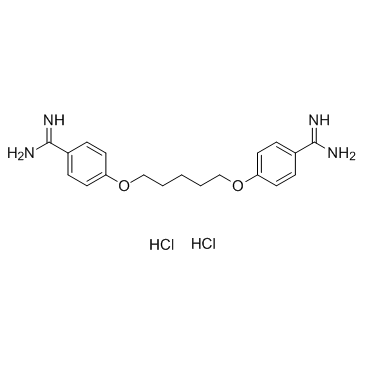
C₁₉H₂₆CL₂N₄O₂
|
|---|---|
| 分子量 |
413.34
|
| 精确质量 |
412.143
|
| CAS号 |
50357-45-4
|
| 相关CAS号 |
Pentamidine-d4 dihydrochloride;1276197-32-0;Pentamidine isethionate;140-64-7;Pentamidine;100-33-4;Pentamidine dimesylate;6823-79-6
|
| PubChem CID |
10431865
|
| 外观&性状 |
Typically exists as solid at room temperature
|
| LogP |
5.284
|
| tPSA |
118.2
|
| 氢键供体(HBD)数目 |
6
|
| 氢键受体(HBA)数目 |
4
|
| 可旋转键数目(RBC) |
10
|
| 重原子数目 |
27
|
| 分子复杂度/Complexity |
376
|
| 定义原子立体中心数目 |
0
|
| SMILES |
N=C(C1=CC=C(OCCCCCOC2=CC=C(C(N)=N)C=C2)C=C1)N.Cl.Cl
|
| InChi Key |
HWURPQUPKQFGJI-UHFFFAOYSA-N
|
| InChi Code |
InChI=1S/C19H24N4O2.2ClH/c20-18(21)14-4-8-16(9-5-14)24-12-2-1-3-13-25-17-10-6-15(7-11-17)19(22)23;;/h4-11H,1-3,12-13H2,(H3,20,21)(H3,22,23);2*1H
|
| 化学名 |
4-[5-(4-carbamimidoylphenoxy)pentoxy]benzenecarboximidamide;dihydrochloride
|
| 别名 |
MP-601205 diHCl MP601205 dihydrochloride
|
| HS Tariff Code |
2934.99.9001
|
| 存储方式 |
Powder -20°C 3 years 4°C 2 years In solvent -80°C 6 months -20°C 1 month |
| 运输条件 |
Room temperature (This product is stable at ambient temperature for a few days during ordinary shipping and time spent in Customs)
|
| 溶解度 (体外实验) |
May dissolve in DMSO (in most cases), if not, try other solvents such as H2O, Ethanol, or DMF with a minute amount of products to avoid loss of samples
|
|---|---|
| 溶解度 (体内实验) |
注意: 如下所列的是一些常用的体内动物实验溶解配方,主要用于溶解难溶或不溶于水的产品(水溶度<1 mg/mL)。 建议您先取少量样品进行尝试,如该配方可行,再根据实验需求增加样品量。
注射用配方
注射用配方1: DMSO : Tween 80: Saline = 10 : 5 : 85 (如: 100 μL DMSO → 50 μL Tween 80 → 850 μL Saline)(IP/IV/IM/SC等) *生理盐水/Saline的制备:将0.9g氯化钠/NaCl溶解在100 mL ddH ₂ O中,得到澄清溶液。 注射用配方 2: DMSO : PEG300 :Tween 80 : Saline = 10 : 40 : 5 : 45 (如: 100 μL DMSO → 400 μL PEG300 → 50 μL Tween 80 → 450 μL Saline) 注射用配方 3: DMSO : Corn oil = 10 : 90 (如: 100 μL DMSO → 900 μL Corn oil) 示例: 以注射用配方 3 (DMSO : Corn oil = 10 : 90) 为例说明, 如果要配制 1 mL 2.5 mg/mL的工作液, 您可以取 100 μL 25 mg/mL 澄清的 DMSO 储备液,加到 900 μL Corn oil/玉米油中, 混合均匀。 View More
注射用配方 4: DMSO : 20% SBE-β-CD in Saline = 10 : 90 [如:100 μL DMSO → 900 μL (20% SBE-β-CD in Saline)] 口服配方
口服配方 1: 悬浮于0.5% CMC Na (羧甲基纤维素钠) 口服配方 2: 悬浮于0.5% Carboxymethyl cellulose (羧甲基纤维素) 示例: 以口服配方 1 (悬浮于 0.5% CMC Na)为例说明, 如果要配制 100 mL 2.5 mg/mL 的工作液, 您可以先取0.5g CMC Na并将其溶解于100mL ddH2O中,得到0.5%CMC-Na澄清溶液;然后将250 mg待测化合物加到100 mL前述 0.5%CMC Na溶液中,得到悬浮液。 View More
口服配方 3: 溶解于 PEG400 (聚乙二醇400) 请根据您的实验动物和给药方式选择适当的溶解配方/方案: 1、请先配制澄清的储备液(如:用DMSO配置50 或 100 mg/mL母液(储备液)); 2、取适量母液,按从左到右的顺序依次添加助溶剂,澄清后再加入下一助溶剂。以 下列配方为例说明 (注意此配方只用于说明,并不一定代表此产品 的实际溶解配方): 10% DMSO → 40% PEG300 → 5% Tween-80 → 45% ddH2O (或 saline); 假设最终工作液的体积为 1 mL, 浓度为5 mg/mL: 取 100 μL 50 mg/mL 的澄清 DMSO 储备液加到 400 μL PEG300 中,混合均匀/澄清;向上述体系中加入50 μL Tween-80,混合均匀/澄清;然后继续加入450 μL ddH2O (或 saline)定容至 1 mL; 3、溶剂前显示的百分比是指该溶剂在最终溶液/工作液中的体积所占比例; 4、 如产品在配制过程中出现沉淀/析出,可通过加热(≤50℃)或超声的方式助溶; 5、为保证最佳实验结果,工作液请现配现用! 6、如不确定怎么将母液配置成体内动物实验的工作液,请查看说明书或联系我们; 7、 以上所有助溶剂都可在 Invivochem.cn网站购买。 |
| 制备储备液 | 1 mg | 5 mg | 10 mg | |
| 1 mM | 2.4193 mL | 12.0966 mL | 24.1932 mL | |
| 5 mM | 0.4839 mL | 2.4193 mL | 4.8386 mL | |
| 10 mM | 0.2419 mL | 1.2097 mL | 2.4193 mL |
1、根据实验需要选择合适的溶剂配制储备液 (母液):对于大多数产品,InvivoChem推荐用DMSO配置母液 (比如:5、10、20mM或者10、20、50 mg/mL浓度),个别水溶性高的产品可直接溶于水。产品在DMSO 、水或其他溶剂中的具体溶解度详见上”溶解度 (体外)”部分;
2、如果您找不到您想要的溶解度信息,或者很难将产品溶解在溶液中,请联系我们;
3、建议使用下列计算器进行相关计算(摩尔浓度计算器、稀释计算器、分子量计算器、重组计算器等);
4、母液配好之后,将其分装到常规用量,并储存在-20°C或-80°C,尽量减少反复冻融循环。
计算结果:
工作液浓度: mg/mL;
DMSO母液配制方法: mg 药物溶于 μL DMSO溶液(母液浓度 mg/mL)。如该浓度超过该批次药物DMSO溶解度,请首先与我们联系。
体内配方配制方法:取 μL DMSO母液,加入 μL PEG300,混匀澄清后加入μL Tween 80,混匀澄清后加入 μL ddH2O,混匀澄清。
(1) 请确保溶液澄清之后,再加入下一种溶剂 (助溶剂) 。可利用涡旋、超声或水浴加热等方法助溶;
(2) 一定要按顺序加入溶剂 (助溶剂) 。
InvivoChem的所有产品仅用于作科学研究,不面向患者销售
Copyright 2020 InvivoChem LLC | All Rights Reserved 粤ICP备20063088号-1


 粤公网安备 44011102003439号
 463611831
